

Maine Coon
“The gentle giant”
 By Priya · The careful one
Published August 20, 2026Updated August 26, 202614 min read
Contents
 Maine Coon photos
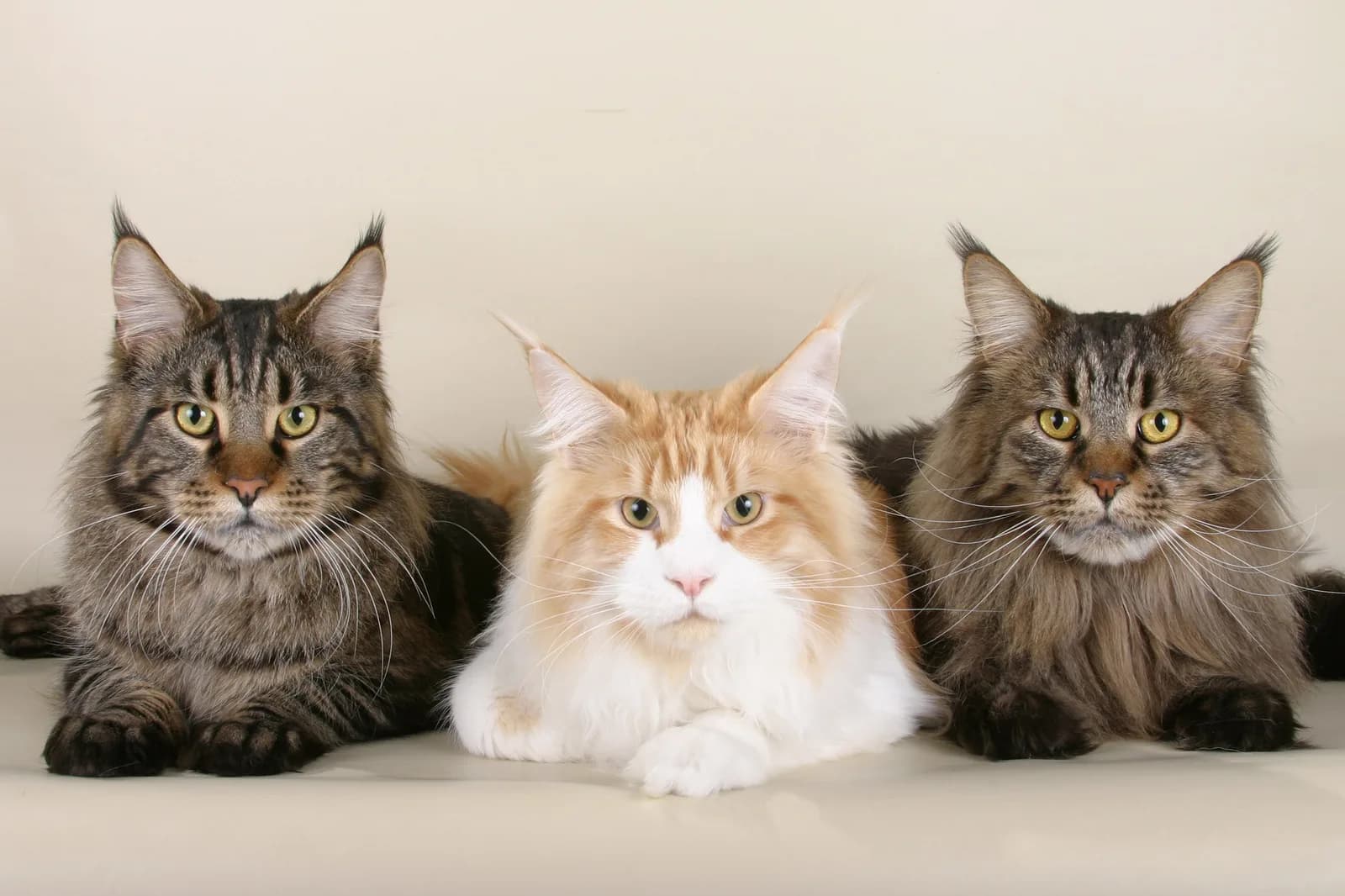
Real photos, so you can see what the breed actually looks like: coats, ear tufts, ruff and build.
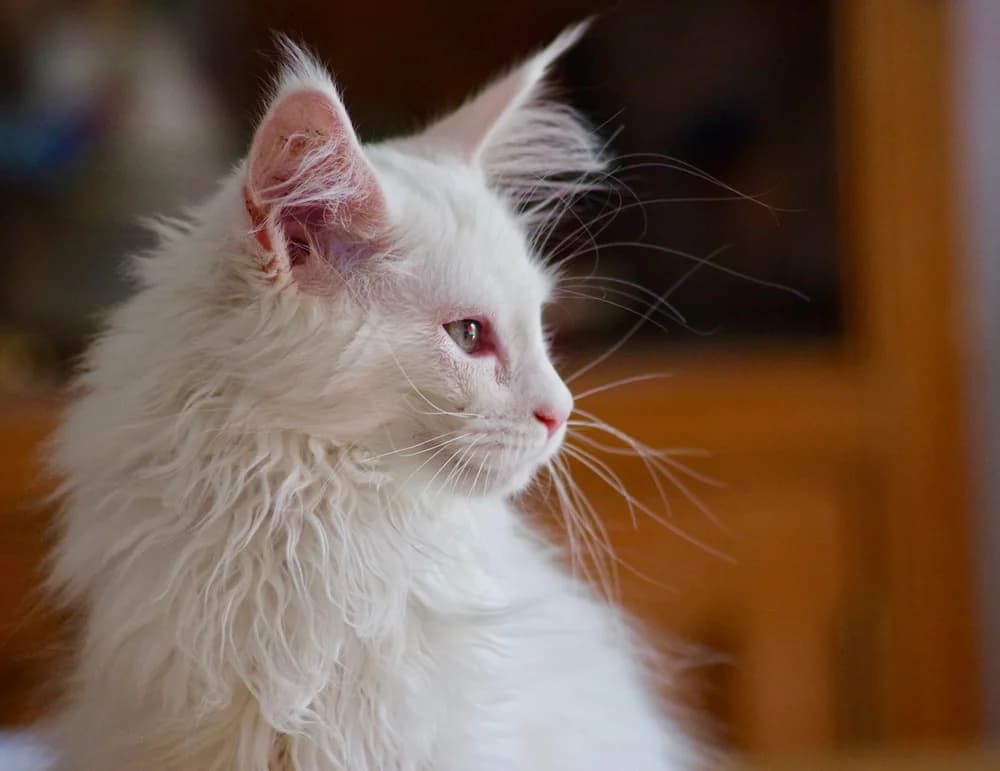
White Maine Coon in profile, showing the ear tufts and long ruff
Photo: Yannick Vallée · CC BY-SA 4.0 · via Wikimedia Commons
 Vital stats
Origin
United States
Developed from working farm and ship cats in the state of Maine, and the first longhair named in American cat literature (a Maine cat is recorded in print in 1861). Maine's official state cat by statute since 1985.
Weight
Female
9-13 lb (4.1-5.9 kg)
Male
13-18 lb (5.9-8.2 kg)
Life expectancy
The 9 to 15 years everyone quotes is the UK registry's range, echoed by insurers and breed pages, and no source attaches a measurement to it. 's own page says 12.5 years and up. The one measured figure is different in kind. A 2024 UK veterinary-records study () put life expectancy at birth at 9.71 years (95% CI 8.42 to 11.00, from 69 deaths), against 11.74 for all cats in the same study.
Measured from birth, in a country where most cats go outdoors, every early loss counts. It is a photograph of a population, not a prediction for your cat. No US, Canadian or Australian measured figure exists. The whole story, including the Swedish survival curve behind that 12.5 figure: our lifespan guide.
Coats
Brown tabby
Black
Blue
Red
Cream
White
Silver
Smoke
Five registries recognize the same core family: solids (black, white, blue, red, cream), classic and mackerel tabbies, torties, the silver and smoke family, and every with-white pattern from bicolor to van. Chocolate, lilac and pointed are excluded by every registry that states a position, and brown is the breed's signature coat. The registry word for gray is blue, and for orange it is red.
Understanding the coats (and their genetics)Size
One of the largest domestic breeds, and the only one holding both current Guinness length records. Large adults run up to about 40 in (1 m) nose to tail, per a manufacturer's survey: no registry publishes a size.
Popularity (CFA)
No. 1
in the CFA ranking for 2026
Did you know
The Maine Coon is the official state cat of Maine by statute: "The state cat shall be the Maine coon cat" (Maine Revised Statutes, Title 1, §217, enacted 1985). It is also the only breed holding both current Guinness records for the longest domestic cat: living (Barivel, Italy, 120 cm) and ever (Stewie, Nevada, 123 cm).
 Personality
 Affection4/5
 Energy3/5
 Intelligence4/5
 Friendliness4/5
 Independence3/5
 Vocal2/5
 Shedding4/5
Compatibility
 Good with children4/5
 Good with other pets4/5
 Apartment friendly3/5
Editorial ratings on our five-point scale, anchored in the registry descriptions and the measured behaviour studies cited on this profile; individual cats vary, and our members' own ratings below are the counterweight.
Still torn between this breed and another?Compare the Maine Coon trait by trait, or filter every breed by what matters to you. What our members say
What our members say
Nobody has described their Maine Coon here yet. As soon as the first profiles come in, this is where the community averages will show up: temperament, food, lifestyle.
Describe my Maine Coon Pros & cons
Strong points
- Gentle, even temperament described by five registries on two continents
- Sociable and people-oriented: measured as more contact-seeking than the other longhaired forest breeds
- Playful into adulthood; many fetch and walk on a leash
- Quiet voice: chirps and trills more than meows
- Low aggression toward other cats in the measured Finnish data
Things to consider
- Real health screening to verify before buying: heart (HCM) and hips are the two big ones
- Coat care runs weekly to daily depending on texture, with a heavy spring shed
- Big-cat logistics: XL litter boxes, carriers and scratching posts, and a giant's food bill
- Petting tolerance has limits: some studies rank the breed high on touch sensitivity
- One of the most expensive breeds to buy in every market
 Is a Maine Coon right for you?
A household with room for a large, sociable cat that follows people from room to room, and time for coat care every week (daily in spring). Registries describe a breed that settles in with children, dogs and other cats, though no study has measured that. Budget honestly. The purchase price is the entry fee, and a giant cat eats, sheds and needs screening-backed breeding to be worth it. If you want a cat that stays off your keyboard and out of your business, this is the wrong profile. If you want a quiet co-worker with opinions delivered as trills, it is exactly right.
Is the Maine Coon right for YOUR home?
Answer a few questions and we'll email you your personalized result.
Take the quiz · 2 min Getting to know the Maine Coon
Start with the name on the paperwork: Maine's state cat, by statute, since 1985. No other breed is written into an American state's law, and none wears it more plainly. The Maine Coon is what a working longhair looks like after a century and a half of New England winters. A big rectangular frame, a shaggy water-resistant coat with a and , tufted paws, and a tail it wraps around itself like a scarf.
The history is documented earlier than any other American breed, and our history guide tells it properly. A Maine cat is named in print in 1861. Cosey, a Maine Coon, won Best Cat at the very first Madison Square Garden show in 1895 (her collar sits at headquarters). The breed then nearly vanished as Persians rose, and its comeback is dated on the record: CFA provisional status on May 1, 1975, championship on May 1, 1976, first UK imports in 1984 and championship in 1993. The myths (raccoon ancestry, Marie Antoinette's cats) are told, and labeled as myths, on the same page.
About the size, because that is the first question. This is one of the largest domestic breeds, and the only one holding both current Guinness length records. Yet the famous "18 to 22 pounds" is 's quick-reference box, not a typical cat. TICA's own descriptive range, backed by five measured cohorts from four countries, puts most females at 9 to 13 lb (4.1 to 5.9 kg) and most males at 13 to 18 lb (5.9 to 8.2 kg).
The measured picture, the record holders and the honest growth anchors are in our size guide. The short version: a Maine Coon takes three to five years to finish growing, depending on the source, and big is frame, not fat.
The personality is where the registry copy and the measured data mostly agree. Five registries independently describe the same cat: gentle, friendly, playful, intelligent, "the gentle giant" in 's, 's and 's own words. The largest measured behaviour study (5,726 cats, Finland, 2019) adds nuance the brochures do not. Mid-table activity (neither the couch Persian nor the rocket Bengal). More contact-seeking than the Norwegian Forest Cat or Ragdoll. Low aggression toward other cats, and one genuinely distinctive quirk, a taste for sucking wool and fabric.
On laps, honesty requires four quotes. says it moves "from one lap to another", says not a lap cat, says always up for a cuddle, and the UK breed club says it picks one person. Nobody has measured it; owners describe both. And some studies rank the breed high on petting-tolerance limits while another clusters it among the calmest. So learn your cat's stop signals (lashing tail, ears back), and take a changed tolerance to touch as a reason to call your vet.
The coat asks for honest work, not heroics: somewhere between weekly and daily depending on whether yours grew the silky or the cottony version, with a real spring shed. The routine, the lion-cut question and the matting hot spots are in our grooming guide. Every recognized coat, from the signature brown tabby to the blue and the black smoke, is mapped in the colors guide.
Two buying notes worth more than any listicle. First, no registry publishes a price. The real figures are named catteries and dated listings, market by market: they are on the price guide, with the premiums and the cheaper doors in. Second, "registered" means nothing without the registry's name, and the health paperwork (heart and hips above all) is the half of the price you cannot see. The breeders guide carries the checklist and the law, market by market. And if you are wondering whether the big friendly cat at the shelter is part Maine Coon: only DNA testing can say, and size proves nothing.
 Health: what to watch for
A few predispositions are well documented. The good news: they can be screened for or avoided by choosing a reputable breeder and keeping an eye on the right signals.
This is information, not veterinary advice, and it cannot tell you what is wrong with your cat. Our rule is a simple one: if something is wrong with your cat, call your vet, and call an emergency clinic if it is out of hours. Nothing you read here is a reason to wait.
Hypertrophic cardiomyopathy (HCM)
Serious, screenableThe thickening of the heart muscle that is the most common heart disease of all cats, and the condition every Maine Coon registry addresses by name. The UK registry (GCCF) has required a clear DNA test for breeding cats registered since 2024. TICA describes responsible breeders testing by DNA plus periodic echocardiogram read by a board-certified cardiologist, "because not all mutations have been identified". The key fact, before any percentage: the DNA test answers one question about one mutation (A31P), and an echocardiogram is what actually looks for the disease.
Cats that test negative still develop HCM. In one German study, three-quarters of Maine Coons with HCM carried no A31P at all. Carrying the mutation is not having the disease either. Roughly a third of tested cats carried A31P when testing arrived (34% of 3,310 worldwide lab samples in 2008; 41.5% of 2,744 European cats in 2010). Where breeders test, carriage has fallen sharply (one laboratory's own series: 19.5% in 2008 down to under 1% in 2021). No US carriage figure has ever been published.
Symptoms to spot
Often nothing at all. Labored or rapid breathing, open-mouth breathing or lethargy can appear when fluid builds up; a clot can cause sudden hind-leg pain or paralysis. Open-mouth breathing or hind-leg paralysis is an emergency; any of the rest is a same-day call to your vet.
How common
Measured HCM in young screening cohorts runs 6 to 7% (332 Danish cats; 164 echoed European cats, mean age 2.6 years); the PawPeds program's own estimate is 10 to 15%, uncited. In Maine Coons the disease arrives young: median age at diagnosis 2.5 years in one French referral series, against 8 to 11 for other breeds.
Screening & prevention
Breeding cats: DNA test plus echocardiogram on the PawPeds-style schedule (first echo at 1 year, yearly to 3, again at 5). GCCF asks breeders to keep scanning at least every two years, retirement included. For a pet cat, ask your vet: no US body publishes a pet-cat echo schedule.
Genetic test
A31P (MYBPC3) DNA test, swab or blood. Negative does not clear a cat; homozygous carries high risk; the A74T and TNNT2 variants sold on some panels have no demonstrated HCM association.
Hip dysplasia
ManageableA poor fit of the hip joint that this breed carries more than most cats, and the second condition breeders screen for by X-ray (OFA in the US, PawPeds in Europe; TICA and CFA both name hip X-rays in their breeder guidance). Two large screening registries, two continents, two grading systems, never averaged: 24.9% of 2,548 scored US cats (OFA, through April 2015) and 37.4% of 5,038 European cats (PawPeds, 20 years). The European study links severity to body mass, and warns against breeding for ever-bigger cats.
Symptoms to spot
Cats hide limps. Watch instead for jumping less or lower, hesitating on stairs, moving more carefully than usual, resenting handling of the hindquarters, or losing muscle back there. That pattern is a vet visit, not an emergency unless sudden.
How common
24.9% of 2,548 US screened cats; 37.4% of 5,038 European screened cats. Both are self-selected screening populations, so neither is a whole-breed rate.
Screening & prevention
Ask a breeder for both parents' hip scores (OFA or PawPeds) with dates. For a pet cat, keep weight ideal: the measured link between mass and severity is the one lever an owner holds.
Genetic test
None exists: hip status is assessed on an X-ray, and two clear parents can still produce an affected kitten.
Spinal muscular atrophy (SMA)
PreventableA recessive, fully penetrant deletion (LIX1 gene) that weakens a kitten's hindquarter muscles from around 13 to 17 weeks. GCCF requires a clear DNA status for its Active Register; FIFe lists the test as recommended. Affected cats are not in pain, and most live comfortably indoors for many years. Two carrier parents is what a DNA test prevents.
Symptoms to spot
A kitten of 3 to 5 months with a fine tremor, weak or swaying hindquarters, hocks nearly touching, that stops jumping well. Not an emergency, but it needs a vet's assessment, and the breeder needs to know.
How common
Carriage, not disease: 0.6% of 1,971 Maine Coons in a 2022 consumer DNA dataset carried the deletion. No clinical prevalence figure exists.
Screening & prevention
Both parents tested clear, in writing, before a kitten is reserved.
Genetic test
SMA (LIX1) DNA test, offered by the major labs; the founding 2006 paper is breed-silent, and the Maine Coon attribution rests on the curated OMIA database and every diagnostic lab.
Pyruvate kinase deficiency (PK-def)
PreventableA recessive enzyme deficiency that can cause an intermittent anemia, with onset and severity so variable that PawPeds itself says it is unclear how often a two-copy cat actually becomes ill. GCCF requires a clear status for its Active Register; the test exists precisely so two carriers are never mated.
Symptoms to spot
Episodes of lethargy, pale gums, poor appetite or weight loss, sometimes jaundice, often subtle and intermittent. Worth a same-week vet call, with the breed named.
How common
Carriage, not disease: 14.3% of 1,955 Maine Coons in the 2022 consumer DNA dataset carried the variant; of ten owners of two-copy cats interviewed, three reported at least one mild possible episode.
Screening & prevention
Both parents tested, at least one clear.
Genetic test
PK-def (PKLR) DNA test, on every major panel.
Blue eyes and hearing (PAX3, and the white-cat rule)
Ask the breederTwo separate mechanisms, one conversation. White cats can carry the classic KIT-linked deafness risk, and GCCF requires a BAER hearing test for white breeding cats. Separately, a 2024 study found PAX3 gene variants behind "dominant blue eyes" lines that are NOT white. Every one of the 8 blue-eyed cats tested had reduced or absent hearing. FIFe now makes the PAX3 test obligatory for blue-eyed and odd-eyed Maine Coons. A blue-eyed kitten sold at a premium deserves a hearing question before money changes hands.
Symptoms to spot
A kitten that startles only to vibration, sleeps through loud noises, or meows unusually loudly. Deaf cats live full indoor lives; this is a breeding and buying question, not a welfare emergency.
How common
No population figure exists: at least four distinct PAX3 variants are now described across separate lineages, and the 2025 follow-up says deafness prevalence "needs to reassess".
Screening & prevention
Blue or odd eyes on a non-white kitten: ask for the PAX3 result or a BAER test. White kitten: ask for the BAER result.
Genetic test
PAX3 DNA test for blue- and odd-eyed cats (FIFe-obligatory); BAER hearing test for white cats (GCCF-required).
Slipped capital femoral epiphysis (SCFE)
Watch young malesA fracture through the growth plate of the hip, a different problem from hip dysplasia. One Austrian referral clinic found it about 12 times more often in Maine Coons than in all other breeds combined (8.17% of its 208 Maine Coons over 7 years, against 0.67%). The profile of the affected cat was consistent: young (around 21 months), male (16 males to 1 female), heavy, neutered. One clinic's series, referral bias included, so not a whole-breed rate. The pattern is what matters.
Symptoms to spot
A young, heavy male that goes lame, bunny-hops, or becomes reluctant to jump. That is a same-week vet visit, not growing pains.
How common
8.17% of 208 Maine Coons at one Austrian referral clinic (2009-2015) versus 0.67% of other breeds at the same clinic; no population figure exists.
Screening & prevention
Keep young males lean, and take any adolescent lameness seriously.
Genetic test
None; the suspected contributors are male sex, neutering, delayed growth-plate closure and body weight.
Go deeper on health
Prevention, warning symptoms, costs and insurance: our guides, researched and sourced.
The Maine Coon also appears in
Our criteria-based guides, to compare this breed with the ones most like it.
 Grooming & living with one
Grooming
No single brushing number is honest. 's own range runs from weekly for a silky coat to daily for a cottony one, and says two or three times a week, five or ten minutes. Expect a real spring shed ('s wording), nails on an age-graduated schedule, and baths on condition rather than calendar. Know that TICA itself names the lion cut as a legitimate option. The full routine, the matting hot spots and the shedding question: our grooming guide.
Living together
Five registries describe a cat that settles in with children, dogs and other cats. The measured data adds nuance: mid-table activity, more contact-seeking than the other longhaired forest breeds, low aggression toward other cats (5,726-cat Finnish study, 2019). The one thing to respect: some studies rank the breed high on petting-tolerance limits. So learn the stop signals (lashing tail, ears back), end the session before the protest, and treat a changed tolerance to touch as a reason to call your vet.
 Food & diet
No special food category exists for giant cats. Neither (US) nor FEDIAF defines a "large breed" profile, so that label on a bag is marketing. What is breed-real: growth runs three to five years, so the "adult food at 12 months" reflex fits this breed poorly; ask your vet at the switch. and both flag weight gain after neutering, answered by body-condition checks rather than the scale. Portions follow the individual cat's real weight, not the breed: our feeding guide has the honest arithmetic.
 Price & budget
$2,500 to 5,500
Price of a kitten from a registered breeder, in the United States
This price reflects the quality of the breeding program: parents' health tests, registry pedigree, socialization. A very low price should raise a red flag. The real cost, though, plays out over the years.
Find a verified Maine Coon breederKitten price, by market
United States
$2,500 to 5,500
United Kingdom
£825 to 2,000
Canada
CA$1,600 to 7,500
Australia
A$2,000 to 5,000
Each figure is that country's real market price, researched separately, not a conversion of the others. The smaller line is only there so you can gauge one against your own money: European Central Bank reference rates of 2026-09-18, refreshed daily.
The Maine Coon in the US, UK, Canada and Australia
| Measure | United States | United Kingdom | Canada | Australia |
|---|---|---|---|---|
| Pet-quality kitten (registered breeder) | $2,500-5,500 (3 named catteries) | £825-2,000 (live listings) | CA$1,600-7,500 (3 catteries, 3 regions) | A$2,000-5,000 (market guide) |
| Main registries | CFA, TICA | GCCF | CCA-AFC | ACF, ANCATS |
| DNA tests required to register | None: CFA and TICA publish guidance, not requirements | HCM, SMA and PK-def clear since 2024 (GCCF Active Register) | None found | None found |
| Measured breed life expectancy | No measured figure exists | 9.71 years at birth (VetCompass 2024, 69 deaths) | No measured figure exists | No measured figure exists |
| Indoor or outdoor norm | 63% of cats indoor-only (2013 survey) | 67% in-and-out, 31% indoor-only (PDSA 2024) | 57% indoors (2021 US+Canada pooled survey) | Varies by state and council; the ACT requires containment for cats acquired since July 2022 |
Four markets, four sets of rules and prices; none of these figures converts into another. Prices are August 2026 and expire with the quarter.
Work out your food budget
Type of food
Estimated monthly budget
$17
≈ 3.0 oz (85 g) per day
A ballpark figure, food only, using the same arithmetic as our portion tool (resting energy requirement × 1.2, a neutered adult). Real needs vary with age, activity level and body condition. Ask your veterinarian for advice.
 Verified Maine Coon catteriesThe registry-checked directory, plus a kitten alert near you
 Should you insure a Maine Coon?
Our sources list several predispositions in the Maine Coon: Hypertrophic cardiomyopathy (HCM), Hip dysplasia, Spinal muscular atrophy (SMA), among others. A predisposition is not a foregone conclusion, and many of these cats live their whole lives without ever developing anything. It does change the nature of the follow-up, though: you monitor, sometimes for life, and it's that monitoring that weighs on a budget, more than a one-off accident.
One thing to weigh before deciding: this is a cat you will live alongside for well over a decade, and that is the span the real cost is spread across, premiums and care alike. Where a breed has a measured life expectancy that differs from the figure usually quoted, we say so in the lifespan section above rather than repeating the quoted one here.
 Maine Coon cats in our community
No Maine Coon here yet
Got one? Add a photo and yours gets to open this page.
 The vet's take

Veterinary review
Are you a vet?
Your professional read belongs here: every verified practitioner can leave a note, published once our editors have reviewed it.
Sign in and get your license number verified. We check it in the public register, we never ask for or keep a copy of your diploma, and your number is never published.
 Frequently asked questions
+What is a Maine Coon cat?
The largest of the long-established American breeds: a semi-longhaired working cat developed from farm and ship cats in Maine, recognizable by its rectangular frame, shaggy water-resistant coat, ear tufts and huge tail. It is Maine's official state cat by statute, CFA's most-registered breed for the 2024 and 2025 registration years, and the only breed holding both current Guinness records for the longest domestic cat.
+How big do Maine Coons get?
Most females weigh 9 to 13 lb (4.1 to 5.9 kg) and most males 13 to 18 lb (5.9 to 8.2 kg): that is TICA's own descriptive range, and five measured studies from four countries back it. The famous 18 to 22 lb figure is TICA's quick-reference box and describes large, well-conditioned males, not a typical adult. Large adults reach about 40 in (1 m) nose to tail, and growth takes three to five years depending on the source.
+How long do Maine Coons live?
The commonly quoted range is 9 to 15 years. The one measured figure, from UK veterinary records in 2024, is a life expectancy at birth of 9.71 years (from 69 deaths, in an outdoor-heavy population, every early loss counted), against 11.74 for all cats. In an insured Swedish population more than half were still alive at 12.5 years. Each number answers a different question, which is why our lifespan guide keeps them labeled.
+How much does a Maine Coon cost?
As of August 2026, from named sources: $2,500 to $5,500 pet quality in the US (three catteries), £825 to £2,000 registered on UK live listings, CA$1,600 to $7,500 across three Canadian catteries in three regions (never averaged), and A$2,000 to $5,000 pet quality in Australia. No registry publishes a price, and a figure far below your market's band is a question, not a bargain.
+Are Maine Coons friendly?
Five registries independently describe the same gentle, sociable, people-oriented cat, and the largest measured behaviour study (5,726 cats, Finland, 2019) backs the shape: more contact-seeking than the other longhaired forest breeds, low aggression toward other cats, and no excess of owner-reported behaviour problems. One honest nuance: some studies rank the breed high on petting-tolerance limits, so it is friendly on its own terms, and it will tell you when a petting session is over.
+Are Maine Coons hypoallergenic?
No cat breed is, this one included. All cats produce the Fel d 1 protein behind most cat allergies, individual cats vary far more than breeds do, and a long coat is more surface for dander, not less. Anyone allergic should spend time with the specific cat before committing.
+Are Maine Coons part Angora?
That idea comes from the Marie Antoinette legend: CFA's telling has the breed descending from Turkish Angoras released by the fleeing queen, and TICA's telling has her sending six pet cats to Wiscasset, Maine, without specifying Angoras. Both registries present it as folklore, and no documentary or genetic evidence supports either version. The documented account is plainer: New England ship cats crossing with local longhairs.
+Is it "Maine Coon", "Main Coon" or "Mainecoon"?
Maine Coon, two words, named after the state of Maine. "Main coon", "mainecoon" and "maincoon" are common misspellings of the same breed, and the "coon" is generally traced to "raccoon", after the ringed bushy tail; the raccoon-ancestry story itself is a myth, since cats and raccoons cannot interbreed.
+Are Maine Coons indoor cats?
The honest answer differs by country. In the US, most cats (about 63% in the last large survey) live indoor-only and TICA frames the breed purely as a household companion. In the UK the norm runs the other way: 67% of owned cats have both indoor and outdoor access (PDSA 2024), and UK sources routinely describe the breed as wanting outdoor room. Australia adds law to preference: the ACT requires containment for cats acquired since July 2022, and councils elsewhere vary. The breed itself has no measured indoor-tolerance data; the choice is husbandry, not genetics.
+Are Maine Coons legal in Australia?
Yes, in every state. The Maine Coon is a recognized domestic breed with Australian registries (ACF Group 1, ANCATS) and is not subject to the hybrid-cat restrictions that affect breeds like the Savannah. What does apply, to all cats, is state and council registration and containment rules, which vary by where you live.
+Is there a difference between male and female Maine Coons in temperament?
No measured breed-level difference exists. Males are markedly bigger (13 to 18 lb against 9 to 13), and the old breeder line that "males are the clowns, females keep more dignity" is folklore from a 1990s breed flyer. Species-level studies find males somewhat more active and novelty-seeking and females somewhat more cautious, in all cats, not just this breed.
 Community questions
Got a question this page doesn't cover? Ask it: the best ones get published here with their answer.
Sources & references
Data checked against reference sources (TICA and CFA standards, genetics laboratories, veterinary schools).
- TICA: Maine Coon breed
- CFA: Maine Coon Cat
- GCCF: Maine Coon
- FIFe: Maine Coon
- Cornell Feline Health Center: Hypertrophic Cardiomyopathy
- VetCompass life tables (Teng et al. 2024)
- Salonen et al. 2019, breed behaviour study
- Loder & Todhunter 2018, US OFA hip study
- Low et al. 2019, European PawPeds hip study
- Maine Revised Statutes, Title 1, §217 (the state cat)

Worth keeping a paw on
Pin this profile
To compare later, or to show someone still torn between two breeds. One click and it sits in your board.
Pin it on Pinterest
 Purr or Pass
Still deciding? Find the perfect breed for your home.
A quick quiz that factors in your lifestyle, your kids and your other pets.
Which breed fits my home?Keep exploring
The floor belongs to our members. Keep it kind, links are not allowed, and images go through moderation before anyone else sees them.