


Coat patterns
Calico vs Tortoiseshell: One Look Tells Them Apart
Put the two side by side, as in the pair above, and the difference answers itself. A calico wears separate patches of black and orange on a white coat. A tortoiseshell weaves the same two colors through the whole cat, with no structured white anywhere. White is the entire one-look test: not the shade of orange, not the size of the cat, not the length of the coat.
Underneath, the two patterns share almost everything: the same X-chromosome genetics, the same almost-always-female rule, the same one-of-a-kind randomness. One gene separates them, and it changes more than the color count. This page is the side-by-side: the registry definitions, the mechanism, the dilute and tabby versions of each, and a field guide of photos for every variant named.
 By Nora · The storyteller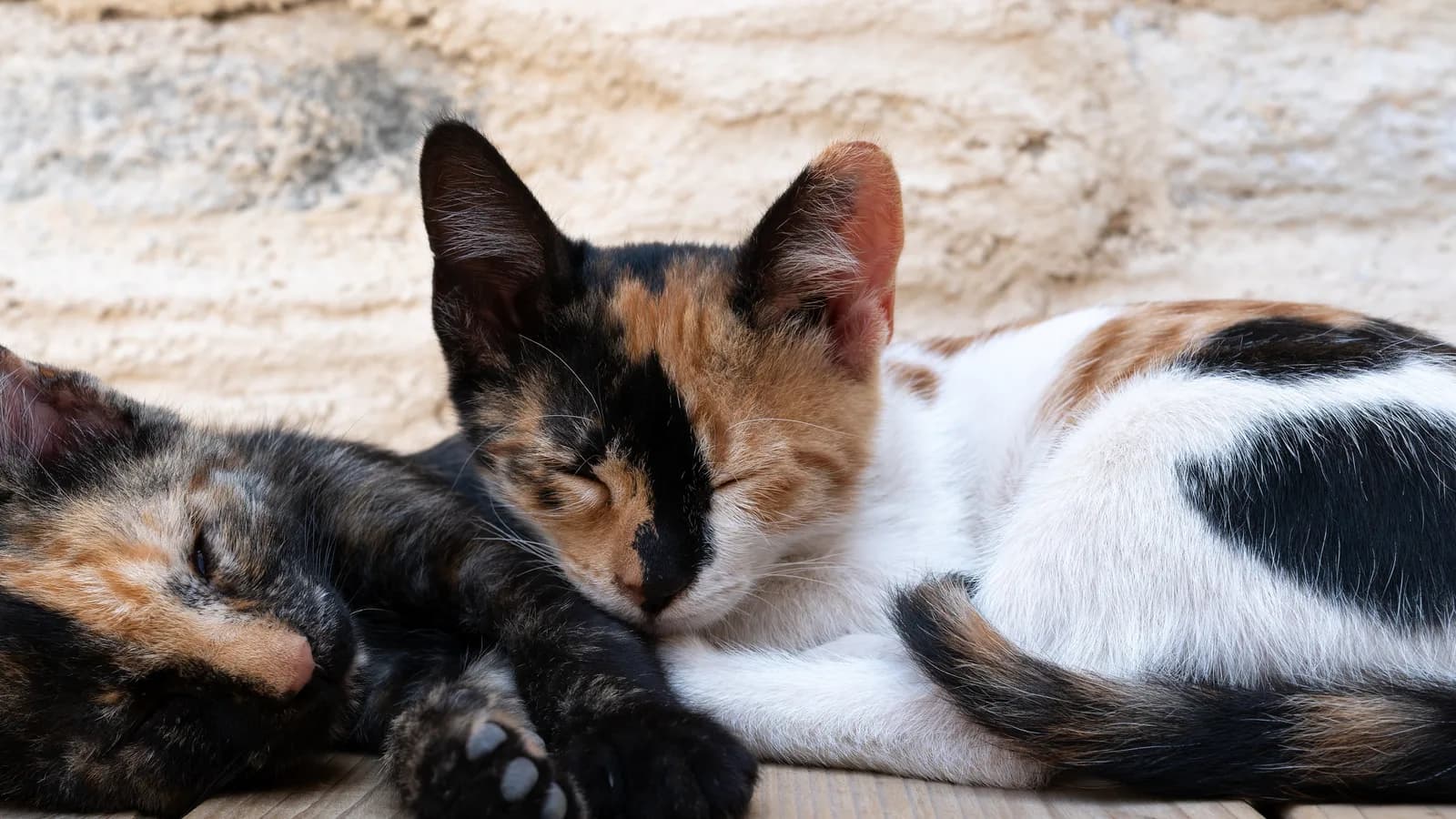
Contents
Breeds worth knowing
Tap a breed for the full profile: temperament, health, price and coat colors, all fact-checked.
The one-look answer: white
The show registries draw the line in almost identical words. 's standards define the calico as "white with unbrindled patches of black and red," with "white predominant on underparts," and the tortoiseshell as "black with patches of red or softly intermingled areas of red on both the body and the extremities." Two adjectives carry the whole distinction: a calico's patches must be unbrindled, separate blocks sitting on white, while a tortoiseshell is allowed to be softly intermingled, the woven look that gives the pattern its shell name.
Canada's registry, the , adds the practical minimum: a calico "should have white feet, legs, underside, chest and muzzle." So when you are reading a real cat, look at the paws, chest and belly. Structured white there means calico; a fully colored cat with at most a stray white hair or a small locket reads as a tortoiseshell.
And the middle cases are real. 's own color guide captions a photo of two cats this way: the one with less white "used to be called a dilute tortoiseshell with white and the girl on the right was a dilute calico." In the registry's own framing, the two names are points on a continuum of white, not two species. The line exists, and it is drawn through the amount of white, which is exactly why it is the only thing you need to look at.
The 5-second test
White paws, chest or belly: calico. No structured white anywhere: tortoiseshell. Everything else about the two coats, colors, genetics, female-only tilt, is shared.
Same genes underneath, one gene apart
Both patterns run on the same engine. The orange-or-black instruction sits on the X chromosome, and a cat needs two X chromosomes, one carrying each version, to show both colors at once. Early in development each cell permanently switches off one of its two Xs at random, and the coat maps those cell-by-cell coin flips. That story, and everything it implies, is told in full on our calico guide and tortoiseshell guide; this page only needs its conclusion: the orange-and-black part of both coats is the same mechanism.
The gene that separates them is , the white-spotting gene, identified in cats in a 2014 study in G3. It is a separate switch entirely, unrelated to the X chromosome, and either sex can carry it: it is the same gene that dresses tuxedo cats. A tortoiseshell is the two-color weave without the white-spotting gene at work. A calico is the same weave plus KIT white spotting layered on top. One gene, present or absent: that is the entire difference between the two names.
| Coat | The one-look tell | Colors | US registry word |
|---|---|---|---|
| Calico | Structured white: paws, chest, belly | Black + orange patches on white | Calico |
| Tortoiseshell | No structured white | Black + orange, woven | Tortoiseshell |
| Dilute calico | White present | Blue-gray + cream on white | Dilute calico |
| Blue-cream | No white | Blue-gray + cream, woven | Blue-cream |
| Caliby | White present, stripes in the patches | Calico + tabby striping | Patterned calico (informal: ) |
| Torbie | No white, stripes in the patches | Tortie + tabby striping | Patched tabby (informal: ) |
Why white changes the pattern itself
Look again at the pair photo up top: the calico's patches are big and clean-edged, the tortoiseshell's colors are finely woven. That is not a coincidence, and the leading explanation is elegant. White spotting means patches of skin where no pigment-producing cells settled at all. Fewer pigment cells means less competition for the colored territory that remains, so the cells that do arrive multiply in place into large, well-defined clonal patches. In a tortoiseshell, with no white, pigment cells pack the whole skin, compete everywhere, and the result is the fine weave.
One honesty note, because this site checks its mechanisms: that account is the standard explanation in the cat-genetics literature, but the primary research on white spotting states that the precise mechanism deciding patch size "remains to be elucidated." So read it as the widely cited explanation it is, not as settled developmental biology. The pattern it explains, more white travels with bigger and cleaner patches, is observable on any pair of these cats.
The dilute versions: same test, softer palette
The dilution gene, , softens black to blue-gray and orange to cream, uniformly, on both patterns at once. 's vocabulary keeps the logic: the dilute tortoiseshell becomes the , and the dilute calico is simply the dilute calico. Nothing about the white test changes. A blue-and-cream cat with white paws, chest and belly is a dilute calico; the same watercolor mix woven through a whole cat with no white is a blue-cream .
The sister photo below is the cleanest demonstration we found anywhere: one standard calico and one dilute calico, side by side, same pattern logic in two intensities. And under it, a tortoiseshell showing the no-white version of the same softened palette. Our dilute calico guide covers the pale tricolor in depth.
Add tabby stripes: torbie vs caliby
Both base patterns can also carry tabby striping inside their colored areas, and the naming trick is the same one again. A tortoiseshell whose patches show tabby stripes is a ; the registries' own filing word is "patched tabby," and 's color guide uses both names in one breath. Lay the same striping onto a calico, white and all, and breeders informally say (or tabico). No registry we read, , TICA, , Canada's or Australia's , registers "caliby" as a term; Canada's structured name for the cat is simply "patterned calico."
The white test keeps working exactly as before: a has no structured white, a does. Stripes change what the patches look like inside, never where the line between the two families sits.
Five registries, two vocabularies, one port city
"Calico" is a North American word, and the paper trail is tidy. Etymonline dates the word to the 1530s as "kalyko cloth," white cotton from Calicut, the seaport on India's Malabar coast, and records its jump to animal coloring in 1807, for horses first, then cats from 1882. The cloth named the cat, not the other way around.
The registries split cleanly along the Atlantic and the equator. uses calico as a standing class name, and Canada's carries a "Calico" entry natively in its colour standards, alongside a parallel "Tortoiseshell & White" entry describing the same combination. Britain's never uses the word once in its 312-page Standard of Points; its cat is the "tortoiseshell and white," or a tri-colour. Australia's glossary is the bluntest of all: it defines calico as "Tortoiseshell () & white (American term). Also called Tricolour." , in its own color guide, lists the official color as "Tortie & White" and files calico under "commonly called."
So no registry anywhere disputes what the cat IS. They disagree only about what to call her, and knowing both vocabularies is genuinely useful when reading British or Australian breeder listings, where a " and white" is exactly the cat an American would call a calico.
| Registry | Its own name for the white version | Note |
|---|---|---|
| (US) | Calico | "White with unbrindled patches of black and red" |
| (international) | Tortie & White | Lists "calico" as the commonly-called name |
| (UK) | Tortoiseshell and white | The word calico appears zero times in its Standard of Points |
| (Canada) | Calico, and Tortoiseshell & White | Both entries coexist in its colour standards |
| (Australia) | Tortoiseshell & white / Tricolour | Glossary marks calico as the American term |
Both are almost always female, for the same reason
Because both patterns need one orange-carrying X and one black-carrying X, both are overwhelmingly female, and the exceptions are the same rare chromosome stories on either side of the white line: usually an extra X (XXY), occasionally a built from two fused cell lines. Most of those males are sterile, though not all; Australia's glossary states the whole thing in one line: "Parti-colour cats ( , and calico) are almost always female, but males can and do occur occasionally (and are not always sterile)."
As for the famous "1 in 3,000 male calicos": that figure is repeated everywhere and traceable to no study, and our calico guide walks through the empty paper trail. The male-calico chromosome science, the 1973 series behind it, and what a male calico is actually worth all live on the two parent pages, which is where a curious reader should head next.
The field guide
Every variant named on this page, in one grid. Each caption names what the photo teaches; tap any image to enlarge it with its credit.
Two coats, one test, and a whole family of variants between them: that is the entire calico-versus-tortoiseshell question, answered the way the registries themselves answer it. If one of these one-of-a-kind coats runs your home, on either side of the white line, we would love to see her: share a photo through the site's Share button, and tell us which name your country gave her.
By Nora · The storytellerFrequently asked questions
What is the difference between a calico and a tortoiseshell cat?
White. A calico wears separate black and orange patches on a white coat, with white paws, chest and belly; a tortoiseshell weaves the same two colors through the whole coat with no structured white. The colors, the genetics and the almost-always-female rule are shared; the white-spotting gene is the difference.
Is a tortoiseshell with white patches a calico?
It depends how much white. Registries treat the two names as points on a continuum of white: a small locket or medallion leaves her a tortoiseshell (UK vocabulary says tortoiseshell-and-white for any white at all), while structured white on paws, chest and belly makes her a calico in North American terms.
Can a cat be both calico and tortoiseshell?
Not in the same registry's vocabulary, because the names describe the presence or absence of white on one underlying pattern. But the same cat can honestly carry both labels across vocabularies: an American calico IS a British tortoiseshell-and-white. The cat is identical; only the word changes.
What is a torbie?
A tortoiseshell whose colored areas also show tabby striping. Registries file her as a patched tabby; torbie is the everyday name. She has no structured white, which is what keeps her on the tortoiseshell side of the family.
What is a caliby cat?
A calico whose colored patches show tabby striping, white included. The word blends calico and tabby and is informal: no registry we read registers caliby (or tabico) as a term, and Canada's CCA-AFC files the same cat as a patterned calico.
Why are calico and tortoiseshell cats almost always female?
Showing black and orange at once requires two X chromosomes carrying different color versions, and two Xs normally means female. Males occur as rare exceptions, usually with an extra X chromosome or as chimeras, and most, though not all, are sterile.
What do the British call a calico cat?
A tortoiseshell and white, or a tri-colour. The GCCF's Standard of Points never uses the word calico, and Australia's ACF glossary explicitly labels calico as the American term for the same coat.
Are a dilute calico and a blue-cream the same thing?
No: they are the dilute versions of the two different patterns. A dilute calico has blue-gray and cream patches on white; a blue-cream (the dilute tortoiseshell) has the same softened colors woven through the coat with no white. The white test separates them exactly as it does their darker versions.
Sources & references
Data checked against reference bodies (breed registries, allergy research, veterinary schools).
- CFA Maine Coon standard (calico and tortoiseshell color class wording)
- TICA, What Color is My Cat? (Tortie & White, commonly called calico; the white continuum)
- GCCF Standard of Points, May 2025 (tortoiseshell-and-white vocabulary; no calico)
- CCA-AFC colour standards: Calico & Vans (the white-minimum wording)
- CCA-AFC colour standards: Tortie Colours
- ACF Glossary of Terms, July 2024 (calico as the American term; the parti-colour female note)
- Etymonline: calico (Calicut cloth 1530s; animal coloring 1807; cats 1882)
- David et al. 2014, KIT and white spotting in domestic cats (G3)
- Sarah Hartwell, Tortoiseshell and Tri-Colour Cats (the patch-size explanations, as theory)
- Kalantry Lab, University of Michigan: X-inactivation and the tricolor coat
This page is a starting point. Every cat is an individual: our profiles spell out the tendencies of each breed, sources included.
 Purr or Pass
Which cat breed is right for you?
Take the quiz