

Norwegian Forest Cat
“The skogkatt, Norway's own”
 By Priya · The careful one
Published August 21, 2026Updated August 26, 202611 min read
Contents
 Norwegian Forest Cat photos
Real photos, so you can see what the breed actually looks like: coats, ear tufts, ruff and build.
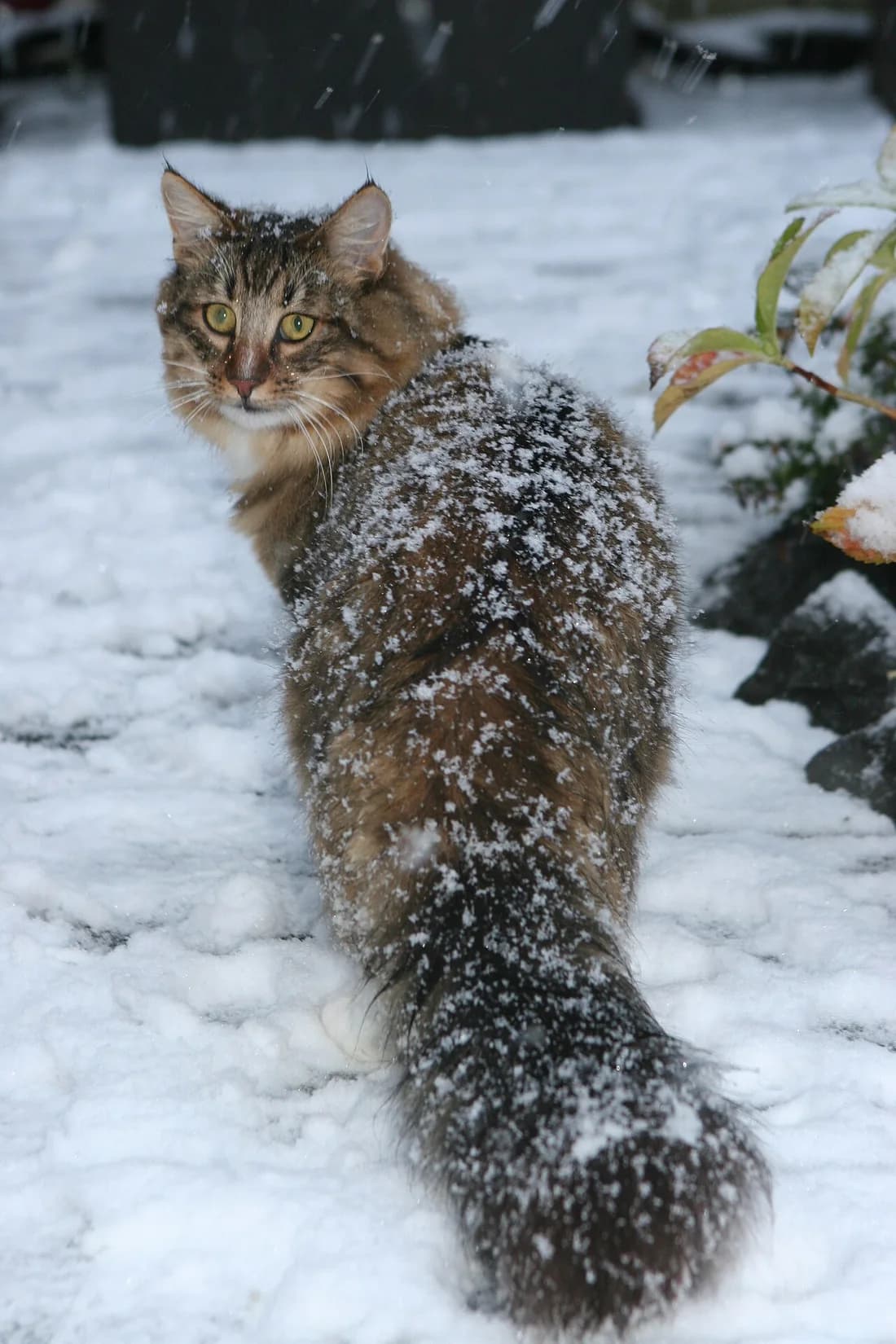
Brown tabby Norwegian Forest Cat in snow, ear tufts and thick coat dusted white
Photo: Pieter Lanser from The Netherlands · CC BY 2.0 · via Wikimedia Commons
 Vital stats
Origin
Norway
A natural landrace shaped by Scandinavia's climate, brought to the brink after the Second World War and revived by Norwegian breeders. The Norwegian club approved it as a domestic breed in 1972, and granted international recognition in 1977 with the cat Pan's Truls as the model, both dates corroborated across three independent sources. The 'official cat of Norway by royal decree' story is told hedged, as itself tells it ('according to legend'). Neither Norway's national encyclopedia nor the Norwegian breed club's own history names King Olav V or any decree.
Weight
Female
9-12 lb (4.1-5.4 kg)
Male
12-16 lb (5.4-7.3 kg)
Life expectancy
The measured figure leads, per this site's standing rule. The UK life tables (2024) give the Norwegian Forest Cat a life expectancy at birth of 9.95 years, from 15 deaths, with a wide interval (7.55 to 12.35). The registry quick-reference ranges sit far above it ( '13+', '14-16') and are commonly cited estimates, not measurements. Read together: a normal big-cat lifespan, honestly uncertain, with the registry ranges running optimistic exactly as they do for the Maine Coon in the same dataset.
Coats
Brown tabby & white
Black & white
Amber
Red tabby
Blue
Cream
Silver tabby
White
Nearly the whole feline deck, plus one color no other breed on earth has: AMBER, an MC1R mutation that turns a brown-tabby kitten honey-gold over its first two years. Black, white, red and every tabby//white combination are in everywhere. The usual exclusions (chocolate, lilac, pointed) are the crossbreeding tells, with exact lists varying by registry.
Understanding the coats (and their genetics)Size
Measured, the breed is a solid medium-large cat wearing two extra size classes of coat. Males run a mean 5.1 kg (11.2 lb) and females 3.9 kg (8.6 lb) in the one sex-split study, with a 4.5 kg (9.9 lb) median across 6,717 screened cats in the largest. TICA alone publishes three different, higher male ranges across its own documents, none of them a measurement. Full growth takes up to five years, the one figure every registry agrees on.
Did you know
The Norwegian Forest Cat is the only breed on earth with the amber coat: a single MC1R gene mutation, identified in 2009, that turns a kitten born looking like an ordinary brown tabby into a honey-gold adult over its first two years. The Siberian's 'sunshine' gold, its nearest look-alike, runs on a completely different gene.
 Personality
 Affection3/5
 Energy3/5
 Intelligence4/5
 Friendliness3/5
 Independence4/5
 Vocal2/5
 Shedding4/5
Compatibility
 Good with children4/5
 Good with other pets4/5
 Apartment friendly3/5
Editorial ratings on our five-point scale, anchored in the registry descriptions and the measured behaviour studies cited on this profile; individual cats vary, and our members' own ratings below are the counterweight.
Still torn between this breed and another?Compare the Norwegian Forest Cat trait by trait, or filter every breed by what matters to you. What our members say
What our members say
Nobody has described their Norwegian Forest Cat here yet. As soon as the first profiles come in, this is where the community averages will show up: temperament, food, lifestyle.
Describe my Norwegian Forest Cat Pros & cons
Strong points
- A measured temperament file with no red flags: never shyest or most aggressive on any of five comparisons
- The amber coat: a color that exists in no other breed, with its gene identified
- GSD-IV is a managed disease: a DNA test exists and UK registration requires it
- A genuinely low-maintenance coat for its size: weekly combing usually suffices
- The easiest head term this site has measured outside the hybrid breeds
Things to consider
- The measured lifespan (9.95 years, one small UK sample) runs well below the registry ranges
- No DNA test exists for HCM in this breed: screening means repeated echocardiograms
- A measured predisposition to weight gain in neutered males (75% overweight in the one show study)
- Five years to maturity: you buy a kitten and raise a teenager for half a decade
- A real spring molt, and a Swedish-data diabetes signal worth knowing about
 Is a Norwegian Forest Cat right for you?
A household that wants a companionable, self-possessed cat rather than a shadow. The registries' own phrase is that it may sit WITH you on its own terms, not on your lap, and the measured Finnish data backs the calm, lightly-vocal portrait. Give it vertical territory (this is the fancy's most committed climber), weekly combing, a hand-on-the-ribs body check the coat otherwise hides, and patience for a five-year adolescence.
Is the Norwegian Forest Cat right for YOUR home?
Answer a few questions and we'll email you your personalized result.
Take the quiz · 2 min Getting to know the Norwegian Forest Cat
The Norwegian Forest Cat, the skogkatt, is the cat Norway's climate built: a natural landrace with a woolly undercoat, water-repellent guard hairs, tufted ears, a plumed tail, and a genuinely documented rescue story, brought back from near-extinction after the Second World War and recognized at home in 1972, internationally in 1977. It is also, by our own measurements, the easiest big head term this site has attacked outside the hybrid breeds. The breed file rewards the attention: this is a cat whose honest numbers keep diverging from its marketing, in both directions.
Start with the legends, told straight. The Norse connection is real mythology (Freyja's chariot was drawn by cats), but its attachment to THIS breed is folklore, and the cat count is two in most tellings (only one registry trivia box says six). The 'official cat of Norway by royal decree' line is repeated everywhere and sourced nowhere. itself writes 'according to legend', Norway's own national encyclopedia names no decree, and one registry page dates the claim to a year when the named king was still Crown Prince. We tell the stories and keep the labels on.
The body is where the marketing and the scale part ways. The size page runs the whole honest file: one registry, three different published male ranges, none a measurement, against two real studies that put the breed's average at a solid medium-large, five slow years in the making. The coat is the size-doubler. It is also the palette that carries the breed's genuine exclusive: amber, the color no other breed has, an identified gene that repaints a brown kitten honey-gold.
Temperament is one of the best-measured files on this site. The registry portrait (gentle, independent, 'may sit with you on its own terms') matches the Finnish data, which never once ranks the breed as shyest or most aggressive across five comparisons, and finds it measurably less clingy than the Maine Coon. The data adds two honest quirks: a taste for wool-sucking, and the top score (among minor between-breed differences, the paper's own hedge) on litterbox fussiness. A dignified, climbing, quietly loyal housemate is the fair summary.
Health leads with the breed's own success story. Glycogen storage disease IV, a rare and fatal genetic disease, has an identified gene, a DNA test, and a UK registry that has REQUIRED a clear result for active breeding cats since June 2021: the most concrete piece of managed-disease machinery in our breed research. , by contrast, has NO DNA test in this breed (echocardiograms are the only screen).
PK deficiency has a small real carrier finding and a commercial test. And a large Swedish insurance dataset flags a genuine diabetes signal (roughly double the incidence of other cats, confidence intervals and all). The measured lifespan, 9.95 years from one small UK sample, sits well under the registries' 13-16: both numbers are on the page, labeled.
Buying one is mostly a study in patience: the price page carries the named figures (a consistent $1,400-2,500 US band, a UK marketplace where the label matters more than the price, and single-source honesty for Canada and Australia). The two comparison pages settle the eternal look-alike arguments: against the Maine Coon it comes down to one nose line, and against the Siberian to coat layers and a pointed pattern one standard bans and the other celebrates. And if your own fluffy tabby is looking suspiciously Nordic, the mix page has the checklist and the honest answer.
 Health: what to watch for
A few predispositions are well documented. The good news: they can be screened for or avoided by choosing a reputable breeder and keeping an eye on the right signals.
This is information, not veterinary advice, and it cannot tell you what is wrong with your cat. Our rule is a simple one: if something is wrong with your cat, call your vet, and call an emergency clinic if it is out of hours. Nothing you read here is a reason to wait.
Glycogen storage disease IV (GSD-IV)
Rare, fatal, DNA-testable and managedThe breed's flagship genetic condition and its success story at once. A GBE1 gene rearrangement identified in 2007 causes a fatal glycogen storage disease (perinatal collapse, or late-juvenile neuromuscular decline). Two carrier figures exist and are never averaged: roughly 14% of a 2007 breeder-submitted sample of 402 cats, against about 1 in 11,000 cats in a 2022 commercial panel of over 11,000 across all breeds (not breed-isolated). Different denominators, different eras, both stated. The concrete machinery: GCCF has required a clear GSD-IV DNA result for Active Register breeding status in the UK since 1 June 2021, and commercial tests list the breed by name.
Symptoms to spot
Affected kittens either collapse perinatally or develop progressive weakness in late kittenhood. For a buyer this is a paperwork disease: it is prevented by testing, not spotted at home.
How common
14.4% carriers in the 2007 breeder-submitted sample (58 of 402); ~1 in 11,000 in the 2022 all-breed commercial panel. Carriers are healthy; the disease needs two copies.
Screening & prevention
Both breeding cats tested, two carriers never paired; in the UK a GCCF Active Register kitten comes with this guarantee built in.
Genetic test
Yes: the GBE1 test, commercially offered (Langford Vets UK, LabGenVet Canada, Wisdom Panel). Ask for both parents' results.
Hypertrophic cardiomyopathy (HCM)
Echo-screening only: no DNA testHCM occurs in this breed as in most, and the honest headline is what does NOT exist: no DNA test for HCM exists for the Norwegian Forest Cat (unlike the Maine Coon's and Ragdoll's MYBPC3 tests). Screening means echocardiography by a cardiologist, repeated every 2-3 years for breeding cats per the breed health programs. One study sometimes miscited as evidence of elevated risk (a troponin I comparison) found the OPPOSITE in healthy cats. Norwegian Forest Cats had the lowest median reading of the three breeds compared, and its authors call the breed effect clinically marginal.
Symptoms to spot
Often nothing early. Laboured or rapid breathing, open-mouth breathing, lethargy or sudden hind-leg pain are emergencies: call your vet immediately, out of hours an emergency clinic.
How common
No breed-specific prevalence figure exists in the material read; anyone quoting one is guessing.
Screening & prevention
Ask breeders for dated echocardiogram reports read by a cardiologist (the PawPeds HCM program is the breed's own standard), and for open pedigree disclosure.
Genetic test
None exists for this breed. An 'HCM DNA certificate' for a Norwegian Forest Cat is paperwork no laboratory issues.
Pyruvate kinase (PK) deficiency
Small documented finding, DNA-testableA red-blood-cell enzyme defect (autosomal recessive) causing intermittent anemia. The breed's finding is small but real: 3 carriers among 13 Norwegian Forest Cat samples in the 2012 multi-breed screen (counts stated as counts, never a rate). A current US commercial test lists the breed by name.
Symptoms to spot
Intermittent lethargy, weakness, pale gums, or a cat that tires unusually fast: any of these is a reason to call your vet.
How common
3 carriers of 13 samples in the one 2012 screen: too small for any population rate, stated as the counts they are.
Screening & prevention
Both breeding cats tested; for a pet kitten, one tested-clear parent rules the disease out.
Genetic test
Yes: the PKLR DNA test, commercially offered with the breed listed by name.
Diabetes mellitus (a Swedish-data signal)
Measured, population-scoped, worth knowingA genuinely well-powered finding scoped to its population. Across 504,688 insured Swedish cats (1.23 million cat-years, 2009-2013), the Norwegian Forest Cat was one of four breeds at significantly elevated diabetes risk: 21.2 cases per 10,000 cat-years (CI 16.7-25.8), an incidence rate ratio of 1.9 versus all other cats (CI 1.5-2.3) and 2.5 versus other purebreds, persisting after age adjustment, with males at higher risk. A Swedish insurance figure, not a universal rate. It pairs naturally with the breed's measured weight-gain disposition: body condition is this breed's most controllable risk factor.
Symptoms to spot
Drinking and urinating more, weight loss despite appetite, lethargy: classic signs in any middle-aged cat, and a vet visit, not a home diagnosis.
How common
21.2 per 10,000 cat-years in insured Swedish cats (IRR 1.9, CI 1.5-2.3). Sweden-scoped by design.
Screening & prevention
Keep the cat lean (weigh, don't eyeball a double coat) and raise thirst or urination changes with your vet promptly.
Genetic test
None: risk management is weight control and ordinary preventive care.
Go deeper on health
Prevention, warning symptoms, costs and insurance: our guides, researched and sourced.
The Norwegian Forest Cat also appears in
Our criteria-based guides, to compare this breed with the ones most like it.
 Grooming & living with one
Grooming
Weekly combing is 'usually sufficient' per two independent registries, with a real spring molt needing extra sessions. The water-repellent guard hairs resist matting better than the coat's volume suggests, and bathing is optional and breeder-guided. The one care task the coat actively hides: body condition. Weigh the cat; the fluff lies.
Living together
The registry portrait is a large, gentle, quietly independent cat, lightly vocal and famously 'not a classic lap cat, though it may sit with you on its own terms'. The measured Finnish data (5,726 cats) adds precision. Significantly less contact-seeking than the Maine Coon and Russian Blue specifically. Never the shyest or most aggressive breed on any of five measured comparisons. And two genuine measured quirks: among the breeds most likely to wool-suck, and the highest score of 26 breeds on a litterbox-issues factor, published with the paper's own hedge that the differences between breeds were minor.
 Food & diet
No breed-specific feeding study exists. Portions follow the general / and guidance applied to the individual cat's actual weight, never a breed multiplier. Two breed-flavoured notes: growth feeding runs long (five years to maturity, reasoning from the timeline rather than a tested protocol), and the one measured warning is weight gain in neutered males. 's own page mentions dehydrated raw food casually; AAHA and AAFP explicitly decline to endorse raw feeding, and this site pairs the two statements rather than picking one.
 Price & budget
$1,400 to 2,500
Price of a kitten from a registered breeder, in the United States
This price reflects the quality of the breeding program: parents' health tests, registry pedigree, socialization. A very low price should raise a red flag. The real cost, though, plays out over the years.
Find a verified breederKitten price, by market
United States
$1,400 to 2,500
United Kingdom
£200 to 1,000
Canada
CA$3,000
Australia
A$1,200 to 5,400
Each figure is that country's real market price, researched separately, not a conversion of the others. The smaller line is only there so you can gauge one against your own money: European Central Bank reference rates of 2026-09-18, refreshed daily.
The Norwegian Forest Cat in the US, UK, Canada and Australia
| Measure | United States | United Kingdom | Canada | Australia |
|---|---|---|---|---|
| Pet-quality kitten (published prices) | $1,400-2,500 (two named catteries + a live sample) | £200-1,000 marketplace; purebred claims only at the top | CA$3,000 (one cattery, announced) | AUD $1,200-5,400 (one dated 2020 estimate) |
| Main registries | CFA, TICA | GCCF (with a binding GSD-IV test rule) | CCA-AFC | ACF, ANCATS |
| The breed's own DNA tests | GSD-IV and PK deficiency tests exist and list the breed by name; NO HCM test exists | Same tests; GCCF REQUIRES a clear GSD-IV result for Active Register breeding since 1 June 2021 | Same tests (LabGenVet lists GSD-IV) | Same tests by mail |
| Measured life expectancy | None (the study is UK) | 9.95 years (VetCompass 2024, 15 deaths, wide CI) | None | None |
| Kitten leaving age | Registries recommend 12+ weeks; legal floors vary by state | 12-16 weeks recommended; 8-week floors in the licensing rules | Same recommendation; Quebec has its own regime | Same recommendation; state rules vary |
Four markets, four rulebooks; single-source figures are labeled as such. Prices August 2026.
Work out your food budget
Type of food
Estimated monthly budget
$16
≈ 2.8 oz (79 g) per day
A ballpark figure, food only, using the same arithmetic as our portion tool (resting energy requirement × 1.2, a neutered adult). Real needs vary with age, activity level and body condition. Ask your veterinarian for advice.
 Verified catteriesThe registry-checked directory, plus a kitten alert near you. Filter it by breed.
 Should you insure a Norwegian Forest Cat?
Our sources list several predispositions in the Norwegian Forest Cat: Glycogen storage disease IV (GSD-IV), Hypertrophic cardiomyopathy (HCM), Pyruvate kinase (PK) deficiency, among others. A predisposition is not a foregone conclusion, and many of these cats live their whole lives without ever developing anything. It does change the nature of the follow-up, though: you monitor, sometimes for life, and it's that monitoring that weighs on a budget, more than a one-off accident.
One thing to weigh before deciding: this is a cat you will live alongside for well over a decade, and that is the span the real cost is spread across, premiums and care alike. Where a breed has a measured life expectancy that differs from the figure usually quoted, we say so in the lifespan section above rather than repeating the quoted one here.
 Norwegian Forest Cat cats in our community
No Norwegian Forest Cat here yet
Got one? Add a photo and yours gets to open this page.
 The vet's take
Veterinary review
Are you a vet?
Your professional read belongs here: every verified practitioner can leave a note, published once our editors have reviewed it.
Sign in and get your license number verified. We check it in the public register, we never ask for or keep a copy of your diploma, and your number is never published.
 Frequently asked questions
+How big do Norwegian Forest Cats get?
Measured: males a mean 5.1 kg (11.2 lb), females 3.9 kg (8.6 lb), with a 4.5 kg median across 6,717 screened cats. The 16-18 lb ranges you read elsewhere are registry claims (TICA alone publishes three different ones), not measurements. Full size takes up to five years.
+How long do Norwegian Forest Cats live?
The one measured figure is 9.95 years (UK life tables, 15 deaths, wide interval); TICA says 13+, GCCF 14-16, both uncited. The honest reading is a normal large-cat lifespan with optimistic marketing, and heart screening plus weight control are where an owner moves the odds.
+Are Norwegian Forest Cats hypoallergenic?
No, and the famous '35-40 percent lower Fel d 1' figure has no study behind it: we traced it to authorless blogs. No study has measured this breed's allergen output at all. Our hypoallergenic page carries the whole file.
+What is an amber Norwegian Forest Cat?
The breed's exclusive color: an MC1R mutation identified in 2009, found in no other breed, that turns a brown-tabby-looking kitten honey-gold over its first two years. The Siberian's 'sunshine' is a different gene.
+How much does a Norwegian Forest Cat cost?
US $1,400-2,500 from named catteries (August 2026); UK £200-1,000 on the open marketplace with purebred claims only at the top; Canada and Australia are single-source markets, honestly labeled on our price page.
+Are Norwegian Forest Cats and Maine Coons related?
The kinship stories are legend with good branding: no genetic study documents descent. Their standards separate them on one hard trait: a straight nose profile is required here and 'not acceptable' there. Our comparison page runs the whole list.
+What is GSD-IV in Norwegian Forest Cats?
A rare, fatal glycogen storage disease with an identified gene (GBE1), a commercial DNA test, and a UK registry rule requiring a clear result for breeding cats since 2021: the best-managed genetic disease in our breed research. Buy from tested parents and it is a paperwork issue.
+Do Norwegian Forest Cats like water?
The water-repellent coat and fishing folklore are real breed lore; what the registries actually document is a climbing, outdoors-built cat with a coat that sheds rain. Individual water-play varies cat by cat.
+Are Norwegian Forest Cats good indoor cats?
Yes, with vertical territory: this is the fancy's most committed climber, and a tall tree plus window real estate covers most of its outdoor inheritance. The measured temperament file shows a calm, lightly-vocal, self-possessed housemate.
+Do Norwegian Forest Cats shed a lot?
A real spring molt, yes; the rest of the year a weekly comb usually suffices, per two registries independently. The guard hairs resist matting better than the coat's volume suggests.
+Is my fluffy tabby part Norwegian Forest Cat?
Probably not, and the resemblance is ancestral: the breed descends from ordinary northern farm cats. Check the standard's tells (straight profile, triangle head, almond eyes, double coat) on our mix page; no DNA test certifies a percentage.
 Community questions
Got a question this page doesn't cover? Ask it: the best ones get published here with their answer.
Sources & references
Data checked against reference sources (TICA and CFA standards, genetics laboratories, veterinary schools).
- TICA: Norwegian Forest breed
- TICA Norwegian Forest breed standard
- CFA: Norwegian Forest Cat
- CFA Norwegian Forest Cat breed standard
- GCCF: Norwegian Forest Cat
- GCCF NFC registration policy (the GSD-IV rule)
- Teng et al. 2024, UK VetCompass life tables
- Häggström et al. 2025, screening body weights
- Kienzle and Moik 2011, adult body weights of pure-bred cats
- Fyfe et al. 2007, the GBE1 (GSD-IV) mutation
- Anderson et al. 2022, 11,000-cat genetic epidemiology
- Öhlund et al. 2015, diabetes in insured Swedish cats
- Peterschmitt et al. 2009, the amber MC1R mutation
- Salonen et al. 2019, breed behaviour study
- Norsk Skogkattring, breed history (Norwegian)

Worth keeping a paw on
Pin this profile
To compare later, or to show someone still torn between two breeds. One click and it sits in your board.
Pin it on Pinterest
 Purr or Pass
Still deciding? Find the perfect breed for your home.
A quick quiz that factors in your lifestyle, your kids and your other pets.
Which breed fits my home?Keep exploring
The floor belongs to our members. Keep it kind, links are not allowed, and images go through moderation before anyone else sees them.