

Abyssinian
“The ticked athlete”
 By Priya · The careful one
Published August 21, 2026Updated August 26, 202610 min read
Contents
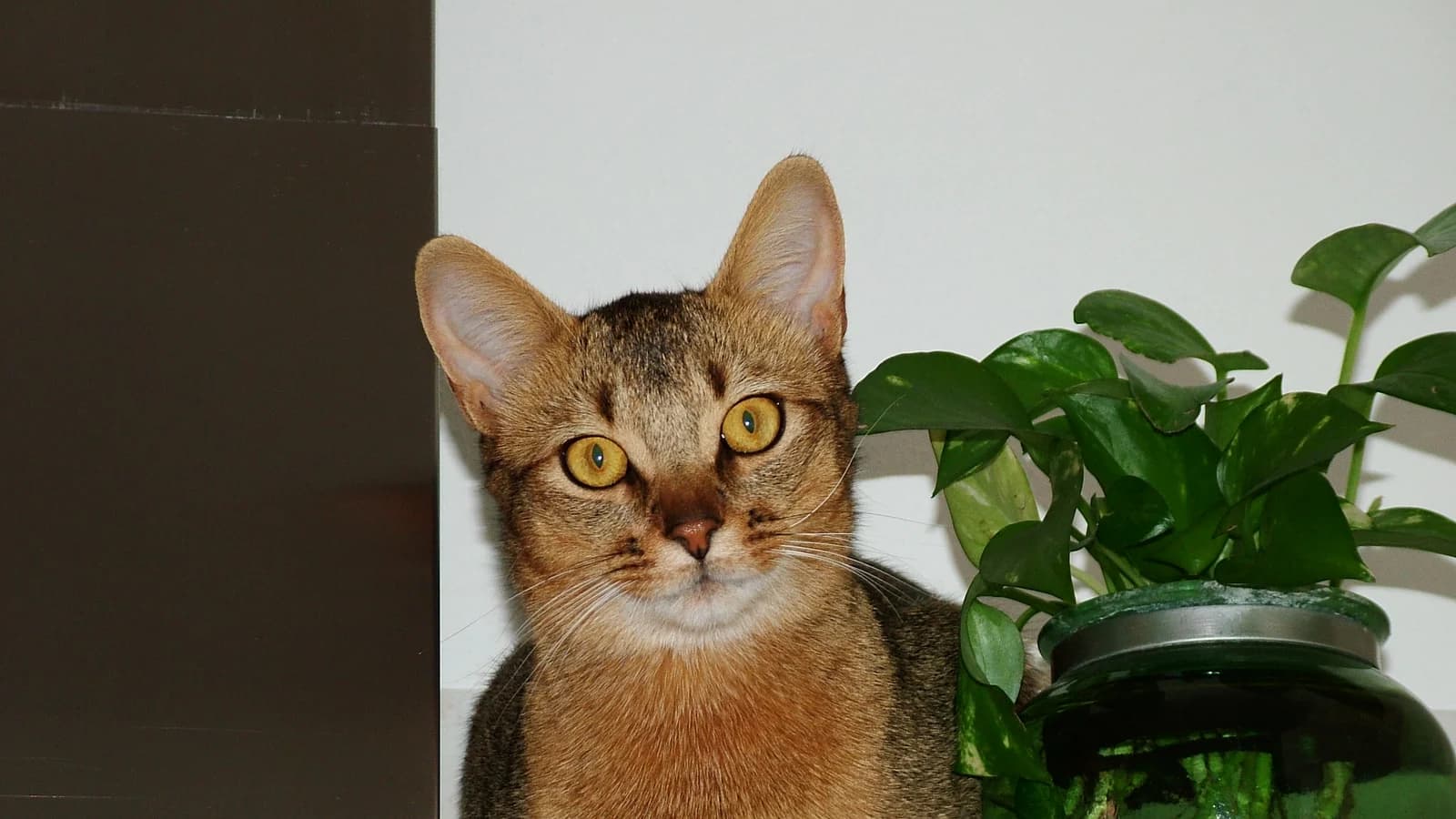
 Abyssinian photos
Real photos, so you can see what the breed actually looks like: coats, ear tufts, ruff and build.
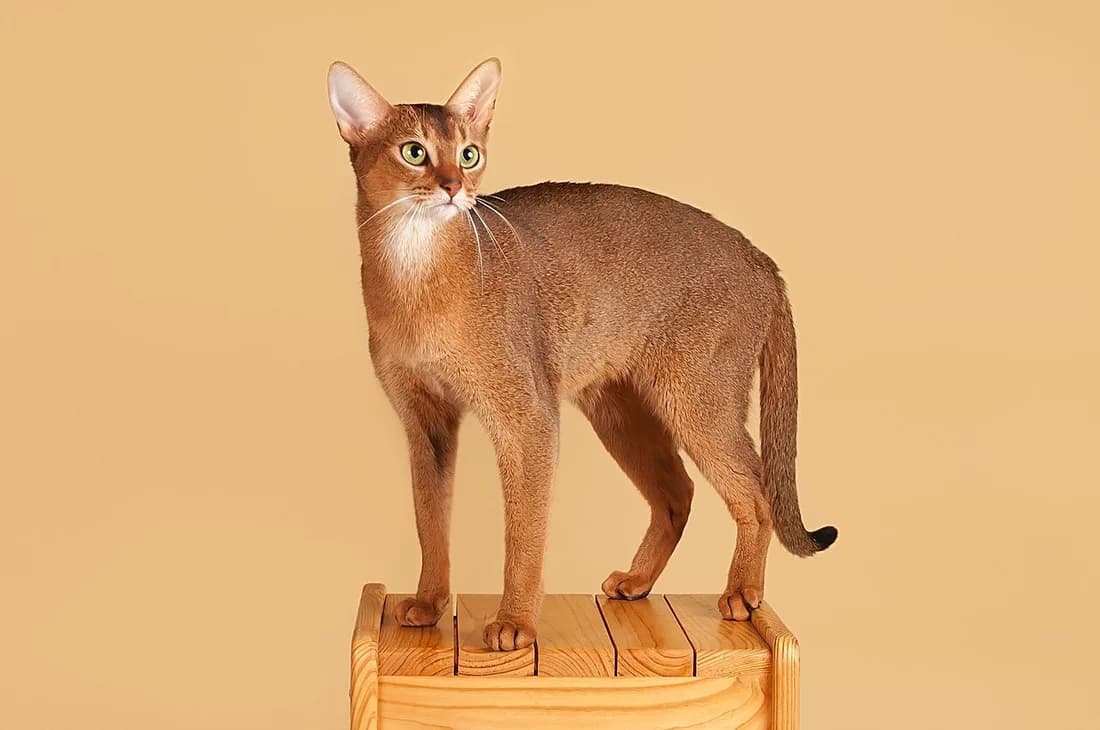
Sorrel Abyssinian standing full-body on a pedestal, the breed's fine-boned athletic frame in profile
Photo: Oleg Royko · CC BY-SA 4.0 · via Wikimedia Commons
 Vital stats
Origin
United Kingdom
One of the fancy's oldest breeds on paper, developed in Britain in the late 1800s. The romantic Zula story (a cat brought home from the 1868 Abyssinian war) is unverified by 's own account. Recent genetic studies place the breed's ancestors on the coasts of the Indian Ocean and in Southeast Asia.
Weight
Female
6-9 lb (2.7-4.1 kg)
Male
7-12 lb (3.2-5.4 kg)
Life expectancy
Two stated ranges, never averaged: 's page says 14 to 17-plus years, a pet insurer's says 9 to 15, and neither cites a study. The one measured figure is small and honest. In England's primary-care records (2009-2012), eleven Abyssinians had a median age at death of 10.0 years, the second-shortest of the breeds in that table. Eleven cats from one country is a data point, not a verdict, and it is the only measured point that exists.
Coats
Ruddy / Usual / Tawny
Cinnamon / Sorrel
Blue
Fawn
Chocolate (TICA, GCCF)
Lilac (TICA, GCCF)
Silver (TICA, GCCF, ACF)
The registries genuinely disagree. recognizes four colors (Ruddy, Cinnamon, Blue, Fawn), twelve including a full Silver Division, and the UK's 28 including Chocolate, Lilac, torties and silvers. Ruddy, Usual and Tawny are three registries' words for the same signature burnt-sienna coat. Every hair is ticked with alternating bands: the breed carries two copies of the ticked allele, which fully masks stripes.
Understanding the coats (and their genetics)Size
Medium and genuinely light. The one measured study (a German pilot, 9 females and 5 males in ideal condition, stated honestly as a small sample) put females at a mean 2.8 kg (6.2 lb) and males at 4.1 kg (9.0 lb). TICA's own quick-reference box runs higher (6-9 lb females, 7-12 lb males) and is shown here as the registry's own range. A fine-boned, muscular cat either way.
Popularity (CFA)
No. 6
in the CFA ranking for 2026
Did you know
The Abyssinian sits at the center of a genetics story still being written. The ticked coat's locus was only separated from the ordinary tabby gene around 2009-2010, and its candidate gene (DKK4) was proposed in 2021. Meanwhile the breed's early-onset PRA gene, Rdy, exists in exactly two breeds on Earth: the Abyssinian and its own longhaired sibling, the Somali.
 Personality
 Affection4/5
 Energy5/5
 Intelligence5/5
 Friendliness4/5
 Independence3/5
 Vocal2/5
 Shedding2/5
Compatibility
 Good with children4/5
 Good with other pets4/5
 Apartment friendly3/5
Editorial ratings on our five-point scale, anchored in the registry descriptions and the measured behaviour studies cited on this profile; individual cats vary, and our members' own ratings below are the counterweight.
Still torn between this breed and another?Compare the Abyssinian trait by trait, or filter every breed by what matters to you. What our members say
What our members say
Nobody has described their Abyssinian here yet. As soon as the first profiles come in, this is where the community averages will show up: temperament, food, lifestyle.
Describe my Abyssinian Pros & cons
Strong points
- Measured the LEAST fearful breed in a 4,316-cat dataset (116 Abyssinians)
- Wash-and-wear coat: occasional brushing and a chamois cloth cover it
- Three cheap, named DNA tests cover the breed's main genetic risks
- Measurably low hyperthyroidism risk in a large insurance dataset
- A busy, clever companion that joins everything you do
Things to consider
- Energy is real: this is a countertop-and-curtain athlete, not a couch ornament
- Renal amyloidosis has no DNA test and is fatal in affected cats by about age 5
- The one measured lifespan point (median 10.0 years, n=11) runs short of the brochure ranges
- An older vet-rated survey scored the breed high on timidity: two instruments disagree
- Established breeders rarely publish prices: budgeting takes conversations
 Is an Abyssinian right for you?
A household that wants a participant, not a spectator: the Abyssinian supervises, climbs, fetches and follows. Give it vertical space, real play time and company. Buy with the three DNA test results in hand (PK deficiency and both PRA genes; all three tests exist and cost $47 each). And read our health section before the breeder conversation, not after.
Is the Abyssinian right for YOUR home?
Answer a few questions and we'll email you your personalized result.
Take the quiz · 2 min Getting to know the Abyssinian
Watch an Abyssinian cross a room and you understand the breed instantly: nothing else in the cat fancy moves like it. A slender, fine-boned athlete in a coat of banded, burnt-sienna hairs. No stripes on the body, just warm shimmer, with huge ears and a face that is always, always paying attention.
The name is a red herring, and we tell the origin story at each source's own confidence. The romantic version says a cat named Zula came home to England from the Abyssinian war in 1868 and stood at the Crystal Palace show in 1871. 's own material states plainly that no documentation links Zula to today's cats, so we say the same. The genetic version points elsewhere entirely. Recent studies place the breed's ancestors on the coasts of the Indian Ocean and in Southeast Asia, with the breed as we know it built by British fanciers. The paperwork is British; the genes never saw Abyssinia.
The coat is a genetics lecture wearing fur. Every hair is ticked with alternating bands: the work of a locus scientists only separated from the ordinary tabby gene around 2009-2010, with a candidate gene (DKK4) proposed in 2021, a story still moving. What the registries call the colors is its own comedy of dictionaries. The same signature coat is "Ruddy" in North America, "Usual" at Britain's and "Tawny" in Australia, and the UK recognizes 28 colors where counts exactly four. The colors page maps all five rulebooks.
On personality, we print both readings because the instruments disagree. The big modern owner-reported dataset (4,316 cats) measured the Abyssinian as the least fearful breed studied. An older, smaller, veterinarian-rated Japanese survey ranked it second-most timid of twelve: a contradiction the newer paper itself names and leaves open. What no source disputes is the energy. This is a busy, clever, everywhere cat that treats your day as a joint project.
Health is where this breed rewards a prepared buyer, because its three headline genetic risks all have cheap, named DNA tests. PK deficiency (an anemia-causing enzyme defect, measured at a 5.23 percent allele frequency in the unbiased US sample), and BOTH progressive retinal atrophy genes: late-onset rdAc and early-onset Rdy, the latter found in exactly two breeds on Earth (this one and the Somali). Forty-seven dollars per test, ninety-five for the bundle: ask for the parents' results by name.
The one risk with NO test is renal amyloidosis, genetically complex and typically fatal by about age five in affected cats. And one finding is quietly excellent: a measured hyperthyroidism risk near the floor of any breed tested. Lifespan gets the honest treatment. says 14 to 17-plus, an insurer says 9 to 15, nobody cites a study, and the one measured point (median 10.0 years at death, eleven English cats) is printed with its sample size instead of hidden.
Two practical notes. The Somali is not a look-alike but this breed's own longhaired sibling, one recessive gene apart, sharing a standard and an explicit intermating rule: it gets its own profile soon. And the market has a personality of its own. Nine of nine established catteries we read publish no price online. The real figures, live-sampled market by market, are on the price page; the allergy question, with its genuinely empty evidence file, on the hypoallergenic page.
 Health: what to watch for
A few predispositions are well documented. The good news: they can be screened for or avoided by choosing a reputable breeder and keeping an eye on the right signals.
This is information, not veterinary advice, and it cannot tell you what is wrong with your cat. Our rule is a simple one: if something is wrong with your cat, call your vet, and call an emergency clinic if it is out of hours. Nothing you read here is a reason to wait.
Pyruvate kinase (PK) deficiency
DNA-testable, the flagship riskAn enzyme defect of the red blood cells causing intermittent haemolytic anemia, and the breed's best-documented genetic issue. Measured carriage varies by sampling: 5.23 percent mutant allele frequency in the unbiased US sample, against 15.12 percent in the biased, test-seeking sample (a gap that is itself a lesson in reading statistics), around 11 percent in the UK and 13 percent in Australia. The literature's own recommendation is plain: test before breeding.
Symptoms to spot
Intermittent lethargy, weakness, pale gums or a cat that tires unusually fast: a vet call, whatever the odds. Severity varies and cannot be predicted for an individual cat.
How common
Allele frequency 5.23% (US unbiased sample); roughly 11% UK, 13% Australia, higher in Japan. Never quote the 15.12% biased figure as a population rate.
Screening & prevention
Both parents' PK results in writing; two carriers should not be paired.
Genetic test
Yes: $47 at UC Davis VGL, or bundled with both PRA tests for $95.
Progressive retinal atrophy: TWO separate genes
Both DNA-testable, never confuse themThis breed carries two entirely different inherited eye diseases, and honest pages keep them apart. rdAc (gene CEP290) is recessive and late-onset. Affected cats lose vision gradually, typically blind by three to five years, and the mutation has since spread into more than twenty breeds. Rdy (gene CRX) is dominant and early-onset. Visual deficits show by seven weeks of age, and the gene is found in exactly two breeds, the Abyssinian and the Somali. One breed, two mechanisms, two tests.
Symptoms to spot
Night-blindness first (hesitation in dim rooms, bumping in low light), widening pupils, increasing eye-shine. Any suspicion of failing vision is a vet visit; blind cats can live superbly, but the diagnosis matters.
How common
No current population rate is published for either gene in this breed; carrier testing is how breeders keep both rare.
Screening & prevention
Ask for the parents' rdAc AND Rdy results, by name: a breeder who conflates the two into 'PRA-tested' has answered half the question.
Genetic test
Yes, one per gene: rdAc $47, Rdy $47 at UC Davis VGL ($95 bundles all three Abyssinian tests).
Renal amyloidosis
No test exists; the honest hard oneMisfolded protein deposits scar the kidneys of affected cats, with progressive kidney failure typically fatal by about age five. (An older figure of one to seven years belongs to the Siamese's liver form, a correction our research made and keeps.) The genetics are complex, NOT a single gene. No consumer DNA test exists, none should be claimed, and breeding away from affected lines plus open disclosure is the only current tool.
Symptoms to spot
Increased thirst and urination, weight loss, appetite loss in a young-to-middle-aged cat: same-week vet call, regardless of breed odds.
How common
No measured population rate exists; the condition is line-associated and breeder-tracked.
Screening & prevention
Ask the breeder directly about amyloidosis history in the line and prefer catteries that disclose over ones that claim none.
Genetic test
None exists. A seller offering an 'amyloidosis DNA certificate' is selling paperwork no laboratory issues.
Hyperthyroidism: a measured LOW risk
Good news, sourcedA large insurance dataset measured the Abyssinian at a fraction of domestic shorthairs' hyperthyroidism risk (odds ratio 0.04, one of the lowest of any breed tested). The wide confidence interval reflects few affected cats, which is the point: the most common endocrine disease of older cats is measurably rare in this breed.
Symptoms to spot
For any older cat: weight loss with a ravenous appetite, restlessness, a racing heart. Rare here, never impossible: an older cat losing weight sees a vet.
How common
Odds ratio 0.04 vs domestic shorthairs (95% CI 0.00-0.74) in the insured-cat dataset.
Screening & prevention
Routine senior bloodwork per your vet's schedule covers it.
Genetic test
Not a genetic-test matter; a thyroid panel at the vet answers it in one blood draw.
Go deeper on health
Prevention, warning symptoms, costs and insurance: our guides, researched and sourced.
The Abyssinian also appears in
Our criteria-based guides, to compare this breed with the ones most like it.
 Grooming & living with one
Grooming
The famous wash-and-wear cat. The short ticked coat needs only occasional brushing, and both major registries independently recommend the same finishing trick: a chamois cloth over the dry coat for sheen. Baths rarely, on condition. 's stated cadences for the rest: nails roughly every two weeks, teeth regularly with a vet-approved paste.
Living together
The clubs and the measured data mostly agree here: a confident, social, dog-friendly cat, and the big Finnish dataset scored the breed least fearful of all studied. Children who like an ACTIVE cat get a great one. The honest caveat: an older Japanese vet-rated survey ranked the breed near the top for timidity and nervousness, a disagreement the newer paper itself names. Individual cats, as always, out-vote instruments.
 Food & diet
No breed-specific feeding literature exists across the four registries we checked. 's own health notes name PK deficiency and renal amyloidosis without tying either to diet. So the honest baseline is a good obligate-carnivore diet, with body-condition checks doing the real work. A lean, athletic breed hides weight badly in the other direction: sudden weight LOSS in an adult is a vet call, not a diet win.
 Price & budget
$1,300 to 3,200
Price of a kitten from a registered breeder, in the United States
This price reflects the quality of the breeding program: parents' health tests, registry pedigree, socialization. A very low price should raise a red flag. The real cost, though, plays out over the years.
Find a verified breederKitten price, by market
United States
$1,300 to 3,200
United Kingdom
£800 to 1,200
Canada
CA$600 to 2,500
Each figure is that country's real market price, researched separately, not a conversion of the others. The smaller line is only there so you can gauge one against your own money: European Central Bank reference rates of 2026-09-18, refreshed daily.
The Abyssinian in the US, UK, Canada and Australia
| Measure | United States | United Kingdom | Canada | Australia |
|---|---|---|---|---|
| Pet-quality kitten | $1,300-3,200 (live market + one cattery card) | £800-1,200 registered; £300-600 unregistered | CA$600-2,500 (live sample) | Price on application (10/10 catteries publish none) |
| Recognized colors | CFA 4; TICA 12 incl. silvers | GCCF 28, the richest palette | CCA-AFC 4, no silver | ACF 4 + silvers ('Tawny' for ruddy) |
| DNA tests that exist | PK deficiency, rdAc and Rdy PRA: $47 each, $95 bundled (UC Davis VGL) | Same three tests | Same three tests | Same three tests |
| Measured life expectancy | No measured figure exists | Median 10.0 yrs at death (n=11, England 2009-2012) | No measured figure exists | No measured figure exists |
| Registry word for the classic coat | Ruddy (CFA, TICA) | Usual (GCCF) | Ruddy (CCA-AFC) | Tawny (ACF) |
Four markets, four rulebooks; none of these figures converts into another. Prices are August 2026 and expire with the quarter.
Work out your food budget
Type of food
Estimated monthly budget
$13
≈ 2.2 oz (63 g) per day
A ballpark figure, food only, using the same arithmetic as our portion tool (resting energy requirement × 1.2, a neutered adult). Real needs vary with age, activity level and body condition. Ask your veterinarian for advice.
 Verified catteriesThe registry-checked directory, plus a kitten alert near you. Filter it by breed.
 Should you insure an Abyssinian?
Our sources list several predispositions in the Abyssinian: Pyruvate kinase (PK) deficiency, Progressive retinal atrophy: TWO separate genes, Renal amyloidosis, among others. A predisposition is not a foregone conclusion, and many of these cats live their whole lives without ever developing anything. It does change the nature of the follow-up, though: you monitor, sometimes for life, and it's that monitoring that weighs on a budget, more than a one-off accident.
One thing to weigh before deciding: this is a cat you will live alongside for well over a decade, and that is the span the real cost is spread across, premiums and care alike. Where a breed has a measured life expectancy that differs from the figure usually quoted, we say so in the lifespan section above rather than repeating the quoted one here.
 Abyssinian cats in our community
No Abyssinian here yet
Got one? Add a photo and yours gets to open this page.
 The vet's take

Veterinary review
Are you a vet?
Your professional read belongs here: every verified practitioner can leave a note, published once our editors have reviewed it.
Sign in and get your license number verified. We check it in the public register, we never ask for or keep a copy of your diploma, and your number is never published.
 Frequently asked questions
+Are Abyssinian cats hypoallergenic?
No breed is proven hypoallergenic, and for the Abyssinian the file is literally empty: zero studies pair the breed with the Fel d 1 allergen. The short coat is a grooming convenience, not an allergy feature: the allergen comes from skin and saliva, not hair. Our hypoallergenic page has the whole (short) story.
+How much does an Abyssinian cat cost?
Live reads, August 2026: US $1,300-3,200; UK £800-1,200 from registered breeders (£300-600 unregistered); Canada CA$600-2,500; Australia effectively price-on-application, since ten of ten directory catteries publish none. Established breeders across all markets rarely post prices online.
+How long do Abyssinian cats live?
TICA says 14-17+, an insurer says 9-15, neither cites a study, and we don't average them. The one measured point: eleven English Abyssinians had a median age at death of 10.0 years in primary-care records: a tiny sample, printed with its size rather than hidden.
+What colors do Abyssinian cats come in?
It depends on the registry: CFA recognizes four (Ruddy, Cinnamon, Blue, Fawn), TICA twelve with silvers, and Britain's GCCF twenty-eight. Ruddy, Usual and Tawny are three registries' words for the same signature coat.
+Are Abyssinian cats cuddly?
Affectionate, yes; a lap ornament, rarely. The breed's affection style is participation: it follows, supervises, rides shoulders and sleeps against you after the day's projects are done. If you want stillness, this is the wrong athlete.
+What health problems do Abyssinian cats have?
Three headline risks, two of them fully testable: PK deficiency ($47 DNA test) and two separate PRA eye genes, rdAc and Rdy ($47 each, $95 for all three tests). The hard one is renal amyloidosis: no test exists, so line disclosure is the real question for a breeder. One measured bright spot: near-floor hyperthyroidism risk.
+What is the difference between an Abyssinian and a Somali?
One gene: the Somali is the Abyssinian's own longhaired sibling, produced by a recessive longhair gene. TICA writes one shared standard for both, and Australia's ANCATS states outright that the two may intermate. The Somali gets its own profile on this site.
+Why don't Abyssinians have stripes?
The breed carries two copies of the ticked allele, which fully masks the mackerel and classic tabby patterns, leaving each hair banded instead. The locus was only separated from the ordinary tabby gene around 2009-2010, with a candidate gene (DKK4) proposed in 2021.
+Are Abyssinian cats good with children and dogs?
Yes by both prose and measurement: the clubs describe a confident, dog-friendly cat, and the big Finnish dataset scored the breed the LEAST fearful studied. Best for households that enjoy an active, involved cat.
+Where do Abyssinian cats actually come from?
Not Abyssinia, in all likelihood. The Zula story (a cat brought to England from the 1868 war) is unverified by TICA's own account; genetic studies point to the coasts of the Indian Ocean and Southeast Asia, with the breed built by British fanciers.
+Do Abyssinian cats shed?
Lightly: the short ticked coat is the fancy's famous wash-and-wear model, kept with occasional brushing and a chamois-cloth polish. Shedding says nothing about allergies, though: that's a skin-and-saliva protein question.
 Community questions
Got a question this page doesn't cover? Ask it: the best ones get published here with their answer.
Sources & references
Data checked against reference sources (TICA and CFA standards, genetics laboratories, veterinary schools).
- TICA: Abyssinian
- CFA Abyssinian standard (PDF)
- GCCF Abyssinian Standard of Points (PDF)
- CCA-AFC Abyssinian standard (PDF)
- ACF Abyssinian standard (PDF)
- Lyons/Buckley/Harvey 2021, ticked-locus candidate gene
- O'Neill et al. 2015, England longevity records
- Mikkola et al. 2021, feline behaviour traits
- Takeuchi & Mori 2009, breed behavioural profiles
- Kienzle & Moik 2011, measured body weights
- UC Davis VGL: cat DNA tests
- CFA Most Popular Breeds 2026

Worth keeping a paw on
Pin this profile
To compare later, or to show someone still torn between two breeds. One click and it sits in your board.
Pin it on Pinterest
 Purr or Pass
Still deciding? Find the perfect breed for your home.
A quick quiz that factors in your lifestyle, your kids and your other pets.
Which breed fits my home?Keep exploring
The floor belongs to our members. Keep it kind, links are not allowed, and images go through moderation before anyone else sees them.