

Snowshoe
“The Snowshoe Siamese (its own honest working nickname)”
 By Priya · The careful one
Published August 21, 2026Updated August 26, 20267 min read
Contents
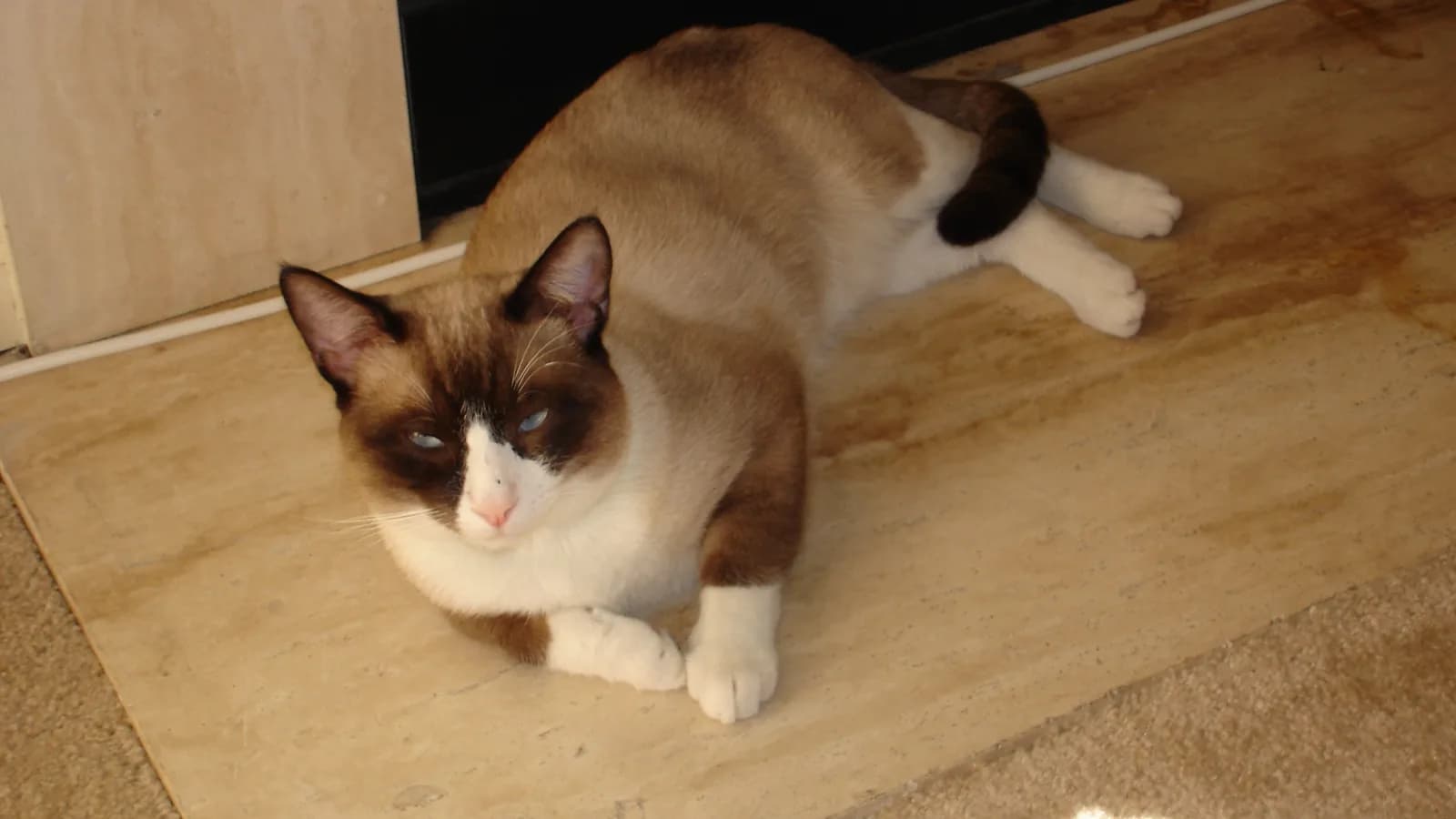
 Snowshoe photos
Real photos, so you can see what the breed actually looks like: coats, ear tufts, ruff and build.
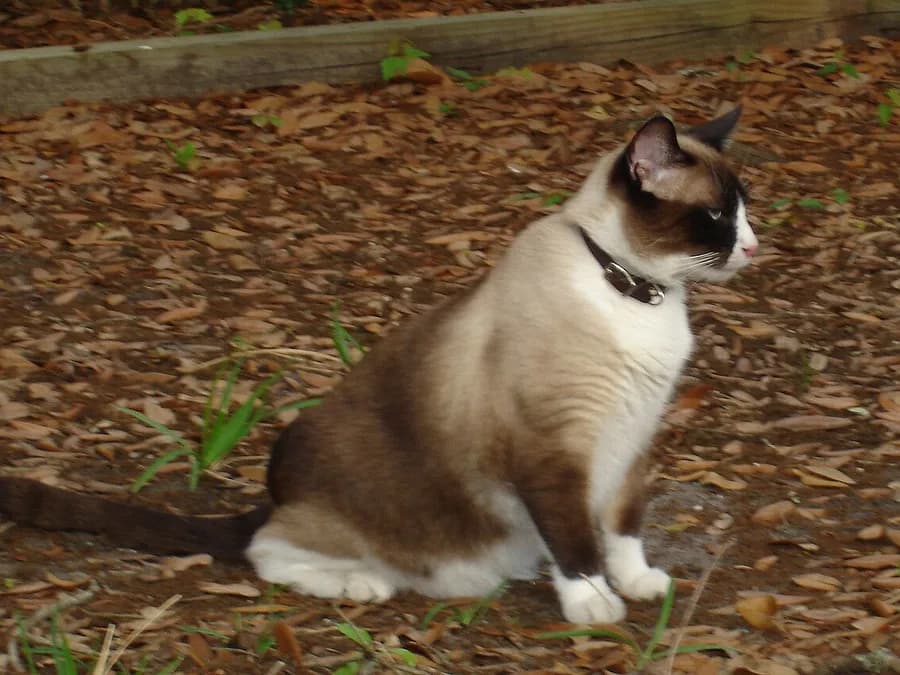
Seal point Snowshoe with white paws sitting outdoors on mulch, wearing a collar
Photo: Cooseman22 at English Wikipedia · CC BY 2.5 · via Wikimedia Commons
 Vital stats
Origin
United States
Philadelphia, early 1960s: breeder Dorothy Hinds Daugherty found white-booted kittens in a Siamese litter and built a breed around the look, crossing to the American Shorthair. , and ACFA tell the same founding story independently. The pattern's genetic randomness nearly ended the project. By 1977 the breed was down to a single active breeder. TICA loosened its pattern rule in 1993, then granted championship status in 1994.
Weight
Female
7-10 lb (3.2-4.5 kg)
Male
9-12 lb (4.1-5.4 kg)
Life expectancy
's clean, unqualified claim anchors the band: 15 to 20+ years. 's own single page states two different ranges with no explanation: a quick-facts box saying 14-20, and a narrative saying about 9 to 15. That internal disagreement we publish side by side rather than resolve (confirmed three separate times against the live page). All of these are commonly cited estimates: no measured study exists, and the Snowshoe is measurably absent from every major mortality cohort this site has ever used, in five countries.
Coats
Seal point & white
Blue point & white
Chocolate point & white
Lilac point & white
Four point colors (seal, blue, chocolate, lilac) under the breed's defining white pattern: four white boots, ideally a white inverted V on the muzzle. The pattern is probabilistic and cannot be bred to a fixed target, the fact the breed's own history turns on. Blue eyes always.
Understanding the coats (and their genetics)Size
The circulating figure is 7-12 lb, sex-split as males 9-12 lb (4.1-5.4 kg) and females 7-10 lb (3.2-4.5 kg) per TICA's box, matching GCCF's narrative word for word. The honest caveat: that is one text reproduced across two registries' pages, not two independent measurements. And NO measured weight study of any kind exists for this breed anywhere in the veterinary literature we could reach. It is absent from every multi-breed body-weight cohort this site has ever used. The absence is itself the finding.
Did you know
By 1977 the Snowshoe was down to one active breeder on Earth, because its defining white pattern refuses to breed true. The registries' own documents tell the near-extinction openly. The same genetic coin-flip still decides every litter today.
 Personality
 Affection5/5
 Energy4/5
 Intelligence4/5
 Friendliness5/5
 Independence2/5
 Vocal4/5
 Shedding2/5
Compatibility
 Good with children4/5
 Good with other pets4/5
 Apartment friendly4/5
Editorial ratings on our five-point scale, anchored in the registry descriptions and the measured behaviour studies cited on this profile; individual cats vary, and our members' own ratings below are the counterweight.
Still torn between this breed and another?Compare the Snowshoe trait by trait, or filter every breed by what matters to you. What our members say
What our members say
Nobody has described their Snowshoe here yet. As soon as the first profiles come in, this is where the community averages will show up: temperament, food, lifestyle.
Describe my Snowshoe Pros & cons
Strong points
- The Siamese-family charm with the fancy's most storied white pattern
- A short single coat with a weekly-pass grooming bill
- Measured family-group sociability second of 26 breed groups: a genuine people cat
- Almost no breed-specific disease literature exists: no condition is documented at a breed rate
Things to consider
- Genuinely hard to buy: countable breeder lists (four in all of Australia; four names at the UK club, one dead)
- The show pattern is a lottery even from champion parents: the white cannot be ordered to spec
- A people-glued, talkative family: wrong for empty households wanting a quiet ornament
- Canada is a structural gap: the national registry does not recognize the breed at all
 Is a Snowshoe right for you?
A present, chat-tolerant household that wants the pointed-and-white look with Siamese-family engagement. One patient enough for a genuinely small market's waiting lists, and that cares more about the cat than the show band its white happens to land in.
Is the Snowshoe right for YOUR home?
Answer a few questions and we'll email you your personalized result.
Take the quiz · 2 min Getting to know the Snowshoe
Start with a litter that broke the rules. In early-1960s Philadelphia, Dorothy Hinds Daugherty's Siamese threw kittens with white boots: a fault by every Siamese standard and, she decided, a breed by itself. Crossed to the American Shorthair, the look became the Snowshoe. Pointed, blue-eyed, four white boots and a white inverted V, on a frame rounder than the Siamese wedge.
The pattern is the plot. White spotting is probabilistic: a litter spans too-little to too-much white, and no breeder can order the target. The registries' own documents narrate the consequence. One active breeder left by 1977. loosening its pattern rule in 1993, championship in 1994. Our colors page tells the whole story, including the one number any registry commits to ('s not-more-than-one-third white).
What the breed formally is, because the nickname confuses everyone: files the Snowshoe in Category IV, Domestic Hybrid Breeds, a FULL championship tier, with the Siamese and American Shorthair as its only accepted parental breeds and a three-clean-generation rule. "Snowshoe Siamese" is the breed's own honest nickname, not a separate category, and our comparison page walks the difference precisely. The recognition map is unusually clean and six-way. TICA and and yes. does not currently register it. Canada's does not recognize it at all, and that last fact is why the Canadian market has no prices (the market file).
The research file is an honest near-absence. No measured weight study, no mortality cohort anywhere carrying the breed, and a health literature of essentially one two-cat case report. We publish those absences as findings, and the practical translation is ordinary good cat care rather than breed-specific dread. If your cat merely LOOKS like all this, the identification page explains why the boots alone prove nothing and the papers prove everything.
 Health: what to watch for
A few predispositions are well documented. The good news: they can be screened for or avoided by choosing a reputable breeder and keeping an eye on the right signals.
This is information, not veterinary advice, and it cannot tell you what is wrong with your cat. Our rule is a simple one: if something is wrong with your cat, call your vet, and call an emergency clinic if it is out of hours. Nothing you read here is a reason to wait.
The honest headline: almost no breed-specific literature exists
LOWThe Snowshoe is absent from every major multi-breed mortality and morbidity cohort this site has ever used, across five countries. Its breed-named research file is essentially one small case report. That is not a certificate of invincibility, it is an absence of data. The practical translation: ordinary preventive care, a good vet relationship, and scepticism toward any page quoting you a Snowshoe disease rate, because none exists.
PKD screening: GCCF's ancestry-based recommendation, precisely scoped
LOWGCCF's breed page names PKD in one sentence. Its own fuller Breeding Policy explains the recommendation is ancestry-based, stating the breed is "not affected by these diseases at present." Neither UC Davis VGL nor Langford names the Snowshoe on its own testing lists. The correct reading: a breeder-paperwork precaution rooted in outcross ancestry, not a measured breed risk.
Our full guide on this topicA single case report: inherited axonal neuropathy, two cats
LOWThe one breed-named finding in the literature is a report of two related young cats with a suspected inherited axonal neuropathy that stabilised without treatment. Two cats is the entire evidence base, and this row states the sample size in the same sentence as the finding, per our health rules. Any gait or weakness change in any cat is a vet visit, never a breed diagnosis.
The pointed-family visual wiring, scoped honestly
LOWGCCF names squint and nystagmus for colourpoint cats generally. The underlying mechanism (temperature-sensitive pigment enzyme, altered optic-nerve crossing) is established in the peer-reviewed literature for the Siamese specifically, and has never been separately measured in Snowshoes. A lifelong developmental squint in a pointed cat is a recognized family trait. Anything sudden-onset is a different matter and a vet visit.
Go deeper on health
Prevention, warning symptoms, costs and insurance: our guides, researched and sourced.
 Grooming & living with one
Grooming
A light weekly pass covers the short, single-layer coat. It carries no noticeable undercoat, by three registries' agreement. No registry publishes a bathing interval or shedding rating, an absence we report rather than fill.
Living together
The family data and every registry portrait agree on a sociable, people-seeking cat. It does well with considerate children and cat-friendly pets, and poorly with absence. Expect commentary. The softer-voice reputation is consistent folklore, never a measurement.
 Food & diet
No breed-specific feeding guidance exists anywhere: every source gives the Snowshoe one generic sentence, and we say so. The general framework applies: a complete diet, portioned to body condition. The resting-energy arithmetic for the breed's own circulating weight band runs roughly 163-248 kcal/day, and your vet, not a webpage, adjusts the number for the individual cat.
 Price & budget
$350 to 3,500
Price of a kitten from a registered breeder, in the United States
This price reflects the quality of the breeding program: parents' health tests, registry pedigree, socialization. A very low price should raise a red flag. The real cost, though, plays out over the years.
Find a verified breederKitten price, by market
United States
$350 to 3,500
United Kingdom
£950 to 1,250
Australia
A$1,800 to 2,200
Each figure is that country's real market price, researched separately, not a conversion of the others. The smaller line is only there so you can gauge one against your own money: European Central Bank reference rates of 2026-09-18, refreshed daily.
Work out your food budget
Type of food
Estimated monthly budget
$14
≈ 2.4 oz (68 g) per day
A ballpark figure, food only, using the same arithmetic as our portion tool (resting energy requirement × 1.2, a neutered adult). Real needs vary with age, activity level and body condition. Ask your veterinarian for advice.
 Verified catteriesThe registry-checked directory, plus a kitten alert near you. Filter it by breed.
 Should you insure a Snowshoe?
Our sources list several predispositions in the Snowshoe: The honest headline: almost no breed-specific literature exists, PKD screening: GCCF's ancestry-based recommendation, precisely scoped, A single case report: inherited axonal neuropathy, two cats, among others. A predisposition is not a foregone conclusion, and many of these cats live their whole lives without ever developing anything. It does change the nature of the follow-up, though: you monitor, sometimes for life, and it's that monitoring that weighs on a budget, more than a one-off accident.
One thing to weigh before deciding: this is a cat you will live alongside for well over a decade, and that is the span the real cost is spread across, premiums and care alike. Where a breed has a measured life expectancy that differs from the figure usually quoted, we say so in the lifespan section above rather than repeating the quoted one here.
 Snowshoe cats in our community
No Snowshoe here yet
Got one? Add a photo and yours gets to open this page.
 The vet's take
Veterinary review
Are you a vet?
Your professional read belongs here: every verified practitioner can leave a note, published once our editors have reviewed it.
Sign in and get your license number verified. We check it in the public register, we never ask for or keep a copy of your diploma, and your number is never published.
 Frequently asked questions
+What is a Snowshoe cat?
A pointed, blue-eyed breed defined by white markings (four boots, ideally a white inverted V on the muzzle), built in 1960s Philadelphia from Siamese and American Shorthair crosses and recognized by TICA since 1994 as a full Category IV breed.
+Are Snowshoe cats rare?
Countably: two independent sources agree Australia has exactly four active breeders, the UK breed club lists four names (one a dead domain), and Canada's registry does not recognize the breed at all. The market runs on waiting lists.
+How long do Snowshoe cats live?
No measured study exists: the breed is absent from every mortality cohort we use. TICA's claim is 15 to 20+ years; GCCF's own page states both 14-20 and 9-15 in different sections, a disagreement we publish rather than resolve.
+How much does a Snowshoe cat cost?
US named catteries run $1,500 to $3,500 with a $350-1,000 unregistered pet tier; the UK's twice-confirmed purebred line is £950; Australia's one published list says A$1,800-2,200 (dated 2023); Canada has no published price because its registry does not recognize the breed.
+Is a Snowshoe Siamese a separate breed from a Snowshoe?
Same cat: "Snowshoe" is the registered name, "Snowshoe Siamese" the everyday nickname describing its ancestry. Our comparison page covers what actually separates it from the Siamese.
+Are Snowshoe cats hypoallergenic?
No cat is, and the Snowshoe has never been measured for allergen production at all: two targeted literature searches return zero studies. Our dedicated page carries the honest file.
+Was Grumpy Cat a Snowshoe?
Unproven either way, and we hedge exactly as the sources do: her own family called her a mixed breed and guessed Snowshoe as one of several possibilities. No papers ever existed, which, as our identification page explains, is precisely why nobody can say.
+Is my white-booted pointed cat a Snowshoe?
Not provably by looks: white spotting lands boots on ordinary pointed cats by chance, and the breed is defined by its three-clean-generation pedigree. Without papers, the honest name is a pointed bicolor domestic, and a lovely one.
+Do Snowshoe cats talk as much as Siamese?
Every source says less, more softly; no study has ever scored it. What IS measured is the family group's sociability, second of 26 breed groups, so expect a people-glued commentator either way.
+What do Snowshoe cats eat?
Nothing breed-specific: no source anywhere publishes a Snowshoe feeding requirement, so ordinary complete-diet, portion-controlled feeding applies, with your vet tuning amounts to the individual cat's body condition.
 Community questions
Got a question this page doesn't cover? Ask it: the best ones get published here with their answer.
Sources & references
Data checked against reference sources (TICA and CFA standards, genetics laboratories, veterinary schools).
- TICA: Snowshoe breed page
- TICA Snowshoe Breed Introduction (PDF)
- TICA Registration Rules (Category IV; the parental-breed and three-generation rules)
- GCCF: Snowshoe breed page (both lifespan figures; the 1/3-white number)
- GCCF Snowshoe Standard of Points (PDF)
- GCCF Snowshoe Breeding Policy (PDF, the recognition timeline)
- ACF Snowshoe standard (PDF, 2020)
- CCA-AFC breed standards index (no Snowshoe: the Canadian gap)
- Mikkola et al. 2021, behaviour traits (the pooled family group's sociability rank)
- Cornell Feline Health Center: hairballs (the general mechanism)

Worth keeping a paw on
Pin this profile
To compare later, or to show someone still torn between two breeds. One click and it sits in your board.
Pin it on Pinterest
 Purr or Pass
Still deciding? Find the perfect breed for your home.
A quick quiz that factors in your lifestyle, your kids and your other pets.
Which breed fits my home?Keep exploring
The floor belongs to our members. Keep it kind, links are not allowed, and images go through moderation before anyone else sees them.