

Ocicat
“The wild look with zero wild DNA”
 By Priya · The careful one
Published August 21, 2026Updated August 26, 20267 min read
Contents
 Ocicat photos
Real photos, so you can see what the breed actually looks like: coats, ear tufts, ruff and build.
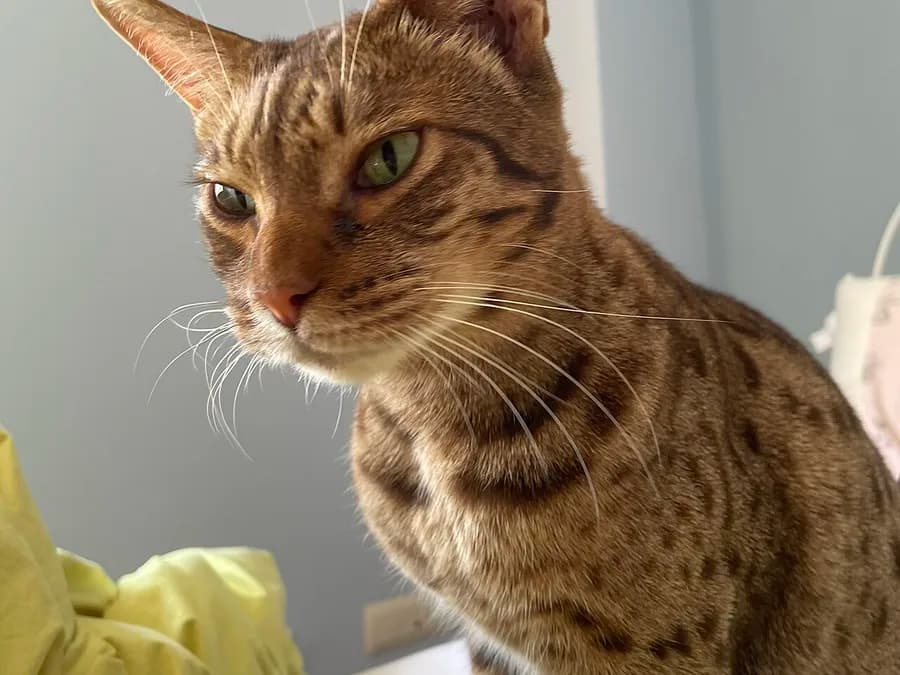
Brown spotted Ocicat close up, green eyes and dark tabby markings on the face
Photo: Ljhlusko · CC0 · via Wikimedia Commons
 Vital stats
Origin
United States
Berkley, Michigan, 1964, entirely by accident. Breeder Virginia Daly was aiming for an Abyssinian-pointed Siamese when a spotted, ivory kitten named Tonga appeared in the litter. Her daughter thought he looked like a baby ocelot, and the name stuck. Geneticist Dr. Clyde Keeler encouraged the project, and an American Shorthair outcross later added build and silver. Bred from Abyssinian, Siamese and American Shorthair only: no wild ancestry whatsoever, a fact , and each state in their own words.
Weight
Female
6-9 lb (2.7-4.1 kg)
Male
9-14 lb (4.1-6.4 kg)
Life expectancy
No measured life-expectancy study exists for this breed, and we say so rather than inventing one. The 12-18 band spans the registries' and consumer sources' commonly cited estimates, none of them measured. The one genuinely measured figure available is a mortality RATE, not a lifespan: Egenvall 2009's Swedish insured-cat cohort recorded 378 deaths per 10,000 cat-years (CI 76-681, 51 deaths) for the breed group. We label that rate as exactly that, and never convert it into an implied years figure.
Coats
Tawny spotted
Chocolate spotted
Cinnamon spotted
Blue spotted
Lavender spotted
Fawn spotted
Twelve coats, all spotted: six bases (tawny, chocolate, cinnamon, blue, lavender, fawn), each also silvered. The naming splits by registry ('s Lavender is 's Lilac; Ebony Silver vs Black Silver; TICA's own 'Brown (Black)' outlier label). No red, cream or anywhere: five registries exclude them for the same stated sex-linked-gene reason. In Britain, the classic-tabby version is its own registered breed, the Ocicat Classic.
Understanding the coats (and their genetics)Size
The registries' judged trait is qualitative, and unusually unanimous: five full standards give NO numeric weight anywhere, converging instead on 'surprisingly heavy for its size', dense muscle over raw dimensions. Where consumer pages do give numbers, they disagree with themselves (TICA's box says roughly 8-12 lb unisex; TICA's own narrative and most consumer sources say roughly 6-15 lb, split about 6-9 lb females / 9-14 lb males). And NO measured weight study exists anywhere to referee: a first on this site, and stated as the finding it is. The qualitative convergence leads; the numbers are attributed detail.
Did you know
The Ocicat and the ocelot share a look and nothing else: different genera, and even a different chromosome count (38 versus 36). That is why, out of forty-plus documented wild-domestic cat crosses, an ocelot hybrid has never even been attempted. The name was coined by the founding breeder's daughter, who thought kitten Tonga looked like a baby ocelot.
 Personality
 Affection5/5
 Energy5/5
 Intelligence5/5
 Friendliness4/5
 Independence1/5
 Vocal3/5
 Shedding2/5
Compatibility
 Good with children4/5
 Good with other pets4/5
 Apartment friendly3/5
Editorial ratings on our five-point scale, anchored in the registry descriptions and the measured behaviour studies cited on this profile; individual cats vary, and our members' own ratings below are the counterweight.
Still torn between this breed and another?Compare the Ocicat trait by trait, or filter every breed by what matters to you. What our members say
What our members say
Nobody has described their Ocicat here yet. As soon as the first profiles come in, this is where the community averages will show up: temperament, food, lifestyle.
Describe my Ocicat Pros & cons
Strong points
- The wild theatre with zero wild DNA and therefore zero hybrid-ownership law anywhere
- Dog-like by four registry accounts: fetch, voice commands, trainability
- A wash-and-wear spotted coat: low grooming by every source read
- One of the fancy's best origin stories: an accident in Michigan, 1964
Things to consider
- Poor tolerance for being left alone: every registry warns it independently
- No measured study exists for weight, lifespan OR temperament: the file is registry consensus, stated honestly
- Genuinely hard to buy outside the US: zero marketplace listings in three countries on our research date
- A busy, athletic cat that needs play and vertical space, not a decorative one
 Is an Ocicat right for you?
A present, playful household that wants a trainable, dog-adjacent spotted athlete without the Bengal's legal file, and can promise company. Every registry independently warns this breed against empty homes. Renters in hybrid-strict buildings, note the advantage: no wild ancestry means no paperwork anywhere.
Is the Ocicat right for YOUR home?
Answer a few questions and we'll email you your personalized result.
Take the quiz · 2 min Getting to know the Ocicat
Start with the accident. Berkley, Michigan, 1964: Virginia Daly crosses toward an Abyssinian-pointed Siamese, and the litter delivers Tonga, spotted and ivory, looking like nothing she was aiming for. Her daughter says he looks like a baby ocelot. Geneticist Clyde Keeler urges the line onward, and an American Shorthair cross later adds bone and silver. Every wild-looking inch of the result is built from three domestic breeds, a fact , and each volunteer in their own words. And our ocelot page turns into the best trivia in the silo: the ocelot is so unrelated that no hybrid was ever even attempted, chromosomes 38 against 36.
The honest absences ARE the profile. No measured weight study exists (the registries' own judged trait is 'surprisingly heavy for its size', and their consumer numbers disagree with their own boxes). No measured lifespan study exists (the one measured figure is a Swedish mortality RATE, labeled as such on this page). No behavioural study has ever measured the breed (the dog-like portrait is four registries' consensus, stated as consensus). This site's value on a breed like this is precisely saying what is measured and what is not. Almost nothing is, and now you know.
The color chart hides two good stories: a naming split no two registries resolve the same way, and Britain's structural surprise, where the classic-tabby Ocicat is a whole separate registered breed with its own overstamp mechanic (the colors page has both). The market is thin and breeder-direct (the price file): four named US catteries, one Canadian, two Australian, and a British waiting list.
Against the Bengal, the comparison everyone eventually wants: same jungle wardrobe, opposite . The difference decides the spots, the history and the law. The comparison page walks it with the registries' own field guide.
 Health: what to watch for
A few predispositions are well documented. The good news: they can be screened for or avoided by choosing a reputable breeder and keeping an eye on the right signals.
This is information, not veterinary advice, and it cannot tell you what is wrong with your cat. Our rule is a simple one: if something is wrong with your cat, call your vet, and call an emergency clinic if it is out of hours. Nothing you read here is a reason to wait.
PK deficiency: a three-way institutional tension, stated plainly
MODERATEThe full picture in one row. The discovery research recommends testing on ancestry grounds (the Abyssinian founder line). Britain's GCCF has MANDATED the DNA test since 2006. The main US reference laboratory does not currently list the Ocicat among breeds it tests for. And the one measured sample found zero carriers among 69 cats (which is evidence of scarcity, not proof of absence). The buyer's translation: ask a breeder for the parents' PK status, and let the paperwork answer.
HCM, amyloidosis and PRA: registry-named, never measured
MODERATEThese three appear as registry-stated concerns to raise with a breeder, and no population prevalence rate exists for any of them in this breed specifically. They are conversation items for a breeder (what do you screen for, and when) and for your vet, not statistics, because the statistics have never been collected.
Our full guide on this topicThe honest structural note: almost nothing is measured
LOWThis breed has no measured weight study, no measured lifespan study, and no behavioural study row anywhere: more well-documented absences than nearly any breed on this site. The practical meaning is ordinary: routine preventive care, a good vet relationship, and scepticism toward any page quoting Ocicat-specific rates, because none exist. Anything wrong with your cat means call your vet; out of hours, an emergency clinic.
Go deeper on health
Prevention, warning symptoms, costs and insurance: our guides, researched and sourced.
 Grooming & living with one
Grooming
Among the easiest coats on this site: short, satin, low-shedding, covered by a weekly hand or rubber-mitt pass. The general shorthair guidance (Cornell, iCatCare) applies as written. Nothing breed-specific exists, because nothing needs to.
Living together
Registry-described as sociable with children, dogs and other cats, and demanding of engagement. No measured study checks any of it, which we state rather than hide. The one unanimous line: it does not tolerate being left alone for long periods. So a companion animal or a present household is part of the deal.
 Food & diet
No breed-specific feeding science exists. The general framework applies: a complete diet, portions matched to a genuinely athletic activity level, body condition checked at the vet. Any weight-management decision belongs to your vet, not a webpage.
 Price & budget
$700 to 1,700
Price of a kitten from a registered breeder, in the United States
This price reflects the quality of the breeding program: parents' health tests, registry pedigree, socialization. A very low price should raise a red flag. The real cost, though, plays out over the years.
Find a verified breederKitten price, by market
United States
$700 to 1,700
United Kingdom
£250 to 500
Canada
CA$2,500
Australia
A$2,000 to 2,800
Each figure is that country's real market price, researched separately, not a conversion of the others. The smaller line is only there so you can gauge one against your own money: European Central Bank reference rates of 2026-09-18, refreshed daily.
Work out your food budget
Type of food
Estimated monthly budget
$14
≈ 2.4 oz (68 g) per day
A ballpark figure, food only, using the same arithmetic as our portion tool (resting energy requirement × 1.2, a neutered adult). Real needs vary with age, activity level and body condition. Ask your veterinarian for advice.
 Verified catteriesThe registry-checked directory, plus a kitten alert near you. Filter it by breed.
 Should you insure an Ocicat?
Our sources list several predispositions in the Ocicat: PK deficiency: a three-way institutional tension, stated plainly, HCM, amyloidosis and PRA: registry-named, never measured, The honest structural note: almost nothing is measured. A predisposition is not a foregone conclusion, and many of these cats live their whole lives without ever developing anything. It does change the nature of the follow-up, though: you monitor, sometimes for life, and it's that monitoring that weighs on a budget, more than a one-off accident.
One thing to weigh before deciding: this is a cat you will live alongside for well over a decade, and that is the span the real cost is spread across, premiums and care alike. Where a breed has a measured life expectancy that differs from the figure usually quoted, we say so in the lifespan section above rather than repeating the quoted one here.
 Ocicat cats in our community
No Ocicat here yet
Got one? Add a photo and yours gets to open this page.
 The vet's take

Veterinary review
Are you a vet?
Your professional read belongs here: every verified practitioner can leave a note, published once our editors have reviewed it.
Sign in and get your license number verified. We check it in the public register, we never ask for or keep a copy of your diploma, and your number is never published.
 Frequently asked questions
+What is an Ocicat?
A fully domestic spotted breed built from Abyssinian, Siamese and American Shorthair, created by accident in Michigan in 1964 and bred to wear the ocelot's look with zero wild ancestry, a fact its registries state in their own words.
+Is the Ocicat part ocelot or part wild cat?
No: different genera, different chromosome counts (38 vs 36), and no ocelot hybrid has ever even been attempted. The name is a family joke that stuck; our ocelot page tells the whole story.
+How much does an Ocicat cost?
US named catteries run $700 to $1,700; the UK is a from-£250 waiting-list market; Canada's one named cattery charges CA$2,500; Australia's two named breeders charge A$2,000 to A$2,800. Our price page carries every source and date.
+How big do Ocicats get?
Honestly: nobody has measured it, and the registries' own judged trait is qualitative, 'surprisingly heavy for its size'. Their consumer pages disagree between roughly 6-15 lb overall; we publish the disagreement rather than fake a precise number.
+How long do Ocicats live?
No measured lifespan study exists; circulating estimates run roughly 12-18 years, none of them measured, and the one measured figure in the literature is a Swedish mortality rate we refuse to dress up as a years figure.
+Are Ocicats good pets?
By four registries' consistent account: dog-like, trainable, fetch-playing and people-oriented, with one unanimous warning: they tolerate being left alone poorly. No independent study has measured the breed's temperament, which we say rather than hide.
+Are Ocicats rare?
Outside the US, measurably: zero marketplace listings in three countries on our research date, one named Canadian cattery, and a British waiting-list economy. Inside the US, findable breeder-direct.
+Are Ocicats hypoallergenic?
No cat is, and no Fel d 1 study exists for this breed specifically: an honest absence. The short coat is easy to live with; that is a grooming fact, not an allergy category.
+Is the Ocicat legal to own?
Everywhere in our four markets, without exception: no wild ancestry means no hybrid-ownership law applies, the clean legal difference from early-generation Bengals and Savannahs.
+Is an Ocicat the same as an Egyptian Mau?
No: both are spotted and fully domestic, but they are separate breeds with separate histories, and the popular claim that a failed Mau-breeding attempt 'became the Ocicat' is uncorroborated and contradicted by four independent accounts of the Ocicat's own origin.
 Community questions
Got a question this page doesn't cover? Ask it: the best ones get published here with their answer.
Sources & references
Data checked against reference sources (TICA and CFA standards, genetics laboratories, veterinary schools).
- TICA: Ocicat breed page
- CFA: Ocicat breed page
- CFA: Spots Before Your Eyes? (the three-breed comparison article)
- GCCF: Ocicat breed page
- GCCF Ocicat registration policy 2024 (PDF)
- GCCF Ocicat & Aztec breeding policy (PDF)
- ACF Ocicat standard (PDF, 2020)
- CCA-AFC Ocicat standard (PDF)
- Egenvall et al. 2009, Swedish insured-cat mortality (the rate, labeled as a rate)
- UC Davis VGL: PK deficiency test page
- VCA Hospitals: Ocicat
- Cornell Feline Health Center: choosing and caring for your new cat

Worth keeping a paw on
Pin this profile
To compare later, or to show someone still torn between two breeds. One click and it sits in your board.
Pin it on Pinterest
 Purr or Pass
Still deciding? Find the perfect breed for your home.
A quick quiz that factors in your lifestyle, your kids and your other pets.
Which breed fits my home?Keep exploring
The floor belongs to our members. Keep it kind, links are not allowed, and images go through moderation before anyone else sees them.