

HCM in Cats: The Silent Heart Disease, Staged and Explained
The most common heart disease of cats is usually silent. The ACVIM stages in plain words, the breathing rate to count at home, and what the studies measured.

Published August 26, 2026Updated September 8, 2026 6 min read
Contents
Hypertrophic cardiomyopathy, to everyone who deals with it, is the most common heart disease of cats, and its defining habit is silence. In the largest screening study of apparently healthy cats, 780 screened at UK rehoming centers, 14.7% had HCM and did not know it, so to speak. That study was built to test an earlier US pilot's guess of 15%, and confirmed it almost exactly.
This page translates what the cardiology consensus actually says: the stages, the signs worth acting on, the one number you can watch at home, and what the genetic tests do and do not answer.
What HCM is, and the stages your vet is using
thickens the wall of the heart's main pumping chamber. The thickened muscle fills less and relaxes worse, and the trouble that follows comes in three forms we cover below.
The 2020 ACVIM consensus statement, the cardiologists' shared rulebook, stages every cat like this:
| Stage | What it means | What generally follows |
|---|---|---|
| A | a predisposed cat, no disease found | screening, nothing more |
| B1 | present, no signs, LOW risk of imminent trouble | no treatment in general; annual recheck |
| B2 | present, no signs, HIGHER risk (enlarged atrium) | clot prevention is recommended |
| C | signs have happened: heart failure or a clot | treatment, lifelong |
| D | heart failure resisting treatment | specialist territory |
The plain-language version of the B1/B2 split, which most pages skip, is the part owners actually need: a B1 diagnosis usually means no drug at all and a recheck in a year, while a B2 diagnosis means the clot-prevention conversation starts now.
Why it stays silent
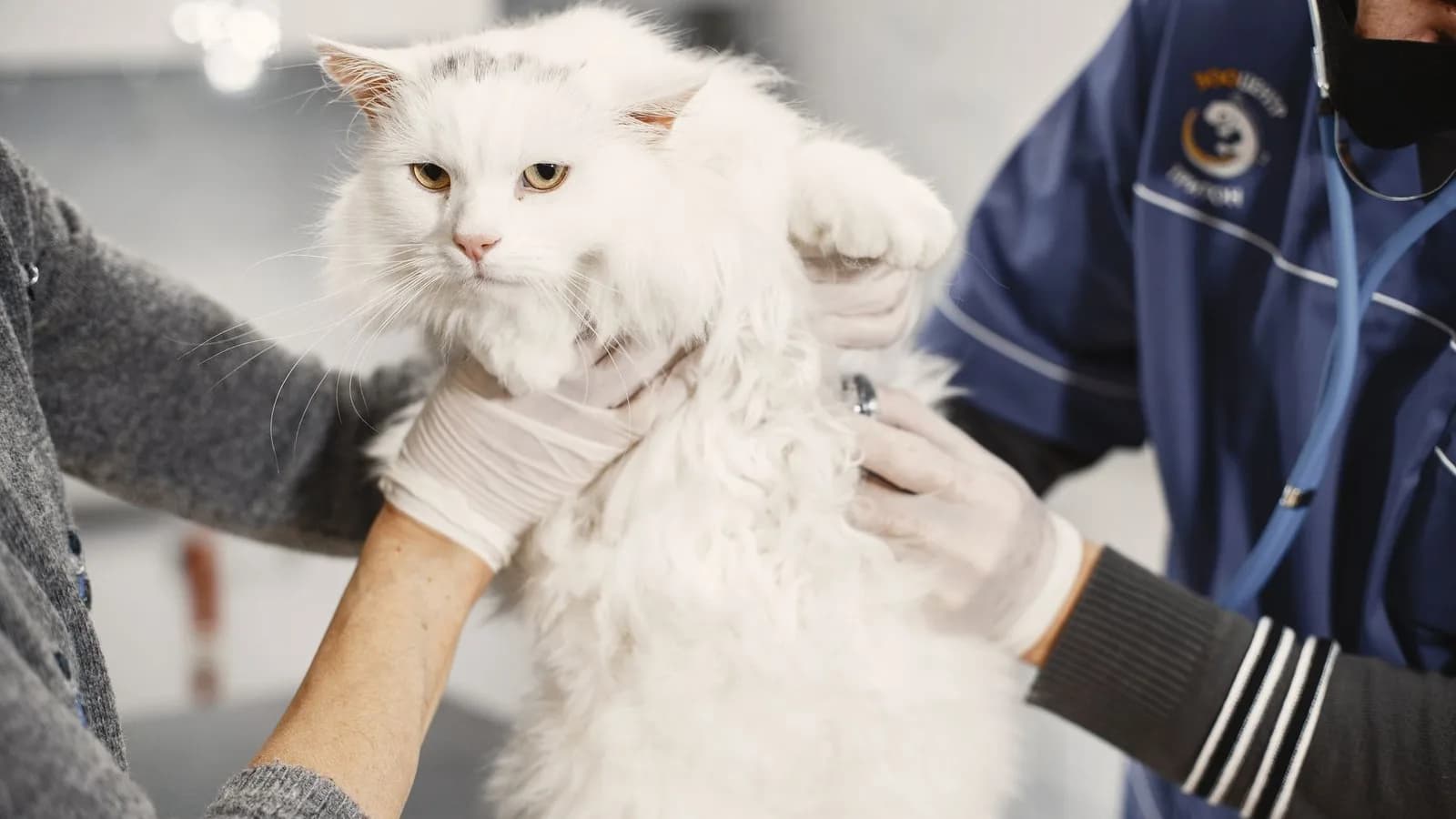
You might expect a heart disease to announce itself through the stethoscope. Both directions of that assumption fail, per the consensus: up to 80% of cats with subclinical have a murmur, but 30 to 45% of perfectly healthy cats have one too, and cats with advanced disease may have no murmur at all.
The sharpest number on this silence comes from the trial that studied cats after a clot event: only 15% of them had any known heart disease diagnosis before the day it happened. For the other 85%, the emergency was the first news.
The three ways HCM shows itself
Congestive heart failure is the most common: fluid builds in or around the lungs. What an owner sees is labored or rapid breathing, open-mouth breathing, lethargy. In the emergency room, a breathing rate above 80 per minute is one of the flags that points to heart failure over other causes.
A clot, called arterial thromboembolism (), and in everyday language a : a clot leaves the heart and blocks the blood supply, most often to the back legs. Sudden hind-leg paralysis or dragging, with real pain and cold paws, is the picture. This is an emergency, hour by hour. The UK charity puts survival of the initial event at about one in three; that is their figure, from their February 2026 page, and it is the honest scale of the thing.
Sudden death is the third and rarest presentation. In one referral series it accounted for 24% of the cardiac deaths.
When to call the vet: open-mouth breathing or hind-leg paralysis is an emergency; labored breathing, rapid breathing at rest, or new lethargy is a same-day call.
The one number you can watch at home
For a cat diagnosed with heart disease, the consensus gives owners a concrete job: count the sleeping breathing rate, and keep it under 30 breaths a minute. The study behind that threshold measured healthy cats and cats with subclinical heart disease at a median around 21; crossing 30 repeatedly is what warrants a call.
How to count it, per the Cardiac Education Group's owner handout:
- Wait until the cat is sleeping, or resting calmly. Not purring; purring ruins the count.
- One breath is the chest moving in and out once.
- Count breaths for 30 seconds, timed on your phone.
- Double it. That is breaths per minute.
Between 15 and 30 is the normal band. Consistently above 30, call your vet; above 30 with labored effort or any of the signs above, treat it as urgent.
How it is diagnosed
Echocardiography, an ultrasound of the heart, is the standard, and Cornell adds a caveat worth repeating: other conditions thicken the heart wall too, notably high blood pressure and hyperthyroidism, and they must be ruled out before is named.
The blood test has a narrower job than its marketing suggests: the consensus rates it useful for telling cardiac from non-cardiac causes of breathing distress, and explicitly not recommended for separating normal cats from mildly affected ones. A positive result is never an answer; it is a reason for an echo.
Genetics, breeds, and what a negative test does not mean
The consensus names the predisposed breeds in one line: Maine Coon, Ragdoll, British Shorthair, Persian, Bengal, Sphynx, Norwegian Forest and Birman, while noting most cats with are ordinary non- cats.
Two DNA tests exist, and only two: A31P for the Maine Coon and R820W for the Ragdoll, both in the same gene. The consensus recommends them for breeding cats of those two breeds and recommends against running them on any other breed, because the mutations are almost completely specific to those two. And its most important sentence for a cat owner is the negative one: cats without these mutations still develop , so echo screening continues regardless of genotype. A breeder's "HCM DNA certificate" for a Sphynx or a British Shorthair is paperwork no laboratory issues; those breeds screen by ultrasound only. Our breed pages carry the carriage rates, registry rules and screening schedules in full.
What treatment can and cannot do, honestly
For the silent stages, the consensus is blunt: no drug has been shown to change the course of preclinical , and atenolol, long the reflex prescription, showed no effect on five-year survival. B1 cats are generally not treated; they are rechecked.
Where treatment has real evidence is clot prevention in higher-risk (B2) cats: in the FAT CAT trial, 75 cats that had survived a clot event, beat aspirin at preventing the next one, with a median 443 days to recurrence against 192. That single trial is why the consensus recommends it for cats at clot risk.
On what the future holds, the longest study is REVEAL: across 1,730 cats in 21 countries, about 30% of preclinical cats went on to heart failure or a clot within 10 years, cats that developed complications survived a mean of 1.3 years after, and about 10% of preclinical cats reached 9 to 15 years. Many cats live with the quiet form for years; the numbers just refuse to promise it.
What to take away
- Hypertrophic cardiomyopathy () is the most common heart disease of cats, and it is usually silent: many affected cats have no murmur and no symptoms.
- Staging drives everything: in the REVEAL study, roughly seven in ten preclinical cats had no cardiac event 10 years on, while cats whose disease turned clinical averaged 1.3 more years.
- The DNA test only makes sense for Maine Coons and Ragdolls, covers one mutation each, and a negative does not clear the cat: is the real screen.
- The one home instrument that matters: a sleeping cat breathes 15 to 30 times a minute; a rate repeatedly above 30 is a call to the vet.
- A (sudden hind-leg paralysis, pain, cold paws) is 's most feared complication and an immediate emergency.
- There is no cure; management prevents clots in higher-risk cats and treats heart failure when it comes, and early detection is the lever owners hold.
The breeds most affected
In our breed profiles, this predisposition is documented and sourced for:
 The vet's take

Veterinary review
Are you a vet?
Your professional read belongs here: every verified practitioner can leave a note, published once our editors have reviewed it.
Sign in and get your license number verified. We check it in the public register, we never ask for or keep a copy of your diploma, and your number is never published.
Frequently asked questions
How long can a cat live with HCM?
It depends on the stage and on luck neither you nor your vet controls. In the REVEAL study, roughly seven in ten preclinical cats had not had a cardiac event 10 years on, one in ten lived 9 to 15 years, and cats whose disease turned clinical averaged 1.3 more years. Cats in stage B1 are rechecked yearly, not written off.
Is there a cure?
No. Management aims to prevent clots in higher-risk cats and to treat heart failure when it comes. The one honest lever owners hold is early detection and the breathing-rate habit.
Should my cat get the HCM DNA test?
Only if it is a Maine Coon or a Ragdoll, and even then a negative does not clear the cat: the tests cover one mutation each, and echo remains the real screen. For every other breed the consensus recommends against the test outright.
What is a saddle thrombus?
The everyday name for a clot blocking the blood supply to the back legs: sudden paralysis, pain, cold paws. It is an emergency, and it is HCM's most feared complication.
What breathing rate is normal for a sleeping cat?
Between 15 and 30 breaths a minute. Count for 30 seconds while the cat sleeps (not purring), double it, and call your vet if it sits above 30 repeatedly.
 Community questions
Got a question this page doesn't cover? Ask it: the best ones get published here with their answer.
This is information, not veterinary advice, and it cannot tell you what is wrong with your cat. Our rule is a simple one: if something is wrong with your cat, call your vet, and call an emergency clinic if it is out of hours. Nothing you read here is a reason to wait.
Medical information applies to every reader. Prices, legal duties and common practice do not: unless stated otherwise, they are given for the United States, and they differ in the UK, Canada and Australia, and often between states or provinces. Check with your own vet and your own local authority.
Our sources
- Luis Fuentes et al 2020, ACVIM consensus statement on classification, diagnosis and management of cardiomyopathies in cats (read in full), J Vet Intern Med 34(3)
- Payne, Brodbelt, Luis Fuentes 2015, the CatScan study (HCM prevalence 14.7 percent, CI 12.3-17.4, 780 cats), J Vet Cardiol
- Paige et al 2009, prevalence of cardiomyopathy in 103 apparently healthy cats, JAVMA
- Fox et al 2018, the REVEAL study: 1,730 cats, 21 countries, long-term outcomes of preclinical HCM, J Vet Intern Med
- Hogan et al 2015, the FAT CAT trial: clopidogrel vs aspirin after arterial thromboembolism (75 cats), J Vet Cardiol
- Ljungvall et al 2014, sleeping and resting respiratory rates in healthy cats and cats with subclinical heart disease, J Feline Med Surg 16
- Trehiou-Sechi et al 2012, comparative echocardiographic study of HCM in 344 cats of 5 breeds, J Vet Intern Med
- Cornell Feline Health Center, hypertrophic cardiomyopathy
- PDSA, saddle thrombus (aortic thromboembolism) in cats: the one-in-three survival figure, page dated February 2026
- Cardiac Education Group, monitoring your pet's respiratory (breathing) rate, owner handout (February 2015)

Worth keeping a paw on
Pin this guide
So you can find it the day you need it, and share it with someone whose cat does the same thing. One click and it sits in your board.
Pin it on PinterestAlso worth reading
All health →
Article
Cystitis in Cats: When the Bladder Problem Is Not Really a Bladder Problem
Most feline cystitis has no infection behind it. The mechanism from stress to bladder pain, who gets it, and the two treatments with real evidence.
Read
Article
Feline Leukemia (FeLV): One Virus, Three Very Different Outcomes
An FeLV exposure is not one sentence: the three measured outcomes, the tests that tell them apart, and a vaccine answer that changes by country.
Read
Article
FIV in Cats: The Scariest Thing About It Is the Nickname
FIV spreads through deep bites and barely at all between calm housemates: zero transmissions in the landmark study. The honest prognosis, tests and vaccine story.
Read
The floor belongs to our members. Keep it kind, links are not allowed, and images go through moderation before anyone else sees them.