

Sphynx cat
“Canada's hairless cat”
 By Priya · The careful one
Published August 21, 2026Updated August 26, 202612 min read
Contents
 Sphynx photos
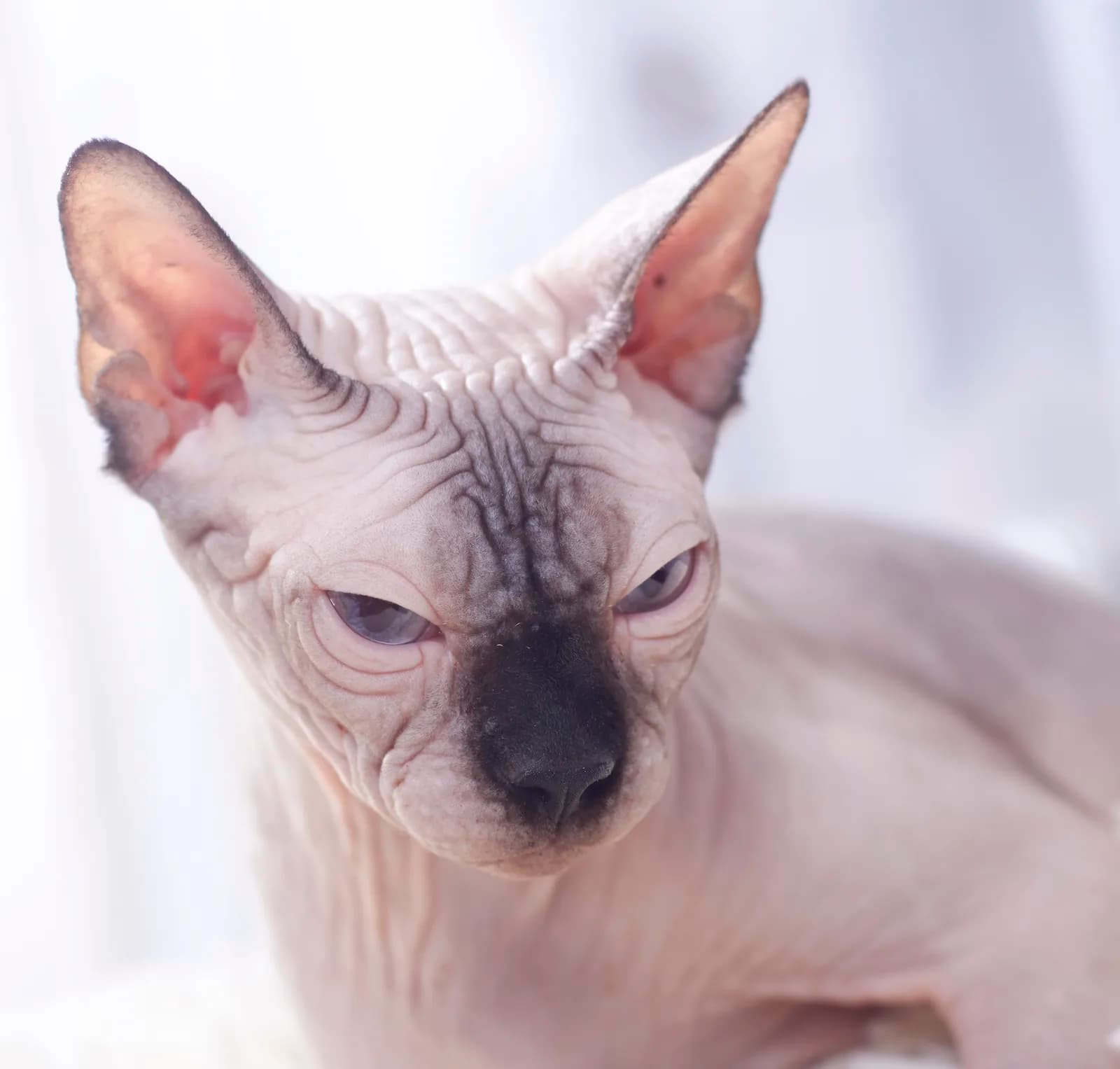
Real photos, so you can see what the breed actually looks like: coats, ear tufts, ruff and build.
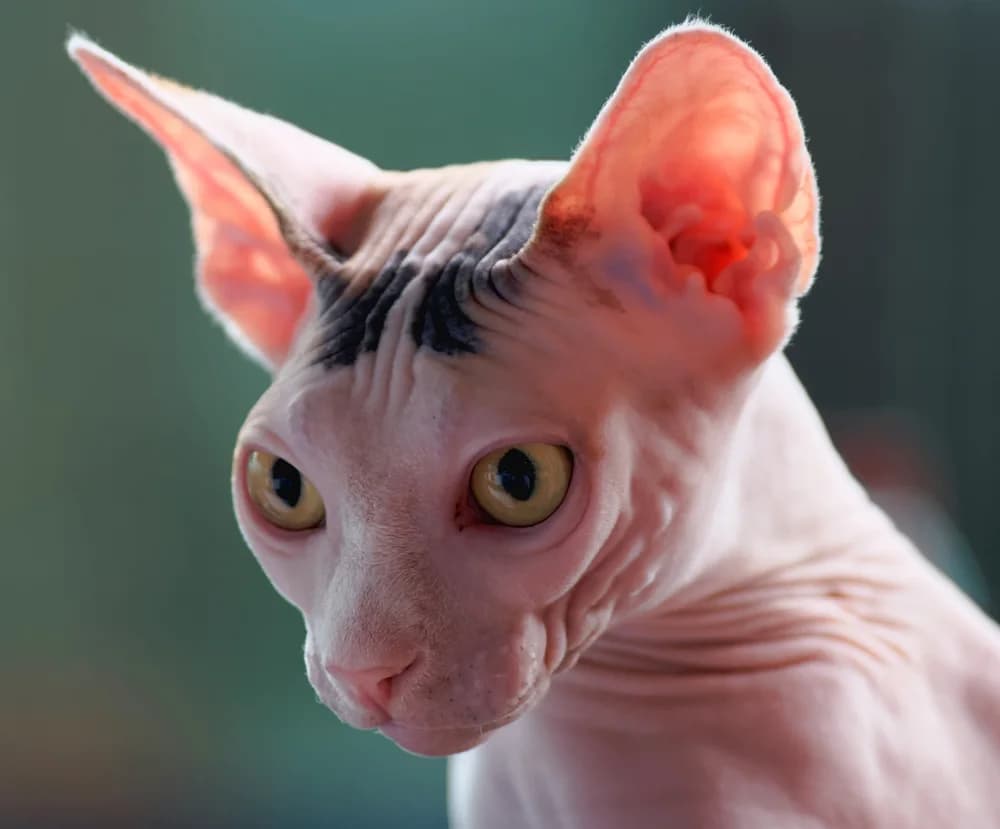
Sphynx cat standing in profile, wrinkled skin and big ears in sharp light
Photo: Jakub Hałun · CC BY-SA 4.0 · via Wikimedia Commons
 Vital stats
Origin
Canada
Toronto, Canada, 1966: a hairless kitten named Prune, born to a black-and-white domestic cat, founded the first breeding attempts. The name is a nod to a RESEMBLANCE ('s own words: physical similarities with an ancient Egyptian sphinx sculpture), not to any Egyptian ancestry. A second founding thread ran through Minnesota and Toronto natural mutations in the mid-to-late 1970s. The registries' own documents disagree on its head count, so the profile states each account as its own.
Weight
Female
7-10 lb (3.2-4.5 kg)
Male
8-12 lb (3.6-5.4 kg)
Life expectancy
The most honest lifespan section on this site, because the numbers refuse to agree. The one measured study (UK life tables, 2024) gives the Sphynx the SHORTEST life expectancy of the 12 breeds it analyzed: 6.68 years, from just 18 recorded deaths, with a wide confidence interval (4.53 to 8.83). 's own box says 7-15 years, and UK pet-content ranges run to 15.
The study's own authors flag the finding and note peer-reviewed Sphynx mortality data is scarce. The breed's documented cardiac and neuromuscular burden is plausible context, not proof. Neither number alone is the truth: the measured figure is small-sample, the ranges are uncited estimates, and the honest reading is the gap itself.
Coats
Pink (white)
Black
Blue
Red
Cream
Seal point
Mink champagne
Tortie
Every feline color and pattern, read on SKIN PIGMENT and sparse down rather than fur: solids from white to black, tabby, tortoiseshell, calico, bicolor, pointed, mink and sepia. No registry excludes a single color, and three (, , ) state color carries zero judging points. TICA's own judges' material says hairless colors are hard enough to read that DNA testing is recommended for correct registration.
Understanding the coats (and their genetics)Size
Medium, dense and warm to the touch. TICA's own box gives females 7-10 lb (3.2-4.5 kg) and males 8-12 lb (3.6-5.4 kg). Its 6-12 lb headline does not match its own sex split, so the split is the citable figure (the Maine Coon T1 precedent). Measured reference: a 2026 Thai HCM-screening cohort averaged 3.82 kg (8.4 lb) across 47 cats.
Did you know
The Sphynx is named for a statue it merely resembles. The founding kitten, Prune, was born in Toronto in 1966, and 's own history says the name came from the breed's physical similarity to an ancient Egyptian sphinx sculpture. Half a century later, "egyptian sphynx cat" still out-searches most true facts about the breed.
 Personality
 Affection5/5
 Energy4/5
 Intelligence4/5
 Friendliness4/5
 Independence2/5
 Vocal3/5
 Shedding1/5
Compatibility
 Good with children4/5
 Good with other pets4/5
 Apartment friendly5/5
Editorial ratings on our five-point scale, anchored in the registry descriptions and the measured behaviour studies cited on this profile; individual cats vary, and our members' own ratings below are the counterweight.
Still torn between this breed and another?Compare the Sphynx trait by trait, or filter every breed by what matters to you. What our members say
What our members say
Nobody has described their Sphynx here yet. As soon as the first profiles come in, this is where the community averages will show up: temperament, food, lifestyle.
Describe my Sphynx Pros & cons
Strong points
- No coat, no shedding: the grooming trade is a washcloth, not a lint roller
- Measured zero aggression toward people in the 272-cat Finnish survey rows
- A documented, named founding story (Prune, Toronto, 1966) told in the registries' own words
- The COLQ myopathy test is real, validated and commercially offered
- Every color allowed, none judged: the most permissive standard in our research
Things to consider
- The one measured life-expectancy figure is the shortest of 12 breeds studied (small sample, stated honestly)
- HCM screening means repeated echocardiograms: no valid DNA test exists despite the 2021 headlines
- A real weekly routine: oil wipes, ear wax, nail beds, sun management
- Gets cold, seeks heat sources, and burns in sun, windows included
- One of the priciest breeds, with a confusing ladder of dearer crosses above it
 Is a Sphynx right for you?
A household that wants a cat physically ON them (the warm bare skin makes lap time literal). One that can hold a weekly skin-and-ears routine without resentment, and can budget for screening rather than a paper certificate. If allergies are the reason you are here, read the hypoallergenic page first: the registry's own words are more honest than the reputation.
Is the Sphynx right for YOUR home?
Answer a few questions and we'll email you your personalized result.
Take the quiz · 2 min Getting to know the Sphynx
The Sphynx is the cat the internet cannot stop arguing about. Hairless but not quite (fine down on the nose, ears, tail and feet is normal, and the skin feels like warm suede). Egyptian in name but Canadian by every document. Marketed as hypoallergenic while its own registry admits no study backs that. And carrying both the fancy's most permissive color standard and its most contested health genetics. Almost everything interesting about this breed comes with a label, and this profile keeps the labels on.
The origin story is unusually well documented, and it starts with a kitten named Prune, born hairless in Toronto in 1966. 's history names the resemblance to an Egyptian sphinx sculpture as the source of the name; 's account agrees on Toronto and 1966. The breed's second founding thread, natural mutations in Minnesota and Toronto in the mid-to-late 1970s, is where the registries' own documents part company.
's PDF counts three cats, 's breed page two, CFA's own magazine four. So this site states each registry's account as its own rather than averaging a head count. CFA registered the breed in 1970s-era experiments, granted championship in 2002. TICA carried it from its own founding. refused the breed in 1990, saw the UK club form in 1991, and granted recognition in 2006.
The look is a study in reading color without fur. Pigment sits in the skin itself, so a black Sphynx is a charcoal-skinned cat and a tabby may keep only ghost markings on its legs. Every registry admits every color (the colors guide maps the system), and none awards points for it. 's own judging material concedes hairless colors are hard enough to call that DNA testing is recommended. That is why the black Sphynx, the most-searched color by a factor of nine, sometimes turns out to be a very dark blue on paper.
On temperament, the registry voice and the measured voice tell compatible halves. The registries sell an extrovert: attention-seeking, "overly-affectionate", a therapy-cat natural ('s claim, attributed, uncited). The measured half is quieter and arguably better. In the 8,000-cat Finnish behaviour survey, the 272 Sphynx rows report aggression toward family, strangers and other cats at or near zero, sensitivity below average, and exactly one statistically distinct trait, licking, which is grooming, not neurosis. The famous "dog-like" framing has never been tested in a published study; the low-aggression numbers have.
Health is where this profile earns its keep, because the popular version is wrong in a dangerous direction. A 2021 study did associate a gene (ALMS1) with Sphynx heart disease. Three larger follow-up studies then failed to replicate it as predictive: in the biggest, carriers and non-carriers developed at the same rate, the variant sat in over half the sampled population, and the consortium's own conclusion recommends routine gene testing only for the Maine Coon's and Ragdoll's separate mutations. No laboratory offers a Sphynx HCM test.
So a breeder claiming a "DNA-tested heart-healthy" Sphynx is selling paperwork that does not exist: real screening is an read by a cardiologist, repeated, because a New Zealand cohort watched prevalence rise from 22 to 40 percent between scans. The COLQ myopathy test, by contrast, is real and validated; ask for both parents' results. Two eye conditions carry genuine statistical weight (corneal sequestrum at eight times the odds of other cats, entropion at four, both diagnosed years younger). And a movement disorder, paroxysmal dyskinesia, is so far documented only in this breed.
Buying one is its own research project: the price guide carries named catteries in four markets, the eye-color premium, and the rule that the crosses stacked above the Sphynx (Elf, Bambino, Dwelf) cost more while holding no registry status, which the hairless breeds roundup untangles gene by gene. The welfare question deserves its plain answer. No law in the US, UK, Canada or Australia restricts breeding or owning a Sphynx.
The Netherlands now bans both breeding and, since January 2026, acquiring one, naming the breed in the regulator's own guidance: the strongest government-sourced welfare signal in our research, and honest context for a buyer anywhere. And the allergy page starts from the sentence the marketing never quotes: 's own admission that no scientific studies back the low-allergen claim.
 Health: what to watch for
A few predispositions are well documented. The good news: they can be screened for or avoided by choosing a reputable breeder and keeping an eye on the right signals.
This is information, not veterinary advice, and it cannot tell you what is wrong with your cat. Our rule is a simple one: if something is wrong with your cat, call your vet, and call an emergency clinic if it is out of hours. Nothing you read here is a reason to wait.
Hypertrophic cardiomyopathy (HCM)
Echo-screening only: no valid DNA testCommon and familial in this breed, and the only reliable screen is echocardiography by a veterinary cardiologist, repeated over the cat's life. A New Zealand cohort of 55 watched prevalence rise from 21.8% to 40% between scans a median 1.8 years apart. The 2021 ALMS1 candidate gene has NOT held up as predictive.
A Thai cohort found carriers and non-carriers equally affected, the New Zealand study found no association, and the 2024 multi-lab ACMG classification rates it a variant of unknown significance, recommending routine gene testing only for the Maine Coon's and Ragdoll's separate MYBPC3 mutations. This is a DIFFERENT gene from those breeds' tests; no laboratory offers a Sphynx HCM test.
Symptoms to spot
Often nothing early. Laboured or rapid breathing, open-mouth breathing, lethargy or sudden hind-leg pain are emergencies: call your vet immediately, out of hours an emergency clinic.
How common
21.8% rising to 40% on recheck in the one prospective cohort (n=55, New Zealand, registered-breeder recruitment); no population-wide rate exists.
Screening & prevention
Ask breeders for dated echocardiogram reports read by a cardiologist, on BOTH parents, and for open pedigree disclosure; expect to re-screen your own cat per your vet's advice.
Genetic test
None exists for this breed. An "HCM DNA certificate" for a Sphynx is paperwork no laboratory issues.
Congenital myasthenic syndrome (COLQ myopathy)
Documented, DNA-testableA hereditary muscle-weakness syndrome shared with the Devon Rex, caused by a COLQ mutation identified independently by two research groups in 2015. Unlike the HCM situation, this test is real, validated and commercially offered. The tested figures are CARRIAGE, not disease: 3.7% of an 81-cat European Sphynx panel carried one copy. Carriers are healthy, and the syndrome needs two copies.
Symptoms to spot
In an affected cat: muscle weakness worsened by exercise or excitement, a fatigable gait, swallowing difficulty or regurgitation (megaesophagus). Any of these is a prompt vet visit.
How common
Carriers: 3.7% of 81 genotyped European Sphynx (one study panel). Affected counts outside study cohorts are not published.
Screening & prevention
Both breeding cats tested; two carriers never paired. For a pet kitten, one tested-clear parent rules the disease out.
Genetic test
Yes: the COLQ DNA test, commercially offered. Ask a breeder for both parents' results.
Eye conditions: corneal sequestrum and entropion
Statistically overrepresented, young onsetThe statistically strongest findings in the breed's literature. In a 110-Sphynx referral study, corneal sequestrum (a dark, dying patch of cornea) was 8 times more likely than in other cats (OR 8.0, CI 5.3-12.2), diagnosed at 2 years old on average against nearly 6 in other cats, and recurred after surgery three times more often. Lower-eyelid entropion (the lid rolling inward against the eye) ran at 4 times the odds (OR 4.1, CI 2.3-7.1), typically before the first birthday.
Symptoms to spot
Squinting, tearing, a visible dark spot on the cornea, or a lower lid that looks rolled in: each is a vet visit, young cats included. Eye problems in this breed start EARLY.
How common
42 of 110 and 25 of 110 in one referral population (a clinic sample, not a breed-wide rate).
Screening & prevention
Ask a breeder whether either parent has needed eye surgery; have a vet check the eyelids at the first kitten visits.
Genetic test
None: these are structural/corneal conditions, screened by veterinary eye examination.
Paroxysmal dyskinesia
Rare, so far breed-specific in the literatureA movement disorder documented, so far, only in this breed: episodes of involuntary movement or posturing during which the cat stays conscious, characterised in a 2022 case series. Rare, and worth knowing about mainly so an episode is filmed and shown to a vet rather than dismissed.
Symptoms to spot
Sudden episodes of abnormal movement or posture with the cat aware throughout, resolving on their own. Film any episode and call your vet; collapse or unresponsiveness is an emergency.
How common
Case-series level only; no rate exists and none should be quoted.
Screening & prevention
No screening exists: awareness plus video documentation of any episode is the useful preparation.
Genetic test
None; diagnosis is clinical, by a veterinary neurologist.
Skin: oil, yeast and sun
Care-dependent, built into the breedBare skin changes the dermatology baseline. Two culture studies found Malassezia yeast colonising all or most sampled Sphynx at populations far above coated breeds, the mechanism behind the breed's oil routine. And sun exposure is a real burn and long-term cancer risk on unprotected skin, windows included. Neither is a disease to cure; both are a routine to keep ([the grooming guide](/breeds/sphynx/grooming) carries it in full, sunscreen-ingredient warnings included).
Symptoms to spot
Red, thickened, sore, crusty or ulcerated skin, greasy build-up that returns fast despite care, or a cat that stops eating, goes lethargic or vomits after sun: each is a vet call, the last an immediate one.
How common
Yeast carriage: 18/18 (UK study) and 26/32 (Swedish study) of sampled healthy Sphynx; a breed baseline, not an illness rate.
Screening & prevention
Weekly skin-fold and ear checks; sun management by shade and timing; any product on the skin cleared with a vet first (salicylates and zinc oxide are toxic to a licking cat).
Genetic test
None: management is routine care, not genetics.
Go deeper on health
Prevention, warning symptoms, costs and insurance: our guides, researched and sourced.
The Sphynx also appears in
Our criteria-based guides, to compare this breed with the ones most like it.
 Grooming & living with one
Grooming
The routine fur would demand is replaced by oil management. Wipe the wrinkle zones weekly. Bathe on evidence of build-up rather than on a calendar ( itself warns over-bathing rebounds into MORE oil). Check ears weekly for wax, clean nail beds at trim time, and treat sun like a hazard, windows included. The full sourced routine, including the two sunscreen ingredient classes that are genuinely dangerous to a licking cat: our grooming guide.
Living together
The registries describe an attention-demanding extrovert, and the measured Finnish data backs the calm half emphatically. Among 272 surveyed Sphynx, reported aggression toward family, strangers and other cats sat at or near ZERO, below the all-cat average on every social axis. The one trait where the breed is statistically distinct is licking, a grooming behaviour. A warm, bare-skinned cat that actively seeks laps, children and other animals is the consistent picture. Give it heat sources and company, and it settles anywhere, apartments included.
 Food & diet
No feeding study exists for this breed. What circulates is 's own seminar claim that Sphynx "eat about 1.5x more than the average cat" because bare skin loses heat, alongside commercial 20-40 percent figures, none of them measured. The honest version: the thermoregulation mechanism is plausible, the multiplier is folklore, and portions follow body condition and a vet's advice, not a breed rule. One real case report warns against all-meat raw diets for growing kittens (metabolic bone disease in a Sphynx kitten).
 Price & budget
$2,000 to 5,000
Price of a kitten from a registered breeder, in the United States
This price reflects the quality of the breeding program: parents' health tests, registry pedigree, socialization. A very low price should raise a red flag. The real cost, though, plays out over the years.
Find a verified breederKitten price, by market
United States
$2,000 to 5,000
United Kingdom
£1,350 to 1,800
Canada
CA$800 to 2,500
Australia
A$2,500 to 4,000
Each figure is that country's real market price, researched separately, not a conversion of the others. The smaller line is only there so you can gauge one against your own money: European Central Bank reference rates of 2026-09-18, refreshed daily.
The Sphynx in the US, UK, Canada and Australia
| Measure | United States | United Kingdom | Canada | Australia |
|---|---|---|---|---|
| Pet-quality kitten (published prices) | $2,000-5,000 tiered; flat $2,300-2,800 common | £1,350-1,800 registered; £200-1,650 open marketplace | CA$800-2,500 live; CA$2,200 cattery benchmark | A$2,500-4,000, pet-only everywhere |
| Main registries | CFA, TICA (championship) | GCCF (recognized 2006 after a 1990 refusal) | CCA-AFC, the homeland registry | ACF (ANCATS' Sphynx entry displays the wrong breed's text) |
| DNA tests that exist | COLQ myopathy test: real and validated. No HCM gene test exists for this breed | Same COLQ test | Same COLQ test | Same COLQ test |
| Welfare law on hairless breeding | No restriction | No restriction; Cats Protection and the RSPCA flag the breed by name | No restriction | No restriction (the Netherlands, outside our markets, bans breeding AND, since 1 Jan 2026, acquiring one) |
| Measured breed life expectancy | None (the one study is UK) | 6.68 years, 18 deaths, CI 4.53-8.83 (VetCompass 2024) | None | None |
Four markets, four rulebooks; no figure converts into another. Prices are August 2026 and expire with the quarter.
Work out your food budget
Type of food
Estimated monthly budget
$14
≈ 2.4 oz (68 g) per day
A ballpark figure, food only, using the same arithmetic as our portion tool (resting energy requirement × 1.2, a neutered adult). Real needs vary with age, activity level and body condition. Ask your veterinarian for advice.
 Verified catteriesThe registry-checked directory, plus a kitten alert near you. Filter it by breed.
 Should you insure a Sphynx?
Our sources list several predispositions in the Sphynx: Hypertrophic cardiomyopathy (HCM), Congenital myasthenic syndrome (COLQ myopathy), Eye conditions: corneal sequestrum and entropion, among others. A predisposition is not a foregone conclusion, and many of these cats live their whole lives without ever developing anything. It does change the nature of the follow-up, though: you monitor, sometimes for life, and it's that monitoring that weighs on a budget, more than a one-off accident.
One thing to weigh before deciding: this is a cat you will live alongside for well over a decade, and that is the span the real cost is spread across, premiums and care alike. Where a breed has a measured life expectancy that differs from the figure usually quoted, we say so in the lifespan section above rather than repeating the quoted one here.
 Sphynx cats in our community
No Sphynx here yet
Got one? Add a photo and yours gets to open this page.
 The vet's take

Veterinary review
Are you a vet?
Your professional read belongs here: every verified practitioner can leave a note, published once our editors have reviewed it.
Sign in and get your license number verified. We check it in the public register, we never ask for or keep a copy of your diploma, and your number is never published.
 Frequently asked questions
+How much does a Sphynx cat cost?
From named catteries read August 2026: US pet tier $2,000-5,000 (flat $2,300-2,800 common, show tier to $10,000+); UK £1,350-1,800 registered; Canada CA$800-2,500 live market; Australia A$2,500-4,000. Blue or odd eyes carry a real premium in two markets. Full breakdown: our price guide.
+How long do Sphynx cats live?
The honest answer is a gap: the one measured study (UK, 2024) found 6.68 years, the shortest of 12 breeds, from only 18 deaths with a wide interval, while TICA's own range says 7-15 years, uncited. Neither alone is the truth; heart screening and vet care are where an owner actually moves the number.
+Are Sphynx cats hypoallergenic?
No, and TICA's own page admits there are "no scientific studies" behind the lower-allergen idea. Fel d 1 comes from skin and saliva, which a Sphynx has like every cat. The full evidence file: our hypoallergenic page.
+Why are Sphynx cats hairless?
A recessive mutation in the KRT71 gene, the same gene where a different mutation curls the Devon Rex. The follicles are all there; they produce misshapen, fragile shafts, which is why fine down persists on the nose, ears, tail and feet.
+Do Sphynx cats have whiskers?
Often sparse, broken or absent, another product of the same follicle defect. Whiskers are sensory organs, and their absence is one reason the Dutch regulator names hairless cats in its welfare guidance. A Sphynx with a few crinkled whiskers is normal for the breed.
+Are Sphynx cats from Egypt?
No: the founding kitten, Prune, was born in Toronto in 1966, and TICA's own history says the name comes from a resemblance to an Egyptian sphinx sculpture. The "Egyptian Sphynx" of the search bar does not exist.
+Are Sphynx cats banned anywhere?
Not in the US, UK, Canada or Australia: no law restricts breeding or owning one in any of our four markets. The Netherlands bans breeding hairless cats (since 2014) and acquiring one (since 1 January 2026), naming the Sphynx in the regulator's own guidance: real international context, not local law.
+Do Sphynx cats get cold?
Yes: TICA's own page says they tend to get cold and are clever about finding warm spots, usually a human. Indoor life, warm bedding and draft-free sleeping places are part of the deal; sweaters divide opinion, warmth does not.
+Are Sphynx cats high maintenance?
Honestly, yes, in a specific way: no brushing ever, but a weekly routine of skin-fold wipes, ear-wax checks and nail-bed cleaning, baths on evidence of oil build-up, and year-round sun awareness. Our grooming guide carries the full sourced routine.
+Do Sphynx cats eat more than other cats?
TICA's own seminar says about 1.5x more, because bare skin loses heat; no study has measured it, and commercial sources quote 20-40 percent with no sourcing either. Feed to body condition with your vet, not to a breed multiplier.
+Is a Sphynx really completely hairless?
No: the standards themselves expect fine down (a peach-fuzz feel), and short hair on the nose, ears, tail and feet is normal. The skin should feel like warm suede or a soft peach, which is most of why people who meet one keep touching it.
 Community questions
Got a question this page doesn't cover? Ask it: the best ones get published here with their answer.
Sources & references
Data checked against reference sources (TICA and CFA standards, genetics laboratories, veterinary schools).
- TICA: Sphynx breed
- TICA Sphynx breed standard (rev. May 2025)
- CFA: Sphynx
- GCCF: Sphynx
- Teng et al. 2024, UK VetCompass life tables
- Meurs et al. 2021, the ALMS1 discovery
- Boeykens et al. 2024, ACMG classification of feline HCM variants
- Abitbol et al. 2015, the COLQ mutation
- Sarfaty et al. 2022, ocular disease in 110 Sphynx
- Gandolfi et al. 2010, the KRT71 hairless gene
- Besluit houders van dieren (NL welfare law, art. 3.4 and 3.33-3.36)
- Sussadee et al. 2026, ALMS1 and HCM in 47 Thai Sphynx

Worth keeping a paw on
Pin this profile
To compare later, or to show someone still torn between two breeds. One click and it sits in your board.
Pin it on Pinterest
 Purr or Pass
Still deciding? Find the perfect breed for your home.
A quick quiz that factors in your lifestyle, your kids and your other pets.
Which breed fits my home?Keep exploring
The floor belongs to our members. Keep it kind, links are not allowed, and images go through moderation before anyone else sees them.