

Munchkin
“A normal cat on short legs, per its own standard”
 By Priya · The careful one
Published August 21, 2026Updated August 26, 202610 min read
Contents
 Munchkin photos
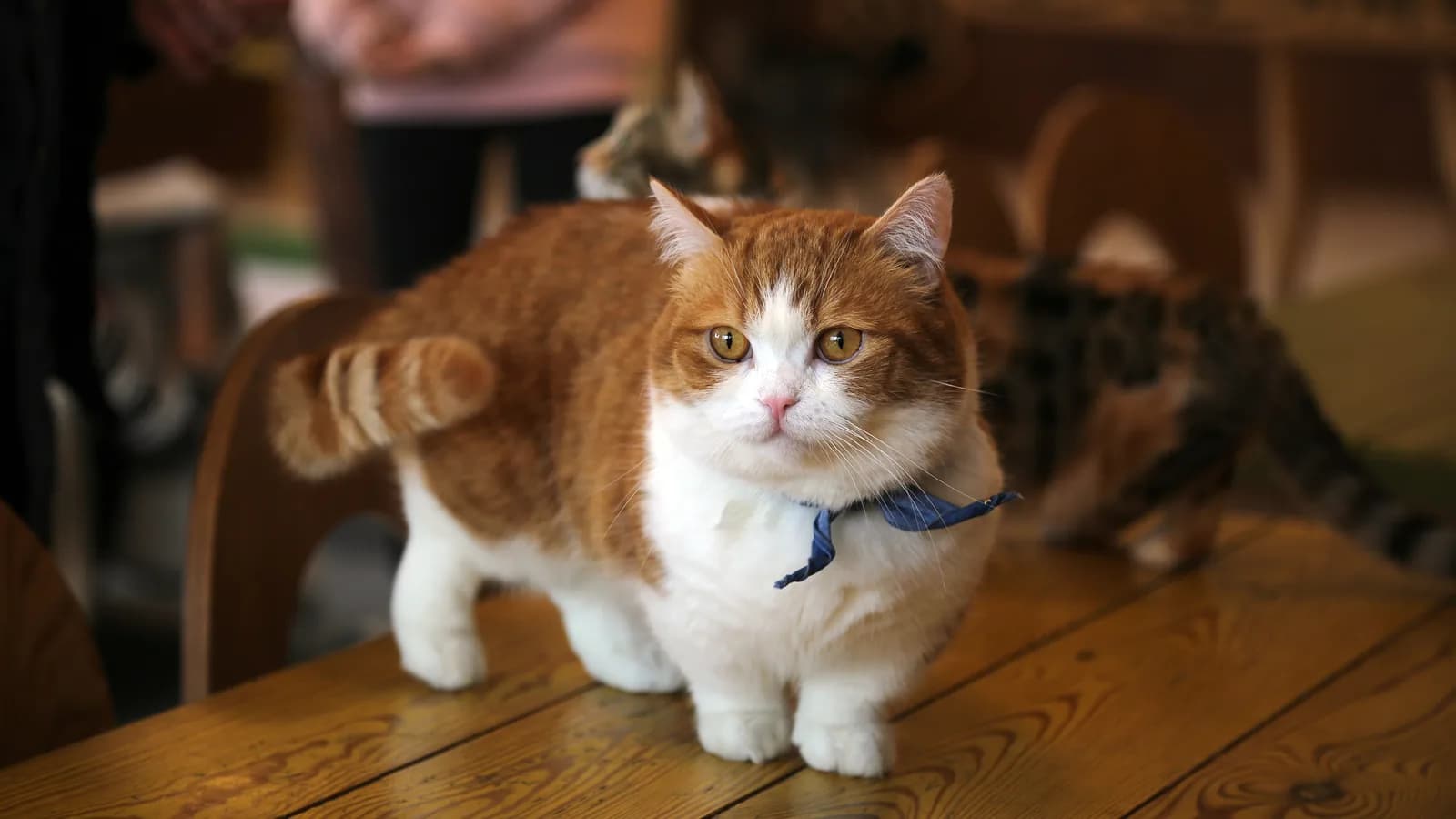
Real photos, so you can see what the breed actually looks like: coats, ear tufts, ruff and build.
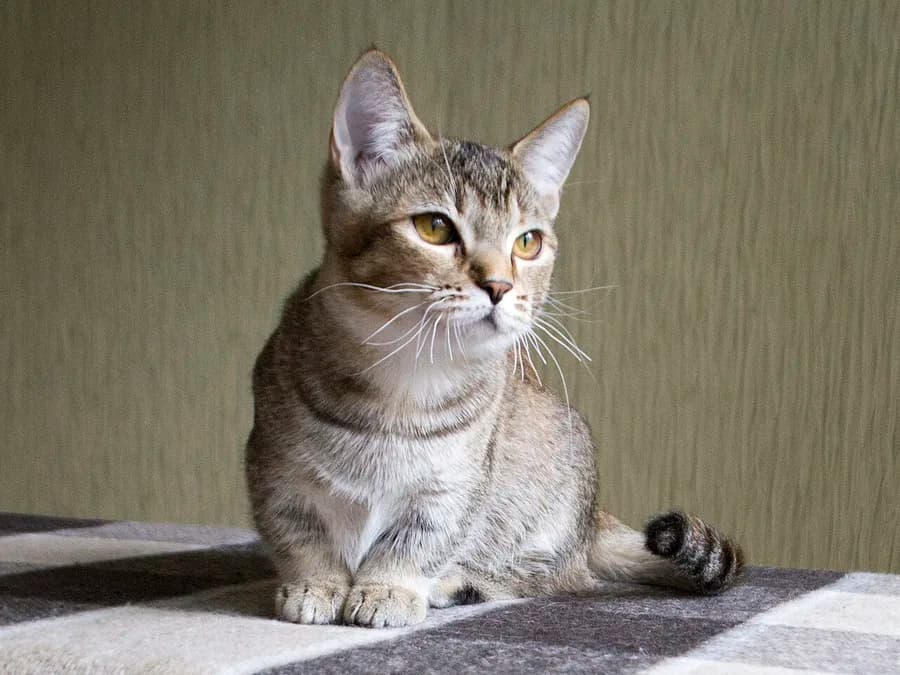
Brown tabby Munchkin cat sitting upright on a blanket, short legs tucked in
Photo: Fedorov078 · CC BY-SA 4.0 · via Wikimedia Commons
 Vital stats
Origin
United States
The modern breed dates to 1983, when Sandra Hockenedel ('s own spelling; secondary sources write Hochenedel) found a short-legged pregnant stray in Louisiana she named Blackberry. A male from one of Blackberry's litters, Toulouse, went to her friend Kay LaFrance, and today's breed descends from those two cats. TICA accepted the breed into its new-breed program in September 1994. The gene behind the legs (UGDH) was identified independently by two research groups in 2020.
Weight
Female
5-7 lb (2.3-3.2 kg)
Male
7-10 lb (3.2-4.5 kg)
Life expectancy
No mortality study anywhere names the Munchkin: we checked the UK life tables, the earlier UK longevity study, the Swedish cohorts and the 2025 screening dataset directly. 's own box says 15-18+ years. Purina UK and PetMD both say 12-15. None of the three cites a study, and the gap between them is what guessing looks like. All of it is a commonly cited estimate, no measured study exists: the breed is recent (1994) and uncommon, and the datasets have not caught up. Our lifespan page carries the whole honest file.
Coats
Calico
Brown tabby
Black
White
Cream
Blue
Tortie
Silver tabby
All of them, literally: 's standard states COLORS: All with no exclusion list, the only breed in our research where that is true. Calico is the most-searched favorite; shorthair and longhair share the same full palette.
Understanding the coats (and their genetics)Size
The Munchkin is NOT a miniaturized cat. The body is normal domestic-cat size, only the limbs are shortened, and TICA's own standard treats resemblance to a miniaturized recognized breed as a fault. TICA's box gives females 5-7 lb (2.3-3.2 kg) and males 7-10 lb (3.2-4.5 kg). Its own narrative says 5-9 lb on the same page, a one-pound self-disagreement worth knowing about. The legs are roughly 3 inches shorter than average; everything else is ordinary cat.
Did you know
Guinness World Records' current "shortest living domestic cat" is Lilieput, a Munchkin measured at 13.34 cm (5.25 in) from floor to shoulder, in GWR's own words on its own showcase page. It is one of the few breed records on this site read at the registry itself rather than in a retelling.
 Personality
 Affection4/5
 Energy4/5
 Intelligence4/5
 Friendliness4/5
 Independence3/5
 Vocal3/5
 Shedding3/5
Compatibility
 Good with children4/5
 Good with other pets4/5
 Apartment friendly5/5
Editorial ratings on our five-point scale, anchored in the registry descriptions and the measured behaviour studies cited on this profile; individual cats vary, and our members' own ratings below are the counterweight.
Still torn between this breed and another?Compare the Munchkin trait by trait, or filter every breed by what matters to you. What our members say
What our members say
Nobody has described their Munchkin here yet. As soon as the first profiles come in, this is where the community averages will show up: temperament, food, lifestyle.
Describe my Munchkin Pros & cons
Strong points
- A normal-bodied cat: the miniature-cat image is wrong by the standard's own words
- COLORS: All: the most open color standard in our whole research corpus
- TICA's portrait (sociable, spirited, good with children and pets) is consistent, if unmeasured
- The gene is identified and its inheritance understood: no hidden machinery
- Apartment-sized activity: fast, low, cornering like a go-kart
Things to consider
- The central health question (does the trait harm?) is genuinely unmeasured in either direction
- Two major registries refuse the breed in welfare language; two more are silent
- No lifespan data exists at all: every figure you read is a guess
- A search space full of templated cattery sites: verification is on you
- Welfare law is moving around the trait (a Dutch enforcement reading, a Victorian schedule)
 Is a Munchkin right for you?
A household that wants a sociable, playful, apartment-friendly cat and can hold two honest thoughts at once: nothing about this breed's day-to-day is proven harder than any cat's, and the biggest question about its trait has never been measured. Buy only from breeders who name their registry and their testing. Watch mobility like any short-legged animal's owner should. And skip the miniature-cat fantasy: this is a full-sized cat that corners lower.
Is the Munchkin right for YOUR home?
Answer a few questions and we'll email you your personalized result.
Take the quiz · 2 min Getting to know the Munchkin
The Munchkin is the cat fancy's most argued-about breed, and the honest version of the argument is more interesting than either side's slogan. One dominant gene (UGDH, identified independently by two research groups in 2020) shortens the legs and changes nothing else. The body is normal domestic-cat size, and 's own standard faults a Munchkin that looks like a miniaturized version of anything. Whether the trait harms the cat has never been measured in either direction, and this profile keeps that sentence intact everywhere it matters.
The registry map is the argument in institutional form, three tiers deep. (home registry, 1994), Australia's and actively register the breed. and Canada's are simply silent. and refuse recognition in formal welfare language, their words, quoted as theirs. The legal page carries the whole map, including the two genuinely consequential legal facts: a Dutch regulator's commissioned expert reading extends a trait-based breeding prohibition to the breed by name, and Victoria's own breeding code names 'Munchkin cats or Twisty Cats' verbatim in a standards-and-disclosure schedule.
Health is one ruled sentence, applied everywhere: report the split neither side proves. calls the trait harmless; and call it a defect; no published rate backs either institution. The one imaging study (six cats) found measurable limb changes without measuring suffering, and a single CT case stays a single case on this site. What an owner actually does is ordinary and real: lean weight, mobility watched, lameness or reluctance mentioned to the vet. The lifespan page tells the matching story: no mortality dataset names the breed, and every figure in circulation is an uncited estimate.
The famous jump question earns its nuance. Munchkins jump, all sources agree, onto sofas and windowsills and out of your arms if you insist: lower and hoppier than a long-legged cat, per the anatomy and a named veterinarian's caution against the like-any-cat comparison. The breed's actual party trick is cornering: low, fast, ferret-flat turns that owners describe with the joy of people who did not expect their furniture to survive anyway.
Two buying pages do the practical work. The price guide carries a market that needs its warnings printed first (a four-fold spread between honest catteries, marketplace tiers full of crosses, template sites our research declined to name, and no reliable Australian price at all). And the dwarf breeds roundup sorts the boutique family: the Minuet's real 2016 championship, the Bambino and Kinkalow's absent registrations checked against 's own rules, and the rug hugger that is a leg measurement, not a breed.
And the colors page carries the breed's one uncomplicated superlative. 's standard says COLORS: All, no exclusions, the only breed in our entire research corpus where the palette is genuinely open. A breed built from ordinary cats around one gene kept the street's whole wardrobe, calicos first among equals.
 Health: what to watch for
A few predispositions are well documented. The good news: they can be screened for or avoided by choosing a reputable breeder and keeping an eye on the right signals.
This is information, not veterinary advice, and it cannot tell you what is wrong with your cat. Our rule is a simple one: if something is wrong with your cat, call your vet, and call an emergency clinic if it is out of hours. Nothing you read here is a reason to wait.
The short-leg trait (chondrodysplasia): the unmeasured split
Institutionally disputed, never measuredThe dossier's central honest sentence, ruled for this site: a single dominant UGDH mutation, identified independently by two research groups in 2020, causes the short legs, and its clinical consequence has never been measured in either direction. TICA calls the trait harmless. GCCF and FIFe refuse the breed and call it a defect in formal regulatory language. Neither institutional claim is backed by a published rate. The one imaging study (six dwarf cats, radiography and MRI) found measurable limb deformity in every cat studied, without measuring pain or dysfunction rates. And a single CT case report stays exactly that on this site: one cat.
Symptoms to spot
What to actually watch: lameness, reluctance to jump, stiffness after rest, or any mobility change: each is worth mentioning to your vet. Observation, never alarm: no measured rate says your cat will develop anything.
How common
No published rate exists for any orthopedic outcome in this breed, in either direction. Anyone quoting one is guessing.
Screening & prevention
Lean body condition (the one controllable load on the joints), mobility watched over the years, and a breeder who discusses the trait's open questions rather than denying they exist.
Genetic test
The UGDH variant itself is identifiable, but there is nothing to screen FOR beyond the visible trait: every standard Munchkin carries one copy by definition.
Skeletal and joint observations (small samples)
Documented findings, samples in the sentenceWhat the imaging literature actually holds, sample sizes attached. Anderson et al. 2021 studied six dwarf cats with radiography and MRI. It found measurable long-bone deformity in every limb studied, with no torsional deformity of femur or tibia and no spinal pathology in the cats examined. A separate single CT scan of one cat is a plausible biomechanical concern and nothing more. A named critical-care veterinarian (Paula Simons, DVM) is on record that comparing Munchkin locomotion to 'a normal cat' is false. None of this is a rate; all of it is why mobility is this breed's watch item.
Symptoms to spot
Same watch list as above: lameness, jump reluctance, stiffness. Kittens clumsy in a growing way are kittens; a cat that stops doing what it used to do is a vet conversation.
How common
n=6 (imaging study) and n=1 (CT case): counts, not rates, and printed as such.
Screening & prevention
No special screening protocol exists; regular vet exams with mobility mentioned explicitly cover what is coverable.
Genetic test
Not applicable: these are observational findings, not testable conditions.
Xanthinuria (one documented family cluster)
Case cluster, not a breed riskA 2024 case series documented xanthinuria (abnormally high urine xanthine, which can form urinary stones) in a familial group of Munchkin cats: four confirmed cases and one suspected, in related animals. A documented family cluster is worth knowing about. It is not a breed-wide urinary-disease claim: no prevalence exists and none should be inferred from five related cats.
Symptoms to spot
Urinary signs in any cat (straining, blood, frequent small trips, crying in the box) are a same-day vet call, this breed or any other. A blocked cat is an emergency.
How common
4 confirmed + 1 suspected cases in one family: a cluster, never a rate.
Screening & prevention
Ordinary urinary vigilance; a breeder should disclose any stone or urinary history in the line, as with any breed.
Genetic test
None commercially; the cluster's genetic basis was not established.
Go deeper on health
Prevention, warning symptoms, costs and insurance: our guides, researched and sourced.
The Munchkin also appears in
Our criteria-based guides, to compare this breed with the ones most like it.
 Grooming & living with one
Grooming
Ordinary cat grooming by coat length: weekly brushing for shorthairs, twice weekly for longhairs, plus the usual nails, ears and teeth. One practical note owners repeat: very short legs mean a lower jump-up. Litter boxes with lower entries and steps to favorite perches are kindnesses, not medical equipment. No breed-specific grooming need exists.
Living together
describes the breed as sociable, spirited, curious and good with children and other pets. Honesty requires the label: no measured behaviour study includes the Munchkin at all (it is absent from both major Finnish datasets), so the portrait is registry voice, consistent and unmeasured. The famous question gets the nuanced answer. Munchkins genuinely jump (every source describes it), lower and with more of a hop than a long-legged cat. An imaging study found measurable limb deformity in every cat studied, while a named veterinarian calls the like-a-normal-cat comparison false. Watch for lameness or reluctance and mention it to your vet: observation, not alarm.
 Food & diet
No breed-specific feeding study exists; feed to body condition per the general veterinary guidance. One breed-flavoured caution every source shares: extra weight on shortened legs is extra load on joints already carrying a structural difference. Lean body condition is the one nutrition lever an owner truly controls. Portion control beats supplements nobody has tested on this breed.
 Price & budget
$900 to 4,100
Price of a kitten from a registered breeder, in the United States
This price reflects the quality of the breeding program: parents' health tests, registry pedigree, socialization. A very low price should raise a red flag. The real cost, though, plays out over the years.
Find a verified breederKitten price, by market
United States
$900 to 4,100
United Kingdom
£200 to 1,200
Canada
CA$300 to 950
Each figure is that country's real market price, researched separately, not a conversion of the others. The smaller line is only there so you can gauge one against your own money: European Central Bank reference rates of 2026-09-18, refreshed daily.
The Munchkin in the US, UK, Canada and Australia
| Measure | United States | United Kingdom | Canada | Australia |
|---|---|---|---|---|
| Pet-quality kitten (published prices) | $900 flat (one cattery) to $3,000-4,100 (another) | £200-1,200 marketplace (single source) | CA$300-950 marketplace, mostly crosses (single source) | No reliable published price exists |
| Registry status | TICA registers (since 1994); CFA silent | GCCF refuses recognition (welfare language) | CCA-AFC silent | ACF and ANCATS register; FIFe (international) refuses |
| Breeding law | No restriction; consumer-protection laws at sale | No restriction; Cats Protection campaigns in Parliament | No restriction found | Victoria's code names 'Munchkin cats or Twisty Cats' in its heritable-defects schedule (standards, not a flat ban) |
| The trait's science | UGDH gene identified 2020 (two groups independently) | Same gene; clinical consequence unmeasured either way | Same | Same |
| Measured lifespan | None exists | None exists | None exists | None exists |
Four markets, four rulebooks; single-source figures are labeled. Prices August 2026.
Work out your food budget
Type of food
Estimated monthly budget
$11
≈ 2.0 oz (57 g) per day
A ballpark figure, food only, using the same arithmetic as our portion tool (resting energy requirement × 1.2, a neutered adult). Real needs vary with age, activity level and body condition. Ask your veterinarian for advice.
 Verified catteriesThe registry-checked directory, plus a kitten alert near you. Filter it by breed.
 Should you insure a Munchkin?
Our sources list several predispositions in the Munchkin: The short-leg trait (chondrodysplasia): the unmeasured split, Skeletal and joint observations (small samples), Xanthinuria (one documented family cluster). A predisposition is not a foregone conclusion, and many of these cats live their whole lives without ever developing anything. It does change the nature of the follow-up, though: you monitor, sometimes for life, and it's that monitoring that weighs on a budget, more than a one-off accident.
One thing to weigh before deciding: this is a cat you will live alongside for well over a decade, and that is the span the real cost is spread across, premiums and care alike. Where a breed has a measured life expectancy that differs from the figure usually quoted, we say so in the lifespan section above rather than repeating the quoted one here.
 Munchkin cats in our community
No Munchkin here yet
Got one? Add a photo and yours gets to open this page.
 The vet's take

Veterinary review
Are you a vet?
Your professional read belongs here: every verified practitioner can leave a note, published once our editors have reviewed it.
Sign in and get your license number verified. We check it in the public register, we never ask for or keep a copy of your diploma, and your number is never published.
 Frequently asked questions
+How much does a Munchkin cat cost?
From named US catteries (August 2026): a flat $900 at one, $3,000-4,100 at another, and that four-fold spread is the honest market. UK marketplace £200-1,200; Canada CA$300-950 (mostly crosses); Australia has no reliable published price. Our price page carries the warnings this search space needs.
+How long do Munchkin cats live?
Nobody has measured it: no mortality study names the breed. TICA's uncited box says 15-18+ years, two pet publishers say 12-15, and the gap is the tell. Our lifespan page carries the whole honest file.
+Can Munchkin cats jump?
Yes, genuinely: every source describes real jumping, onto sofas and windowsills. Lower and hoppier than a long-legged cat, and an imaging study plus a named vet caution against the 'just like any cat' framing. Steps to high perches are a kindness.
+Are Munchkin cats healthy? Are they in pain?
The honest, ruled answer: nobody has measured it in either direction. TICA says harmless, GCCF and FIFe say defect, and no published rate backs either. What an owner controls: lean weight, mobility watched, changes mentioned to the vet.
+Are Munchkin cats ethical to breed?
The question the institutions split on: two registries refuse the breed in welfare language, three register it, a Dutch enforcement reading and a Victorian code touch it by name, and the measured file that would settle the argument does not exist. Our legal page maps every position with its source.
+Are Munchkin cats hypoallergenic?
No evidence says so: no allergen study includes the breed, and no registry makes the claim. Every cat produces Fel d 1. Coat length (shorthair or longhair) changes shedding visibility, not allergen.
+How big do Munchkin cats get?
Normal cat sized, minus the legs: females 5-7 lb and males 7-10 lb per TICA's box, on a standard domestic-cat body. The miniature-cat image is wrong by the standard's own words: only the legs are short.
+What is a rug hugger cat?
The shortest leg-length tier of the Munchkin: a breeder's descriptive term for a measurement, not a separate breed and not a synonym for Munchkin.
+What is a non-standard Munchkin?
A long-legged kitten from a Munchkin litter: the trait is dominant, breeding pairs one short-legged cat with a long-legged one, and roughly half the kittens inherit ordinary legs. They register under TICA's generic mutation-breed rules and make excellent ordinary cats.
+Do Munchkin cats shed?
Like any cat of their coat length: shorthairs modestly, longhairs more, with no breed-specific shedding finding anywhere. Weekly to twice-weekly brushing covers it.
+What breeds come from the Munchkin?
The dwarf family: Minuet/Napoleon (x Persian, the one with real TICA championship status since 2016), Bambino (x Sphynx), Kinkalow (x American Curl), Lambkin (x Selkirk Rex), Dwelf (three-way). Our dwarf breeds page sorts who is actually registered: fewer than the ads claim.
 Community questions
Got a question this page doesn't cover? Ask it: the best ones get published here with their answer.
Sources & references
Data checked against reference sources (TICA and CFA standards, genetics laboratories, veterinary schools).
- TICA: Munchkin breed
- TICA Munchkin breed standard
- Struck et al. 2020, the UGDH variant
- Buckley et al. 2020, independent UGDH identification
- Anderson et al. 2021, skeletal imaging of dwarf cats
- GCCF: unrecognised breeds
- FIFe health and welfare rules
- Victoria Code of Practice, heritable defects
- Besluit houders van dieren (NL welfare law)
- Guinness World Records cats showcase (Lilieput)
- PetMD Munchkin breed page (Paula Simons DVM quoted)
- ACF Munchkin standard

Worth keeping a paw on
Pin this profile
To compare later, or to show someone still torn between two breeds. One click and it sits in your board.
Pin it on Pinterest
 Purr or Pass
Still deciding? Find the perfect breed for your home.
A quick quiz that factors in your lifestyle, your kids and your other pets.
Which breed fits my home?Keep exploring
The floor belongs to our members. Keep it kind, links are not allowed, and images go through moderation before anyone else sees them.