

Russian Blue
“The Archangel cat”
 By Priya · The careful one
Published August 21, 2026Updated August 26, 20268 min read
Contents
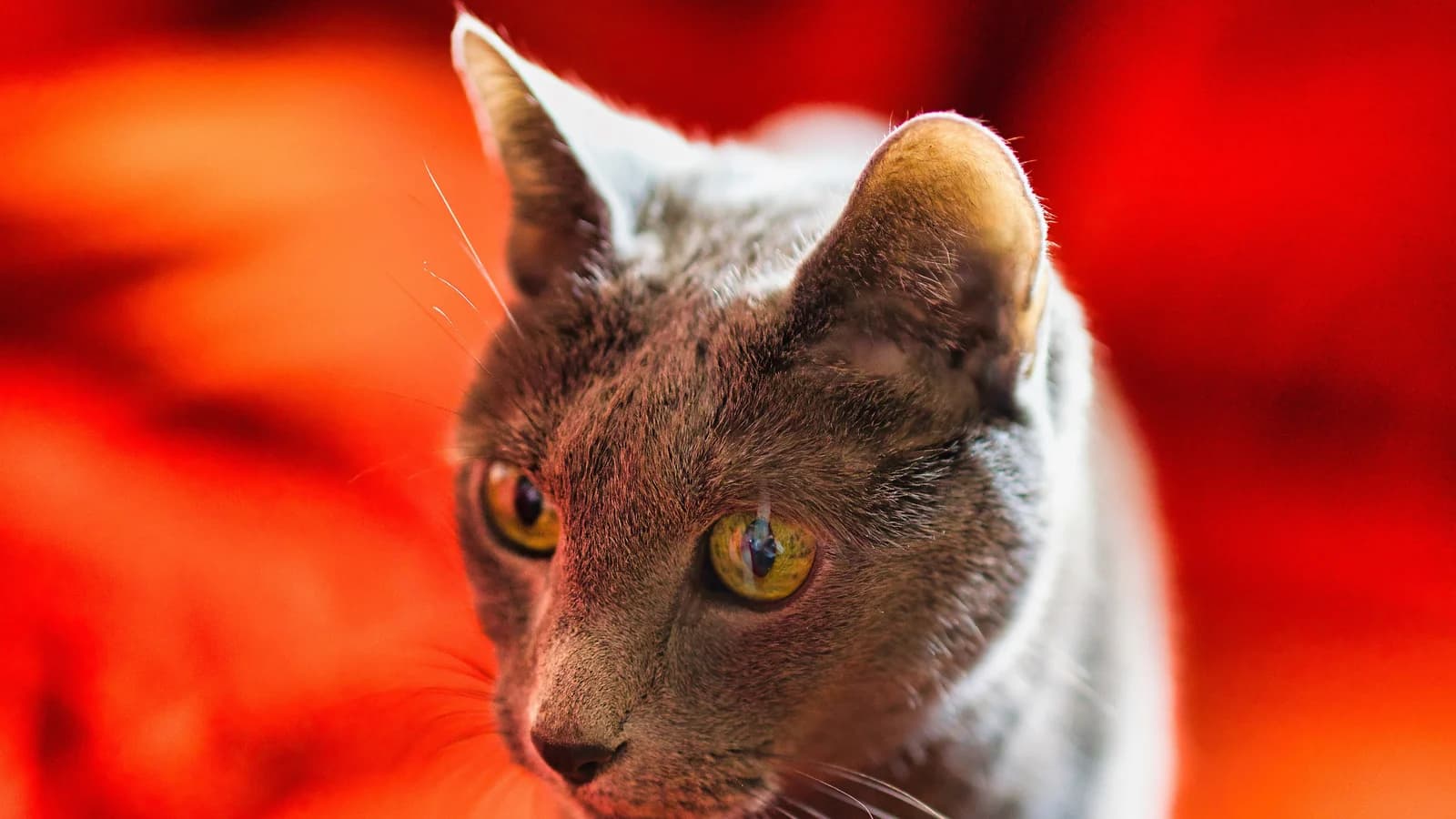
 Russian Blue photos
Real photos, so you can see what the breed actually looks like: coats, ear tufts, ruff and build.
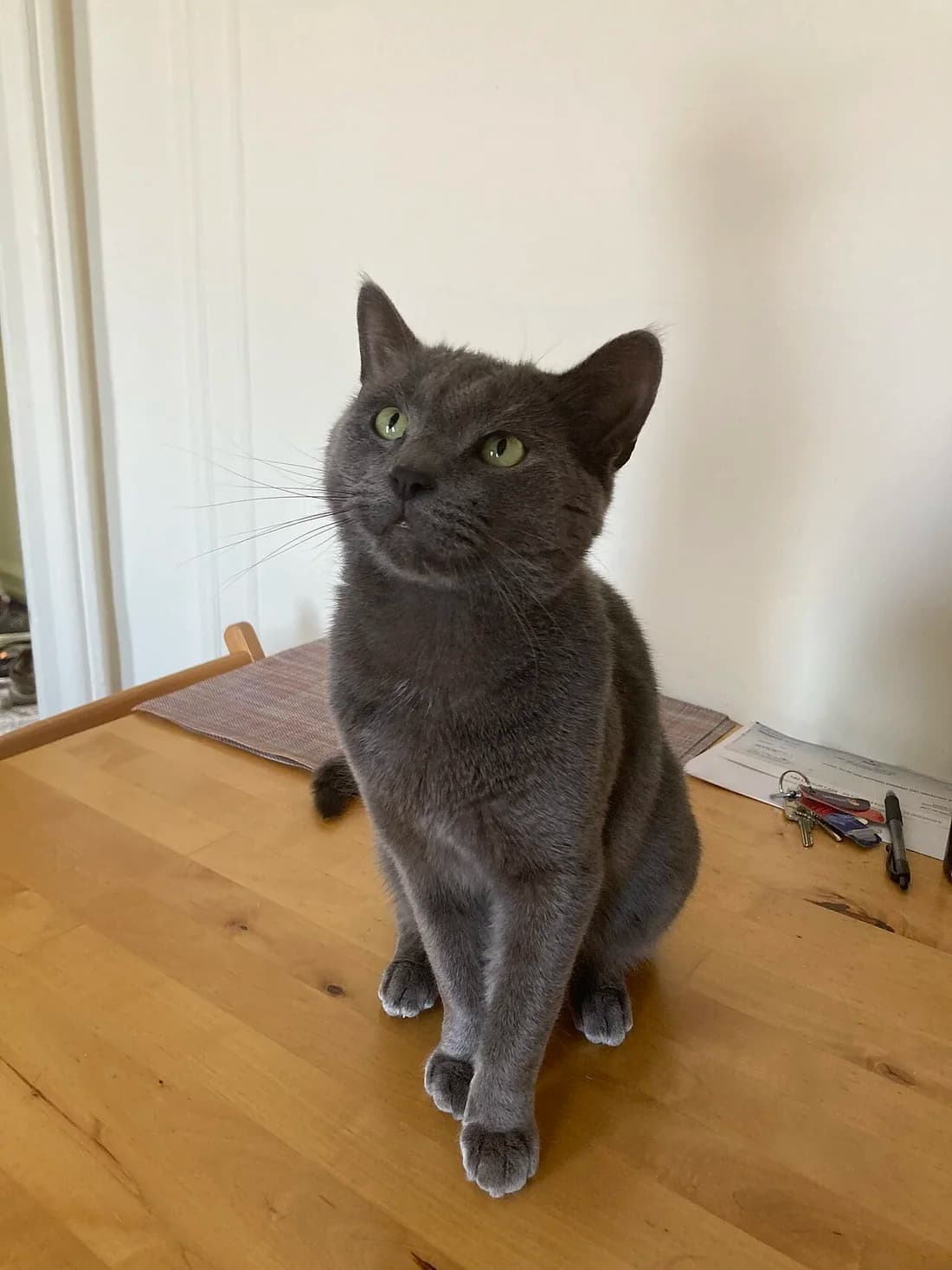
Russian Blue looking up, the wedge face and green eyes
Photo: Buls1585 · CC BY-SA 4.0 · via Wikimedia Commons
Got a Russian Blue? Share them with the community. Photos from our members round out this page.
 Vital stats
Origin
Russia
The port of Arkhangelsk on Russia's White Sea, carried west by sailors in the 1860s-1880s: the one origin story , and the dated 19th-century press all state plainly. The royal-ownership legend is another matter. Every source that carries it hedges it, and a vet-reviewed account calls it more rumor than fact, with no historical documents confirming it.
Weight
Female
5-8 lb (2.3-3.6 kg)
Male
8-10 lb (3.6-4.5 kg)
Life expectancy
The 10 to 20 years commonly quoted is uncited convention, published here as such. The measured record is two UK studies that genuinely disagree. The 2024 life tables give 9.65 years at birth (CI 7.20-12.10, 19 deaths, a pooled Russian group). A differently designed 2024 text-mining study gives a 14.99-year median (CI 14.77-15.21, 26 cats), more than five years higher, with non-overlapping intervals. We print both with their samples and never average them; no US, Canadian or Australian measured figure exists.
Coats
Blue (silver-tipped)
Russian Black (UK/AU)
Russian White (UK/AU)
Blue only at , and Canada's . Britain's and Australia's also run Russian Black and Russian White at championship level (GCCF's since 2013), under one shared Russian standard. The palette depends on the passport.
Understanding the coats (and their genetics)Size
Stated honestly per our own research: this breed has LESS measured weight research behind it than any other we have profiled. The registry ranges say females 5-8 lb (2.3-3.6 kg) with males rarely exceeding 10 lb (CFA), or 8-15 lb combined (GCCF). The ONE measured cohort anywhere (24 German cats at ideal condition) weighed females at 2.9 kg and males 4.2 kg, at or below every published range. A fine-boned, elegant cat whose double coat makes it read bigger than it weighs.
Popularity (CFA)
No. 10
in the CFA ranking for 2026
Did you know
Tom from Tom and Jerry is often called a Russian Blue. The standard itself disagrees. Tom wears white paws, muzzle and chest, and the Russian Blue is one color, blue, with no white anywhere, in 's own text. A great cartoon cat; not this breed.
 Personality
 Affection4/5
 Energy3/5
 Intelligence4/5
 Friendliness3/5
 Independence3/5
 Vocal2/5
 Shedding1/5
Compatibility
 Good with children4/5
 Good with other pets4/5
 Apartment friendly5/5
Editorial ratings on our five-point scale, anchored in the registry descriptions and the measured behaviour studies cited on this profile; individual cats vary, and our members' own ratings below are the counterweight.
Still torn between this breed and another?Compare the Russian Blue trait by trait, or filter every breed by what matters to you. What our members say
What our members say
Nobody has described their Russian Blue here yet. As soon as the first profiles come in, this is where the community averages will show up: temperament, food, lifestyle.
Describe my Russian Blue Pros & cons
Strong points
- Measurably MORE sociable with its own household than several calmer-reputation breeds
- Low-shedding double coat, named directly by Cats Protection
- Quiet voice and apartment-perfect routine-loving temperament
- One of the fancy's most elegant, naturally occurring breeds
- No registry-flagged testing burden: the health file is short and specific
Things to consider
- Measurably one of the shyest breeds with strangers (three studies, two countries)
- A third of one breed-club cohort carried hereditary cataracts, and no DNA test exists yet
- Two large studies disagree about diabetes risk: an appetite worth managing either way
- Scarce, waitlisted and priced accordingly in every market
- Routine-loving: a chaotic household is the wrong match
 Is a Russian Blue right for you?
A calm household that respects a slow warm-up. The measured file says reserved with new faces, then at least as sociable as any house cat with its own people. Suits quiet homes, apartments and patient families; suits nobody expecting an instant greeter.
Is the Russian Blue right for YOUR home?
Answer a few questions and we'll email you your personalized result.
Take the quiz · 2 min Getting to know the Russian Blue
Start at the docks. The one origin story every registry and the dated 19th-century press agree on is unromantic and solid: grey cats from Arkhangelsk, Russia's White Sea port, carried west by sailors in the 1860s-1880s, shown in England before the century turned. The romantic add-on, that they were the pets of the Tsars, is hedged by every source that carries it ( says rumored, says other stories indicate). A vet-reviewed account calls it more rumor than fact, with no historical documents confirming it: we print the legend with its label.
After WWII nearly erased the breed, breeders openly rebuilt it with British Shorthair and Siamese crosses, a documented chapter three registries' own histories carry. The cat itself is a study in understatement. A fine-boned frame under a dense, silver-tipped double coat that stands away from the body through sheer density. Vivid green eyes, required absolutely, showing their ring by about four months. A quiet voice. Our colors page carries the transatlantic surprise (Russian Black and Russian White are championship colors in Britain and Australia, unknown to American paperwork).
The comparisons page separates the breed from the internet's three grey look-alikes, including the Chartreux whose standard disqualifies exactly the eyes this breed requires. The temperament is measured, and better than the stereotype. Three studies in two countries agree this is one of the shyest breeds with STRANGERS. The same data scores it at least as sociable as an ordinary house cat with its own household, and more sociable than several breeds with warmer reputations.
The bonds-to-one-person line you have read elsewhere has no source anywhere, and we do not print it. The health file is short and specific. One Swedish breed-club cohort found hereditary cataracts in a third of the cats examined (no DNA test exists yet). Two large studies genuinely disagree about diabetes. And the famous hypoallergenic claim is denied by the breed's own UK club, in its own words, on our hypoallergenic page. The price page carries four markets of named catteries, including two that decline to price at all: with this breed, that is often the ethics talking.
 Health: what to watch for
A few predispositions are well documented. The good news: they can be screened for or avoided by choosing a reputable breeder and keeping an eye on the right signals.
This is information, not veterinary advice, and it cannot tell you what is wrong with your cat. Our rule is a simple one: if something is wrong with your cat, call your vet, and call an emergency clinic if it is out of hours. Nothing you read here is a reason to wait.
Hereditary cataracts
MODERATEThe breed's one confirmed specific finding. A Swedish study examined 66 Russian Blues recruited through the two Swedish breed clubs, and found mainly bilateral cataracts in 22 of them (33%), most in a small posterior form causing no observable visual impairment. The 6 cats with extended forms all had impaired vision, and none of a small re-examined subset had progressed years later. Pedigree analysis supports recessive inheritance without ruling out alternatives (the paper's own hedge). The number travels with its frame: one country, breed-club-recruited, not a random population.
Symptoms to spot
A visible cloudiness in the eye, bumping into things, hesitation in dim light: a veterinary ophthalmology visit, never a home diagnosis
How common
22 of 66 (33%) in the one Swedish breed-club cohort; no other population measured anywhere
Screening & prevention
Ask the breeder about eye examinations in the line; an ophthalmologist's certificate is the available paper
Genetic test
None exists: UC Davis VGL's full test index lists no feline cataract test of any kind (checked directly)
Diabetes mellitus (two studies that disagree)
MODERATEA Swedish insurance study (504,688 cats) measured the breed at 3.8 times other cats' diabetes incidence (44.1 per 10,000 cat-years, CI 21.0-67.2, 14 cases). A UK primary-care study 380 times larger and ten years newer found NO significant association at all (adjusted OR 1.05, CI 0.26-4.24). Different countries, eras and populations; neither study explains the gap, and we do not pick a winner. The honest read: the older insurance-based signal has not been replicated in the much larger population.
Symptoms to spot
Increased thirst and urination, weight loss despite appetite, lethargy: any of these is a same-week vet visit
How common
44.1/10,000 cat-years (Sweden, insured) vs no significant elevation (UK, primary care): both printed, never averaged
Screening & prevention
Weight management is the lever an owner holds: CFA's own page flags the breed's hearty appetite
Genetic test
None
Weight and appetite (the registry's own caution)
LOWCFA's own breed page describes a healthy natural breed with a hearty appetite that will overeat if free-fed: a registry-stated husbandry caution, not a disease. It matters more here than on most profiles, because of the diabetes question above. Whatever that unresolved literature settles on, an ideal-weight Russian Blue has already banked the one protection an owner controls. A 2023 UK referral study we checked found no significant breed association with upper-urinary-tract stones, an absence worth recording.
Symptoms to spot
A thickening waistline is the observable: body-condition checks at every vet visit
How common
A registry caution, not a measured rate
Screening & prevention
Measured portions, weigh-ins, treats inside the ration: the whole protocol
Genetic test
None
Go deeper on health
Prevention, warning symptoms, costs and insurance: our guides, researched and sourced.
The Russian Blue also appears in
Our criteria-based guides, to compare this breed with the ones most like it.
 Grooming & living with one
Grooming
The easy end of the double-coat spectrum. The dense, silver-tipped coat stands away from the body through sheer density, and asks for a weekly comb to a few sessions a month (the two registries' own cadences, both named on the profile). Shedding is genuinely low: Cats Protection names the breed directly as low-shedding. Bathing is condition-based, never scheduled. The green eyes and pale coat need nothing special: this is a wash-and-wear aristocrat.
Living together
Good with children and other pets, once the introduction respects the breed's measured caution. Reserved with strangers until assessed is the personality, not a flaw. At home, the same studies score it MORE sociable than several supposedly warmer breeds. Slow introductions, stable routines, and the cat meets you the rest of the way.
 Food & diet
's own page flags a hearty appetite and a conditional obesity risk if free-fed. A Swedish insurance study separately measured elevated diabetes incidence (a finding a much larger UK study did not replicate: both live on the profile with their scopes). The practical translation is unglamorous: measured portions against body condition, weigh-ins at vet visits, and treats inside the budget, not on top of it.
 Price & budget
$2,500 to 4,000
Price of a kitten from a registered breeder, in the United States
This price reflects the quality of the breeding program: parents' health tests, registry pedigree, socialization. A very low price should raise a red flag. The real cost, though, plays out over the years.
Find a verified breederKitten price, by market
United States
$2,500 to 4,000
United Kingdom
£900 to 1,750
registered listings in a live Pets4Homes sample; the site's own FAQ (£1,800-2,300) sits ABOVE its own live ceiling
Canada
CA$3,200 to 3,800
two named Toronto catteries; a third declines to price at all, as an ethics posture
Australia
A$2,500 to 3,000
the two priced NSW catteries' own figures (their shared guidance sentence counted once)
Each figure is that country's real market price, researched separately, not a conversion of the others. The smaller line is only there so you can gauge one against your own money: European Central Bank reference rates of 2026-09-18, refreshed daily.
The Russian Blue in the US, UK, Canada and Australia
| Measure | United States | United Kingdom | Canada | Australia |
|---|---|---|---|---|
| Pet-quality kitten (registered breeder) | $2,500-4,000 flat (3 named catteries) | £900-1,750 registered (live listings) | CA$3,200-3,800 (2 named catteries) | A$2,500-3,000 (2 named catteries) |
| Recognized colors | Blue only (TICA, CFA) | Blue, Black and White at championship since 2013 (GCCF) | Blue only (CCA-AFC) | Blue, Black and White (ACF's own Russian standard) |
| Outcrossing | Closed breed | One gated exception: DNA-tested green-eyed Domestic Shorthair (GCCF) | Closed breed | Closed breed |
| Measured breed life expectancy | No measured figure exists | 9.65y at birth (2024) vs a 14.99y median (2024): two studies that disagree | No measured figure exists | No measured figure exists |
Four markets, four sets of rules and prices; none of these figures converts into another. Prices are August 2026 and expire with the quarter.
Work out your food budget
Type of food
Estimated monthly budget
$11
≈ 2.0 oz (57 g) per day
A ballpark figure, food only, using the same arithmetic as our portion tool (resting energy requirement × 1.2, a neutered adult). Real needs vary with age, activity level and body condition. Ask your veterinarian for advice.
 Verified catteriesThe registry-checked directory, plus a kitten alert near you. Filter it by breed.
 Should you insure a Russian Blue?
Our sources list several predispositions in the Russian Blue: Hereditary cataracts, Diabetes mellitus (two studies that disagree), Weight and appetite (the registry's own caution). A predisposition is not a foregone conclusion, and many of these cats live their whole lives without ever developing anything. It does change the nature of the follow-up, though: you monitor, sometimes for life, and it's that monitoring that weighs on a budget, more than a one-off accident.
One thing to weigh before deciding: this is a cat you will live alongside for well over a decade, and that is the span the real cost is spread across, premiums and care alike. Where a breed has a measured life expectancy that differs from the figure usually quoted, we say so in the lifespan section above rather than repeating the quoted one here.
 Russian Blue cats in our community
This breed is barely covered by free photo libraries: we only found 4 photos we could verify. Your cats are especially welcome here.
No Russian Blue here yet
Got one? Add a photo and yours gets to open this page.
 The vet's take

Veterinary review
Are you a vet?
Your professional read belongs here: every verified practitioner can leave a note, published once our editors have reviewed it.
Sign in and get your license number verified. We check it in the public register, we never ask for or keep a copy of your diploma, and your number is never published.
 Frequently asked questions
+Are Russian Blue cats hypoallergenic?
No: the breed's own UK breeders' club states it outright, no study measures the breed's allergen output (a direct literature search returns zero results), and no cat breed is allergen-free. Our hypoallergenic page carries the whole honest file, including the famous mechanism story that has no source.
+How much does a Russian Blue cost?
August 2026, from named sources: US $2,500-4,000 flat at named catteries (one itemised ceiling reaches $4,700-5,625); UK registered listings £900-1,750; Canada C$3,200-3,800 in Toronto; Australia A$2,500-3,000. Two named catteries decline to publish prices at all, as an ethics posture.
+How long do Russian Blue cats live?
Two UK measured studies genuinely disagree: 9.65 years at birth (VetCompass life tables, 19 deaths) against a 14.99-year median (a text-mining study, 26 cats). We print both with their samples and never average; the 10-20 you read elsewhere is uncited convention.
+Do Russian Blue cats shed?
Comparatively little: Cats Protection names the breed directly as low-shedding, and the dense double coat holds its hair well. Low shedding is a housekeeping fact, not an allergy exemption.
+How big do Russian Blues get?
Smaller than the photos suggest, and honestly under-measured: registries say 5-8 lb females with males rarely over 10 lb (CFA), and the one measured cohort anywhere (24 German cats) weighed lighter still. The double coat does the illusion of size.
+Are Russian Blue cats rare?
Scarce rather than exotic: small catteries, waitlists in every market, and two named catteries that will not even publish a price. The measured research base is thin for the same reason: fewer cats, fewer studies.
+When do Russian Blue kittens' eyes turn green?
The green ring should be showing by about four months, per TICA and Canada's CCA-AFC independently. Adult green is required absolutely: a yellow-eyed adult grey cat is telling you it is another breed.
+Is there a black or white Russian Blue?
Depends on the passport: blue only at TICA, CFA and CCA-AFC, but Britain's GCCF has run Russian Black and Russian White at championship since 2013, and Australia's ACF recognizes all three. Our colors page carries the split, including the white's own deafness-testing responsibility.
+What is the difference between a Russian Blue and a Nebelung?
The Nebelung is the one formally related breed, and even so its own registry calls 'semi-longhaired Russian Blue' an incorrect description: separate breed, one-way bloodline rule (Russian Blue may enter Nebelung programs, never the reverse). Our Nebelung page tells the whole story.
+Are Russian Blue cats friendly?
Measured answer: one of the shyest breeds with STRANGERS (three studies, two countries agree), and at least as sociable as an ordinary house cat with its own household, more than several warmer-reputation breeds. The 'bonds to one person' line has no source anywhere, and we do not repeat it.
 Community questions
Got a question this page doesn't cover? Ask it: the best ones get published here with their answer.
Sources & references
Data checked against reference sources (TICA and CFA standards, genetics laboratories, veterinary schools).
- TICA: Russian Blue breed
- CFA: Russian Blue breed
- Russian Breed Advisory Committee (GCCF documents)
- Russian Blue Breeders' Association kitten notes
- CCA-AFC Russian Blue breed standard
- ACF Russian standard
- Nygren et al. 2018: hereditary cataracts in Russian Blue cats
- Öhlund et al. 2015: diabetes incidence in insured Swedish cats
- Waite et al. 2026: diabetes in 1.2M UK cats
- Teng et al. 2024: UK feline life tables
- Salonen et al. 2019: breed differences in feline behaviour
- Cats Protection: why cats shed their fur

Worth keeping a paw on
Pin this profile
To compare later, or to show someone still torn between two breeds. One click and it sits in your board.
Pin it on Pinterest
 Purr or Pass
Still deciding? Find the perfect breed for your home.
A quick quiz that factors in your lifestyle, your kids and your other pets.
Which breed fits my home?Keep exploring
The floor belongs to our members. Keep it kind, links are not allowed, and images go through moderation before anyone else sees them.