

American Shorthair
“America's founding show cat”
 By Priya · The careful one
Published August 21, 2026Updated August 26, 202611 min read
Contents
 American Shorthair photos
Real photos, so you can see what the breed actually looks like: coats, ear tufts, ruff and build.
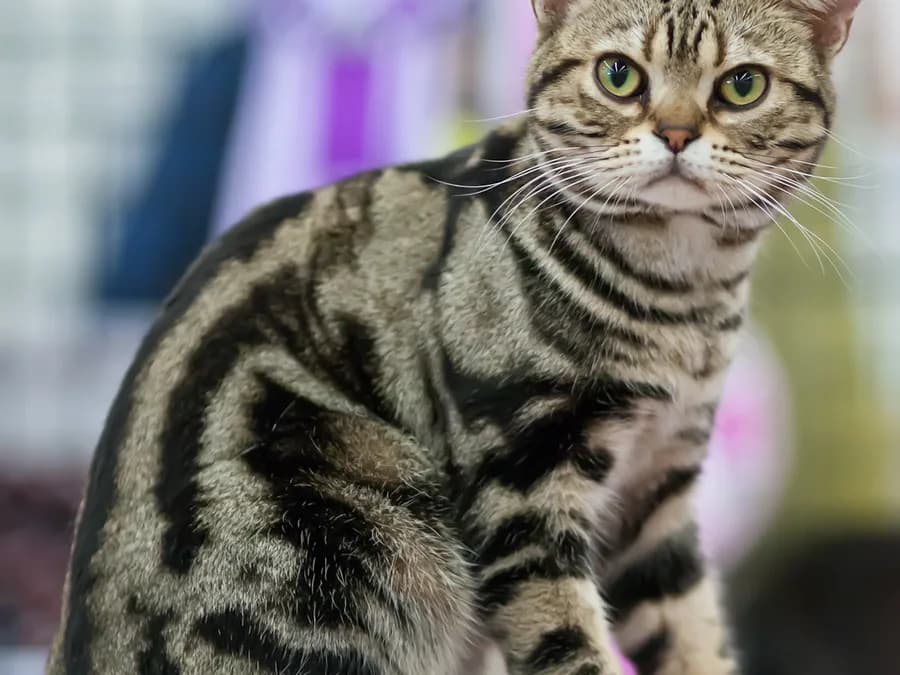
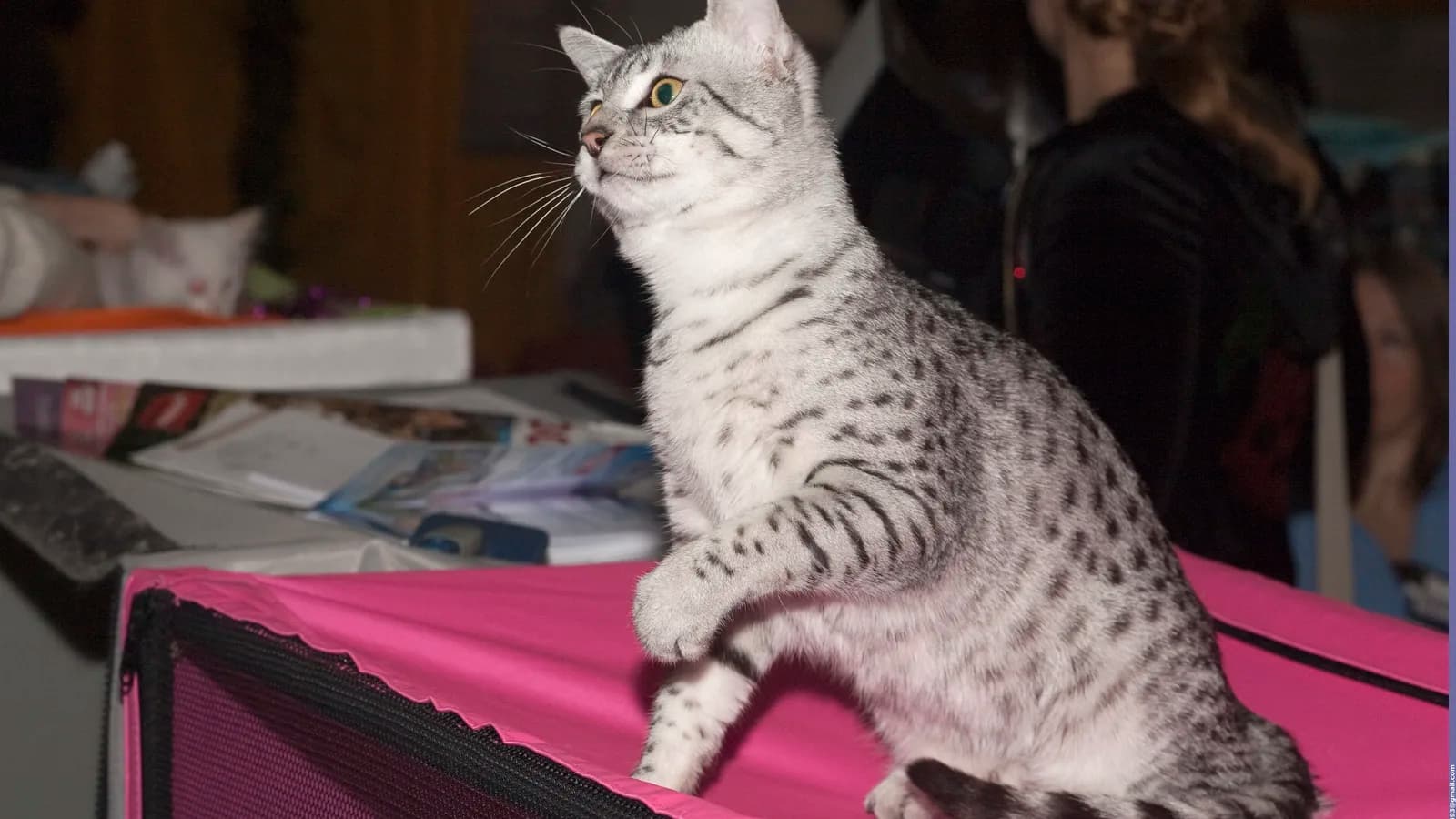
Brown classic tabby American Shorthair at a cat show
Photo: Heikki Siltala or catza.net · CC BY 3.0 · via Wikimedia Commons
Got an American Shorthair? Share them with the community. Photos from our members round out this page.
 Vital stats
Origin
United States
The pedigreed descendant of North America's working cats. It was present in force (over 50 entries) at America's first cat show in 1895, and was one of the first five breeds recognized at its 1906 founding. Renamed from "Domestic Shorthair" in the mid-1960s, to separate the pedigreed breed from the everyday cats sharing the old name.
Life expectancy
The "15 to 20 years" every pet site quotes is a commonly cited estimate, no measured study exists. Five unrelated commercial pages state it in identical words, and none cites a study. One insurer's page even shows the figure in a fact card mislabelled for a different breed. The American Shorthair appears in none of the UK, Swedish or US mortality cohorts this site checks. So unlike our Bengal or Maine Coon pages, no measured figure can honestly appear here.
Coats
Silver tabby
Brown tabby
Black
Blue
Red
Cream
White
Golden (CCA-AFC classes)
More than 100 color and pattern combinations by 's own count (the "80" the internet repeats is a copy error). Solids from white to black, tortoiseshell, bi-color and calico, smoke, shaded and chinchilla, and the tabby heartland led by the breed's signature silver . Chocolate, lilac and pointed coloring are disqualifying evidence of crossbreeding at CFA and . 's standard, unusually, excludes nothing.
Understanding the coats (and their genetics)Size
A balanced, medium-boned cat: TICA's own standard says it "is not a large, heavy boned cat as is the British." Honest numbers: NO registry prints a weight figure, and no measured weight study exists anywhere. Secondary sources cluster adults around 6-16 lb (2.7-7.3 kg), and we store no range we cannot source.
Popularity (CFA)
No. 9
in the CFA ranking for 2026
Did you know
The American Shorthair's is closed ( allows no outcrosses at all). Yet 's own registration rules list it as a permitted outcross DONOR for seven other breeds, from the Maine Coon to the Sphynx: the fancy's quiet genetic lender. Its one current Guinness World Records title is thoroughly modern: Bao Zi skated 10 meters in 12.85 seconds in April 2024.
 Personality
 Affection4/5
 Energy3/5
 Intelligence4/5
 Friendliness4/5
 Independence4/5
 Vocal2/5
 Shedding3/5
Compatibility
 Good with children4/5
 Good with other pets4/5
 Apartment friendly4/5
Editorial ratings on our five-point scale, anchored in the registry descriptions and the measured behaviour studies cited on this profile; individual cats vary, and our members' own ratings below are the counterweight.
Still torn between this breed and another?Compare the American Shorthair trait by trait, or filter every breed by what matters to you. What our members say
What our members say
Nobody has described their American Shorthair here yet. As soon as the first profiles come in, this is where the community averages will show up: temperament, food, lifestyle.
Describe my American Shorthair Pros & cons
Strong points
- Measured 1st of 12 breeds on novelty-seeking and 2nd on friendliness in the one comparative behaviour study
- A documented, founding-breed history no other American breed matches
- Low-maintenance weatherproof coat: weekly grooming covers most cats
- Essentially no type-B blood in US surveys, simplifying veterinary emergencies
- Calm, adaptable registry portrait consistent across CFA, TICA and their catteries
Things to consider
- No measured weight or lifespan study exists: the famous figures are unlabelled conventions elsewhere
- The name is a trap: most cats sold as 'American Shorthair' are unpedigreed look-alikes
- Genuinely scarce outside North America (no GCCF recognition; nobody has applied)
- The stocky build hides weight gain; the waistline needs actual checking
- Its two registries disagree about its heart-health history; screening questions still belong in the buyer conversation
 Is an American Shorthair right for you?
A household that wants a sturdy, even-tempered companion with a working cat's curiosity. The measured data shows a breed bold with novelty and warm with people, and the registry prose adds adaptable and quiet. Buy with the paperwork discipline this breed uniquely needs (its name is the most borrowed in the fancy). And if you are outside North America, expect a search measured in breeders, not listings.
Is the American Shorthair right for YOUR home?
Answer a few questions and we'll email you your personalized result.
Take the quiz · 2 min Getting to know the American Shorthair
Start at the beginning, because no other American breed can. Over fifty of these cats stood in the benching rows of the first American cat show in 1895, and when formed in 1906, the breed was one of its first five. (The 1895 Best in Show, for the record, was a Maine Coon named Cosey: this breed was present in force, not on the podium.) It was America's working shorthair, refined into a .
The name took sixty years to settle, and the story is better than the date. First plain "Shorthair," then "Domestic Shorthair" from around 1930, a label the breed's own national club calls a grave mistake once it came to read as ordinary rather than American-bred. From 1961 the fanciers pushed for the current name.
dates the change 1965, Canada's registry says 1966, and the 1965 Cat of the Year was recorded under the old name "later to be called American Shorthair." A rename that happened mid-stride. That is exactly how our domestic shorthair explainer untangles the confusion the old name left behind: the breed was bred FROM the everyday shorthair population, so the resemblance runs backwards from what most people assume.
In the flesh, the standards ask for balance. 's own text says this "is not a large, heavy boned cat as is the British. It is a very balanced medium size, medium boned cat, with a firm muscular feel." The head is an oval, slightly longer than wide. The coat: short, dense and hard-textured, built per to "stand up to rough weather, bushes and brambles." Honest numbers where numbers exist: no registry prints a weight, no measured study exists, and secondary sources cluster adults around 6-16 lb. Our British Shorthair comparison settles the most-asked look-alike question with the registries' own words.
On personality, this breed owns one genuinely remarkable measured result. In the one study comparing it to eleven other breeds (veterinarian-rated, Japan, 2009), it scored FIRST on novelty-seeking, the boldest cat in the table. It also scored second on friendliness, playfulness and demand for affection, while sitting mid-table on aggression and among the least timid. One country and no significance tests, so hold it lightly. But it matches the registry portrait: a good-natured, adaptable companion that never stopped being a working cat around household insects.
Health reads differently here than on our other profiles, because this breed's own two registries disagree in public. acknowledges was "noted in some cats in the 1980s and 90s" and describes it as largely bred away. says the breed is "not known to be prone to any genetic or hereditary illnesses." We print both, alongside Cornell's list (which includes the breed among HCM-prevalent ones, without a rate) and the fact that no DNA test exists: screening and open paperwork are the real buyer questions.
The kidney-gene story is a lesson in sampling. It runs 47 percent in a Japanese study of cats already suspected of kidney disease, and 2.97 percent (not statistically significant) in a general caseload, and neither UC Davis nor the UK's Langford lab flags the breed for PKD at all. Details, tests and the two quietly good findings (PK deficiency essentially absent; virtually no type-B blood) are in the health section below.
Two buying notes. The palette runs past 100 combinations by 's own count, mapped with registry classes on the colors page, with the silver tabby as the breed's face and black as its search-volume king. And the market has a trap built into the name. Named US catteries charge $1,200-2,900 (the receipts), while the cheap listings wearing the breed's name are, by their own captions, ordinary kittens. Outside North America the breed is genuinely scarce, and the UK case is almost funny: 's own page grades it "Green: not applied, probable acceptance." In a century, nobody has filed the form. The breeders page has every registry's actual position.
 Health: what to watch for
A few predispositions are well documented. The good news: they can be screened for or avoided by choosing a reputable breeder and keeping an eye on the right signals.
This is information, not veterinary advice, and it cannot tell you what is wrong with your cat. Our rule is a simple one: if something is wrong with your cat, call your vet, and call an emergency clinic if it is out of hours. Nothing you read here is a reason to wait.
Hypertrophic cardiomyopathy (HCM)
Two registries, two storiesThis breed's own registries disagree in public, and we print both. CFA acknowledges HCM was "noted in some cats in the 1980s and 90s" and describes it as largely bred away through testing and careful breeding. TICA states the breed is "not known to be prone to any genetic or hereditary illnesses." Independent voices lean toward CFA's franker account.
Cornell's Feline Health Center lists the American Shorthair among breeds where HCM is more prevalent (a list, not a rate), and one confirmed clinical case with an aortic clot complication exists in the peer-reviewed literature. No prevalence study exists in any of our four markets, and no DNA test exists for this breed's HCM.
Symptoms to spot
Often nothing early. Labored or rapid breathing, lethargy, or sudden hind-leg pain or paralysis (a clot): the last is an emergency in any cat. Call your vet the same day for any of these; out of hours, an emergency clinic.
How common
No measured rate exists for this breed in any market. Anyone quoting one is guessing.
Screening & prevention
Ask a breeder about echocardiogram results in the line and how they answer the HCM question at all: a breeder who says 'this breed has no heart issues' is quoting one registry; a breeder who shows scans is quoting their own cats.
Genetic test
None exists for this breed. Screening means an echocardiogram read by a cardiologist.
Polycystic kidney disease (PKD1)
Sampling decides the numberTwo Japanese studies, fifteen-fold apart, and the gap is the lesson. A large secondary-care study found the PKD1 mutation in 2.97 percent of tested American Shorthairs (not statistically significant). An earlier referral study of cats ALREADY suspected of kidney disease found 47 percent: a figure that describes a pre-selected sick sample, and must never be quoted as a breed rate. Outside Japan, neither UC Davis VGL nor the UK's Langford lab lists this breed among PKD-risk breeds at all.
Symptoms to spot
Kidney cysts are silent for years; increased thirst and urination, weight loss or appetite loss in an adult cat is a call-your-vet sign regardless of breed.
How common
2.97 percent in Japan's general secondary-care caseload (not significant); no US, UK, Canadian or Australian figure exists.
Screening & prevention
If certainty matters to you, ask for a parent's PKD1 result; ultrasound is the clinical check for an adult cat.
Genetic test
Yes: the PKD1 DNA test used across breeds. A tested-clear parent settles the question for a kitten.
Pyruvate kinase (PK) deficiency
Essentially absent: good news, sourcedThe red-blood-cell enzyme defect that shadows several other breeds is essentially absent here. Japan's purebred genotyping survey measured a mutant allele frequency of 0.008 in American Shorthairs, and multi-breed screening elsewhere found nothing to flag. One of the conditions where this breed's news is simply good.
Symptoms to spot
For completeness: intermittent lethargy, weakness or pale gums in any cat is a vet call, whatever the breed odds.
How common
Allele frequency 0.008 in the Japanese purebred survey; low to absent in every population checked.
Screening & prevention
Not a routine ask for this breed; spend the screening conversation on the heart instead.
Genetic test
Exists (PKLR test) but is rarely relevant for this breed given the measured near-absence.
Blood type: virtually no type B
A quiet practical advantageUS blood-typing surveys found essentially no type-B American Shorthairs. Practically, that simplifies two things: transfusion matching in an emergency, and the neonatal blood-type incompatibility risk (a type-B queen nursing type-A kittens) that complicates breeding in some other breeds essentially does not arise here.
Symptoms to spot
Not a disease: a background fact your vet may care about in an emergency or a breeding context.
How common
No type-B cats found in the US survey populations reported for this breed.
Screening & prevention
Nothing to screen; worth mentioning to your vet if a transfusion is ever on the table.
Genetic test
Blood typing is a standard veterinary test when it matters.
Go deeper on health
Prevention, warning symptoms, costs and insurance: our guides, researched and sourced.
The American Shorthair also appears in
Our criteria-based guides, to compare this breed with the ones most like it.
 Grooming & living with one
Grooming
The registries disagree on cadence, so we print the range. recommends daily brushing to keep shedding under control. calls it barely a coat to be groomed. A weekly session with a comb is the midpoint most sources land on, stepped up during the spring and fall sheds. Baths on condition, never on a calendar. Light-colored cats that sun-worship can burn at the ear tips. And no, no cat is hypoallergenic, this breed included.
Living together
The clubs describe an easygoing family cat that settles in with children, dogs and other pets, and the one measured study backs the friendliness half outright (2nd of 12 breeds). The working-cat inheritance is real: expect serious interest in anything that scuttles. The one split in the sources is being carried. Some describe tolerant cats, others four-feet-on-the-floor cats; read the individual, not the brochure.
 Food & diet
No veterinary body publishes American Shorthair-specific feeding guidance, and that absence is the finding. Feed a good adult diet and watch the body condition, because the stocky frame hides extra weight early. One sourced, reassuring note: a US review of 5,072 urate-stone cases found this breed at significantly LOWER odds of urate uroliths than mixed-breed cats, scoped to that US dataset.
 Price & budget
$1,200 to 2,900
Price of a kitten from a registered breeder, in the United States
This price reflects the quality of the breeding program: parents' health tests, registry pedigree, socialization. A very low price should raise a red flag. The real cost, though, plays out over the years.
Find a verified American Shorthair breederKitten price, by market
United States
$1,200 to 2,900
United Kingdom
£300 to 900
Each figure is that country's real market price, researched separately, not a conversion of the others. The smaller line is only there so you can gauge one against your own money: European Central Bank reference rates of 2026-09-18, refreshed daily.
The American Shorthair in the US, UK, Canada and Australia
| Measure | United States | United Kingdom | Canada | Australia |
|---|---|---|---|---|
| Pet-quality kitten (published prices) | $1,200-2,900 (4 named catteries) | £300+ floor, no named cattery publishes a price | No sourced figure exists | No sourced figure exists |
| Registry status | CFA (founding breed, 1906) and TICA | Not GCCF-recognized: "Not applied, probable acceptance" (GCCF's own words) | CCA-AFC, fully closed pedigree | ACF Group Three (CFA-sourced standard); ANCATS silent |
| Availability | The one market with named catteries and rate cards | Effectively import-only | One named cattery found | A handful of breeders; one named program active since 2016 |
| Measured breed life expectancy | No measured figure exists | No measured figure exists | No measured figure exists | No measured figure exists |
| The name trap | $75 'American Shorthair' listings are unpedigreed kittens wearing the name | 58 listings read: nearly all with no registry language | Listings self-captioned 'Domestic Shorthair' surface under the breed's name | Perfect Pets' own search: 'No results meet your search criteria' |
Four markets, one very American breed; none of these figures converts into another. Prices are August 2026 and expire with the quarter.
Work out your food budget
Type of food
Estimated monthly budget
$14
≈ 2.4 oz (68 g) per day
A ballpark figure, food only, using the same arithmetic as our portion tool (resting energy requirement × 1.2, a neutered adult). Real needs vary with age, activity level and body condition. Ask your veterinarian for advice.
 Verified American Shorthair catteriesThe registry-checked directory, plus a kitten alert near you
 Should you insure an American Shorthair?
Our sources list several predispositions in the American Shorthair: Hypertrophic cardiomyopathy (HCM), Polycystic kidney disease (PKD1), Pyruvate kinase (PK) deficiency, among others. A predisposition is not a foregone conclusion, and many of these cats live their whole lives without ever developing anything. It does change the nature of the follow-up, though: you monitor, sometimes for life, and it's that monitoring that weighs on a budget, more than a one-off accident.
One thing to weigh before deciding: this is a cat you will live alongside for well over a decade, and that is the span the real cost is spread across, premiums and care alike. Where a breed has a measured life expectancy that differs from the figure usually quoted, we say so in the lifespan section above rather than repeating the quoted one here.
 American Shorthair cats in our community
This breed is barely covered by free photo libraries: we only found 3 photos we could verify. Your cats are especially welcome here.
No American Shorthair here yet
Got one? Add a photo and yours gets to open this page.
 The vet's take

Veterinary review
Are you a vet?
Your professional read belongs here: every verified practitioner can leave a note, published once our editors have reviewed it.
Sign in and get your license number verified. We check it in the public register, we never ask for or keep a copy of your diploma, and your number is never published.
 Frequently asked questions
+Is an American Shorthair the same as a domestic shorthair?
No: the American Shorthair is a pedigreed CFA/TICA breed with a written standard; 'domestic shorthair' is the catch-all for any non-pedigreed shorthaired cat, which is most cats alive. The breed was refined FROM that population, so look-alikes are expected and papers are the only proof. Our full explainer untangles the two.
+How much does an American Shorthair cost?
From named US catteries (August 2026): $1,200-2,900, pet quality mostly $1,200-2,000. Far cheaper listings under the breed's name are, by their own captions, unpedigreed kittens. Outside North America the breed is scarce: no named UK, Canadian or Australian cattery price could be sourced at all.
+How long do American Shorthairs live?
The '15 to 20 years' everyone quotes is a commonly cited estimate, no measured study exists: this breed appears in none of the mortality cohorts that give measured figures for other breeds, and the five pages repeating the number all repeat it unsourced.
+Are American Shorthairs friendly?
Measurably, yes: 2nd of 12 breeds on friendliness, playfulness and demand for affection in the one comparative behaviour study, and 1st on novelty-seeking, the boldest cat in the table. One-country, rater-based data, but it matches the registries' good-natured, adaptable portrait.
+How big do American Shorthairs get?
No registry prints a figure and no measured study exists, an honest first for our breed pages. Secondary sources cluster adults around 6-16 lb (2.7-7.3 kg): a medium, muscular, balanced cat, deliberately not the heavy-boned build of its British cousin.
+Are American Shorthairs hypoallergenic?
No, and no breed is: allergen comes from skin and saliva proteins, not hair length. The short dense coat sheds moderately year-round with seasonal peaks.
+What colors do American Shorthairs come in?
More than 100 combinations by CFA's own count (the '80' most sites repeat is a copy of a copy): solids including black, tortoiseshell, bi-color, smoke, shaded, and the tabby family crowned by the signature silver classic tabby.
+Is the American Shorthair recognized in the UK?
Not yet: GCCF's own page grades it 'Green: not applied, probable acceptance.' No welfare objection exists; in over a century nobody has filed the application. GCCF itself points UK readers to the British Shorthair as the closest recognized equivalent.
+Do American Shorthairs have health problems?
The honest file: its two registries publicly disagree about HCM history (we print both), no DNA test exists for the breed's heart, the scary 47-percent kidney figure came from a pre-selected sick sample (the general figure is 2.97 percent, not significant), and two findings are simply good news: PK deficiency is essentially absent and so is type-B blood.
+Are American Shorthairs good with kids and dogs?
The registries describe an easygoing family cat, and the measured data adds high friendliness and low timidity. A sturdy, patient build helps; teach children the usual respect and let the cat own its exits.
+What is the difference between an American Shorthair and a British Shorthair?
Frame and head: balanced and medium-boned with an oval head (American) against heavy-boned and cobby with a round, almost neckless head (British). TICA's own standard draws exactly this contrast, and our comparison page settles the rest.
 Community questions
Got a question this page doesn't cover? Ask it: the best ones get published here with their answer.
Sources & references
Data checked against reference sources (TICA and CFA standards, genetics laboratories, veterinary schools).
- CFA: American Shorthair
- TICA: American Shorthair
- CFA American Shorthair standard (PDF)
- TICA Registration Rules (Category I, outcross tables)
- GCCF Unrecognised Breeds (Green status)
- Takeuchi & Mori 2009, breed behavioural profiles
- Shitamori et al. 2023, PKD1 large-scale study
- Sato et al. 2019, PKD1 referral study
- Cornell Feline Health Center: HCM
- Albasan et al. 2012, urate urolith risk factors
- GWR: Bao Zi, fastest 10 m on a skateboard by a cat
- National American Shorthair Club: breed history

Worth keeping a paw on
Pin this profile
To compare later, or to show someone still torn between two breeds. One click and it sits in your board.
Pin it on Pinterest
 Purr or Pass
Still deciding? Find the perfect breed for your home.
A quick quiz that factors in your lifestyle, your kids and your other pets.
Which breed fits my home?Keep exploring
The floor belongs to our members. Keep it kind, links are not allowed, and images go through moderation before anyone else sees them.