

Cornish Rex
“The greyhound of cats”
 By Priya · The careful one
Published August 21, 2026Updated August 26, 20268 min read
Contents
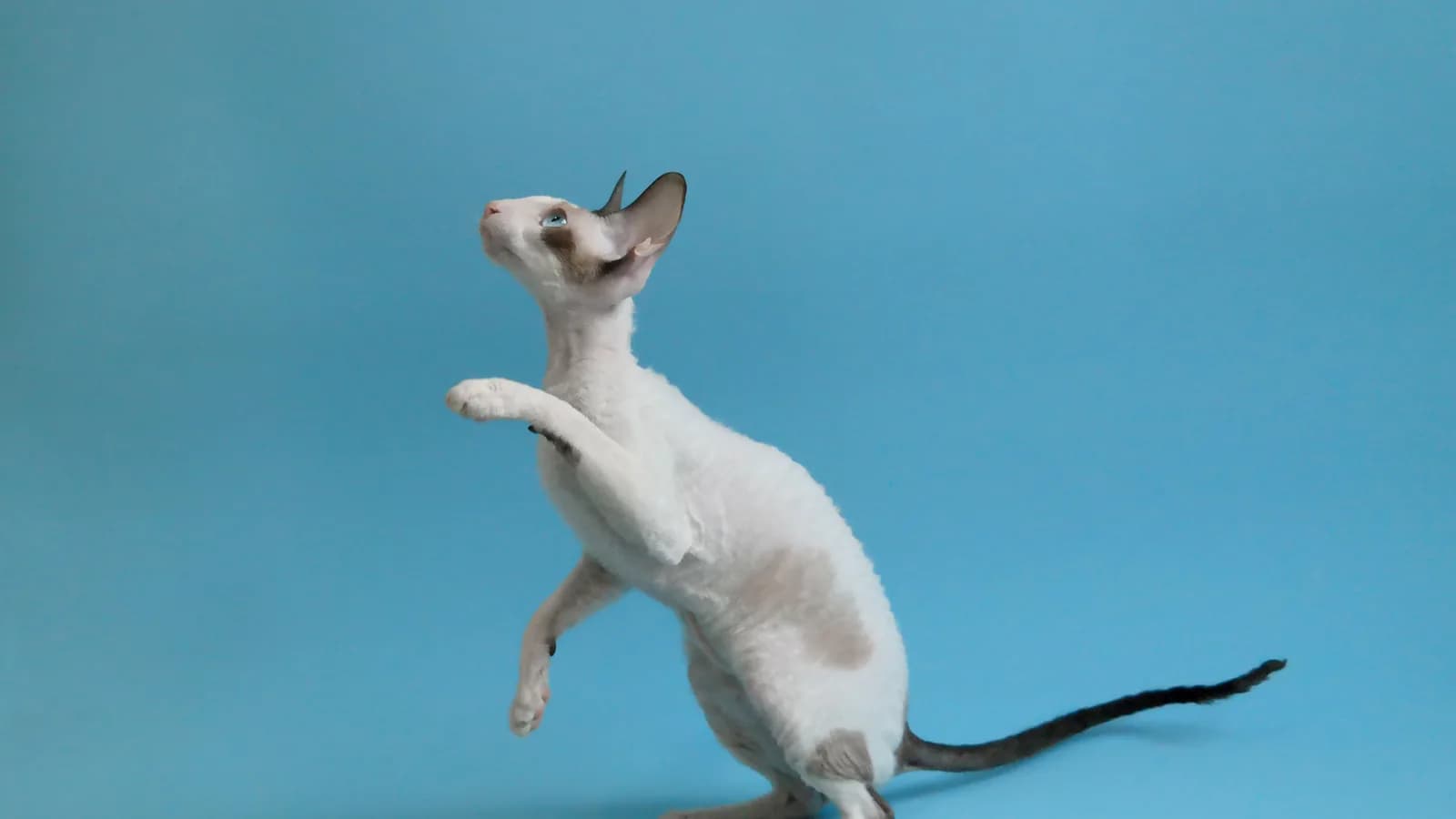
 Cornish Rex photos
Real photos, so you can see what the breed actually looks like: coats, ear tufts, ruff and build.
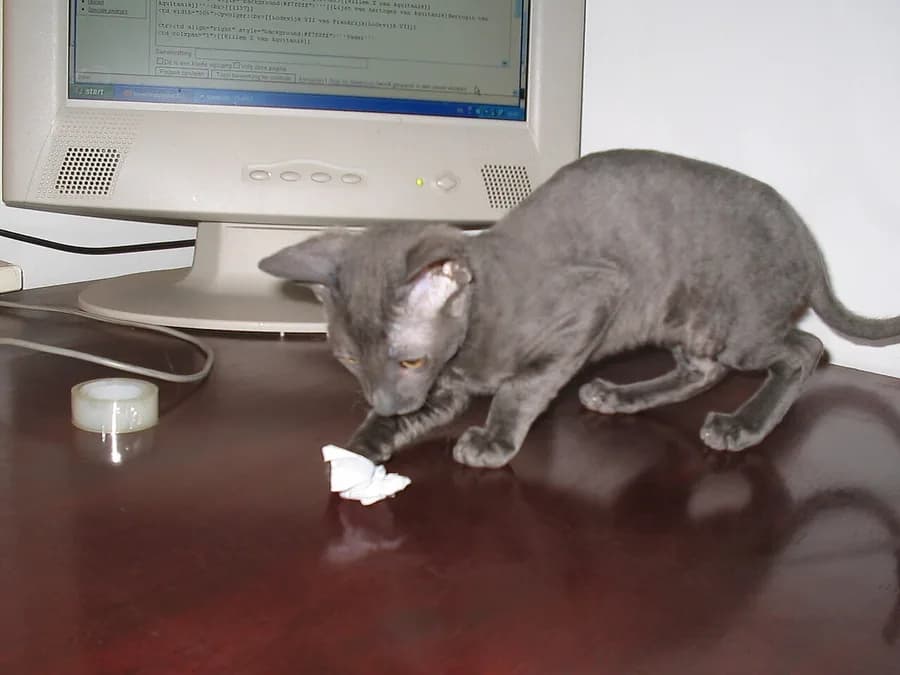
Cornish Rex playing at a desk, the slender frame in motion
Photo: M.Minderhoud · CC BY-SA 3.0 · via Wikimedia Commons
 Vital stats
Origin
Bodmin Moor, Cornwall, England: the breed descends from Kallibunker, a curly-coated kitten born in a farm litter of five on July 21, 1950, to a tortoiseshell-and-white named Serena. His own color is the fancy's oldest open dispute. and say cream, says red and white, and we print both.
Weight
Female
5-7 lb (2.3-3.2 kg)
Male
8-10 lb (3.6-4.5 kg)
Life expectancy
No measured life expectancy exists for this breed in any market. It is absent from the UK life tables by sample design. And 11-15 is the middle band of the pet-content convention, not a study figure ('s own 9-13+ sits lower, 's 16+ and WebMD's 15-20 higher; none cites a study). The one measured figure anywhere is a Swedish insured-population MORTALITY RATE: 475 deaths per 10,000 cat-years (126 deaths, 1999-2006), a whisker above that cohort's 462 average. A rate, never a lifespan.
Coats
Black
Black and white
White
Blue
Red tabby
Calico
Tortoiseshell
Cream
Color-open at every registry. says All. closes its exhaustive palette with an any-other-color class. scores color at zero points. permits any color or pattern, and allows everything except amber. Black is the most frequent color family in CFA's own titled-cats record, whatever the rare-black folklore says.
Understanding the coats (and their genetics)Size
No judging standard states a weight, and CFA publishes no figure anywhere. TICA's own prose says females average 5-7 lb and males 8-10 lb. The one measured cohort (Häggström 2025, n=1,430, the largest Cornish Rex sample ever weighed) puts the median at 3.1 kg (6.8 lb), IQR 2.6-3.6 kg. That is statistically inseparable from the Devon Rex's 3.0 kg. A fine-boned, arched, whippy cat: the muscle is real, the bulk never is.
Did you know
The whole breed once narrowed to a single cat. In 1956 the founding cattery culled most of its rexes. A vet then accidentally castrated Poldhu, one of the two remaining breeding males, while taking a tissue sample (losing the sample too, by 's own account). Every Cornish Rex alive traces through the one fertile male left in England, Sham Pain Charlie.
 Personality
 Affection5/5
 Energy5/5
 Intelligence4/5
 Friendliness5/5
 Independence1/5
 Vocal2/5
 Shedding1/5
Compatibility
 Good with children5/5
 Good with other pets4/5
 Apartment friendly4/5
Editorial ratings on our five-point scale, anchored in the registry descriptions and the measured behaviour studies cited on this profile; individual cats vary, and our members' own ratings below are the counterweight.
Still torn between this breed and another?Compare the Cornish Rex trait by trait, or filter every breed by what matters to you. What our members say
What our members say
Nobody has described their Cornish Rex here yet. As soon as the first profiles come in, this is where the community averages will show up: temperament, food, lifestyle.
Describe my Cornish Rex Pros & cons
Strong points
- Top-tier measured activity with a bold, sociable temperament (three Finnish datasets)
- The wave: a coat no other breed's gene produces, low-shedding by structure
- Measured LOW skin-yeast carriage: the greasy-rex stereotype fits the Devon, not this breed
- Color-open everywhere: no color restriction at any registry
- The UK's rdAc-PRA DNA test rule makes tested lineage easy to verify
Things to consider
- A genuinely high-energy cat: needs play and company, not a quiet ornament
- Thin single coat: seeks warmth, indoor life fits best
- Rare in practice: absent from CFA's popularity lists, 12 UK registrations in 2025
- No measured lifespan exists anywhere: the quoted ranges are conventions
- Australia publishes no prices: budgeting means inquiring
 Is a Cornish Rex right for you?
Someone home enough, and entertained enough, for a cat measured into the fancy's top activity tier: an acrobat that wants laps AND runways. Warm rooms, tall furniture, and a family that reads a quiet voice as conversation.
Is the Cornish Rex right for YOUR home?
Answer a few questions and we'll email you your personalized result.
Take the quiz · 2 min Getting to know the Cornish Rex
Start on a Cornwall farm in 1950. A tortoiseshell-and-white farm cat named Serena delivered five kittens on Bodmin Moor on July 21, 1950. One of them wore a coat nobody had seen on a cat: tight, even waves. Every registry agrees on the litter, the date and the place. What they still disagree on, seventy-five years later, is the kitten's color ( and say cream, says red and white; we print both accounts, attributed, and pick neither). The kitten was Kallibunker. On veterinary advice he was bred back to his mother: the curl bred true, recessive, and a breed began.
It nearly ended in 1956. Money ran short, and the founding cattery culled most of its cats. In 's own telling, a vet accidentally castrated one of the two remaining breeding males while taking a tissue sample. The breed squeezed through a single fertile male, Sham Pain Charlie, before outcrosses rebuilt it. The coat took 63 years to explain. In 2013 the mutation was found in LPAR6, a signalling-receptor gene: the first curly-coat mutation of its kind characterized in any animal besides humans.
The Devon Rex, the look-alike from the next county, runs on a completely different gene, and our comparison tells that whole two-gene story. The wave is also why the coat sheds so little: the mutation removes the guard hairs entirely. The cat inside the coat is a measured athlete. In all three Finnish behaviour surveys, the Cornish Rex keeps its own unmerged group.
It lands in the top activity tier (named first among the three highest-activity breeds by the 2019 study's own text), and sits at the bold end with strangers, with a quieter voice than its Siamese-adjacent silhouette suggests. And it is genuinely uncommon. Absent from 's last two most-popular lists while its Devon cousin ranks 5th, twelve registrations in 2025. If you meet one, you were lucky, and what one costs varies more by market than almost any breed we have priced.
 Health: what to watch for
A few predispositions are well documented. The good news: they can be screened for or avoided by choosing a reputable breeder and keeping an eye on the right signals.
This is information, not veterinary advice, and it cannot tell you what is wrong with your cat. Our rule is a simple one: if something is wrong with your cat, call your vet, and call an emergency clinic if it is out of hours. Nothing you read here is a reason to wait.
Progressive retinal atrophy (rdAc)
MODERATEThe breed's one mandatory-test condition, led by the registry's own rule. Since June 2022, GCCF requires a normal rdAc DNA result before a Cornish Rex can be registered for breeding in the UK. rdAc is a late-onset retinal degeneration; the DNA test makes it fully avoidable in tested lineage.
Symptoms to spot
Gradual night-vision loss in adult cats; a breeder-side genetics question long before it is an owner-observable one
How common
No Cornish-Rex-specific population rate published
Screening & prevention
Ask for both parents' rdAc results; in the UK the paperwork must exist
Genetic test
Yes: the rdAc DNA test, mandatory for UK Active-Register breeding since June 2022
Tooth resorption
MODERATEOne large Finnish case-control study measured the Cornish Rex at 2.44 times the odds of tooth resorption. Worth noting for how real the finding is: the same paper found NO elevated odds for the Devon Rex. This is a Cornish-specific signal, not a rex-family assumption.
Symptoms to spot
Drooling, dropping food, chattering jaw, reluctance to chew: any of these is a dental vet visit
How common
OR 2.44 in one Finnish case-control study (Vapalahti 2024)
Screening & prevention
Annual dental checks; ask the vet to chart resorptive lesions from young adulthood
Genetic test
No
Dystocia (difficult birth)
MODERATEThree studies from three eras give three different pictures of birthing difficulty in this breed. The newest, largest source itself explains the disagreement; we publish the spread rather than an average. Relevant to breeders; a neutered pet never meets this file.
Symptoms to spot
A breeding-side condition: prolonged unproductive labour is an emergency vet call, always
How common
Three studies, three framings, published with their scopes, never averaged
Screening & prevention
A breeder conversation: ask how the line's births have gone and what the plan is
Genetic test
No
Umbilical hernia (historical family study)
LOWA 1977 study described near-monogenic umbilical hernia inheritance in one Cornish Rex family, and no modern prevalence figure has ever followed it up. We carry it because it is the breed's literature, with its age stated: one family, one era, never re-measured.
Symptoms to spot
A soft swelling at the navel in a kitten: a routine vet check settles it
How common
None published since 1977; a single-family finding
Screening & prevention
Kitten check at the first vet visit, as for any breed
Genetic test
No
What the registries disagree about (HCM, patellas)
LOWTICA's material names HCM and patellar luxation as possible in the breed. CFA's page states the breed has no known inherited health issues. No peer-reviewed study settles it either way, so we print both registries' positions, attributed, and arbitrate neither. No Cornish Rex HCM mutation exists; echocardiogram, not a swab, is the only heart screen.
Symptoms to spot
For HCM: often none until late; breathlessness or sudden hind-limb weakness is an emergency
How common
No breed-specific rate exists in any study we reached
Screening & prevention
Breeding cats: periodic echocardiogram per breed-club practice; pets: routine vet auscultation
Genetic test
No: no validated Cornish Rex HCM mutation
The case-report file (rickets, drug reaction, mites)
LOWThree genuinely small things live in this breed's literature. One fully-treated vitamin-D-dependent rickets kitten case. One severe bleeding reaction after an off-label arthritis injection (history worth mentioning to a prescribing vet, never a warning against any treatment). And Demodex gatoi mite case series from two countries: itchy, transmissible between cats, and treatable. Single cases and small series, not breed-wide rates.
Symptoms to spot
Kitten limb swelling or odd gait; intense scratching with hair loss: both are vet visits, both treatable
How common
Case reports and small series only
Screening & prevention
Nothing special: report the breed and any drug history to your vet, as always
Genetic test
No
Go deeper on health
Prevention, warning symptoms, costs and insurance: our guides, researched and sourced.

The Cornish Rex also appears in
Our criteria-based guides, to compare this breed with the ones most like it.
 Grooming & living with one
Grooming
Almost none, gently. The guard-hairless wave needs no brushing beyond a soft weekly hand-over or grooming mitt, and over-grooming can break the fine coat. The greasy-rex folklore runs backwards here. The one measured study found LOW Malassezia yeast carriage (39% vs 50% in ordinary shorthairs and 90% in Devon Rex). So routine bathing is not a default requirement; ears and nails as for any cat.
Living together
Excellent with children and good with other pets by the measured tolerance findings: a bold, stranger-friendly cat that joins households rather than hiding from them. Its energy wants playmates; a second active cat is a feature.
 Food & diet
No breed-specific feeding study exists. The elevated-metabolism claim breeders repeat is unmeasured, and the breed appears in ordinary body-condition ranges in the cohorts that weigh it. Feed to body condition on a complete diet, per the standard frameworks (/), with the usual portion math on our tools.
 Price & budget
$950 to 3,500
Price of a kitten from a registered breeder, in the United States
This price reflects the quality of the breeding program: parents' health tests, registry pedigree, socialization. A very low price should raise a red flag. The real cost, though, plays out over the years.
Find a verified breederKitten price, by market
United States
$950 to 3,500
United Kingdom
£400 to 1,250
two independent live marketplaces sampled the same day (Pets4Homes £500-1,200, UKPets £400-1,250, clustering £850-1,050); retired adults £250-400 kept separate
Canada
CA$800 to 1,500
Kijiji, all 16 live listings read: 8 genuinely priced kitten listings $800-1,500, clustering $800-1,000; registry catteries publish no totals
Each figure is that country's real market price, researched separately, not a conversion of the others. The smaller line is only there so you can gauge one against your own money: European Central Bank reference rates of 2026-09-18, refreshed daily.
Work out your food budget
Type of food
Estimated monthly budget
$11
≈ 2.0 oz (57 g) per day
A ballpark figure, food only, using the same arithmetic as our portion tool (resting energy requirement × 1.2, a neutered adult). Real needs vary with age, activity level and body condition. Ask your veterinarian for advice.
 Verified catteriesThe registry-checked directory, plus a kitten alert near you. Filter it by breed.
 Should you insure a Cornish Rex?
Our sources list several predispositions in the Cornish Rex: Progressive retinal atrophy (rdAc), Tooth resorption, Dystocia (difficult birth), among others. A predisposition is not a foregone conclusion, and many of these cats live their whole lives without ever developing anything. It does change the nature of the follow-up, though: you monitor, sometimes for life, and it's that monitoring that weighs on a budget, more than a one-off accident.
One thing to weigh before deciding: this is a cat you will live alongside for well over a decade, and that is the span the real cost is spread across, premiums and care alike. Where a breed has a measured life expectancy that differs from the figure usually quoted, we say so in the lifespan section above rather than repeating the quoted one here.
 Cornish Rex cats in our community
No Cornish Rex here yet
Got one? Add a photo and yours gets to open this page.
 The vet's take

Veterinary review
Are you a vet?
Your professional read belongs here: every verified practitioner can leave a note, published once our editors have reviewed it.
Sign in and get your license number verified. We check it in the public register, we never ask for or keep a copy of your diploma, and your number is never published.
 Frequently asked questions
+Are Cornish Rex cats hypoallergenic?
No cat is, and no study has measured this breed's allergen levels. The guard-hairless coat sheds less than most, which some allergic owners find helps in practice; the Fel d 1 allergen itself is produced normally. Our hypoallergenic page carries the full honest answer.
+How much does a Cornish Rex cost?
US named catteries run $950 to $3,500 depending on the cattery's pricing model; UK live listings £400 to £1,250; Canada $800 to $1,500 on the marketplace; Australia publishes no prices at all, and quotes by inquiry. Our price page carries the market-by-market detail.
+How long do Cornish Rex cats live?
Honestly: no measured life-expectancy study covers this breed anywhere. 11 to 15 years is the commonly quoted convention, with TICA quoting lower (9-13+) and GCCF higher (16+); none of those figures comes from a study, and we label them accordingly.
+Do Cornish Rex cats shed?
Less than almost any coated breed: the LPAR6 mutation removes the guard hairs entirely, leaving the fine wavy undercoat. Less is not none, and the fine hair it does drop is easy to miss until it isn't.
+Are Cornish Rex and Devon Rex the same?
No: different genes entirely (LPAR6 vs KRT71), proven by test-crosses in 1961 and DNA in 2010-2013, and GCCF explicitly forbids crossing them. Our comparison page tells the two-gene story in full.
+Are Cornish Rex cats high-maintenance?
Grooming, no: a gentle weekly hand-over does it, and the greasy-rex reputation belongs to other breeds by the one measured study. Attention, yes: this is a measured top-activity, people-glued cat that wants company and play, not a quiet ornament.
+Why is my Cornish Rex always cold?
The single fine coat insulates less than a normal double coat, so warmth-seeking (laps, sunny spots, under blankets) is normal breed behaviour. Keep warm refuges available and let the cat choose; a cat that seems lethargic rather than warmth-seeking is a vet question, not a coat question.
+Are Cornish Rex cats rare?
Genuinely uncommon: absent from CFA's own last two most-popular-breed lists (while the Devon Rex ranks 5th), and GCCF registered just 12 in 2025, rank 37 of 66. Expect waiting lists, not shop windows.
+What color was the first Cornish Rex?
The registries still disagree: CFA and GCCF say Kallibunker was cream, TICA says red and white. Same litter, same date, same farm, two accounts; we print both and pick neither.
+Are Cornish Rex cats good with kids and other pets?
Yes by the measured findings: bold with strangers, tolerant of children and other pets in the Finnish survey data, and energetic enough to enjoy a busy household. An active playmate cat rather than a hide-under-the-bed one.
 Community questions
Got a question this page doesn't cover? Ask it: the best ones get published here with their answer.
Sources & references
Data checked against reference sources (TICA and CFA standards, genetics laboratories, veterinary schools).
- TICA: Cornish Rex breed
- TICA Cornish Rex breed standard (PDF)
- CFA: Cornish Rex breed
- CFA Cornish Rex show standard (PDF, revised 2023)
- CFA Cornish Rex Profile article (the 1956 bottleneck account)
- GCCF: Cornish Rex breed
- GCCF Cornish Rex Registration Policy (rdAc test rule, PDF)
- GCCF Cornish Rex Breeding Policy (PDF)
- Gandolfi et al. 2013, the LPAR6 discovery (PLoS One)
- Häggström et al. 2025, the measured weight cohort (JVIM)
- Egenvall et al. 2009, Swedish insured-cat mortality (J Vet Intern Med)
- Salonen et al. 2019, breed differences in behaviour (Sci Rep)
- Vapalahti et al. 2024, tooth resorption case-control (Vet J)
- Bond et al. 2008, Malassezia carriage in Cornish Rex, Devon Rex and DSH (Vet Dermatol)

Worth keeping a paw on
Pin this profile
To compare later, or to show someone still torn between two breeds. One click and it sits in your board.
Pin it on Pinterest
 Purr or Pass
Still deciding? Find the perfect breed for your home.
A quick quiz that factors in your lifestyle, your kids and your other pets.
Which breed fits my home?Keep exploring


The floor belongs to our members. Keep it kind, links are not allowed, and images go through moderation before anyone else sees them.