

Cat Dental Care: What Works, What Is Cosmetic, and the Numbers Behind It
The real prevalence curve behind the famous by-age-3 line, why every major veterinary body rejects anesthesia-free cleaning, and what actually keeps a cat's mouth healthy.

Published August 26, 2026Updated September 8, 2026 6 min read
Contents
Cat dental pages love one line: most cats have dental disease by age 3. We went looking for the study behind it, and here is the honest version: the line traces to a textbook aggregate for cats over 2, explicitly labeled an estimate, and it keeps circulating uncited, even in a 2026 journal paper. Meanwhile a real measurement exists, and almost nobody quotes it.
How common dental disease actually is, by age
The UK's program measured diagnosed periodontal disease across 18,249 cats in primary care:
| Age | Diagnosed with periodontal disease in one year |
|---|---|
| under 3 | 3.6% |
| 3 to 6 | 13.1% |
| 6 to 9 | 19.9% |
| 9 to 12 | 25.1% |
| 12 to 15 | 26.7% |
| 15 and over | 27.2% |
Overall: 15.2% in a year, with the median affected cat aged 9.5. That is diagnosed disease in real records, a conservative count, and the honest floor. Institutional estimates run far higher, Cornell's page says 50 to 90% of cats over 4 have some form of dental disease, but those pages cite no sample, and mild , which is extremely common and rarely makes it into a record, explains much of the gap. Both things are true: severe disease is a disease of age, and quiet early disease is everywhere.
The disease cats get that people do not
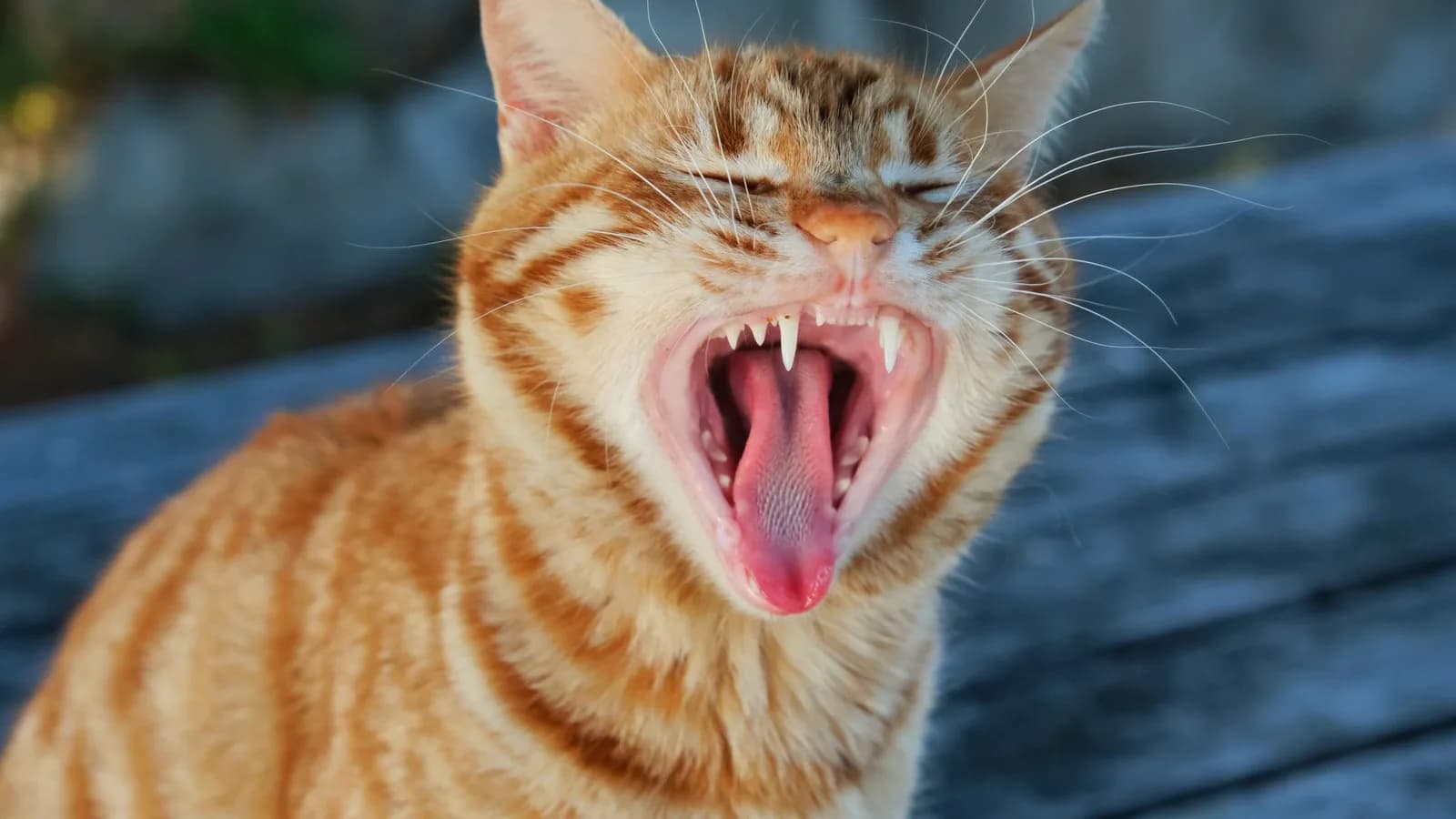
Cats do not develop human-style cavities. What they get instead is : the tooth's own structure dissolving from within, often below the gumline, staged as a progressive condition and, per the 2025 feline guidelines, often painful. Estimates run from roughly 20% to 70% of cats depending on the study, climbing with age and higher again in cats already at a dental clinic.
Two facts define it for an owner. It hides: the guidelines note it is not unusual for the caregiver to have noticed nothing at all. And it is the champion argument for dental X-rays: in the study cites, full-mouth radiographs found clinically important problems in 42% of feline teeth that looked completely normal to the eye.
The third condition worth naming is , a severe immune-driven inflammation spreading beyond the gums, affecting a pooled 10.9% of cats across studies spanning very different populations. It is intensely painful, and its most effective management, per the guidelines, is surgical, which is a conversation for a vet, not a shopping aisle.
The signs, shown and hidden
Cats mask oral pain; Cornell's dentist puts it down to the old wild logic that visible weakness makes you prey. So the list runs from obvious to indirect:
- Bad breath. The AVDC is categorical: healthy mouths do not have an odor, and what the smell is telling you sorts the dental cause from the kidney and metabolic ones.
- Red or swollen gums, pawing at the mouth, refusing hard food
- Chattering the jaw, tilting the head to chew on one side, dropping food, drooling
- Irritability, weight loss, a cat that stops enjoying being touched near the face
When to call the vet: any of the above is an appointment. A cat that stops eating is urgent whatever the cause. And the standing rule: if something is wrong with your cat, call your vet; out of hours, an emergency clinic. And if the main thing you are seeing is saliva, our guide to why cats drool sorts the harmless lap-bliss kind from the warning kind.
What a real dental procedure is
The professional standard, called a in North America and a scale and polish in the UK and Australia, is performed under general anesthesia with a protected airway: full cleaning above and below the gumline, probing of every tooth, and full-mouth X-rays. recommends a first complete procedure by age 1, an awake oral exam every 6 months, and its radiograph position is blunt: without full-mouth X-rays, the team must tell you the exam was not complete.
Anesthesia is also the part that scares owners most, and names that directly: fear of anesthesia is the single most common reason owners decline dental care. The guidelines' answer is not to skip the anesthesia but to do it properly, because the alternative below is not actually an alternative.
Anesthesia-free dentistry: what every major body says
This is the consumer-protection section of this page. Anesthesia-free scaling, scraping visible tartar off an awake cat, is formally rejected by the veterinary establishment of three of our four markets, in their own words:
- (US): "not appropriate," a "false sense of benefit," and removal of visible tartar alone is "purely cosmetic and ineffective to treat disease."
- AVDC (the US dental specialists): they refuse even the name, preferring "Anesthesia-Free Tooth Scraping," state that access "is impossible in an unanesthetized veterinary patient," and call the effect "purely cosmetic."
- (Canada): does not condone anesthesia-free or sedation-free dentistry.
- AVA (Australia): "purely cosmetic and does not identify dental disease."
The mechanism is simple: the disease lives below the gumline, where no awake cat will permit an instrument, and a whitened visible crown over an untreated infection is worse than nothing, because it looks like care. The UK's does not even address the practice; it simply describes the real procedure as requiring anesthetic, like your own dentist's deep clean would.
Home care, ranked by evidence
Daily brushing is the gold standard, in the identical words of both and the AVDC. The mechanics that make daily the operative word: plaque left on a tooth hardens into calculus within about 3 days, and a brush removes plaque only, never calculus. Use a cat-specific toothpaste, human toothpaste can be toxic to cats, build up over weeks, and do not brush already-inflamed gums into aversion; that is a vet visit first.
For everything else, the reference is the seal, and it is worth knowing what it actually certifies. The VOHC does not test products; it reviews submitted trial data against a stated bar: mechanical treats and diets must show at least a 15 to 20% reduction in plaque or tartar, and a brush product must perform at least as well as a real soft toothbrush used daily. Its public accepted-products list covers cat dental diets, treats, brushes and water additives, and it is the list to check instead of trusting a package's own claims: 's guideline states that many products claim tartar control and only the VOHC-accepted ones have met a preset standard.
Two subtractions complete the picture. Ordinary dry kibble is not a dental program; the evidence-backed claim belongs only to the tested diets. And sees no strong rationale for hard chews, antlers or bones, which can break the very teeth they are sold to clean. Even with perfect home care, 's own line is that many cats, particularly middle-aged and older, still need periodic professional scaling.
What it costs, market by market, honestly
| Market | What the named sources say |
|---|---|
| US | PetMD (2023 data): $113 to $600. MetLife (2024): $100 to $400. Chewy (2025): $300 to $680+, extractions extra. Three named sources, roughly 3x apart; we show all three rather than invent an average |
| UK | , on two separate dated pages, gives no figure: "several hundreds of pounds, depending on the problem" |
| Canada | the only hard number found is OVMA's 2025 provincial average of $1,320 a year for professional dental care in Ontario, an annual line, not a per-cleaning price |
| Australia | no fixed figure published by RSPCA, the AVA or the Sydney teaching hospital, which quotes per cat after assessment |
The asymmetry is itself the finding: dental pricing is quote-based almost everywhere, so a page promising you "the" price of a cat dental is quoting nobody.
What to take away
- Cats do not get human-style cavities; their disease is , painful, hidden below the gumline, and common enough to find in a substantial share of cats.
- Healthy cat mouths do not smell: persistent bad breath is the most dismissed early sign of dental disease.
- Anesthesia-free "cleanings" are cosmetics: dental X-rays found significant problems in 42% of feline teeth that looked normal, and , the AVDC, the and the AVA all require anesthesia for real dental work.
- Ordinary kibble does not clean teeth; only diets and treats carrying the seal have measured plaque or tartar reductions.
- 's schedule: an awake oral exam every 6 months and a first full anesthetized cleaning with X-rays by age 1.
- Costs are quote-based everywhere: named US sources run about $100 to $680+, Ontario's association publishes CA$1,320 as a provincial annual average, and extractions move every figure substantially.
The breeds most affected
In our breed profiles, this predisposition is documented and sourced for:
 The vet's take

Veterinary review
Are you a vet?
Your professional read belongs here: every verified practitioner can leave a note, published once our editors have reviewed it.
Sign in and get your license number verified. We check it in the public register, we never ask for or keep a copy of your diploma, and your number is never published.
Frequently asked questions
Do cats get cavities?
No, not the human kind. The cat-specific problem is tooth resorption, the tooth dissolving from within, painful, hidden below the gumline, and found in a substantial minority to majority of cats depending on the study and age.
Is bad breath normal in cats?
No. The dental specialists' line is that healthy mouths do not have an odor. Persistent bad breath is the single most dismissed early sign of dental disease.
Is anesthesia really necessary for a dental cleaning?
For anything beyond cosmetics, yes, and that is the formal position of AAHA, the AVDC, Canada's CVMA and Australia's AVA. The disease lives below the gumline, an awake cat cannot be probed or X-rayed there, and the guidelines' own number makes the case: X-rays found significant problems in 42% of feline teeth that looked normal.
Does dry food keep teeth clean?
Ordinary kibble, no. Specific dental diets and treats that carry the VOHC seal have demonstrated a measured plaque or tartar reduction; the seal, not the marketing, is the tell.
How often should my cat's teeth be checked?
AAHA's schedule: an awake oral exam every 6 months, a first full anesthetized cleaning with X-rays by age 1, then as your vet advises from what those exams find.
How much does a cat dental cost?
It is quote-based nearly everywhere. Named US sources range from about $100 to over $680 depending on year and what is included; the UK's PDSA says only "several hundred pounds"; Ontario's association publishes $1,320 as an annual provincial average. Extractions move any of these numbers substantially.
 Community questions
Got a question this page doesn't cover? Ask it: the best ones get published here with their answer.
This is information, not veterinary advice, and it cannot tell you what is wrong with your cat. Our rule is a simple one: if something is wrong with your cat, call your vet, and call an emergency clinic if it is out of hours. Nothing you read here is a reason to wait.
Medical information applies to every reader. Prices, legal duties and common practice do not: unless stated otherwise, they are given for the United States, and they differ in the UK, Canada and Australia, and often between states or provinces. Check with your own vet and your own local authority.
Our sources
- 2019 AAHA dental care guidelines for dogs and cats (read in full)
- AVDC position statement on anesthesia-free dentistry, adopted April 2024
- AVDC, pet periodontal disease (owner education)
- 2025 FelineVMA feline oral health and dental care guidelines (read in full), J Feline Med Surg
- O'Neill et al 2023, periodontal disease in cats under primary veterinary care in the UK (18,249 cats; the age curve), J Feline Med Surg
- Cornell Feline Health Center, feline dental disease
- Cornell Feline Health Center, tooth resorption
- Veterinary Oral Health Council: what the seal certifies, and the accepted products list
- Canadian Veterinary Medical Association, veterinary dentistry position statement (October 2022)
- Australian Veterinary Association, anesthesia-free dentistry in dogs and cats (policy)
- PDSA, dental disease in cats (February 2023)
- PetMD, how much does a cat teeth cleaning cost (2023 figures, vet reviewed)
- Chewy, cat teeth cleaning guide (2025 cost figures)
- MetLife Pet Insurance, cat teeth cleaning cost (2024)
- Ontario Veterinary Medical Association, cost of care, feline 2025 (professional dental care as an annual provincial average)

Worth keeping a paw on
Pin this guide
So you can find it the day you need it, and share it with someone whose cat does the same thing. One click and it sits in your board.
Pin it on PinterestAlso worth reading
All health →
Article
Overweight Cat: How to Tell Honestly, and What Actually Works
How to read your cat's body honestly, the owner blind spot science has named, and the real success rates of weight-loss plans, dropouts included.
Read
Article
Fleas on Cats: You Are Not Fighting the Fleas You Can See
One flea on your cat means an infestation in your home, and even a perfect product needs 2-3 months. The honest plan, and the dog-product mistake that kills cats.
Read
Article
Can You Spay a Cat in Heat? Yes, and Here Is What Changes
Vets spay cats in heat every day. The one study that measured it found no extra bleeding; what changes is the bill, and only where you live decides by how much.
Read
The floor belongs to our members. Keep it kind, links are not allowed, and images go through moderation before anyone else sees them.