

Fleas on Cats: You Are Not Fighting the Fleas You Can See
One flea on your cat means an infestation in your home, and even a perfect product needs 2-3 months. The honest plan, and the dog-product mistake that kills cats.

Published August 27, 2026Updated September 8, 2026 10 min read
Contents
Here is the fact that explains every failed flea battle, stated plainly by the UK charity International Cat Care: 95% of fleas are in the home, not on the cat. The fleas you comb off are the adults; the eggs, larvae and cocoons are in your carpet, your sofa seams and your cat's bedding, on a conveyor belt weeks long. That is why the veterinary manual's most useful sentence on this subject is also its most deflating: even if the product you use is 100% effective, complete control of an existing infestation typically takes 2 to 3 months, because of the life stages already seeded in the environment.
So this page is a plan with three fronts, in order: confirm, treat the cat, treat the home. Plus the one warning that outranks everything else here, because it kills cats every year: never, under any circumstances, use a dog flea product on a cat.
First, confirm it: the wet paper test
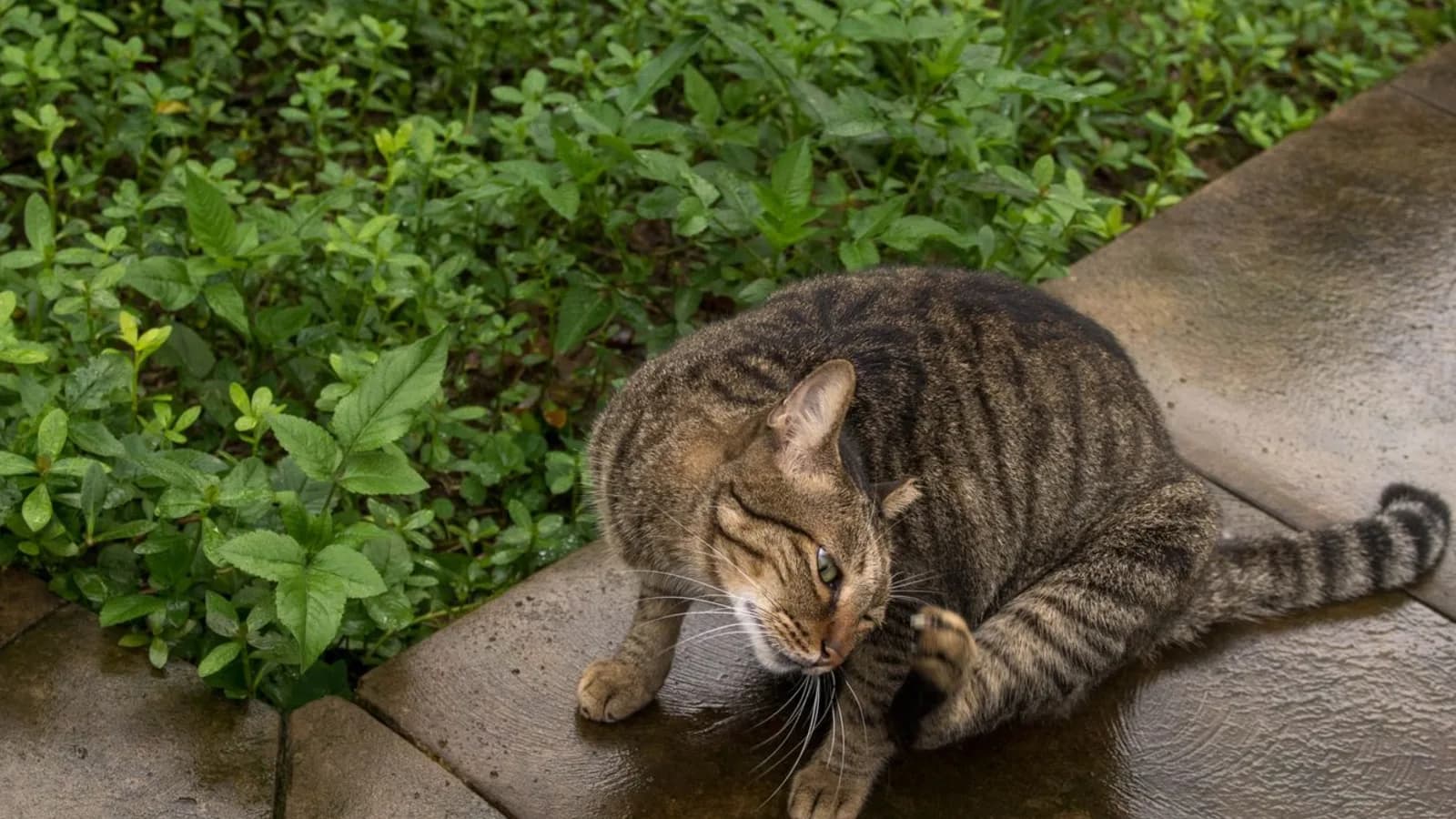
Run a fine-toothed flea comb through the coat, especially over the rump and neck, and tap the combings onto a damp white paper towel. Live fleas are brown, fast and unmistakable. The subtler tell is flea dirt: black specks that look like ordinary grime until the damp paper haloes them red-brown, because flea dirt is digested blood. A red halo is a positive test even if you never see a single live flea. Both CAPC, the parasite council that writes the US veterinary guidelines, and International Cat Care describe this same technique.
Know the enemy's clock
The numbers below are why half-measures fail, drawn from the Merck veterinary manual and the CAPC guideline:
- A female flea starts feeding within about 5 minutes of landing on your cat, starts laying within a day or two, and can lay 40 to 50 eggs per day at peak, averaging 27 a day for 50 days.
- The eggs do not stay on the cat: they fall off within hours, wherever the cat goes. Your cat is a salt shaker of flea eggs, and the map of where it sleeps is the map of the infestation.
- Egg to adult can take as little as 12 to 14 days in warm humid conditions, and typically runs 3 to 8 weeks in a household.
- The cocoon is the armored stage: a developed adult can sit inside it, waiting, for up to 30 weeks, emerging when it feels the vibration, warmth and breath of a passing host. This is why homes "get fleas back" weeks after everything seemed clear, and why a newly moved-into empty house can bloom with fleas when people and pets arrive.
- The vulnerabilities: humidity below 50% kills larvae, and no life stage survives several days below 3 C (37 F).
Front one: treat the cat, with a cat product, on schedule
Modern veterinary flea treatments, the monthly spot-ons, tablets and long-acting products your vet prescribes or recommends, are genuinely effective, and the science says the common fear of "resistance" is mostly misplaced: a major review of the field found little evidence of resistance to the modern on-animal and oral treatments despite decades of use, with monitoring across Australia, Europe and 29 US states confirming fleas stayed susceptible to one of the most-used actives, and most perceived product failures traced to compliance and application problems, not resistant fleas. The product did not fail; the calendar did, or the environment was never treated. The same monthly spot-ons that cover fleas also cover the mite behind most itchy, dirty-looking ears, which is one reason cats on a routine turn up with ear mites less often.
Three practical truths the packaging rarely explains:
- You may keep seeing fleas for weeks, and that is not failure. Most treatments are not repellents. New fleas from the home environment jump on, live for hours before the product kills them, and are visible in that window. The manual is explicit that occasional flea sightings on a treated pet can continue for up to 8 weeks while the environmental infestation burns out.
- Every animal in the house gets treated, on the same schedule, or the untreated one becomes the flea nursery that reinfests everyone.
- Where you buy matters by market. In the US, oral flea products are FDA-regulated drugs while most topical spot-ons are EPA-regulated pesticides; in the UK, products range from general-sale to prescription tiers; Canada and Australia run their own registration systems. In all four markets the same rule holds: a product labeled for cats, dosed for your cat's weight, on the label's schedule.
We deliberately name no brands on this page: the right product depends on your cat's age, weight, health and what else it needs covered (worms, ticks, mites), and that is a one-minute conversation with your vet or pharmacist.
The warning that outranks everything: dog products kill cats
Many dog spot-on treatments contain at 45 to 65% concentration. Cat-safe products, where permethrin appears at all, use a fraction of a percent. The difference is not marketing: a cat's liver lacks an enzyme needed to break permethrin down, so a dose a dog shrugs off accumulates in a cat as a neurotoxin. Regulators state plainly that even one drop from a dog pipette, or licking an empty packet, may be lethal to some cats, and the minimum lethal dose in cats has never been established, which is a scientific way of saying there is no known safe amount.
The pharmacovigilance data is grim and specific. In the Australian regulator's case series, three-quarters of poisonings happened because an owner applied the dog product directly to the cat, the rest mostly through close contact with a freshly treated dog, and 23% of the affected cats died. UK surveillance from 2000 reported that 37% of exposed cats died. The signs: trembling, twitching, oversensitivity to touch and sound, drooling, staggering, and in severe cases seizures. Onset is usually within hours but can be delayed up to 72 hours. Drooling on its own has many gentler explanations, our drooling guide walks the full list, but drool plus trembling after any contact with a dog flea product is this emergency until proven otherwise.
The rules that follow:
- Never apply any dog product to a cat, not a partial dose, not "just this once." The US EPA's own guidance says exactly this.
- In a dog-and-cat household using a product on the dog, keep the cat away from the dog for 72 hours after application, and prevent the cat grooming the dog.
- If exposure happens: wash the product off with water and mild detergent, and go to a vet immediately, packaging in hand. Treated early, most cats recover fully within days; the deaths concentrate in the cases that waited.
Front two: treat the home, where the 95% lives
- Vacuum like it is medicine, because measurably it is. In an Ohio State University study, vacuuming killed 96% of adult fleas and 100% of eggs, larvae and pupae pulled in, the researchers concluding a vacuum ride is "probably a one-way trip"; the brushes abrade the flea's waxy coating and it dehydrates. Vacuum daily where the cat sleeps and lounges, get under furniture and into crevices, and bin the bag or canister contents outside immediately.
- Hot-wash everything the cat sleeps on: blankets, throws, bed covers, the sofa cushion covers. A heavily infested cat bed is sometimes cheaper to discard than to sanitize.
- Keep it up for months, not days. The cocooned generation emerges on its own stubborn schedule; the guideline's own wording is that moderate to severe infestations may take several months to bring under control. Household insecticide sprays and foggers exist for serious infestations, and in the UK the regulator makes a point worth repeating everywhere: those household products often contain and must never be used on the animal itself.
One more honest note from the field studies: with the modern systemically acting products used correctly on every pet, many infestations resolve without any premises insecticide at all, on the same 2-to-3-month clock. The vacuum and the washing machine shorten the siege either way.
What not to use: the "natural" shortcuts that poison cats
No source we reviewed found any measured flea-killing efficacy for garlic, onion or essential oils. What the toxicology literature does document is the harm:
- Garlic and onion damage cats' red blood cells; cats are the most susceptible species, toxicity has followed less than a teaspoon of cooked onion, and the frightening part is the delay: a poisoned cat can look fine on day one, with the blood damage peaking around day three.
- Essential oils, including tea tree, peppermint, citrus, eucalyptus, cinnamon, clove and pine oils, are absorbed through a cat's skin and poorly cleared by its liver. Poison-line casebooks list drooling, tremors, wobbliness, breathing trouble and liver failure. "Natural" is not a safety category.
What fleas do beyond the itch
- Flea allergy dermatitis is the most common allergic skin disease of cats: some cats react to flea saliva itself, so a handful of bites produces crusty "millet seed" scabs, bald patches from overgrooming and raw skin, classically concentrated over the back, the tail base and the thighs, a distribution our cat losing hair guide maps against the other causes of hair loss. For these cats, rigorous year-round prevention is not optional.
- Anemia in kittens: both major guidelines warn that heavy infestations can cause iron-deficiency anemia and death, particularly in young animals. A heavily flea-ridden kitten with pale gums is an emergency, not a bath appointment.
- Tapeworms ride in on fleas: a cat that swallows an infected flea while grooming gets Dipylidium, the "cucumber seed" tapeworm, which is why worming without flea control is a revolving door. Our cat worms guide covers that half, and the flea-control requirement is written into the parasite council's own treatment guidance.
- Fleas bite people too, typically around the ankles as new fleas emerge hungry from the carpet, and cat fleas can transmit the bacteria behind cat scratch disease between cats and, via scratches, to people.
Ticks: the shorter, sharper problem
Cats pick up ticks less often than dogs, partly thanks to fastidious grooming, but the checks and the technique matter, especially for outdoor cats.
- Removal: use fine tweezers or a tick tool with gloved hands, grip as close to the skin as possible, and pull slowly, steadily, straight back, without twisting, jerking or crushing. Speed genuinely matters for some infections: certain bacteria can transfer within 3 to 6 hours of attachment, while other pathogens need 36 to 72 hours of feeding, so a tick found and removed today is a risk genuinely reduced.
- A tick on a treated cat is not product failure: with the modern oral and spot-on tick products, the tick has to bite to meet the drug, so an attached tick on a protected cat is usually a dying tick.
- Australia has its own emergency: the paralysis tick of the east coast, whose toxin causes progressive weakness, voice change, wobbliness and breathing difficulty, with a spring peak and cases year-round. The reassuring number from the largest study, 2,077 cat cases across Queensland emergency clinics: treated mortality was about 3%, and the study's own conclusion calls the risk for treated cats low. The catch is the word treated: signs in cats start subtle, and a coastal Australian cat that seems weak, wobbly or oddly quiet needs a vet immediately, not observation.
What to take away
- 95% of a flea infestation lives in the home as eggs, larvae and cocoons, not on the cat (International Cat Care).
- Even a 100% effective product typically needs 2 to 3 months to clear an established infestation, and occasional flea sightings for up to 8 weeks are not product failure (Merck).
- The wet-paper test settles it: comb the cat, tap onto damp white paper; black specks that halo red-brown are flea dirt, digested blood.
- Dog spot-ons with 45 to 65% kill cats: one drop can be lethal, 23% of poisoned cats died in the Australian case series, and a permethrin-treated dog stays off-limits to cats for 72 hours.
- Vacuuming is measurably lethal to fleas: 96% of adults and 100% of immature stages in the Ohio State study.
- Garlic, onion and essential oils have no measured flea-killing efficacy and are documented cat poisons.
 The vet's take

Veterinary review
Are you a vet?
Your professional read belongs here: every verified practitioner can leave a note, published once our editors have reviewed it.
Sign in and get your license number verified. We check it in the public register, we never ask for or keep a copy of your diploma, and your number is never published.
Frequently asked questions
How do I know if my cat has fleas?
Flea-comb the rump and neck over a damp white paper towel. Live fleas are definitive, and so are black specks that halo red-brown on the damp paper: that is flea dirt, digested blood. Itching, overgrooming, scabs around the neck and tail base, and bites around human ankles all point the same way.
I treated my cat and I still see fleas. Did the product fail?
Almost certainly not. Treatments kill fleas that jump on; they do not build a force field, and the home keeps producing new fleas for weeks. The veterinary manual expects occasional sightings for up to 8 weeks, and full control of an established infestation in 2 to 3 months even with a perfectly effective product. Failure usually means a missed dose, a missed pet, or an untreated home.
Can I use dog flea treatment on my cat?
No, never, in any amount. Many dog spot-ons are 45 to 65% permethrin, which cats cannot metabolize; a single drop can be lethal, roughly a quarter of poisoned cats in the Australian regulator's case series died, and there is no established safe dose. Keep cats away from a permethrin-treated dog for 72 hours too.
How long does it take to get rid of fleas?
Two to three months is the honest, source-backed answer for an established infestation, because eggs, larvae and cocooned adults keep hatching from the home long after the cat is protected. The cocoon stage alone can wait 30 weeks. Consistency beats intensity: every pet, every dose, on time, plus vacuuming.
Do natural flea remedies like garlic or essential oils work?
No efficacy has been measured for any of them, and the toxicity is real: garlic and onion destroy feline red blood cells at teaspoon quantities, and essential oils like tea tree, peppermint and citrus can cause tremors and liver failure in cats. They are poisons that do not kill fleas.
How do I remove a tick from my cat?
Fine tweezers or a tick tool, gloves on, grip at skin level, and pull straight back slowly without twisting or crushing. Removing ticks promptly genuinely cuts infection risk, since some pathogens need a day or more of feeding to transfer. In coastal eastern Australia, any weakness, voice change or wobbliness after a tick is an emergency vet visit.
 Community questions
Got a question this page doesn't cover? Ask it: the best ones get published here with their answer.
This is information, not veterinary advice, and it cannot tell you what is wrong with your cat. Our rule is a simple one: if something is wrong with your cat, call your vet, and call an emergency clinic if it is out of hours. Nothing you read here is a reason to wait.
Medical information applies to every reader. Prices, legal duties and common practice do not: unless stated otherwise, they are given for the United States, and they differ in the UK, Canada and Australia, and often between states or provinces. Check with your own vet and your own local authority.
Our sources
- CAPC (Companion Animal Parasite Council), fleas guideline
- Merck Veterinary Manual (professional), fleas in dogs and cats (the life-cycle figures and the 2-3 month control timeline)
- Merck Veterinary Manual (professional), flea allergy dermatitis in dogs and cats
- UK Veterinary Medicines Directorate, permethrin: don't put your cat at risk (the pharmacovigilance tables)
- Linnett 2008, permethrin toxicosis in cats (Australian Veterinary Journal, on behalf of the APVMA)
- US EPA, EPA's regulation of flea and tick products
- Leister et al 2018, tick paralysis in 2,077 cats caused by Ixodes holocyclus (JFMS)
- Rust et al 2018, the biology and ecology of cat fleas and advancements in their pest management: a review (Insects)
- CAPC, ticks guideline (removal technique and transmission timing)
- CAPC, Dipylidium caninum guideline (the flea-tapeworm cycle)
- Merck Veterinary Manual, garlic and onion (Allium spp) toxicosis in animals
- International Cat Care, fleas and flea control in cats (the 95% figure)
- International Cat Care, permethrin poisoning
- Pet Poison Helpline, essential oils and cats
- Ohio State University via ScienceDaily, cat fleas' journey into the vacuum is a one-way trip (Hink and Needham)
- University of Sydney veterinary hospitals, ticks on cats (the Australian paralysis-tick signs)

Worth keeping a paw on
Pin this guide
So you can find it the day you need it, and share it with someone whose cat does the same thing. One click and it sits in your board.
Pin it on PinterestAlso worth reading
All health →
Article
Can You Spay a Cat in Heat? Yes, and Here Is What Changes
Vets spay cats in heat every day. The one study that measured it found no extra bleeding; what changes is the bill, and only where you live decides by how much.
Read
Article
Neutering a Cat, Male or Female: The Right Age, What It Costs Where You Live, and How Recovery Goes
Spay, neuter, desex: one operation, four vocabularies. The age advice changed in 2016, the law differs by state, and the price depends on where you live. Sourced, market by market.
Read
Article
Ear Mites in Cats: Why Nothing Kills Them Instantly
A mite the size of a pinhead, more than a thousand per ear, and no product that reaches the eggs. What ear mites look like, how cats catch them, and why a month is the honest clock.
Read
The floor belongs to our members. Keep it kind, links are not allowed, and images go through moderation before anyone else sees them.