

Neutering a Cat, Male or Female: The Right Age, What It Costs Where You Live, and How Recovery Goes
Spay, neuter, desex: one operation, four vocabularies. The age advice changed in 2016, the law differs by state, and the price depends on where you live. Sourced, market by market.

Published August 28, 2026Updated September 8, 2026 15 min read
Contents
Neutering a cat means one thing everywhere and is called three different things depending on where you stand. In the United States and Canada a female is spayed and a male is neutered. In the United Kingdom, neutering is the word for both sexes, split into spaying and castration. In Australia the whole subject is . The operation is the same, the reasons are the same, and the age advice moved in 2016 in a way that a lot of clinic websites still have not caught up with.
This guide covers both sexes and all four countries: what the surgery is, when to do it and who says so, where the law decides for you, what it costs from real published fee schedules, and what the first two weeks of recovery look like. Every price carries its currency and its source, because a converted number is not a price anyone will be charged.
One operation, four vocabularies
| Where you live | The female operation | The male operation | The everyday umbrella word |
|---|---|---|---|
| United States | Spay ( or ) | Neuter () | "Fixed," used by clinics and owners, not by the veterinary bodies |
| Canada | Spay | Neuter | "Spayed or neutered" (the 's own phrasing); Toronto's bylaw calls both "sterilization" |
| United Kingdom | Spaying | Castration | Neutering, for either sex (Cats Protection, ) |
| Australia | Spaying | Castration | Desexing (RSPCA); the statutes vary: WA says "sterilised," the ACT hyphenates "de-sex" |
The 's definition is the cleanest one-liner: spaying removes a female's uterus and ovaries, neutering removes a male's testicles. Cats Protection says the same thing from the other side of the Atlantic with the UK word: "Neutering is an operation to prevent female cats from getting pregnant and male cats from making females pregnant." Only the labels travel badly.
What the surgery actually is
A spay is abdominal surgery under general anesthesia. Through a small incision on the midline of the belly, the surgeon removes both ovaries and the uterus (an ) or the ovaries alone (an ). Merck's veterinary manual notes that the ovariectomy is becoming more popular because it means less surgery time, a smaller incision and less trauma, with "no difference in short or long-term complications" found between the two. Skin sutures, where used, come out after seven to ten days, and most cats go home within 12 to 24 hours.
A castration is shorter and simpler: both testicles are removed through small incisions in the scrotum, which are usually left unsutured because stitches irritate that skin. The lists the less common alternatives too, a hysterectomy that leaves the ovaries or a vasectomy, neither of which stops the hormones or the behaviors that come with them.
Two details worth knowing before the day. Many vets set a weight floor, often 1 kg (2.2 lb), below which they will not operate, because that weight is taken as a sign of mature liver function. And in some cats, notably Siamese, the shaved patch grows back darker for a while, a skin-temperature effect that VCA says usually grows out with the next molt.
The right age is a dated decision, not a timeless fact
Ask three reputable pages when to spay a cat and you can get three answers, and the reason is the calendar. On January 15, 2016, a veterinary task force on feline sterilization met in Orlando and called on practitioners and their associations to recommend sterilizing cats by five months of age. The formally endorsed it in June 2017, and the , , the Association of Shelter Veterinarians, the and all signed on. The AAFP's 2020 position statement adds the reason in one sentence: a cat can be reproductively active as early as four to five months, sometimes without obvious signs.
Older client-education pages are still live and still say something else. VCA's spay page opens with "traditionally, cats are spayed at six months of age." Cornell says a female should be spayed before her first heat and that castration is "preferably performed at three to six months." Those pages are not wrong so much as older than the consensus they sit beside, and the 's current page makes the correction explicit: there is "no known benefit to delaying the spay procedure until a female dog or cat has gone through their first heat cycle."
| Market | Recommended age | Who says so, and when | The older figure you may still meet |
|---|---|---|---|
| United States | By 5 months | task force (2016), endorsement (2017), (2020) | 6 months, or "before the first heat" (VCA, Cornell client pages) |
| Canada | By 5 months | position statement (December 2024) | Same US legacy copy |
| United Kingdom | Around 4 months (16 weeks) | The Cat Group (since 2006), Cats Protection, (2022), BVA/BSAVA (feline advice left unchanged in the March 2026 update) | 6 months, "the traditional age" the UK bodies moved away from |
| Australia | Before 4 months (before 16 weeks) | RSPCA Australia (updated November 2025), AVA policy (ratified July 2022); RSPCA Victoria's own page says 8 to 12 weeks | The AVA notes vets had already dropped to a 3.4-month average for queens in a 2012 survey |
The evidence behind the earlier age is older than the policy. Howe and colleagues followed 263 shelter cats for a median of 37 months and found that sterilizing before 24 weeks did not increase infectious disease, behavior problems or problems in any body system, and did not change how many cats stayed in their adoptive homes (JAVMA, 2000). Spain, Scarlett and Houpt looked back at 1,660 cats over up to 11 years: cats neutered before 5.5 months were not more likely to die, be given up, or develop any serious medical or behavioral condition, and the authors recommended routine surgery "before the traditional age of 6 to 8 months" (JAVMA, 2004). Cat-Kind's UK evidence summary reaches the same conclusion in one line: similar physical and behavioral development, no greater surgical or anesthetic risk, compared with six months or older.
Owners lag the advice. Cats Protection's 2015 survey found only 4% of UK owners neutered at or before four months, and 22% believed it was cruel to do it that young. The survey is eleven years old, and the charity's 2025 report says neutering numbers are now falling as younger owners of cats want litters, so the gap has not closed on its own.
Where the law decides for you
In the United States, no federal or state law requires that an owned cat be sterilized; the pressure is through shelters, which routinely operate before adoption. England's 2024 law is about microchipping, not neutering. Canada has no federal or provincial mandate, but Montreal requires every cat, dog and rabbit over six months to be spayed or neutered unless it is a registered breeding animal or a vet certifies a medical delay (city page dated February 2026); Toronto and Calgary simply charge more to license an unaltered animal.
Australia is where "is compulsory?" has six answers, and most pages flatten them into one. This table names the jurisdiction in every row, because the rule stops at the border.
| Jurisdiction | The rule | Where it is written |
|---|---|---|
| ACT | A cat 3 months or older must be de-sexed unless the owner holds a permit (breeding, show or health grounds); 50 penalty units; selling an undesexed cat of 3 months or more without a permit is a separate offence | Domestic Animals Act 2000, s 74 and 74A |
| Western Australia | A cat that has reached 6 months must be sterilised by a vet, $5,000 fine; exemptions for a vet health certificate or an approved breeder; the vet issues a certificate of sterilisation | Cat Act 2011, s 18 and 21 |
| Tasmania | A cat over 4 months must be desexed and marked inside the left ear; up to 20 penalty units; selling a cat under 8 weeks or undesexed is an offence unless the buyer is a registered breeder | Cat Management Act 2009, s 14 and 15 (in force since March 2022) |
| South Australia | Cats born after 1 July 2018 must be desexed before 6 months, or within 28 days of taking possession; expiation fee $170; exemptions for registered cat-fancy and DACO-registered breeders and vet certificates | Dog and Cat Management Act 1995 as restated by the Dog and Cat Management Board (the statute text itself was not reachable for this guide) |
| Victoria | No state mandate. A council may refuse to register an undesexed cat after a gazetted date, with exemptions for registered breeders, members of applicable organisations and vet advice | Domestic Animals Act 1994, s 10A and 10B |
| New South Wales | No mandate. An undesexed cat of 4 months or older needs an annual permit, $104 in the 2026-27 fee year, with a two-month grace period; the permit lapses once the cat is desexed | Companion Animals Act 1998, s 11B; NSW Office of Local Government fee page (July 2026) |
Queensland and the Northern Territory are described as not mandatory by RSPCA Australia's own summary table (current to May 2023), which is where our knowledge of those two stops. And the strangest fact on this page belongs to the Australian Veterinary Association, which supports early and, in its 2022 policy, doubts the laws work: mandatory desexing of privately owned animals "has not been shown to substantially reduce the unwanted dog and cat population to date," because for cats most of the oversupply comes from semi-owned and unowned animals, and 75 to 90% of breeding animals would need to be desexed to halt growth.
What it costs, market by market
The honest version of this section is that the price of a cat spay or neuter is a local number, and the pages that rank for the question are fee schedules from named clinics. We publish those, each with its currency, its place and its date, and we never convert one into another.
United States (USD). Nonprofit and municipal clinics publish the clearest figures. The Alabama Spay Neuter Clinic in Irondale lists a cat spay at $120 and a neuter at $95, flea treatment included. SNAP Houston, effective December 9, 2024, charges $110 for a spay (with a pain injection, take-home pain medication and a cone) and $95 for a neuter. The Nebraska Humane Society in Omaha lists $80 and $70. The Humane Society of Southern Arizona in Tucson lists $95 and $90. The 's own one-time estimate is $150, from a page last updated in 2021. No private-practice range with a stated method was found anywhere: the $300 to $500 figures that circulate online trace to aggregator sites, not to a source.
United Kingdom (GBP). UK pricing is single-source per scheme and there is no general private-practice figure in the open. 's own guidance says the cost varies between practices and to call for a price; Vets4Pets publishes no price on its neutering page; the RSPCA's national page gives no number. What exists is means-tested: Cats Protection's scheme for eligible owners inside the M25 neuters and microchips a cat for £10, and the RSPCA's Oxfordshire branch offers vouchers at £25 for a female and £15 for a male, plus £10 for a microchip, for residents on means-tested benefits. If you are in the UK and not eligible for either, the price is a phone call.
Canada (CAD). Toronto Humane Society's fee guide effective August 10, 2026 lists a feline spay at $275 (subsidized $192.50) and a neuter at $218.75 (subsidized $153.13), with subsidies for ODSP, Ontario Works, GIS and CPP-D recipients and no HST added; an earlier version of the same guide carried a $325 "extended time" spay tier for higher-risk cats, so ask which tier applies. BC SPCA's Prince George clinic lists a spay at $186 (plus $25 if pregnant or obese) and a neuter at $126, microchip registration included; the BC SPCA's Vancouver hospital lists packages at $357 and $271 plus a $60 exam. Same charity, same province, nearly double the price: cite the clinic, never "the BC SPCA price." Calgary publishes only adoption fees that include the surgery, and Montreal's SPCA publishes no figure and is not currently taking non-urgent bookings.
Australia (AUD). RSPCA NSW's guide range of $225 to $400 for is the only general figure any Australian body publishes, and it is marked approximate on the page. Around it sit subsidies: RSPCA Tasmania runs a payment plan for concession-card holders ($50 up front, $40 a fortnight through Centrepay), RSPCA South Australia routes concession holders to the 's discount vouchers at 13 participating vets, and King Island Council desexes and microchips eligible residents' cats for free through the same network (since February 2024). The RSPCA's Operation Wanted campaign takes 20% off desexing in participating Queensland councils each winter.
For a bill in any of these ranges, how cat insurance works matters less than for a disease, because routine neutering is usually excluded, but the surgery is the moment many owners first read a policy, and the kitten insurance question arrives at the same age.
What neutering changes, with the studies attached
Cancer and the uterus. The mammary tumor benefit has real numbers. In a University of Pennsylvania case-control study of 308 cats with mammary carcinoma and 400 controls, intact cats were 2.7 times over-represented, and cats spayed before one year of age had an 86% lower risk than intact cats (Overley and colleagues, 2005). The same paper reports an even larger reduction for cats spayed before six months, but the odds ratio printed with that figure does not match it, so we cite the number that adds up. Spaying also removes the possibility of pyometra, the pus-filled uterine infection that VCA calls fatal without treatment.
Roaming, fighting and infection. VCA describes the un-neutered 's arc plainly: a territory that grows at night, more fights, abscesses, and exposure to FIV, which Cornell says is spread through deep bite wounds in fights and is most common in un-neutered outdoor males. The same VCA page states that castration reduces roaming in about 90% of cats and reduces or eliminates spraying in about 85%. Those two percentages are VCA's own rounding of two old papers (Hart and Barrett, 1973; Hart and Cooper, 1984); the earlier one has no retrievable abstract, so treat them as a clinic's summary rather than a measured result. The direction is not in doubt, and VCA adds the practical warning: the longer a tom has sprayed and fought, the less likely surgery is to stop it. Spraying has its own guide.
Weight. Two studies describe two mechanisms, and both are probably right. Root and colleagues measured heat production in 36 cats and found resting metabolic rate lower after sterilization at every age checked (1996). Kanchuk and colleagues followed adult males for 36 weeks and found body weight up 27 to 29%, mostly fat, driven by a rapid 12% rise in food intake while measured metabolic rate did not change (Journal of Nutrition, 2003). Either way the answer is the same one VCA gives: adjust the food and keep the play going, and the weight gain is preventable. Our overweight cat guide has the portion math.
Bones and the urethra. Early sterilization delays the closure of the growth plates in the forelimb and leaves the bones slightly longer, with no growth spurt seen in any group (Root, 1997, six cats per group, so a small study). The old worry that early neutering narrows a male cat's urethra is answered by the American College of Veterinary Surgeons in one sentence: "Early neutering of cats does not cause reduction of urethral size as in some other species," and the states there is no evidence of adverse orthopedic, neoplastic or medical conditions from surgery before sexual maturity. The 's list of other long-term risks (incontinence, some cancers, joint disease) is written for dogs on its own page, and we do not import it.
Recovery: what the first two weeks look like
Most cats are home the same day or the next morning. VCA's discharge instructions are specific: a quiet, draft-free room at 68 to 75°F (20 to 24°C), indoors, about half the usual dinner a few hours after arriving home and the rest an hour later if she is hungry, and water never restricted. Behavior should be back to normal within 24 to 48 hours. Activity is restricted for one to two weeks, no baths, and skin sutures come out at 7 to 14 days depending on the page you read; VCA's own pages give three slightly different ranges, and your clinic's discharge sheet wins.
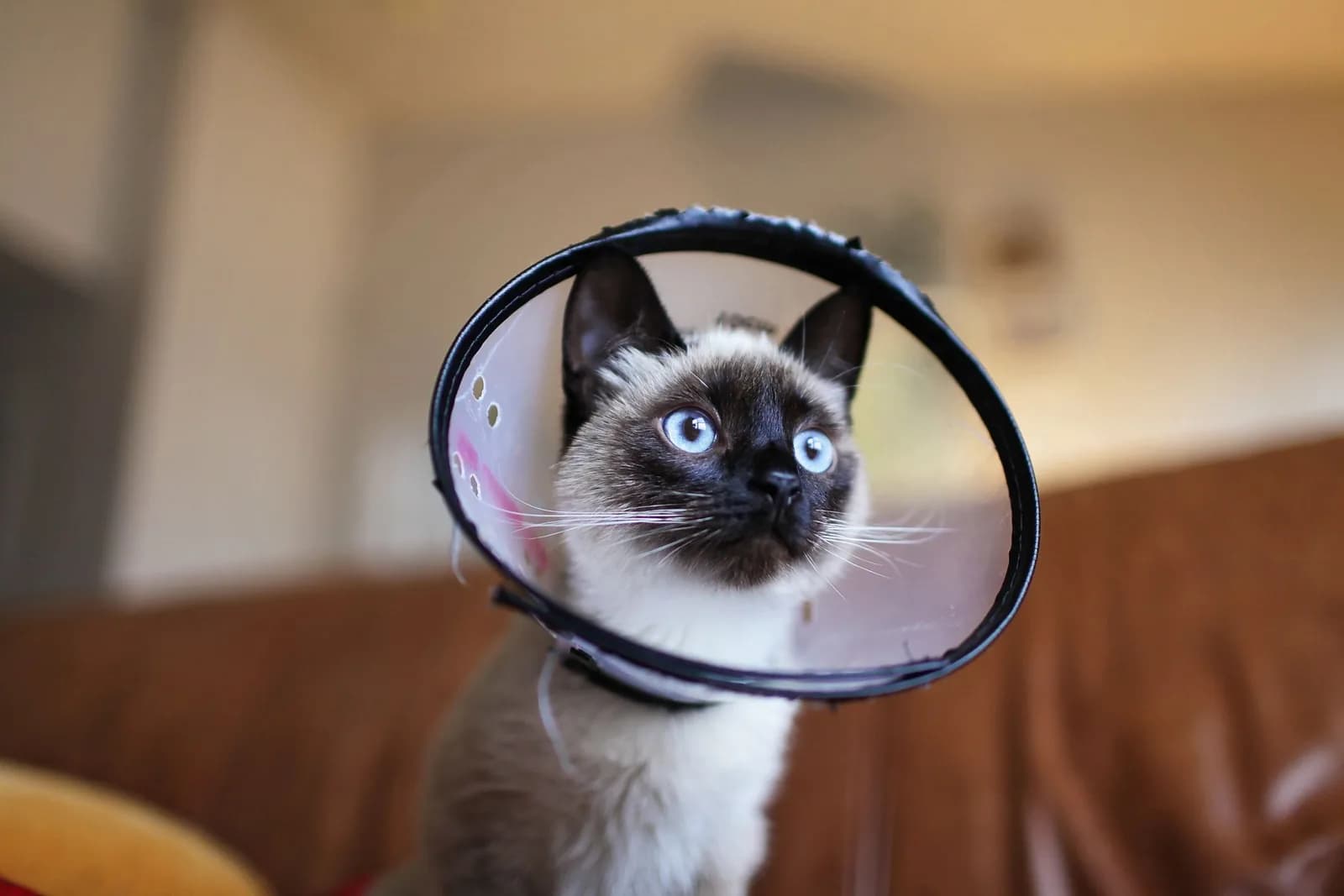
The cone is not optional if the cat licks. VCA's rule is that if you were not given an or a recovery suit and your cat starts licking or chewing the incision, call and ask for one, because a cat can undo a suture line in seconds. Never put anything on the incision unless the clinic says so, and never hydrogen peroxide or rubbing alcohol, which damage healing tissue.
What a normal incision looks like: skin that is its usual color or slightly pink, with at most a little intermittent seepage in the first 24 hours. The signs that VCA and its discharge sheets say mean call the clinic:
- Continuous or excessive bleeding or fluid from the incision, or intermittent seepage that goes on past 24 hours.
- Swelling that is more than mild, redness spreading on the skin, a bad smell, or any discharge from an elective incision.
- Sutures the cat has removed, some or all.
- A mild post-anesthetic cough is normal for a few days; one that persists or worsens is not.
Cornell's framing is the short version: stable and moving about within an hour of the procedure, then supervised and kept as quiet as possible for about a week.
The numbers behind the advice
The reason every veterinary body pushes the age down is not the individual cat, it is the count. About 3 million cats entered US shelters and rescues in 2025 and about 277,000 were euthanized, per the 's compilation of Shelter Animals Count data. The UK's owned-cat population fell from 10.6 million to 10.2 million between 2024 and 2025 in Cats Protection's report, which also records neutering rates falling; in 2021 the same charity estimated 86% of the country's 10.8 million owned cats were neutered. RSPCA Australia's societies took in 25,639 cats in 2024-25, down from 42,572 four years earlier. Humane Canada's shelters reported 60,677 cats in 2021 with the lowest euthanasia rate the survey had ever recorded, 11%, and a juvenile share that jumped from 30% to 53% in a year.
The timing question is the whole game in those figures. A can conceive from about four months, before most owners think of her as anything but a kitten, which is why how long cats are pregnant and what a cat in heat looks like are the two pages most often read the week after this one.
What to take away
- Spay, neuter, castrate and desex describe one pair of operations: removal of the ovaries (with or without the uterus) in a female, of the testicles in a male, under general anesthesia.
- The recommended age is by 5 months in the US and Canada (, 2016; 2017; 2024) and around 4 months in the UK and Australia; the "6 months" still on some clinic pages predates that consensus.
- Two cohort studies, 263 and 1,660 cats, found no increase in disease, behavior problems or relinquishment after early sterilization (Howe 2000; Spain 2004).
- Desexing is compulsory by statute in four Australian jurisdictions (ACT from 3 months, Tasmania 4, WA and SA 6) and nowhere in the US or UK; Montreal requires it by 6 months.
- Published clinic prices run $70 to $150 at US nonprofit clinics, CA$126 to CA$357 at Canadian charity clinics, A$225 to A$400 on RSPCA NSW's guide, and £10 to £25 on UK means-tested vouchers, with no general UK price in the open.
- Spaying before one year cuts mammary carcinoma risk by 86% (Overley 2005); neutered cats eat about 12% more and gain 27 to 29% of body weight unless fed accordingly (Kanchuk 2003).
- Recovery is 24 to 48 hours to normal behavior and 7 to 14 days of restricted activity; bleeding past 24 hours, swelling, odor, discharge or removed sutures are the signs VCA says mean call the clinic.
 The vet's take

Veterinary review
Are you a vet?
Your professional read belongs here: every verified practitioner can leave a note, published once our editors have reviewed it.
Sign in and get your license number verified. We check it in the public register, we never ask for or keep a copy of your diploma, and your number is never published.
Frequently asked questions
What does spayed mean?
A spayed cat is a female whose ovaries and uterus, or ovaries alone, have been surgically removed under general anesthesia, so she cannot become pregnant or go into heat. The veterinary names are ovariohysterectomy and ovariectomy. A neutered or castrated male has had both testicles removed, an orchiectomy.
Can a cat be spayed while in heat?
Yes, and the one study that measured it in cats found no extra blood loss or surgical time in estrus compared with anestrus; some clinics still prefer to wait or charge a higher tier. The full answer, with the fee tiers, is on its own page: can you spay a cat in heat.
Is it too late to neuter an adult cat?
No. The age recommendations are about doing it before the first litter and before habits form; surgery on a healthy adult is routine, and the cancer and infection benefits still apply. What may not fully reverse is behavior: VCA notes that a tom who has sprayed and fought for years may keep some of it after castration.
Does neutering calm a cat down?
It removes the hormone-driven behaviors: roaming, fighting over territory, calling and spraying in most cats, and the AAFP's 2020 statement records no evidence of adverse behavioral effects from early surgery. It does not change a cat's basic personality, and the 2004 cohort found early-neutered cats were, if anything, a little shyer and less hyperactive.
Will my cat get fat after being neutered?
Only if the bowl does not change. In the 2003 UC Davis study, neutered males ate about 12% more and gained 27 to 29% of their body weight; a 1996 study found resting metabolism lower after surgery. Feed to the new requirement and keep play in the day and the gain is avoidable.
How much does it cost to neuter a cat near me?
A local number: US nonprofit clinics publish $70 to $150, Canadian charity clinics CA$126 to CA$357, RSPCA NSW's guide A$225 to A$400, and UK charities publish only means-tested voucher prices of £10 to £25. Private practices in every market tend not to publish a price, so the schedule to trust is the one your clinic hands you.
What does "fixed" mean for a cat?
Everyday American English for either operation. None of the veterinary bodies use the word on their pages, but every clinic understands it.
 Community questions
Got a question this page doesn't cover? Ask it: the best ones get published here with their answer.
This is information, not veterinary advice, and it cannot tell you what is wrong with your cat. Our rule is a simple one: if something is wrong with your cat, call your vet, and call an emergency clinic if it is out of hours. Nothing you read here is a reason to wait.
Medical information applies to every reader. Prices, legal duties and common practice do not: unless stated otherwise, they are given for the United States, and they differ in the UK, Canada and Australia, and often between states or provinces. Check with your own vet and your own local authority.
Our sources
- United Spay Alliance, why Feline Fix by Five is important (the 2016 task force recommendation and its endorsements)
- AAFP, pediatric sterilization in cats position statement (2020)
- AAFP, early spay and castration position statement (PDF)
- AVMA, spaying and neutering (pet owner page)
- ASPCA, spay/neuter your pet
- Howe et al 2000, long-term outcome of gonadectomy performed at an early age or traditional age in cats (JAVMA, PMID 11110455)
- Spain, Scarlett and Houpt 2004, long-term risks and benefits of early-age gonadectomy in cats (JAVMA, PMID 14765796)
- Overley et al 2005, association between ovariohysterectomy and feline mammary carcinoma (J Vet Intern Med, PMID 16095174)
- Kanchuk et al 2003, weight gain in gonadectomized male cats results from increased food intake (J Nutr, PMID 12771331)
- Root, Johnston and Olson 1996, effect of gonadectomy on heat production in cats (Am J Vet Res, PMID 8669771)
- Root, Johnston and Olson 1997, gonadectomy and radial physeal closure in cats (Vet Radiol Ultrasound, PMID 9238769)
- Hart and Cooper 1984, urine spraying and fighting in prepubertally gonadectomized cats (JAVMA, PMID 6539762)
- VCA Animal Hospitals, spaying in cats
- VCA Animal Hospitals, neutering in cats
- VCA Animal Hospitals, post-operative instructions in cats
- VCA Animal Hospitals, care of surgical incisions in cats
- VCA Animal Hospitals, cat neutering and behavior (the 90% and 85% figures)
- Cornell Feline Health Center, spaying and neutering
- Cornell Feline Health Center, feline immunodeficiency virus (transmission through fight wounds)
- Merck Veterinary Manual, reproductive management of the female small animal (ovariectomy vs ovariohysterectomy)
- American College of Veterinary Surgeons, urinary obstruction in male cats
- Cats Protection, neutering your cat
- Cats Protection, kitten neutering (the four-month recommendation)
- Cats Protection, financial assistance (the £10 London scheme)
- Cats Protection, neutering at four months survey release (2015)
- Cats Protection, Cats and Their Stats UK 2025 key findings (PDF)
- Cats Protection, CATS report 2021 summary
- Cat-Kind, neutering kittens at four months: a summary of the evidence (PDF)
- British Veterinary Association, neutering of cats and dogs policy
- BVA news, updated neutering guidance from BVA and BSAVA (March 2026)
- PDSA, cat neutering: a guide to castration and spaying (2022)
- RSPCA Oxfordshire branch, help with the cost of neutering
- RSPCA Australia knowledgebase, why should I have my cat desexed (updated November 2025)
- RSPCA Australia knowledgebase, is desexing mandatory for cats and dogs
- Australian Veterinary Association, desexing (surgical sterilisation) of companion animals policy (2022)
- RSPCA Victoria, desexing and breeding pets
- ACT Domestic Animals Act 2000 (republication 51, PDF)
- Western Australia Cat Act 2011 (PDF)
- Tasmania Cat Management Act 2009 (authorised consolidation)
- Victoria Domestic Animals Act 1994 (authorised version 091, PDF)
- New South Wales Companion Animals Act 1998 (in force)
- NSW Office of Local Government, non-desexed cat and dog fees (July 2026)
- SA Dog and Cat Management Board, desexing (the regulator's restatement of the Act)
- RSPCA NSW, cost of owning a pet (the A$225 to A$400 guide range)
- RSPCA Tasmania, cat desexing program
- RSPCA South Australia, desexing
- King Island Council, subsidised cat desexing program (2024)
- RSPCA Australia, annual statistics 2024-2025 (PDF)
- Canadian Veterinary Medical Association, spaying and neutering of dogs and cats position statement (December 2024)
- Toronto Humane Society, spay/neuter services and fee guide
- BC SPCA Prince George spay/neuter clinic, fees
- BC SPCA Vancouver animal hospital, cost of care
- Ville de Montreal, spaying/neutering and microchipping your pet (February 2026)
- Alabama Spay Neuter Clinic, fees and services
- SNAP Houston, price list (effective December 2024)
- Nebraska Humane Society, low-cost spay and neuter
- Humane Society of Southern Arizona, clinic prices
- ASPCA, cutting pet care costs (2021 update, the $150 estimate)
- ASPCA, US animal shelter statistics (2025, compiled from Shelter Animals Count)
- Humane Canada, 2021 animal shelter statistics (PDF)

Worth keeping a paw on
Pin this guide
So you can find it the day you need it, and share it with someone whose cat does the same thing. One click and it sits in your board.
Pin it on PinterestAlso worth reading
All health →
Article
Ear Mites in Cats: Why Nothing Kills Them Instantly
A mite the size of a pinhead, more than a thousand per ear, and no product that reaches the eggs. What ear mites look like, how cats catch them, and why a month is the honest clock.
Read
Article
Cat Weight Chart: What a Healthy Cat Weighs, by Breed and Sex
No cat has a single healthy weight. Lean weights for 12 breeds in lb and kg, female and male, the 9-point body condition scale, and what one point above ideal really costs.
Read
Article
Cat Giving Birth: What Normal Looks Like, and When It Stops Being Normal
Most cats deliver alone. Stage-by-stage timings from measured studies, the pause that looks like trouble but usually is not, and the thresholds vets use for calling for help.
Read
The floor belongs to our members. Keep it kind, links are not allowed, and images go through moderation before anyone else sees them.