

Cat in Heat: How Long It Lasts, How Often It Comes Back, and What Actually Helps
A cat in heat (in season in the UK, on heat in Australia) cycles for about a week, every one to three weeks, from as young as 4 months. Phases, signs, the age question, the spay answer.

Published August 28, 2026Updated September 8, 2026 15 min read
Contents
A cat in heat is loud, restless, unusually affectionate, and back again a week or two after you thought it was over. In the UK she is "in season" or "calling," in Australia she is "on heat," and in every market the questions are the same: how long does this last, how often does it happen, is she in pain, and what can I do about it.
This page answers those questions with the phase table from a peer-reviewed review of feline reproduction, a veterinary hospital network's owner guidance, and the manuals vets use themselves. The short version: a heat lasts about a week, the whole cycle repeats every one to six weeks (about three on average) for most of the year, a cat can conceive on her very first heat from as young as 4 months, and the only thing that ends the cycle for good is spaying. The long version has the numbers.
The heat cycle, phase by phase
The cat's cycle is called the , and "heat" is the everyday name for one of its phases: , the days when she is receptive to a male. Around it sit four other phases. The durations below come from Brenda Griffin's 2001 refereed review of the feline estrous cycle (Compendium on Continuing Education), which tabulates the underlying studies; the veterinary edition of the Merck Veterinary Manual gives compatible ranges, noted where they differ.
| Phase | What is happening | How long (Griffin 2001) | Merck's range |
|---|---|---|---|
| Proestrus | She attracts toms, rubs and rolls, but is not yet receptive | 0.5 to 3 days | 0 to 2 days, and not seen in every |
| Estrus (heat) | Receptive: calling, , treading | Average 4 to 7 days, range 1 to 21 | 2 to 19 days |
| Interestrus | The gap between heats when no ovulation happened | Average 1 to 3 weeks, range 3 days to 7 weeks | 8 to 10 days ("postestrus" in Merck's wording) |
| Diestrus | After ovulation, pregnant or not | Average 35 days, range 30 to 50; 35 to 100 days out of heat in total | About 40 days if not pregnant, 60 if pregnant |
| Anestrus | The seasonal off-switch | October or November through January or February in free-roaming cats | Late fall (October to December) under natural daylight |
Two things in that table explain most of what owners see. First, cats are induced ovulators: the ovaries release eggs in response to mating, not on an internal timer. An unmated therefore never enters . She goes from heat to a short and straight back into heat, which is why the cycle looks endless from the sofa. Second, the phases vary a lot between individual cats, so any single "average" is only a center of gravity.
How long does a cat stay in heat, and how often?
A heat commonly lasts four to seven days. Some cats are in and out in a day; a few stay in heat for three weeks. VCA's owner guide puts the average at seven days with a one-to-21-day range; Griffin's table says four to seven on average with the same outer range; PetMD's veterinarian-written page says three to 14 days. Those are three legitimate sources describing three overlapping populations, not a disagreement, so we publish the range rather than pick a number.
If she is not mated, the next heat arrives after a break that averages about a week in VCA's figures and one to three weeks in Griffin's, with extremes from three days to seven weeks. Put together, a complete cycle runs from one to six weeks, about three weeks on average. Cats Protection, the UK charity, rounds this to "every two to three weeks" for its readers, which sits inside that range.
The practical reading: a cat can seem to be in heat "all the time" in spring because each break is barely noticeable, and a cat who is quiet this week is between rounds, not done for the year.
Seasons, daylight, and why indoor cats cycle all year
Cats are seasonally polyestrous: many heats in a row during a breeding season, then a rest. The trigger is day length, which is why vets call them long-day breeders. As the days lengthen after the December solstice, light reaching the eye signals the pituitary, which signals the ovaries to start growing follicles (the mechanism as Veterinary Partner's reproductive-cycle page lays it out).
For free-roaming cats in the Northern Hemisphere, Griffin's calendar runs like this: the season opens in February and closes in late September, with peaks in February to March and May to June (shifting to July to August in northern, temperate climates); October through December is the quiet . VCA gives the same shape in owner language: cycling from January until late fall.
Indoor cats often skip the rest entirely. In controlled laboratory settings, ten or more hours of light in every 24 keep queens cycling; a 14-hour under daylight-spectrum bulbs gives maximum fertility, and cycling typically begins within seven to ten weeks of starting such a light regime. That last detail matters: the "14 hours of light" line repeated across the internet describes a lab protocol with a delay measured in weeks, not a switch. A living room with lamps on until midnight is close enough to that protocol that many house cats cycle in December.
Breed changes the picture at the margins. Griffin notes that Siamese queens appear less sensitive to and tend to cycle year-round, while longhaired cats are more sensitive and rarely come into heat in winter. That is a claim about seasons, not about age; the age question is below, and the two are often confused.
The signs: what a cat in heat looks and sounds like
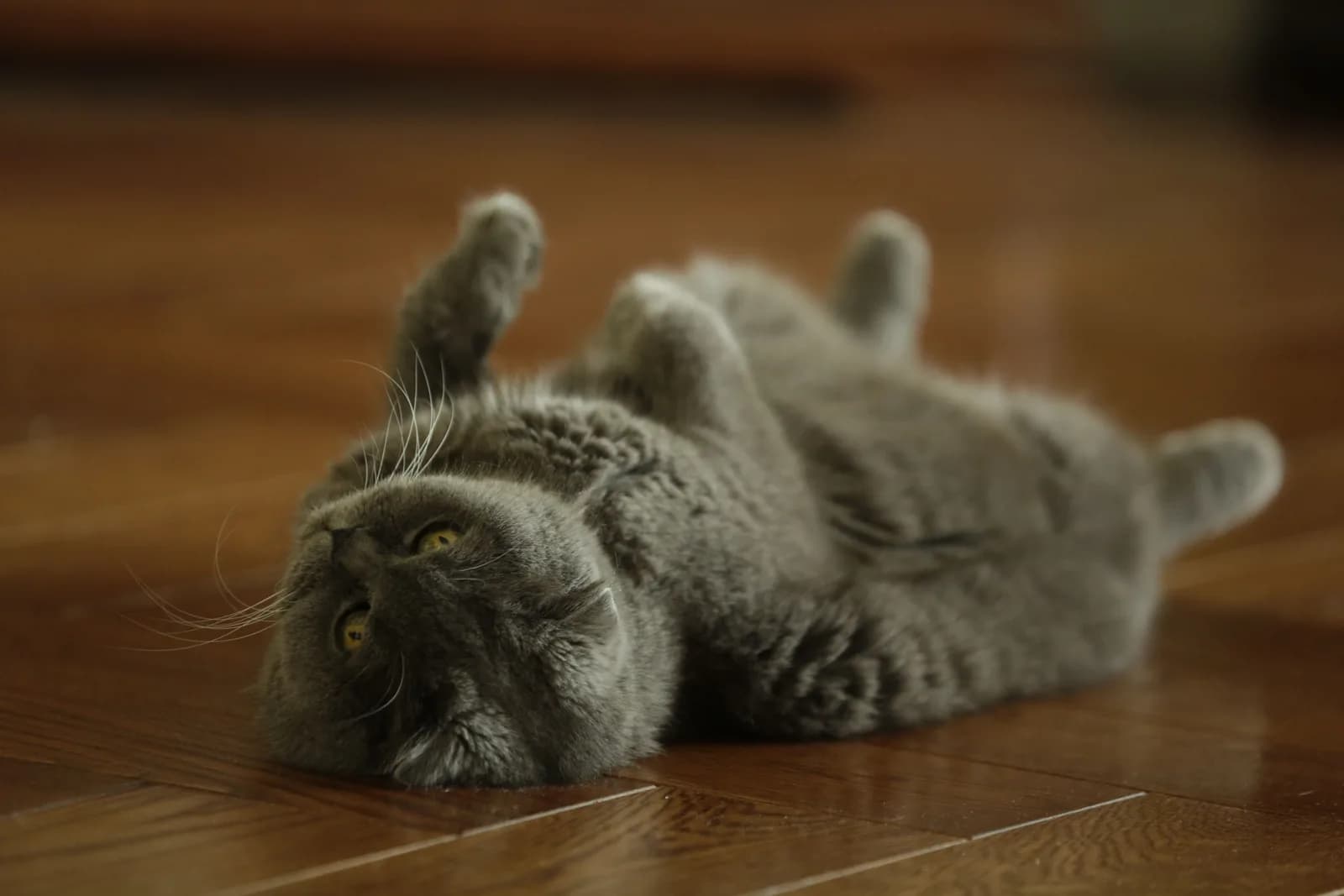
The signs arrive in order. In she rubs, rolls, and becomes more affectionate than usual, but she rejects a . In the full repertoire appears, and Griffin's description is the one to keep in mind: queens vocalize and call to toms, crouch into a stance with the chest and belly on the floor, the rear end raised and the tail deflected to the side, and tread in place with the hind legs. Stroking her along the back or the base of the tail usually triggers that posture on the spot.
VCA's owner guide adds the household version. Most cats become very affectionate, even demanding, rubbing persistently against people and furniture and constantly wanting attention. They roll on the floor more, raise the hindquarters when stroked, and become very vocal. Some urinate more often or spray urine on vertical surfaces; the urine carries pheromones and hormones that advertise her state and attract toms. PetMD lists a drop in appetite and restlessness as well.
One reassurance worth its own paragraph, because it is on none of the top-ranking pages: Griffin reports that owners commonly mistake two entirely normal behaviors for seizures, the exaggerated -and-treading posture, and the after-reaction that follows mating, when a screams, rolls violently, and grooms frantically for a few minutes. Both are normal. A cat who is calling at 3 a.m. and rolling on the kitchen floor is doing what her hormones ask.
Is she in pain? Two veterinarian-authored sources answer. A vet-reviewed Catster piece says flatly that a typical heat is not a painful process and that the howling is a mating call, not distress. PetMD is more careful: the behavior changes can be dramatic enough that owners worry, and sudden or unusual changes are what deserve a call to the vet, not heat itself. Both agree on the practical line: heat is loud, not harmful. A cat who is lethargic, off her food, or seems sore is showing something other than heat.
What age does the first heat come, and how young can a cat get pregnant?
Griffin's review puts the first heat between 5 and 9 months of age on average, with a range from 3.5 to 18 months, and adds a useful marker: adolescent queens may start cycling once they reach about 2 kg (4.4 lb) of body weight. VCA's owner figure is "about six months," a little earlier or later depending on the time of year, because day length pulls the first heat forward or back.
Breed matters, and the sourced picture is not the one the internet repeats. In Griffin's data, domestic shorthairs mature earlier than domestic longhairs, mixed breeds earlier than purebreds, Persians are notoriously late (often not cycling until 12 months), and Burmese queens frequently cycle as early as 3.5 to 4.5 months. The breed usually named for early puberty, the Siamese, is credited in the same paper with something else: cycling regardless of season.
The age answer therefore has a blunt corollary. A female cat can get pregnant at any time she is in heat, on her very first heat included, which means a 4-month-old kitten who weighs 2 kg can conceive. VCA draws the conclusion most vets draw: because the first heat is hard to predict, spay before it, and the age they name is six months. Cats Protection in the UK says around four months, and Australia's RSPCA says before 16 weeks. The spay guide sets those ages side by side with their reasons.
Fertility then runs long. Griffin's peak reproductive years are 1.5 to 8, with two to three litters a year of three to four kittens on average (range 1 to 15). Queens under a year and over eight cycle irregularly and have smaller litters and more losses, but adolescent queens commonly carry successful pregnancies all the same. How many kittens that produces over a lifetime is its own page: how many kittens can a cat have.
Do male cats go into heat?
No. Heat is a female phase; a has no cycle to enter. What he has is a seasonal rise in testosterone that tracks the same lengthening days, and a nose. VCA's estrous-cycle guide describes the result from the 's side: the pheromones and hormones in her urine attract intact males, who may spray around the house to mark the territory, and the female, as theirs, and may even try to get inside to reach her. Veterinary Partner's phrasing for toms once the season opens is "always ready and willing."
So "my male cat is in heat" usually describes a responding to a nearby, or simply an intact male in spring: roaming, fighting, spraying, calling at the door. Those are the behaviors neutering addresses in males.
Spraying during heat
Queens can spray too. VCA says some female cats urinate more often or spray on vertical objects when in heat; Griffin calls it occasional rather than typical. The urine is a message board: it tells every within range that she is receptive.
The charities in our other markets name it among the behaviors that end with neutering. Cats Protection lists "calling or wailing, spraying smelly pee, trying to escape and wandering further than normal" as the behaviors of a cat in heat or in season. RSPCA Queensland lists urine spraying and vocalisation among the "unwanted behaviours" that waiting to desex will bring. A who sprays only around her heats is behaving normally for an intact cat; a spayed cat who starts spraying is a different question, and that one belongs on the spraying page and, if she strains or cries in the tray, with her vet.
How to calm a cat in heat (and the catnip question)
Honest answer first: nothing an owner does shortens a heat. What the veterinary sources actually recommend is management. PetMD's veterinarian-authored page lists keeping her indoors, providing enrichment, keeping a consistent routine, and offering extra attention as things that may reduce her stress during a cycle, and states the only permanent solution is spaying. The indoor part is not optional: a cat in heat who gets out will find, or be found by, a .
Warmth, play sessions that burn energy, a quiet room at night, and patience are the tools. Scent and pheromone products, supplements and home remedies circulate widely; none of the sources this page is built on endorse any of them for heat, so we do not either.
Catnip is searched alongside "cat in heat" often enough to deserve a straight answer. The one vet-reviewed source that addresses the pairing says catnip can distract most cats in heat for a short while and help them settle, with two caveats: only about two thirds of cats respond to it at all, and in a cat it makes combative it can add aggression rather than calm. The idea that its active compound mimics cat sex hormones is described by that same source as not currently clear. Treat catnip as a ten-minute distraction, not a cycle changer; what it does and why is on our catnip page.
Heat after kittens: how soon it comes back
Sooner than most owners expect. In Griffin's review, queens return to heat two to eight weeks after a normal lactation and weaning, four weeks on average, and in many queens nursing does not suppress the cycle at all: fertile cycling resumes in the second to fifth week of lactation, while the kittens are still feeding. A whose litter is lost, or removed within three days of birth, is back in heat in about a week.
Stranger still, about 10% of queens show heat between the third and sixth week of pregnancy. Fertile cycles are rare then, but a second, younger litter conceived during a first pregnancy () can happen. The practical reading: a mother cat is not "safe" while nursing, and the birth page and the kitten age chart both assume she may be pregnant again before the kittens leave.
The spay answer, and the alternatives that exist for toms, not queens
Spaying ends the cycle, and the health case for doing it early has real numbers. In a 2005 case-control study of 308 cats with mammary carcinoma and 400 controls (Overley and colleagues, University of Pennsylvania, published in the Journal of Veterinary Internal Medicine), intact cats were 2.7 times overrepresented among the cancer cases; cats spayed before 6 months had a 91% reduction in risk compared with intact cats, and cats spayed before 1 year an 86% reduction. Cats Protection's "over 90% less likely if spayed before six months" is that finding restated.
The other disease spaying removes is , a pus-filled uterus that is a surgical emergency. In Swedish insurance data from 1999 to 2006 (Hagman and colleagues, 2014), the incidence was about 17 cats per 10,000 cat-years at risk, the median age at diagnosis was 4 years, the risk climbed sharply after 7, and the Sphynx led every breed at 433 per 10,000 cat-years. That is an incidence rate, not a lifetime percentage; what it looks like in a living cat is on our pyometra page. Whether a vet will spay a cat while she is in heat has its own answer: yes, with caveats.
What about the alternatives you may have read about? The implant (Suprelorin) is the one most often cited, and its licensing surprises people: per the Alliance for Contraception in Cats and Dogs, it is approved to temporarily prevent fertility in male dogs, male cats and prepubertal female dogs, and is labeled in intact male cats to suppress libido, vocalization, marking and aggression. That is the axis that matters. It is a product for toms; use in a is off-label wherever it is sold, and it does not appear in any of our sources as a heat control for females.
Megestrol acetate, a , is the older option. The same alliance's position statement describes it as something a vet may use for short periods to "buy time" for a female cat waiting to be spayed, and lists its side effects without softening them: diabetes mellitus, , adrenal suppression, and mammary cancer, more likely at higher doses. It recommends the drug only for cats that can be dosed accurately at prescribed times and monitored, as a bridge to surgery. That is a conversation with a vet, not a supplement aisle; this page gives no doses on purpose.
In heat, in season, on heat: the same cat in three countries
The vocabulary shifts with the accent. In the US and Canada she is "in heat." Cats Protection writes "in heat or in season" in one sentence and calls the vocal part "calling or wailing." RSPCA Australia writes "on heat" and "calling," and RSPCA Queensland promises that "will stop your cat's vocalisation when on heat." The procedure changes its name too: spay in North America, neutering for both sexes in Britain, desexing in Australia. Our spay and neuter guide sorts the words, the ages and the costs by market.
What to take away
- A heat () commonly lasts 4 to 7 days, with a documented range of 1 to 21 days; unmated, a cat returns to heat after a break of about a week to three weeks, so a full cycle runs 1 to 6 weeks, about 3 on average.
- Cats are induced ovulators and long-day breeders: free-roaming Northern Hemisphere cats cycle from about February to late September, and indoor cats under ten or more hours of light a day can cycle all year.
- The first heat comes at 5 to 9 months on average (range 3.5 to 18), earlier in shorthairs, mixed breeds and Burmese (as early as 3.5 to 4.5 months), later in Persians (often 12 months); a cat can conceive on her first heat.
- Heat is not painful: calling, rolling, and treading are normal, and Griffin's review notes owners sometimes mistake them for seizures.
- Male cats do not go into heat; an intact responds to nearby queens by roaming, fighting and spraying.
- A nursing can be fertile again from the second to fifth week of lactation and returns to heat 2 to 8 weeks after weaning.
- Spaying before 6 months cut mammary carcinoma risk by 91% in a 308-case study (Overley 2005); the implant is a product for male cats, and is a short-term, vet-supervised bridge with serious listed side effects.
 The vet's take

Veterinary review
Are you a vet?
Your professional read belongs here: every verified practitioner can leave a note, published once our editors have reviewed it.
Sign in and get your license number verified. We check it in the public register, we never ask for or keep a copy of your diploma, and your number is never published.
Frequently asked questions
How long does a cat stay in heat?
Commonly four to seven days, according to a peer-reviewed review of the feline cycle and VCA's owner guide, with individual cats anywhere from one day to three weeks. If she is not mated she is usually back in heat within one to three weeks.
How often do cats go into heat?
Roughly every one to six weeks during the breeding season, about every three weeks on average. Free-roaming cats in the Northern Hemisphere cycle from about February to late September; indoor cats under long artificial light can cycle year-round.
Is a cat in heat in pain?
No, according to the veterinarian-authored sources this page uses: the calling and rolling are mating behavior, not distress. Sudden or unusual changes, lethargy, or a cat who seems sore are not heat and deserve a vet's look.
How old can a cat get pregnant?
From her first heat, which averages 5 to 9 months but can come as early as 3.5 months in some cats, and once she weighs about 2 kg (4.4 lb). Burmese queens are documented cycling at 3.5 to 4.5 months; Persians often not until 12 months.
Do male cats go into heat?
No. Heat is a female phase. An intact male responds to queens in heat by roaming, calling, fighting and spraying, and his behavior peaks in the same lengthening-day season.
Can a cat go into heat while nursing kittens?
Yes. In many queens fertile cycling resumes during the second to fifth week of lactation, and the average return to heat after weaning is four weeks.
Does catnip calm a cat in heat?
It can distract a responsive cat for a short while, and only about two thirds of cats respond to catnip at all. It does not change the cycle, and in an already combative cat it can add aggression.
What is the difference between "in heat," "in season" and "on heat"?
Nothing but geography. "In heat" is the North American term, "in season" and "calling" are British, "on heat" is Australian. The cycle, and the spay that ends it, are the same.
 Community questions
Got a question this page doesn't cover? Ask it: the best ones get published here with their answer.
This is information, not veterinary advice, and it cannot tell you what is wrong with your cat. Our rule is a simple one: if something is wrong with your cat, call your vet, and call an emergency clinic if it is out of hours. Nothing you read here is a reason to wait.
Medical information applies to every reader. Prices, legal duties and common practice do not: unless stated otherwise, they are given for the United States, and they differ in the UK, Canada and Australia, and often between states or provinces. Check with your own vet and your own local authority.
Our sources
- Griffin B, Prolific Cats: The Estrous Cycle, Compendium on Continuing Education for the Practicing Veterinarian, vol 23 no 12, December 2001 (the phase-duration table, the seasonal
- VCA Animal Hospitals, Estrous Cycles in Cats (heat duration and interval, signs, spraying during heat, the six-month spay age)
- Merck Veterinary Manual (professional edition), Reproductive Management of the Female Small Animal (the five phases and their ranges)
- Johnson AK, Normal feline reproduction: the queen, Journal of Feline Medicine and Surgery 2022 (seasonal polyestrus and the 14-hour light regime; abstract)
- Veterinary Partner (VIN), Mackie MM, Reproductive Cycle of Cats May Surprise You (the photoperiod mechanism)
- PetMD, Cat in Heat: Signs, Timeline, and What To Do (veterinarian-authored; the calming advice and the indoor rule)
- Catster (vet-reviewed), What Do Cats Feel When They're in Heat? (the pain question)
- Catster (vet-reviewed), Does Catnip Help a Cat in Heat?
- Overley B et al, Association between ovarihysterectomy and feline mammary carcinoma, Journal of Veterinary Internal Medicine 2005 (308 cases, 400 controls; 91% and 86% risk reductions)
- Hagman R et al, Incidence of pyometra in Swedish insured cats, Theriogenology 2014 (17 per 10,000 cat-years; the Sphynx figure)
- Cats Protection, Neutering your cat (UK vocabulary: in heat or in season, calling; the four-month age; the over-90% mammary figure)
- RSPCA Australia, Why is it so important to desex your pet? (on heat, calling)
- RSPCA Queensland, Operation Wanted fact check (vocalisation when on heat, urine spraying)
- RSPCA Knowledgebase, Why should I have my cat desexed? (before 16 weeks; mammary cancer)
- Alliance for Contraception in Cats and Dogs, Suprelorin (deslorelin acetate): approved uses by species and sex
- Alliance for Contraception in Cats and Dogs, position statement on short-term megestrol acetate for estrus prevention in cats

Worth keeping a paw on
Pin this guide
So you can find it the day you need it, and share it with someone whose cat does the same thing. One click and it sits in your board.
Pin it on PinterestAlso worth reading
All health →
Article
Cat Pregnancy Stages Week by Week: What Is Happening Inside, and What You Can See
Nine weeks, day by day, from the studies that actually measured them: when the sac shows on ultrasound, when the skeleton shows on an X-ray, when nesting starts, and when to call the vet.
Read
Article
Do Cats Have Periods? No, and Here Is What Happens Instead
Cats do not menstruate: the uterine lining is reabsorbed, not shed. Why bleeding in heat is the exception, what blood or discharge can mean, and when it is a vet call.
Read
Article
How Long Are Cats Pregnant? The Honest Answer Is a Range
About 63 to 65 days, nine weeks, but the measured studies run from 57 to 72. Signs week by week, the tests a vet uses (and how early they work), feeding, false pregnancy, and when to call.
Read
The floor belongs to our members. Keep it kind, links are not allowed, and images go through moderation before anyone else sees them.