

Overweight Cat: How to Tell Honestly, and What Actually Works
How to read your cat's body honestly, the owner blind spot science has named, and the real success rates of weight-loss plans, dropouts included.

Published August 26, 2026Updated September 8, 2026 8 min read
Contents
Three in five US cats assessed by veterinary professionals are overweight or obese, a figure our feeding guide carries with the full scoring scale behind it. This page is the other half of the subject: how to see it on your own cat, which is harder than it sounds, and what a weight-loss plan really looks like when studies follow it to the end, dropouts and all. One boundary first: a cat losing weight WITHOUT a diet is a different and more urgent question, covered on our weight-loss page.
What overweight looks like under your hands
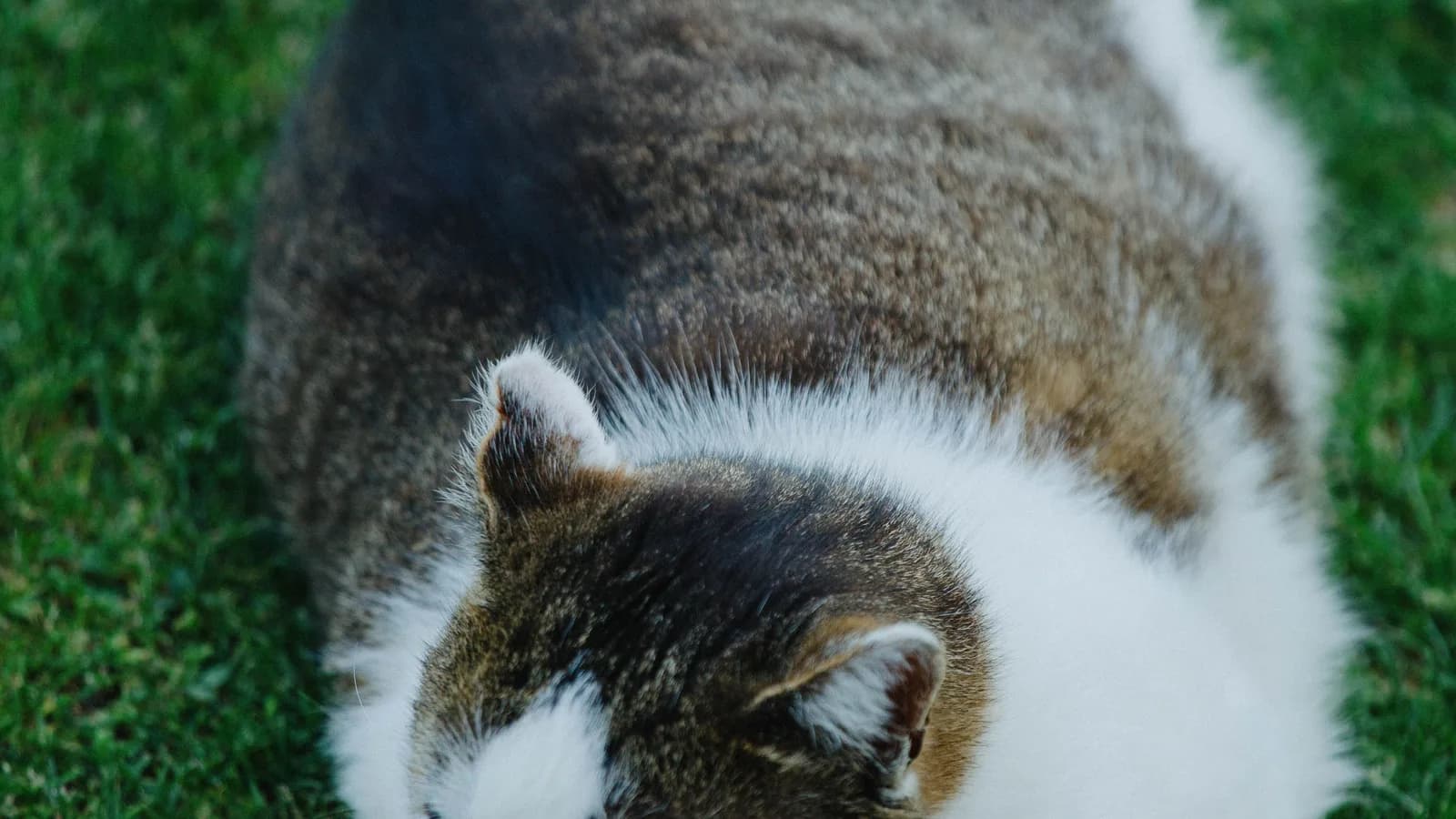
The scale vets use runs 1 to 9, with 5 ideal and every point above it counted as roughly 10% over in the manuals, though the one study that weighed cats against their own breed found the step steeper than that, measured against the scale. The scale's own words are more useful than the numbers. At 8, per the chart: ribs "not felt due to excess fat covering", waist absent, an obvious rounding of the belly with a prominent fat pad. At 9, the top of the scale: heavy fat over the lower back, face and limbs, a distended abdomen, no waist at all.
The at-home version is a two-part check: flat hands on the ribcage, where you should feel ribs under a light fat cover the way you feel the bones on the back of your hand; then a look from above, where a waist should tuck in behind the ribs. One nuance from the chart itself: a 6 can be acceptable in some cats, especially older ones. And Cornell's home-monitoring advice is charmingly concrete: buy a baby scale, weigh regularly, and let the trend tell the story.
"He's just fluffy": the blind spot with a name
Research now calls it weight blindness, and it is measured, not a joke about doting owners. In APOP's 2022 US survey, owners were asked about their cat's body condition BEFORE being told the score: 28% of cat owners called an overweight cat normal. A French veterinary-hospital study found 24% of cat owners underestimating their cat's condition, and a Danish study of 192 cats added the telling detail: owners of overweight cats were significantly MORE attached to their cats, and rated them as less active. None of this makes anyone a bad owner. It means the eye test fails at scale, in every country measured, which is exactly why the hands-and-scale check above beats impressions.
When the weight arrives
A 1.34-million-cat US dataset breaks the story down by life stage, and the shape is worth knowing in advance:
| Life stage | Overweight | Obese |
|---|---|---|
| Late growth (under 1) | 10.7% | 0.4% |
| Young adult | 36.2% | 3.6% |
| Adult | 47.2% | 13.9% |
| Mature | 44.8% | 21.7% |
| Senior | 32.0% | 12.6% |
Two findings sharpen it. A cat recorded as overweight during GROWTH carried 1.52 times the odds of being overweight as an adult, so the kitten months are already the game. And the Danish study found indoor-only cats at high risk from age one, while cats with outdoor access stayed low-risk until around seven: an indoor cat, which is the right and safe way to keep most cats, simply needs the calories managed on the human side of the bowl.
Why it matters, in multipliers
The core figures live on their own pages: up to four times the diabetes risk, which our diabetes guide details, and the lameness and mid-life mortality multipliers our feeding guide carries. This dossier adds three with their own frames: overweight cats carried four times the lower-urinary-tract-disease risk of normal-weight cats in the study a 2026 review cites; a 2.3-fold higher risk of nonspecific skin conditions; and Cornell's list of conditions that extra weight aggravates includes osteoarthritis, hip dysplasia and cardiovascular health. Weight is the one risk factor on those lists an owner can actually change. A heavy cat cannot fold itself into the shapes grooming needs, and the coat says so before the scale does: cat dandruff.
The plan, from the sources rather than the sales page
- Start at the clinic, with a real target weight: the plan is built on the cat's IDEAL weight, not the current one, which is 's plainly stated rule, and the reduction happens gradually over weeks, never overnight. The reason is on our not-eating page: a fat cat that stops eating can tip into , which makes crash-dieting genuinely dangerous.
- Scheduled meals, not the open buffet. Cornell's phrasing: there should be a distinct meal time, and the owner should be in control of it. The feeding-consensus literature says free access "can lead to inactivity and even distress, often resulting in overconsumption and obesity".
- Wet food earns a specific mention. The guideline states that high-moisture diets may increase satiety and help promote weight loss, and a small controlled trial found newly neutered cats on ad-lib WET food held their weight stable for weeks while the ad-lib dry group gained. That is a satiety and calorie-density story, on top of the hydration story the feeding page tells.
- Count the treats for real. The treat ceiling is 10% of daily calories, per the feeding guide; a US-Canadian survey found the most common treat-tracking method was an eyeball estimate, and eyeballs are how the ceiling quietly doubles.
The honest numbers on losing it
The published SAFE ceiling is 1 to 2% of body weight per week. What real programs achieve is slower, and that is fine: a UK weight clinic's cats lost a median 0.7% per week, a 22-country program averaged 0.8%, and slower is not failure, it is the documented norm. The UK clinic's completers took a median 177 days and lost a median 18% of body weight, and the payoff showed up beyond the scale: in the international cohort, activity and quality of life improved and begging DECREASED as weight came off, which answers the fear that a diet means a miserable cat.
Now the numbers most pages skip. In that UK clinic, 45% of cats completed the program; the heaviest cats were the least likely to make it, and the study's authors said supporting their owners is where help is most needed. In the 22-country trial, completion ranged from 5 of the 53 UK cats (9%, with the other 48 stopping early) to 77% in the US, on the same program, which says the decisive variable is not feline: it is whether the humans and the clinic keep the appointments. Plan the follow-up before you plan the food.
Multi-cat homes: a measured fix exists
"Feed them separately" is the advice everyone gives; two controlled studies actually tested versions of it. In one, cats fed by automatic feeders giving separated, portioned meals reached ideal body condition far more often, 83% in the best arm against none in the bowls-down group, and the study's own conclusion was that the SEPARATION did the work, not the meal count. In the other, a technology bundle built around smart feeders and a home scale quadrupled the weekly loss rate against diet alone, and owners rated the feeders and scale as the parts worth having. The no-hardware version, per : microchip-activated bowls that open for one cat only, separate rooms at mealtime, or hand-feeding the cat that needs it. The principle is identical: in a multi-cat home, the diet fails at the moment one cat can eat another's portion.
The food-puzzle caveat nobody prints
Food puzzles are recommended on nearly every weight page, and they remain a reasonable tool. The honest footnote comes from a controlled study at UC Davis: given the same food free in a tray and inside a puzzle, most cats, 13 of 17, showed little or no willingness to work for it, a trait called contrafreeloading that cats largely lack. The energy-expenditure figures quoted for puzzles are review estimates, not trial measurements, and no controlled trial has isolated PLAY alone as a feline weight-loss intervention. So use puzzles to slow a gobbler and stretch mealtime, use daily play because the guideline recommends non-food interaction and cats are happier for it, and put the actual weight-loss bet on the calories, where the controlled evidence lives.
When to call: before any diet begins, because the plan needs a vet's target weight and a rule-out of medical causes; and immediately if a dieting cat stops eating, since an overweight cat that quits food is the exact profile takes. And the standing rule: if something is wrong with your cat, call your vet; out of hours, an emergency clinic.
What to take away
- Hands beat eyes: ribs you cannot feel under fat, a missing waist and a rounded belly are the scale's own definition of overweight, and owner eyes fail measurably often.
- Safe feline weight loss is 1 to 2% of body weight a week at the ceiling, 0.7 to 0.8% in real programs, and the median successful program ran about six months.
- Crash-dieting a cat is dangerous: a cat that stops eating risks , a life-threatening liver disease.
- Wet food carries two measured advantages for weight control: higher satiety per calorie, and a trial where ad-lib wet held weight stable after neutering while ad-lib dry did not.
- In multi-cat homes, diets only work mechanically: microchip feeders or separate rooms, because every successful trial made the other cat's bowl unreachable.
- Over a real program, owners reported more activity, better quality of life and less begging, not a miserable cat.
The breeds most affected
In our breed profiles, this predisposition is documented and sourced for:
 The vet's take

Veterinary review
Are you a vet?
Your professional read belongs here: every verified practitioner can leave a note, published once our editors have reviewed it.
Sign in and get your license number verified. We check it in the public register, we never ask for or keep a copy of your diploma, and your number is never published.
Frequently asked questions
How do I know if my cat is overweight?
Hands first: ribs you cannot feel under the fat are the line, per the WSAVA scale's own wording, along with a missing waist and a rounded belly. The eye alone fails measurably often, so add a monthly weigh-in at home; a baby scale is Cornell's suggestion.
How fast should a cat lose weight?
The published ceiling is 1 to 2% of body weight per week, and real programs typically achieve 0.7 to 0.8%. Expect months, not weeks: the median successful program ran about six months. Faster is not better; a cat that stops eating on a harsh diet risks hepatic lipidosis.
Is my cat fat because of dry food?
Not automatically, but the evidence gives wet food two real advantages in weight control: higher satiety per calorie, per the AAHA guideline, and a controlled trial where ad-lib wet food held weight stable after neutering while ad-lib dry did not. What matters most remains the daily calorie total, whatever the texture.
How do I put one cat on a diet in a multi-cat home?
Separate the food, mechanically: microchip or automatic feeders that serve one cat, or separate rooms at mealtime. The controlled trials that succeeded in multi-cat homes all made the other cat's bowl unreachable; without that, the diet leaks.
Will my cat hate the diet?
The cohort evidence says the opposite: over a real program, owners reported activity and quality of life improving and begging decreasing. Cats beg hardest in the first weeks; scheduled meals, slowed delivery and non-food attention are the bridge across them.
 Community questions
Got a question this page doesn't cover? Ask it: the best ones get published here with their answer.
This is information, not veterinary advice, and it cannot tell you what is wrong with your cat. Our rule is a simple one: if something is wrong with your cat, call your vet, and call an emergency clinic if it is out of hours. Nothing you read here is a reason to wait.
Medical information applies to every reader. Prices, legal duties and common practice do not: unless stated otherwise, they are given for the United States, and they differ in the UK, Canada and Australia, and often between states or provinces. Check with your own vet and your own local authority.
Our sources
- WSAVA, cat body condition score chart (2025 update, the descriptive language per score)
- Montoya et al 2025, overweight and obese body condition in 1.34 million US cats by life stage (Banfield), Prev Vet Med 235
- Association for Pet Obesity Prevention, 2022 US pet obesity prevalence survey results (the pre-reveal 28% figure)
- Blanchard et al 2023, perception of body condition by French pet owners, Animals 13
- Bjornvad et al 2026, feline obesity, owner attachment and indoor confinement (Denmark, 192 cats), Front Vet Sci
- Quinn, Quain 2026, overweight and obesity in dogs and cats: welfare and management review (the weight blindness term and the urinary and skin multipliers)
- O'Connell et al 2018, factors associated with overweight cats completing a weight loss program (UK, 62 cats), BMC Vet Res 14
- Flanagan et al 2018, international multi-center cohort of weight loss in overweight cats (730 cats, 22 countries), PLoS ONE 13
- Hadar et al 2022, technology-enhanced weight-loss program in multiple-cat households: a randomized controlled trial, J Feline Med Surg 24
- Witzel-Rollins et al 2022, pet-separating automatic feeder and meal frequency for weight loss in multi-cat households, J Feline Med Surg 24
- Delgado, Han, Bain 2022, domestic cats prefer freely available food over food that requires effort, Anim Cogn 25
- Bian et al 2023, wet food and body-weight control in newly neutered cats, J Anim Sci 101
- 2021 AAHA nutrition and weight management guidelines for dogs and cats (satiety and non-food interaction), JAAHA 57
- Cornell Feline Health Center, obesity (the baby-scale and scheduled-meals advice)
- PDSA (UK), obesity in cats (target-weight feeding and multi-cat strategies)
- Nielson et al, cat caregivers' perceptions, motivations and behaviours for feeding treats (the eyeball-estimate finding)

Worth keeping a paw on
Pin this guide
So you can find it the day you need it, and share it with someone whose cat does the same thing. One click and it sits in your board.
Pin it on PinterestAlso worth reading
All health →
Article
Fleas on Cats: You Are Not Fighting the Fleas You Can See
One flea on your cat means an infestation in your home, and even a perfect product needs 2-3 months. The honest plan, and the dog-product mistake that kills cats.
Read
Article
Can You Spay a Cat in Heat? Yes, and Here Is What Changes
Vets spay cats in heat every day. The one study that measured it found no extra bleeding; what changes is the bill, and only where you live decides by how much.
Read
Article
Neutering a Cat, Male or Female: The Right Age, What It Costs Where You Live, and How Recovery Goes
Spay, neuter, desex: one operation, four vocabularies. The age advice changed in 2016, the law differs by state, and the price depends on where you live. Sourced, market by market.
Read
The floor belongs to our members. Keep it kind, links are not allowed, and images go through moderation before anyone else sees them.