

Cat Dandruff: What Those Flakes Actually Are
Dandruff is not dry skin. It is dead skin cells leaving in clumps instead of one by one. Why it gathers at the tail base, and why black cats only look worse.

Published September 8, 2026 9 min read
Contents
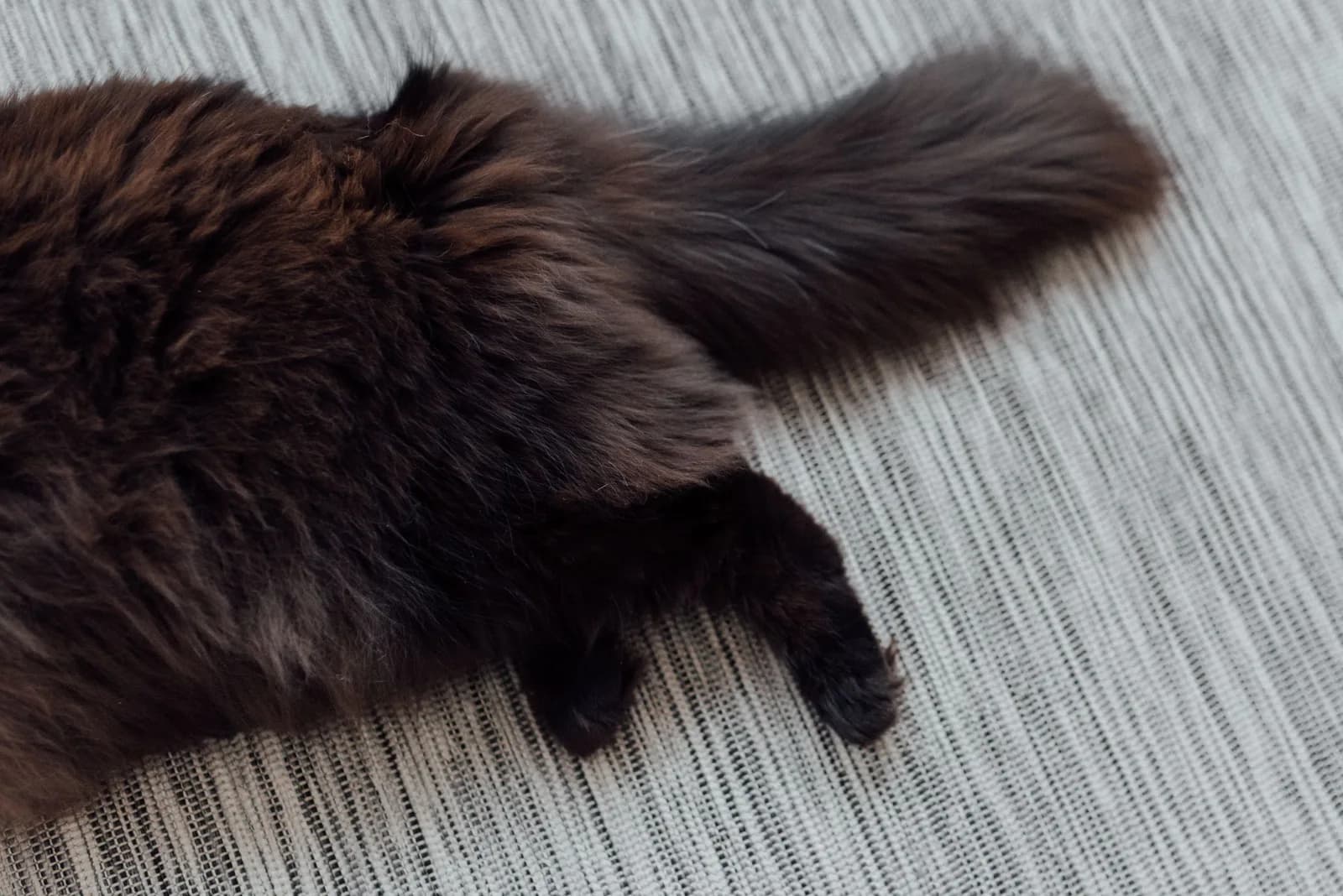
You usually notice it on something dark. A black cat stretched across a pale sofa, sunlight coming in sideways, and there it is: a scatter of white specks along the back that was not there in July.
The word is borrowed from us and it misleads, because everyone's first thought is dry skin, and dry skin is rarely the whole story. A flake is a physical object with a history, and once you know what it is made of, the rest falls into place: where the flakes gather, what they point at, and why the anti-dandruff shampoo under your sink is the worst thing in the house to reach for.
Why does my cat have dandruff
Skin is a wall that rebuilds itself from the inside. New cells are made at the bottom, harden as they rise, and arrive at the surface dead and interlocked like bricks, on a renewal that takes about three to four weeks in dogs and cats. The brick at the top is a corneocyte, and the mortar holding it there is a thin layer of lipids.
At the surface an enzyme dissolves that mortar and the corneocytes leave one at a time, far too small for the naked eye. Every cat is doing this right now. Dandruff is what happens when they stop leaving individually and start leaving in clumps: a visible flake is a raft of dead skin cells that came away together.
That is half the explanation. The other half is the cat, because one that grooms normally lifts the flakes off its own coat before you ever see one. Visible dandruff means the shedding changed, or the grooming did.
The clinical word for the shedding half is seborrhea, dry in some cats, greasy in others, mixed in most. The inherited version, faulty from birth, is rare and turns up mainly in Persians; nearly every other flaky cat has the kind driven by something else. In one US teaching hospital's fifteen-year record of 1,407 cats seen for skin disease, seborrhea does not appear among the ten most common diagnoses at all.
What causes dandruff on cats
Sorted by what is driving the flaking, not by how alarming it sounds.
- Dry air. Winter heating pulls the humidity out of a house and skin follows. This is the version a humidifier and a brush genuinely fix, and the reason dandruff has a season.
- What is in the bowl. Cats on low-fat diets often develop dandruff, and so do cats on aggressive weight-loss regimes. A flaky coat on a restricted diet is a predictable side effect.
- Weight. A heavy cat cannot fold into the shapes grooming requires, and overweight cats carry a 2.3-fold higher risk of ordinary, non-allergic skin problems. The weight chart says which side of the line yours is on; what to do next is its own conversation.
- Pain. A change in grooming habits is one of the things vets ask owners about when hunting for arthritis, common in older cats and under-recognized for decades. A cat that has quietly stopped twisting tells you in its coat before it tells you in its walk.
- Parasites. Fleas leave dark specks rather than white ones, and often turn up on the same cat. One mite makes flakes directly: cheyletiellosis, called walking dandruff because in a heavy infestation the scale appears to move. It is uncommon in house cats, found in four of 2,586 client-owned cats in a US laboratory survey, and it passes to people. Its cousin the ear mite stays put in the ears.
- Ringworm. A fungus, not a worm, and dandruff sits on its sign list beside circular hair loss and broken, stubbly hair. Left alone in a healthy cat it can take nine months to a year to clear.
- Systemic illness. Hyperthyroidism heads most veterinary lists here, with diabetes, kidney disease and cortisol disorders behind it. The coat is rarely the loudest sign: weight, appetite and the water bowl move first.
- Allergies. Food and environmental allergies produce dry, itchy, inflamed skin carrying plenty of scale. Pollen, cigarette smoke and a protein in dinner are all on the list.
The tail base, where a cat cannot reach
Ask owners where the flakes are and a large share name the same place: the lower back and the base of the tail. That is not something about the skin there. It is geometry. The tail base is the last place a cat's spine and neck can deliver its tongue, and the first territory lost when reach shortens. A heavy cat loses it, an arthritic cat loses it, and an old cat loses it slowly enough that nobody notices the moment. Everything the tongue would have taken simply stays.
Two things live there that are not this. Flea dirt also gathers on the rump, but it is dark rather than white, and on a damp tissue it smears rust red, because it is digested blood. Stud tail is a testosterone-driven gland on the upper side of the tail that in intact males leaves a waxy, matted oval patch.
The skin at the rump happens to be among the thickest on a cat's body. That is true, and it is not the explanation. Thick skin does not flake more; skin a tongue never reaches does.
When dandruff is a symptom and not a cosmetic problem
Flakes alone, on a cat eating, drinking and moving normally through a dry January, are usually a dry-air story. Here is what turns them into an appointment.
- It has run more than a couple of weeks. That is the stated threshold, and the one most owners let slide.
- The skin is doing something else too. Scabs, redness, sores, hair loss, itching, or a greasy coat. An odor is its own flag: seborrhea smells worse once a bacterial or yeast infection moves in on top.
- You can see parasites. Fleas, ticks or mites on the cat mean a vet visit, not a shopping trip.
- The rest of the cat has changed. Vomiting, appetite up or down, weight moving either way, more drinking, different litter box habits, limping, or a cat that has given up on its own back half.
- Someone in the house has a rash. Ringworm and walking dandruff both cross to people, so a human skin lesion beside a flaky cat is a clue, not a coincidence.
Itching deserves particular weight: the usual causes of a cat that scratches are parasites, infection and allergic skin disease. A cat with plain dry skin does not generally scratch.
Black cats: the dandruff you can finally see
Search for black cat dandruff and you will find pages written as though black cats have a skin problem. They do not. The flakes are white, the coat is not, and that is the entire phenomenon. The silence here is meaningful. Coat color is genuinely linked to real conditions in cats, documented in detail: deafness in white cats with blue eyes, the dark freckling on orange cats, the pigment loss most common in Siamese. Dandruff is on none of those lists, and a search of the veterinary literature for any association between coat color and scaly skin comes back empty. The one veterinarian who takes the question head on puts it as plainly as it can be put: black cats are not more likely to have dandruff, it is simply far more obvious on them.
Which leaves an advantage rather than a problem. A black cat is an early-warning coat: the same scatter on a cream Persian or a ginger tabby stays invisible until there is a lot of it. Yours shows up in week one. Take the free information, and treat the flakes as you would on any other cat.
What actually helps
It depends on the cause, which is why the first step is a diagnosis and not a product. A vet works the same short list: history and physical exam, bloodwork and thyroid levels for systemic disease, skin scrapings and hair plucks for mites and fungus, a culture if infection is on the table. What veterinary sources name, once the cause is known:
- Brushing. It lifts shed hair, spreads the skin's own oils and does the job the tongue has stopped doing. For a cat that cannot reach its own tail base, this is the whole intervention.
- Humidity, weight and pain, treated as themselves. A humidifier through the dry months; a cat that can bend again grooms again.
- Parasite prevention kept current. It takes a family of causes off the board.
- Omega-3 fatty acids. Every source recommending them for coat quality does so as practice consensus, not as a trial result: no controlled study of omega-3 for feline coat outcomes exists. Vets still advise them, and advise asking first, because supplements built for people can carry metals cats handle badly.
- Medicated shampoo, when prescribed. A veterinary anti-seborrheic program is a real treatment on a real schedule, typically once or twice weekly for 30 to 45 days, written for a diagnosed cat.
What is not a fix
Human anti-dandruff shampoo. This needs a mechanism rather than a warning, because "cats have sensitive skin" has never stopped anybody. In the United States, the ingredients an over-the-counter dandruff shampoo may legally contain are set out in federal regulation, and the list is short: coal tar, pyrithione zinc, salicylic acid, selenium sulfide, sulfur. Look at the first one. Coal tar's active toxins are phenol and cresol, and cats are deficient in UDP-glucuronosyl transferase, the liver enzyme that packages that family of compounds for disposal. What a person clears, a cat accumulates. Coal tar poisoning in cats runs to jaundice, anemia and death, and phenol-based disinfectants are advised against anywhere cats live for the same reason.
This is not a cat being delicate. It is a missing enzyme in an animal that then licks off whatever you put on it.
Over-bathing. The intuitive move makes it worse, stripping the skin of oils the flaking already suggests are short. Cat skin is not human skin, and a product balanced for us can disrupt a barrier built to other specifications.
What to take away
- A flake is a raft of dead skin cells that left the surface together; individually they shed invisibly, in every cat, every day. Visible dandruff means the shedding changed or the grooming did.
- Flakes gather at the tail base because it is the last place a cat's tongue reaches, and the first lost to weight, arthritis and age.
- Formally diagnosed seborrhea is uncommon: it is absent from the ten most frequent diagnoses in a 1,407-cat feline dermatology case series.
- Black cats are not more prone to dandruff: no veterinary study links coat color to scaly skin, the flakes are just white and the coat is not.
- Flakes past a couple of weeks, or arriving with scabs, itching, hair loss, an odor, visible parasites, or changes in appetite, thirst or movement, are a reason to call the vet.
- Human anti-dandruff shampoo is uniquely dangerous to cats, which lack the liver enzyme that clears the phenol family its ingredients are built on.
 The vet's take

Veterinary review
Are you a vet?
Your professional read belongs here: every verified practitioner can leave a note, published once our editors have reviewed it.
Sign in and get your license number verified. We check it in the public register, we never ask for or keep a copy of your diploma, and your number is never published.
Frequently asked questions
Is cat dandruff normal?
Every cat sheds skin cells constantly and you see none of it, because they leave one at a time and grooming lifts whatever reaches the surface. Visible white flakes sit outside that range. Dry winter air is a common and harmless cause, but the flakes are a change worth reading.
Why is my cat's dandruff only near the tail?
Because that is the part its own tongue reaches last. When flexibility drops, through weight, arthritis or age, the tail base is the first territory abandoned. If the specks there are dark rather than white, you are probably looking at flea dirt.
Can I use human dandruff shampoo on my cat?
No, and for a specific reason. The ingredients licensed for human dandruff products include coal tar, whose active toxins are phenol and cresol, and cats lack the liver enzyme that clears that chemical family. The cat then grooms the product off and swallows it.
What is walking dandruff?
A surface mite that feeds on skin keratin and produces heavy scale, named for the way the flakes appear to shift as the mites move underneath. It is uncommon in pet cats, found in four of 2,586 client-owned cats in one US laboratory survey, and more frequent in cats living rough. It spreads to people, and a vet identifies it from a skin scraping.
Are black cats more likely to get dandruff?
No. There is no measured link between coat color and scaly skin anywhere in the veterinary literature, and the veterinarians who address the question say so directly. White flakes on a black coat show up at a quantity that would go unnoticed on a cream or ginger cat. That is earlier warning, not worse skin.
 Community questions
Got a question this page doesn't cover? Ask it: the best ones get published here with their answer.
This is information, not veterinary advice, and it cannot tell you what is wrong with your cat. Our rule is a simple one: if something is wrong with your cat, call your vet, and call an emergency clinic if it is out of hours. Nothing you read here is a reason to wait.
Medical information applies to every reader. Prices, legal duties and common practice do not: unless stated otherwise, they are given for the United States, and they differ in the UK, Canada and Australia, and often between states or provinces. Check with your own vet and your own local authority.
Our sources
- Merck Veterinary Manual (professional), seborrhea in animals: the keratinization defect, primary vs secondary, more common in dogs than cats
- Merck Veterinary Manual (professional), mange in dogs and cats: Cheyletiella blakei, dorsal scaling, contagion to people
- Merck Veterinary Manual, coal-tar poisoning: phenol and cresol as the active toxins, and cats' particular sensitivity
- Merck Veterinary Manual (professional), phenols as antiseptics: cats' UDP-glucuronosyl transferase deficiency and why phenolics are avoided
- Merck Veterinary Manual (pet owner), congenital and inherited skin disorders of cats: the documented coat-color-linked conditions, dandruff absent from them
- Merck Veterinary Manual (professional), hyperplastic and seborrheic syndromes: the Persian breed predisposition
- Merck Veterinary Manual (professional), dermatological problems in animals: pruritus as a sign, and its usual causes
- Merck Veterinary Manual (pet owner), whole-body disorders affecting the skin in cats: the endocrine and metabolic skin changes
- Cornell Feline Health Center (Catwatch, 2022), dealing with dry skin: William H Miller Jr VMD on invisible daily shedding, humidity, low-fat diets and prescribed shampoo courses
- Cornell Feline Health Center, ringworm in cats: dandruff on the sign list, the nine-months-to-a-year untreated course, zoonosis
- Today's Veterinary Practice (2023), Cheyletiella blakei infection in cats, Lara Tomich DVM MS DACVD: keratin-feeding surface mites and their presentation
- Nagamori et al 2020, Vet Parasitol (PMID 31841945): Cheyletiella in 4 of 2,586 client-owned North American cats, 2007-2018
- Thomas et al 2016, Vet Parasitol (PMID 27692321): ectoparasites of free-roaming US cats, Cheyletiella at 0.9 percent
- Scott, Miller and Erb 2013, JFMS (PMID 23186638), 1,407 cats at Cornell 1988-2003; ABSTRACT ONLY, full text and tables not reached
- Bennett et al 2012, osteoarthritis in the cat part 1 (PMID 22247326): grooming change as an owner-reported sign; abstract only
- Bennett et al 2012, osteoarthritis in the cat part 2 (PMID 22247327): limited feline evidence for omega-3 rich diets; abstract only
- Frontiers in Veterinary Science 2026, obesity in cats: body mass and grooming, and the 2.3-fold skin-condition risk (a review's restatement, original untraced)
- VIN, WSAVA 2003 proceedings, Chiara Noli DVM DECVD on seborrhea: corneocytes detaching singly vs in visible aggregates (mechanism is general mammalian dermatology)
- 21 CFR 358.710 (US federal regulation, via the govinfo PDF): the active ingredients permitted in over-the-counter human dandruff products
- VCA Animal Hospitals, seborrhea in cats: the secondary-seborrhea cause list and the vet diagnostic workup (live page 403, read via a Wayback capture)
- Kinship, why does my cat have dandruff, Dr Alycia Washington DVM MS: the black-cat finding, the tail-base reach mechanism, and the human-shampoo warning
- PetMD, dandruff in cats, reviewed by Dr Katie Grzyb DVM: the two-week threshold, flea dirt at the tail base, and the diagnostic list
- PetMD, inherited skin disease in the Persian cat: idiopathic seborrhea as a breed predisposition
- WebMD Pets, what to know about dandruff in cats: the full contact-your-vet list used in the symptom section
- DermaVet.eu, the skin of dogs and cats (William Bordeau, 2017): the brick-wall model and the three-to-four-week renewal, stated for dogs and cats jointly
- SafariVet dermatology training material, SINGLE SOURCE and uncited: horny-layer thickening, regional skin thickness, and the caudal tail gland (stud tail)
- Agria Pet Insurance UK, dandruff in cats: the UK consumer wording that flakes simply show more on a black coat

Worth keeping a paw on
Pin this guide
So you can find it the day you need it, and share it with someone whose cat does the same thing. One click and it sits in your board.
Pin it on PinterestAlso worth reading
All health →
Article
Cat Bad Breath: What That Smell Is Telling You
A cat's breath should not smell. When it does, the cause is usually the gum line, sometimes the kidneys. What each one smells like, and when to call the vet.
Read
Article
Cat Insurance: How It Actually Works, and When It Is Worth It
The four policy types, real premium figures per country with their sources, the exclusions that surprise people, and the honest arithmetic behind "worth it".
Read
Article
Cat Insurance for Older Cats: The Two Ages That Matter
When insurers call a cat "older", what happens to the premium, the real enrollment cutoffs by product, and why switching late is the costly move.
Read
The floor belongs to our members. Keep it kind, links are not allowed, and images go through moderation before anyone else sees them.