

Arthritis in Cats: The Most Common Disease Nobody Sees
Nine in ten senior cats show joint disease on X-rays and almost no owners see it. What to watch instead of a limp, and the honest treatment map.

Published August 27, 2026Updated September 8, 2026 7 min read
Contents
Here is the gap this page exists to close. When researchers X-rayed 100 cats over the age of twelve, 90% showed degenerative joint disease. In another study of 100 cats across all ages, the figure was 92%, and severity climbed measurably with every year of age. Now the other half of the gap: in a Japanese study of 101 cats, where three-quarters had radiographic arthritis, exactly one owner had noticed lameness. One.
Cats do not do arthritis the way dogs do. They almost never limp, they hide pain expertly, the habit our sick cat symptoms guide decodes across every illness, and the disease announces itself through small subtractions from daily life that look exactly like "just getting old." Veterinarians commonly explain the hiding as inherited caution in an animal that is both predator and prey; whatever the reason, the measurement stands. A 2025 study across five ordinary vet clinics made it uncomfortably concrete: reviewing 502 medical records built on standard exams and owner conversations, 1% of cats had any orthopedic issue noted. When the same clinics screened cats with a validated arthritis checklist instead, 39% showed at least one behavior consistent with osteoarthritis.
What to watch instead of a limp
The one prospective study built purely on clinically arthritic cats, 28 cases, found the real signature: 71% had a changed ability to jump and 67% jumped lower than before. Jumping, not limping, is the instrument. The elbow and hip were the most affected joints, and most cases had no injury behind them, just wear.
The full watch list, drawn from that study, Cornell's guidance and the validated owner questionnaires this field now uses:
- Hesitating before a jump the cat used to make without thinking, or choosing a chair as a staging post to reach the counter
- Jumping lower, or abandoning favorite high places altogether
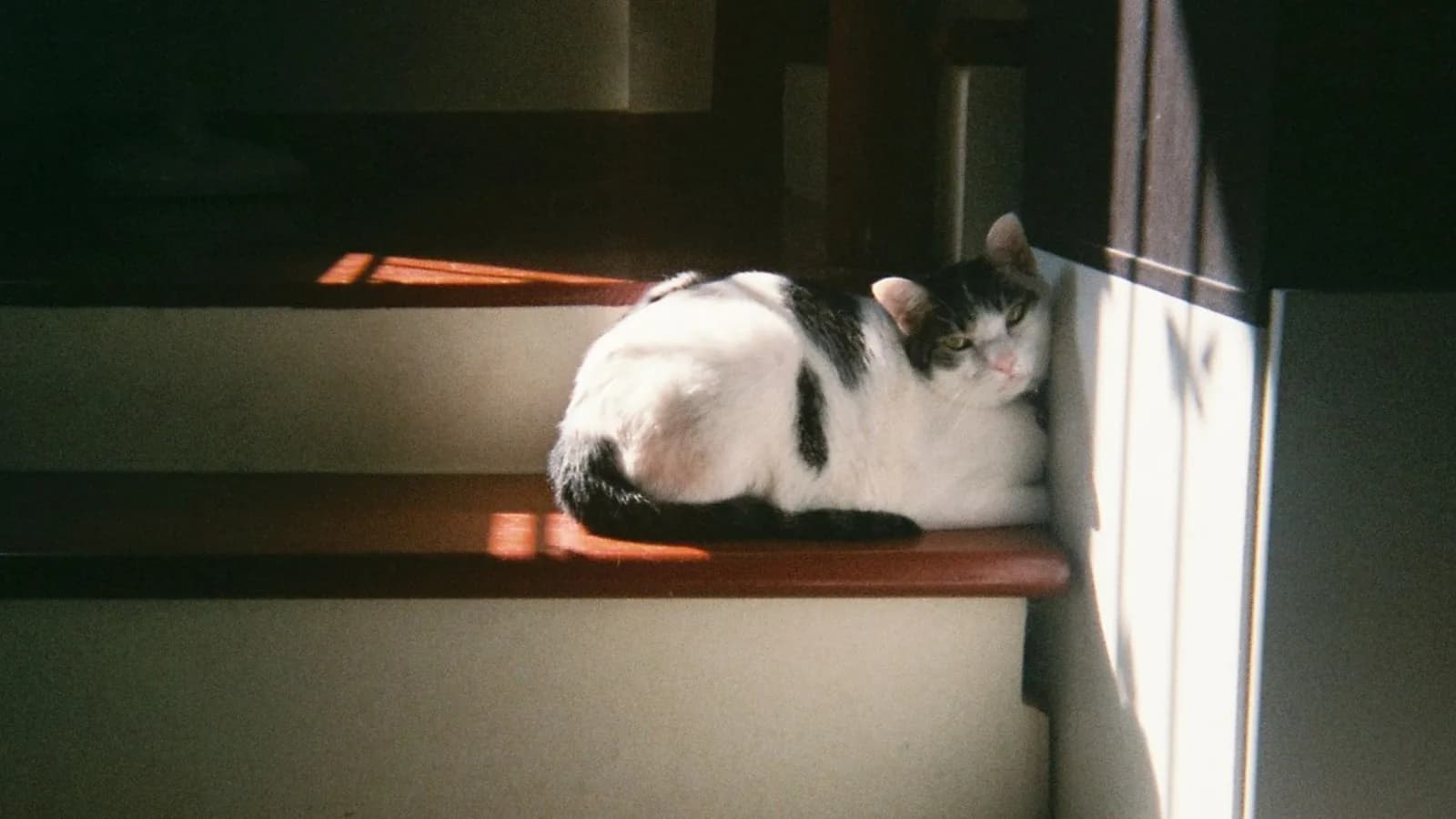
- Trouble with stairs, or taking them one careful step at a time
- Difficulty stepping into a high-sided litter box, sometimes showing up as accidents right next to it
- A scruffy, unkempt coat in the hard-to-reach places, because grooming means bending. One of the first places arthritis shows is the coat over the lower back, because that is the last patch a cat can reach: what those flakes mean.
- Sleeping more, seeking warm spots, playing less
- Irritability when touched over the back or hips
None of these diagnoses anything on its own. Together, in a cat past ten, they are exactly the pattern a checklist finds in 39% of cats while the standard visit finds it in 1%. Bring the list to your vet; a Canadian study of 50 diagnosed cats found the owner's observations were the primary or contributing route to diagnosis in 94% of cases. You are the diagnostic instrument here.
If your stiff senior cat has also started crying at night, that overlap has its own page: night vocalization in older cats shares causes with joint pain, and our cat meowing at night guide walks the fork.
How common is it really?
The honest way to hold the numbers: the professional life-stage guidelines reconcile the studies as a range, 40 to 92% of cats showing signs associated with degenerative joint disease, much more prevalent and severe with age. X-ray findings run ahead of visible discomfort, so not every radiographic cat is a suffering cat. But Cornell's own pages carry a figure worth hearing on the younger end: some degree of arthritis in 20% of cats aged one and up. This is not exclusively a senior disease; it is a disease seniors can no longer hide.
Treatment: what exists, and the honest map of where
There is no cure for arthritis, in cats or anyone else. Management rests on pain control, weight, and the home. The drug shelf is genuinely different depending on your market, which almost no general page tells you:
| Treatment | United States | United Kingdom | Canada | Australia |
|---|---|---|---|---|
| Meloxicam (Metacam), an NSAID | One-time injectable dose around surgery only; repeated use carries the FDA's strongest label warning (kidney failure risk); chronic oral use is off-label | Oral suspension licensed for chronic musculoskeletal disease, including arthritis, since 1998 | Oral suspension licensed for long-term use including osteoarthritis since 2007 | Registered since 2007 for acute and chronic musculoskeletal disorders |
| Robenacoxib (Onsior), an NSAID | Post-surgical use only, three days maximum; chronic use off-label | Post-surgical use capped at three days; the arthritis indication carries no stated duration cap | Licensed for chronic musculoskeletal disorders including osteoarthritis | Licensed; arthritis treatment can continue long-term |
| Frunevetmab (Solensia), a monthly anti-NGF antibody injection | FDA-approved January 2022, the first US-approved treatment specifically for feline arthritis pain | Authorized, prescription-only | Marketed since April 2022 (Health Canada DIN 02518449) | Registered, vet-administered |
Two honest notes on that table. First, the US-versus-everyone split on NSAIDs is real and old: the low-dose long-term safety study that reassured UK, Canadian and Australian regulators (40 cats, nearly six months of daily low-dose meloxicam, one adverse effect class, no kidney impairment detected) never changed the US label. Caution is not paranoia either way: an Australian case series documented acute kidney injury in 18 cats after injectable meloxicam, and kidney disease is common in exactly the senior cats who need arthritis care. If your cat has kidney disease, say so before any NSAID conversation; a pooled safety analysis of robenacoxib, 449 cats including 126 with concurrent kidney disease, found no increased adverse events versus placebo, which is why this conversation has options rather than a wall. Our kidney disease guide covers that side.
Second, Solensia deserves its numbers stated the way the peer-reviewed trial stated them, not the way the press releases did. In the pivotal 275-cat trial, treated cats improved significantly over placebo on owner-scored measures, with a number-needed-to-treat of nine on the main measure at day 56, and skin issues were the one side effect clearly more frequent in treated cats (32 of 182, versus 8 of 93 on placebo). A number-needed-to-treat of nine means real but modest: for every nine cats treated, one improves who would not have on placebo. Many owners report more than that; the trial arithmetic is the floor you can bank on. It is a genuine option, especially where NSAIDs are off the table, and it is not a miracle shot.
Supplements: the part nobody wants to hear
A 2022 systematic review pooled 72 trials of enriched diets and supplements in dogs and cats together. Its findings, honestly relayed with that mixed-species caveat attached: omega-3 fatty acids, whether as enriched diets or supplements, showed meaningful benefit. Glucosamine-chondroitin, the best-selling joint supplement on every shelf, showed what the authors called a very marked non-effect, and they recommend it no longer be used for arthritis pain in dogs or cats. If your budget has one supplement line in it, the evidence says omega-3, not the famous one.
Weight: the lever you own
In a study of 1,457 cats, obese cats were 4.9 times as likely as lean cats to develop lameness needing veterinary care. We will state the limit of the evidence plainly, because this site does: no prospective trial has yet measured whether weight loss reduces arthritis pain in cats. The association is strong, the mechanics of joint load are not controversial, and the veterinary consensus treats weight management as the most actionable thing an owner controls. Our overweight cat guide covers how to actually do it, including why crash-dieting a cat is dangerous.
The five-dollar fixes
The home matters as much as the pharmacy, and the guidelines' recommendations are mostly carpentry, offered here as practical advice rather than trial findings:
- A litter box with one low side, so stepping in stops being a hurdle. Shallower litter helps some cats, since digging can hurt.
- Steps or a ramp to the favorite sleeping spot, wide and non-slippery.
- Warm bedding where the cat already likes to sleep; stiffness is typically worst after a night of stillness.
- Food and water where no jump or staircase guards them.
What to take away
- Radiographic studies find degenerative joint disease in about 90% of cats over 12, and owners almost never see it: in one 101-cat study, exactly one owner had noticed lameness.
- The early sign of feline arthritis is a changed jump, not a limp: 71% of clinically arthritic cats had a changed ability to jump and 67% jumped lower in the key 28-case study.
- Long-term arthritis NSAIDs are licensed for cats in the UK, Canada and Australia but not in the US; the monthly Solensia antibody injection is approved in all four markets.
- The pooled evidence supports omega-3 for feline joint pain and finds glucosamine-chondroitin measurably ineffective.
- Obese cats were 4.9 times more likely than lean cats to develop lameness needing veterinary care; weight is the one lever owners fully control.
- The five-dollar fixes work: a low-sided litter box, a ramp to the favorite sleeping spot, warm bedding for stiff mornings.
 The vet's take

Veterinary review
Are you a vet?
Your professional read belongs here: every verified practitioner can leave a note, published once our editors have reviewed it.
Sign in and get your license number verified. We check it in the public register, we never ask for or keep a copy of your diploma, and your number is never published.
Frequently asked questions
What are the first signs of arthritis in cats?
Changes in jumping, before anything else: hesitating, jumping lower, or giving up high places, which affected two-thirds to three-quarters of clinically arthritic cats in the key study. Stiff stairs, litter box trouble, a scruffier coat and more sleeping round out the early picture. Overt limping is genuinely uncommon.
At what age do cats get arthritis?
It is strongly age-linked, and earlier than the stereotype: Cornell cites some degree of arthritis in 20% of cats aged one and up, and one study measured joint disease worsening by roughly 13.6% per year of age. By the senior years, radiographic studies find it in around nine cats in ten.
Can cat arthritis be cured?
No. It can be managed well: licensed pain medication (which ones depend on your country), a monthly antibody injection available in all four of our markets since 2022, weight control, and a home adjusted so the cat spends less pain on daily logistics.
Is there a safe painkiller for cats with arthritis?
Options exist everywhere, and the menu differs by market: long-term NSAIDs are licensed for cats in the UK, Canada and Australia but not the US, and Solensia, the monthly injection, is approved in all four. Never give human painkillers, and never dose a cat without a vet: several common human drugs are lethal to cats at tiny doses.
Do joint supplements work for cats?
The pooled evidence in dogs and cats says omega-3 fatty acids help and glucosamine-chondroitin measurably does not, to the point that the 2022 review recommends dropping it. Talk to your vet before adding anything, especially in a cat with other conditions.
Should an arthritic cat still jump and play?
Yes, gently: movement maintains muscle, and muscle protects joints. The goal of ramps and steps is not to end climbing but to remove the painful launches and landings. A cat that suddenly stops moving altogether has earned a vet visit, not a softer sofa.
 Community questions
Got a question this page doesn't cover? Ask it: the best ones get published here with their answer.
This is information, not veterinary advice, and it cannot tell you what is wrong with your cat. Our rule is a simple one: if something is wrong with your cat, call your vet, and call an emergency clinic if it is out of hours. Nothing you read here is a reason to wait.
Medical information applies to every reader. Prices, legal duties and common practice do not: unless stated otherwise, they are given for the United States, and they differ in the UK, Canada and Australia, and often between states or provinces. Check with your own vet and your own local authority.
Our sources
- Lascelles et al 2010, cross-sectional study of the prevalence of radiographic degenerative joint disease in domesticated cats (Veterinary Surgery)
- Hardie, Roe and Martin 2002, radiographic evidence of degenerative joint disease in geriatric cats (JAVMA)
- Kimura et al 2020, retrospective radiographic study of degenerative joint disease in cats (Frontiers in Veterinary Science)
- Clarke and Bennett 2006, feline osteoarthritis: a prospective study of 28 cases (JSAP; the jump-change figures)
- Gober et al 2025, implementation of a prospective in-clinic validated feline osteoarthritis checklist (JFMS; the 1% vs 39% gap)
- Klinck et al 2012, owner-perceived signs and veterinary diagnosis in 50 cases of feline osteoarthritis (Canadian Veterinary Journal)
- Gruen et al 2021, frunevetmab for the treatment of pain from osteoarthritis in cats (JVIM; the pivotal Solensia trial)
- Gunew, Menrath and Marshall 2008, long-term safety, efficacy and palatability of oral meloxicam in osteoarthritic cats (JFMS)
- King et al 2021, clinical safety of robenacoxib in cats with chronic musculoskeletal disease (JVIM; the CKD subgroup)
- Barbeau-Gregoire et al 2022, systematic review and meta-analysis of enriched therapeutic diets and nutraceuticals in canine and feline osteoarthritis
- Scarlett and Donoghue 1998, associations between body condition and disease in cats (JAVMA; the 4.9x lameness figure)
- Cornell Feline Health Center, is your cat slowing down?
- Health Canada Drug Product Database, Solensia DIN 02518449 (marketed April 2022; verified 27/08/2026)

Worth keeping a paw on
Pin this guide
So you can find it the day you need it, and share it with someone whose cat does the same thing. One click and it sits in your board.
Pin it on PinterestAlso worth reading
All health →
Article
Pyometra in Cats: The Infection That Hides Behind a Clean Cat
A uterus infection that hides behind a fastidious cat. How common it is (17 per 10,000 cat-years), who gets it, what the surgery achieves, and why "she was in heat last month" is the clue.
Read
Article
Cat Vaccinations: The Schedule, the Laws, and What the Numbers Actually Say
Which vaccines are core and why, the kitten schedule with the reason behind the 6-month booster, the rabies laws market by market, and the honest sarcoma math.
Read
Article
Cat Worms: The Three That Matter, and the Test That Misses One
The three worms that carry the caseload, the stool test that misses tapeworms entirely, what the prevalence studies actually measured, and the schedules the major bodies publish.
Read
The floor belongs to our members. Keep it kind, links are not allowed, and images go through moderation before anyone else sees them.