

Cat Vaccinations: The Schedule, the Laws, and What the Numbers Actually Say
Which vaccines are core and why, the kitten schedule with the reason behind the 6-month booster, the rabies laws market by market, and the honest sarcoma math.

Published August 26, 2026Updated September 8, 2026 5 min read
Contents
Two documents sit behind almost every vaccine decision your vet makes: the 2020 / feline vaccination guidelines and the 2024 guidelines. We read both in full for this page, so what follows is what they actually say, including the parts most pages skip: why the 6-month booster exists, what the sarcoma risk really measures, and how the law changes completely depending on which of our four countries you live in.
In the US they are shots, in Britain jabs, in Australia the core bundle goes by F3. Same needles everywhere.
Core, non-core, and not recommended
| Category | Vaccine | Notes |
|---|---|---|
| Core, every cat | one combination shot: feline herpesvirus (), (), panleukopenia () | |
| Core, every cat | Rabies | and the law often requires it, see below |
| Core under 1 year | (feline leukemia) | becomes risk-based after age 1: outdoor access keeps it on |
| Non-core | Chlamydia felis, Bordetella | specific exposure situations only |
| Not generally recommended | FIP vaccine | insufficient evidence of real-world protection, per the guidelines |
| Not recommended | Ringworm vaccines | ineffective in cats, per Cornell |
| No longer sold in North America | vaccine | poor effectiveness, and it muddied testing |
Pregnant queens are a special case: the 2024 guidelines rule out live attenuated vaccines during pregnancy, as our cat pregnancy guide explains.
The kitten schedule, and the reason behind its strangest line
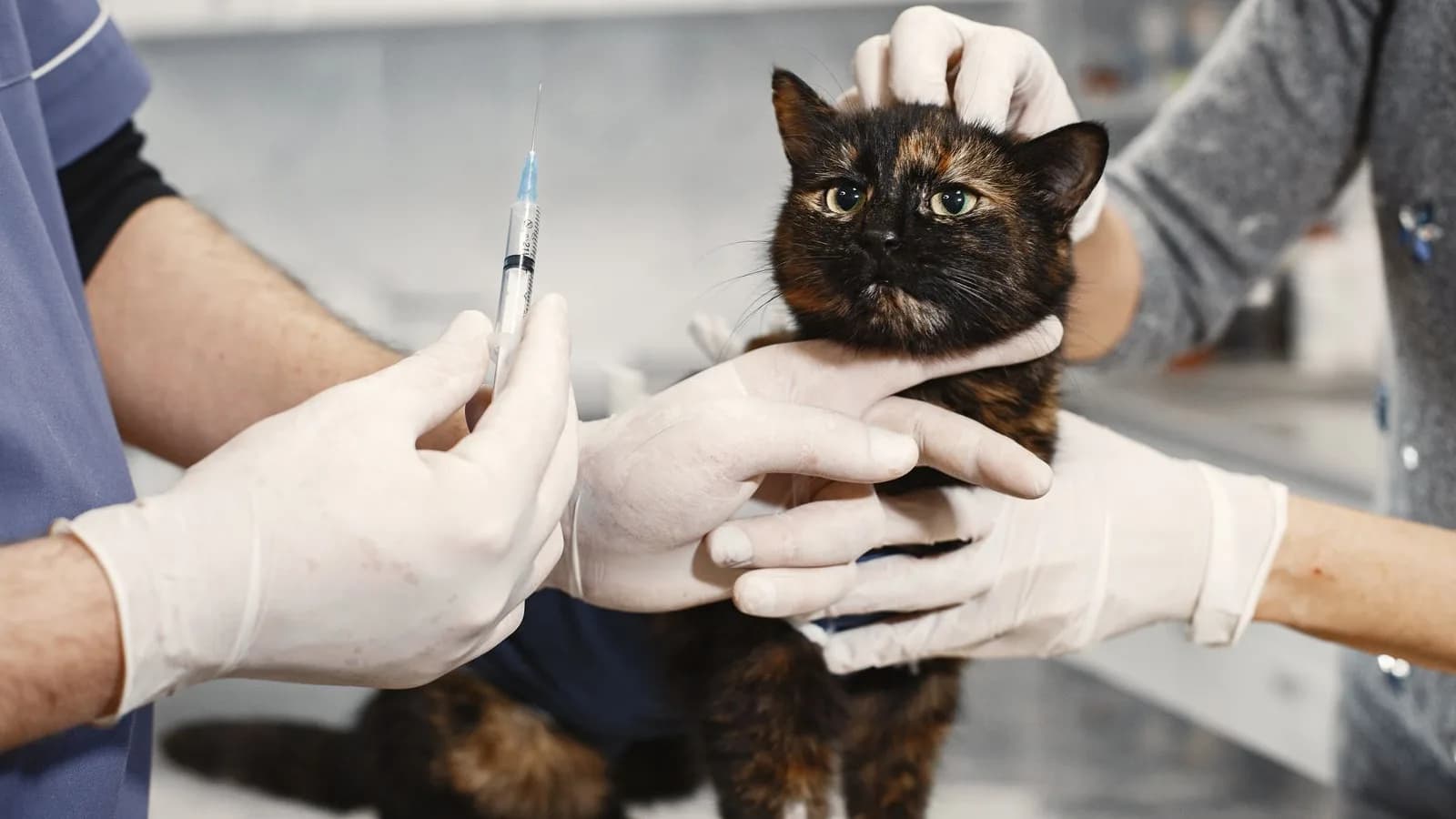
Kittens get a series every 2 to 4 weeks until 16 to 18 weeks of age, starting around 6 to 8 weeks. Then comes the line that looks arbitrary and is not: a booster at 6 months.
The reason is measured: up to one-third of kittens fail to respond to their final 16-week vaccine, because antibodies inherited from their mother are still blocking it. The 6-month booster exists to close that window, and both guideline bodies now recommend it.
After that, the cadence for the core is every 3 years for low-risk adult cats. stays annual for cats with continuing exposure. And a cat heading into a boarding cattery, a practical requirement at most UK and Australian catteries, should be boosted 1 to 2 weeks before the stay, not the morning of.
Do indoor cats need any of this?
The guidelines answer this directly rather than rhetorically. Indoor cats meet pathogens at the vet clinic, through other animals entering the home, and on their owner's hands and clothing. Cornell adds a twist most owners have never heard: a strictly indoor cat may actually be more susceptible to some infections, because it never gets the natural immune boosting outdoor cats pick up from low-level exposure. Core stays core, indoors included.
Rabies and the law: four countries, four different worlds
| Where | The rule | Source |
|---|---|---|
| New York | vaccinated by four months old, second dose within a year | NY Public Health Law §2141 |
| Texas | vaccinated by 16 weeks, by or under a veterinarian's supervision | 25 Tex. Admin. Code §169.29 |
| California | no state mandate for cats; local ordinances (Los Angeles County, for one) fill the gap | state law covers dogs |
| Ontario | mandatory from 3 months old | Ontario Regulation 567; the only Canadian province with a cat mandate |
| Quebec, BC | no provincial mandate; recommended, and municipal bylaws vary | |
| UK | no domestic requirement at all; rabies vaccination exists only for travel | GOV.UK; the UK does not have the disease |
| Australia | rabies-free, actively defended at the border; domestic cats are not rabies-vaccinated | Dept of Agriculture (DAFF) |
The stakes of a lapse are concrete, per Cornell: an up-to-date cat exposed to a rabid animal gets a booster and a home quarantine of 10 to 45 days; an unvaccinated or lapsed cat faces a strict six-month quarantine, or worse under the strictest laws. Worldwide, rabies still kills a commonly cited 50,000 to 60,000 people a year, which is why the paperwork is not optional where the disease exists.
Side effects, honestly, with the thresholds
In the largest dataset the guidelines cite, 1.25 million doses across nearly half a million cats, adverse reactions of any kind were reported in 0.52% of cats. The expected, mild ones: a day or two of low energy, reduced appetite, mild fever, tenderness at the site. They resolve on their own.
Call your vet immediately if, within hours of vaccination, your cat starts vomiting or scratching, develops hives or facial swelling, or has any difficulty breathing. That is the guidelines' own threshold, and it describes anaphylaxis, which is rare, roughly 1 to 5 per 10,000 doses, and urgent every time.
For lumps at the injection site, the guidelines give owners a rule worth memorizing, the 3-2-1 rule: see a vet for a biopsy if a lump is still present 3 months after vaccination, is larger than 2 cm, or is still growing 1 month after the shot.
The sarcoma question, with the real math
Injection-site sarcoma, a rare aggressive tumor at the vaccine site, is the reason some owners hesitate. Here is what the evidence actually says. A 2026 meta-analysis pooling 14 million vaccinations and 411 cases landed at about 1 case per 10,000 vaccinations, and then did something most pages quoting it omit: it graded its own evidence as very low certainty, with enormous variation between studies. The one UK-specific study put the risk between 1-in-5,000 and 1-in-12,500 vaccination visits and called it very low.
Two practical notes from the guidelines: vaccines are now given low on the limbs precisely so that the worst case remains surgically treatable, and neither shoulder-blade injection nor reduced vaccine volume is recommended as a safety measure. The 3-2-1 rule above is the owner's half of the surveillance.
Titer testing: narrower than its reputation
Blood antibody testing gets floated as an alternative to boosters. 's position is precise: in cats, a reliably predicts protection for panleukopenia () only, not for herpesvirus, , or rabies as far as the law is concerned, and titer testing is a choice, not an obligation. An in-clinic kit can also return a false positive, clearing a cat that is not actually protected, which is the failure mode that matters.
What it costs, from named sources only
| Market | Figure | Source, as seen 2026 |
|---|---|---|
| US, low-cost clinic | $20 to $25 per vaccine | Sacramento SPCA, pricing effective March 2026 |
| US, full-service | typically more; commonly quoted around $15 to $45 per dose plus the exam | aggregator consensus, no single named source |
| Canada (Ontario) | $33 per vaccine (rabies, , alike) | Ontario SPCA 2026 fee schedule |
| Australia | A$140 to A$160 a year, vaccination plus the annual check | RSPCA NSW |
| UK | practices set their own prices; states plainly that no single figure exists |
That empty-looking UK line is deliberate: the UK's own charities decline to publish a number, so neither do we invent one.
What to take away
- Indoor cats need the core vaccines too: pathogens travel on clothing and through clinic visits, and the guidelines make no indoor exception.
- The kitten series runs from 6 to 8 weeks, every 2 to 4 weeks until 16 to 18 weeks, then the 6-month booster; up to a third of kittens fail to respond to the 16-week shot, which is what the 6-month booster fixes.
- Low-risk adults move to a 3-year cycle for the core ; stays annual only while real exposure continues; rabies follows your local law.
- The vaccine is core for every kitten in the US guidelines, then risk-based after age one.
- The injection-site tumor risk is about 1 per 10,000 vaccinations (a very-low-certainty pooled estimate) against diseases that kill unvaccinated cats: the answer is smart injection sites, not skipping.
- A day or two of low energy after shots is expected; facial swelling, hives or labored breathing within hours is an immediate call.
 The vet's take

Veterinary review
Are you a vet?
Your professional read belongs here: every verified practitioner can leave a note, published once our editors have reviewed it.
Sign in and get your license number verified. We check it in the public register, we never ask for or keep a copy of your diploma, and your number is never published.
Frequently asked questions
Does my indoor cat really need vaccines?
Yes, for the core set. Pathogens reach indoor cats through clinic visits, other animals and your own clothing, and the guidelines make no indoor exception for core vaccines. Rabies additionally stays a legal requirement in much of North America regardless of lifestyle.
How often does an adult cat need boosters?
For low-risk adults, the core FVRCP moves to every 3 years after the kitten series and 6-month booster. FeLV is annual while real exposure continues. Rabies follows your local law and the product's licensed duration.
Why does my kitten need yet another shot at 6 months?
Because up to a third of kittens fail to respond to the 16-week vaccine, blocked by maternal antibodies. The 6-month booster closes that gap; it is the newest and best-justified line on the schedule.
Is the injection-site tumor risk a reason to skip vaccines?
The best pooled estimate is about 1 per 10,000 vaccinations, graded very-low-certainty by its own authors, against diseases that kill unvaccinated cats. The guidelines' answer is not skipping; it is smart injection sites and the 3-2-1 lump rule.
What is an F3 vaccine?
The Australian and New Zealand name for the same core trio the US calls FVRCP: panleukopenia, herpesvirus, calicivirus. Boarding catteries there commonly require a current F3 certificate.
My cat is lethargic after shots. Normal?
A day or two of low energy, small appetite and mild fever is the documented, expected reaction. Vomiting, facial swelling, hives or labored breathing within hours is not: that is an immediate call.
 Community questions
Got a question this page doesn't cover? Ask it: the best ones get published here with their answer.
This is information, not veterinary advice, and it cannot tell you what is wrong with your cat. Our rule is a simple one: if something is wrong with your cat, call your vet, and call an emergency clinic if it is out of hours. Nothing you read here is a reason to wait.
Medical information applies to every reader. Prices, legal duties and common practice do not: unless stated otherwise, they are given for the United States, and they differ in the UK, Canada and Australia, and often between states or provinces. Check with your own vet and your own local authority.
Our sources
- 2020 AAHA/AAFP Feline Vaccination Guidelines (read in full), J Am Anim Hosp Assoc 56
- WSAVA core and non-core vaccines for pet cats, 2024 guidelines table (read in full)
- WSAVA 2024 vaccination guidelines for dogs and cats (read in full), J Small Anim Pract
- Cornell Feline Health Center, feline vaccines: benefits and risks
- Emdin et al 2026, incidence of vaccine-associated sarcomas in cats: systematic review and meta-analysis (14 million vaccinations), J Small Anim Pract
- The incidence of feline injection site sarcomas in the United Kingdom (read in full), BMC Vet Res 2013;9:69
- New York Public Health Law section 2141, rabies vaccination (initial doses by four months)
- Texas Administrative Code, 25 TAC section 169.29, rabies vaccination requirement (16 weeks)
- Ontario.ca, rabies and your pets (mandatory from 3 months, Regulation 567)
- GOV.UK, bringing your pet dog, cat or ferret to Great Britain (rabies vaccination is travel-scoped)
- Australian Government DAFF, protecting Australia from rabies (rabies-free status)
- Cats Protection, infectious disease and vaccination leaflet (2025)
- PDSA, cat and kitten vaccinations (UK schedule; no single UK price exists)
- Sacramento SPCA clinic pricing, effective March 2026 (US low-cost figures)
- Ontario SPCA clinical services fee schedule, 2026
- RSPCA NSW, costs of owning a pet (annual vaccination and check figure)

Worth keeping a paw on
Pin this guide
So you can find it the day you need it, and share it with someone whose cat does the same thing. One click and it sits in your board.
Pin it on PinterestAlso worth reading
All health →
Article
Cat Worms: The Three That Matter, and the Test That Misses One
The three worms that carry the caseload, the stool test that misses tapeworms entirely, what the prevalence studies actually measured, and the schedules the major bodies publish.
Read
Article
Cat Dental Care: What Works, What Is Cosmetic, and the Numbers Behind It
The real prevalence curve behind the famous by-age-3 line, why every major veterinary body rejects anesthesia-free cleaning, and what actually keeps a cat's mouth healthy.
Read
Article
Overweight Cat: How to Tell Honestly, and What Actually Works
How to read your cat's body honestly, the owner blind spot science has named, and the real success rates of weight-loss plans, dropouts included.
Read
The floor belongs to our members. Keep it kind, links are not allowed, and images go through moderation before anyone else sees them.