

Cat Bad Breath: What That Smell Is Telling You
A cat's breath should not smell. When it does, the cause is usually the gum line, sometimes the kidneys. What each one smells like, and when to call the vet.

Published September 8, 2026 7 min read
Contents
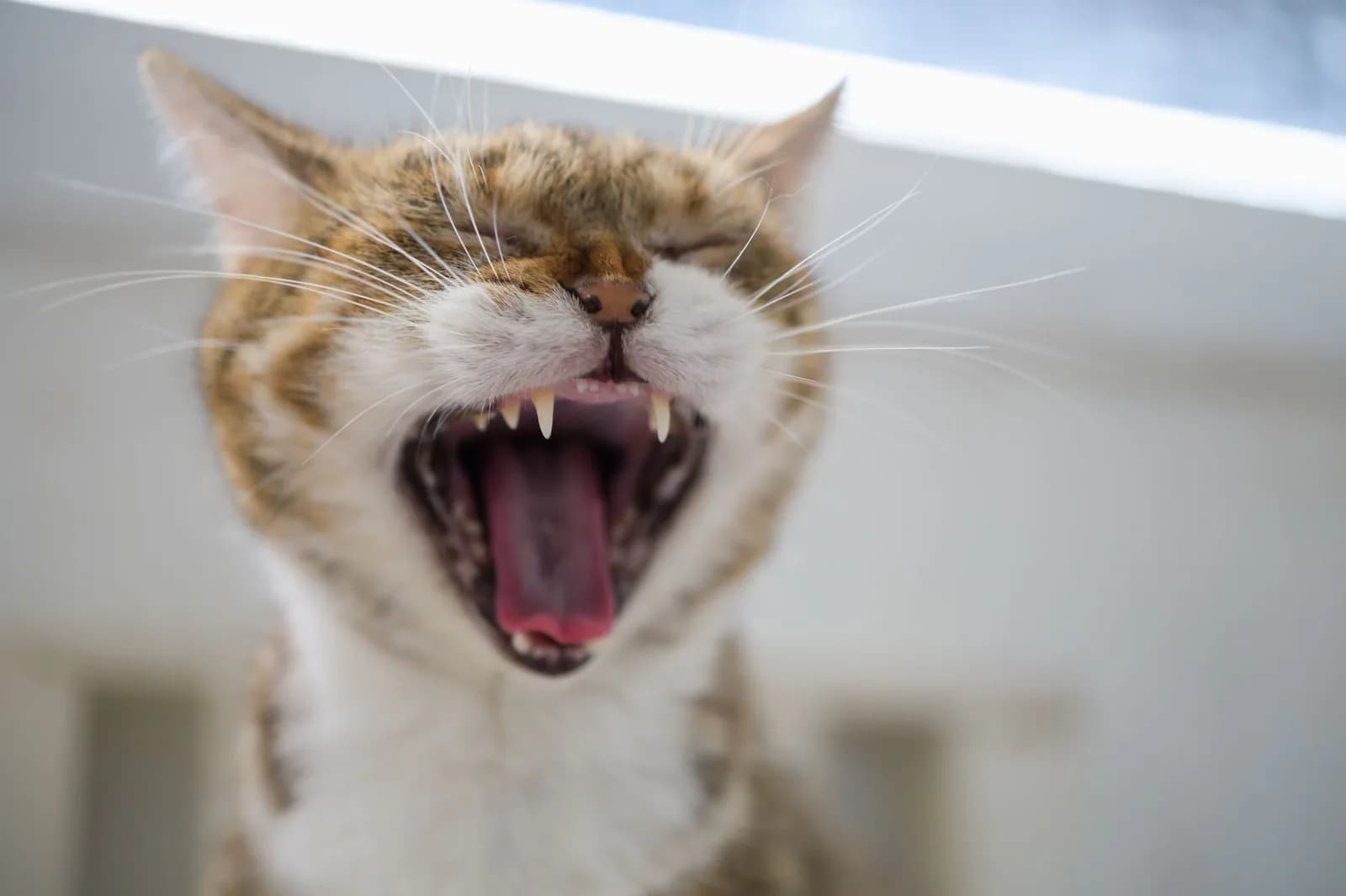
Most cat owners know the ritual. Your cat yawns into your face at close range and you get the full report: warm, faintly of dinner, tolerable. Then one morning it is not, and you lean away.
The instinct is to look for a fix for the smell. This page will talk you out of that, gently. A healthy cat's breath is not offensive, and when it turns, the smell is the message rather than the problem. It points at one of three places: the gum line, the kidneys, or the way the body handles sugar.
Why breath smells at all
The chemistry is much the same as the reason human morning breath exists. A film of plaque settles on the teeth and thickens, oxygen runs out inside it, and the bacterial population shifts toward the species that thrive without air. Those bacteria eat protein and give off volatile sulfur compounds. That is the smell, and it drives the disease forward too.
The useful part is where it happens: under and around the gum line, not on the surface of the teeth. That one fact decides which products are worth buying.
Nearly always, it is the mouth
By a wide margin, the most common cause is periodontal disease, the slide from inflamed gums to lost bone and lost teeth. It begins as , which is reversible, and ends as , which is not: the attachment holding a tooth in the jaw does not grow back.
How common? Depends what you count. A year of UK primary-care records gave a diagnosed rate of 15.2% across 18,249 cats; institutional estimates put "some form of dental disease" at 50 to 90% of cats over four. One counts what a vet wrote down, the other what an exam would find.
Vets stage it per tooth, not per cat, which is why one report can say several things about the same mouth:
| Stage | What it means | Where the tooth stands |
|---|---|---|
| PD0 | Clinically normal, no inflammation or evident | Healthy |
| PD1 | Gingivitis only, no attachment loss | Inflamed, still reversible |
| PD2 | Early , under 25% attachment loss | The anchor is going |
| PD3 | Moderate , 25 to 50% attachment loss | Up to half gone |
| PD4 | Advanced , over 50% attachment loss | Often not savable |
Then there is the condition that is essentially a cat problem. In , the tooth's own hard tissue dissolves from within, usually starting below the gum line. Published rates look inconsistent until you sort them by who was in the room: 60 to 67% among cats brought in for a dental problem, against 29 to 37.5% among healthy ones. Same condition, different waiting rooms. It is staged by depth:
- TR1: mild loss of the tooth's outer hard tissue.
- TR2: moderate loss, reaching the dentin but not the pulp cavity.
- TR3: deep loss into the pulp cavity, though most of the tooth still holds together.
- TR4: extensive loss into the pulp cavity, and most of the tooth has lost its integrity.
- TR5: only irregular remnants are left, with the gum grown back over them.
The behavioral tell beats the staging: a cat with resorptive lesions often stops chewing, swallowing kibble whole or switching abruptly to wet food.
Two more belong on the list. Gingivostomatitis inflames the whole mouth lining, not just the gums: rarer, far more painful, and cats with it drool, bleed and paw at their faces. And sometimes it is mechanical, a strand of hair wedged under the gum and decomposing. Our dental care guide carries the prevention side.
When the smell is not coming from the teeth
Kidney disease is the second family, and what matters here is timing. Two thirds of kidney function has to be gone before any clinical sign appears, so the signs that show up are late ones. Bad breath is one, sometimes with mouth ulcers. If your vet suspects it, the answer comes back as a number, staged on blood chemistry measured twice in a stable, hydrated patient:
| stage | Creatinine (mg/dL) | Creatinine (µmol/L) | (µg/dL) | What it usually looks like |
|---|---|---|---|---|
| 1 | under 1.6 | under 140 | under 18 | Creatinine normal, another kidney abnormality present |
| 2 | 1.6 to 2.8 | 140 to 250 | 18 to 25 | Mild , signs usually mild or absent |
| 3 | 2.9 to 5.0 | 251 to 440 | 26 to 38 | Moderate , signs outside the kidney appear |
| 4 | above 5.0 | above 440 | above 38 | Rising risk of systemic signs and uremic crises |
Blood pressure and urine protein layer on top of that number; our kidney disease guide covers what each stage changes day to day.
The third family is metabolic. In a diabetic cat whose disease is out of control, the body burns fat and makes ketones. It travels with the classic pair, drinking and urinating far more than usual, plus weight loss. The breath sign is inconsistent across sources, and some ketoacidosis lists omit it, so treat it as a clue to raise rather than a test. Our diabetes symptoms guide has the rest.
The families are also less separate than they look. In a US cohort of more than 169,000 cats, a periodontal diagnosis came with a higher later risk of kidney disease, highest at the advanced stages. An association, not proof of cause, and still a reason to stop hearing "it is just the teeth" as good news.
What each smell points to, in the sources' own words
| The smell | What it may point to | What travels with it |
|---|---|---|
| Bad the ordinary way, a mouth needing a dentist | Periodontal disease | Red, swollen gums, drooling, chewing on one side |
| Urine-like or ammonia-like | Kidney disease | Drinking and urinating more, poor appetite, mouth ulcers |
| Sweet or fruity | Diabetes, from ketones | Drinking and urinating more, weight loss |
| Foul, worst around vomiting | A liver disorder | Poor appetite, swollen abdomen, yellowing eyes or gums |
One honest gap: no source we could reach describes what smells like, only that bad breath is one of its signs. Use the table as a vet would, a hint that shapes the first question, never a diagnosis.
Cat halitosis, and why the word matters
Halitosis is the clinical term for bad breath, the one that turns up on your invoice. It has a practical use: search the clinical word and you get clinical pages, search the everyday phrase and you get products.
What will not fix it
Start with the thing most likely to be open in another browser tab. Anesthesia-free dental cleaning, sold as the gentler and cheaper option, is a scrape of the visible surfaces of an awake animal's teeth. The American Veterinary Dental College, the body that writes the staging systems above, refuses even to call it dentistry: it says anesthesia-free tooth scraping instead. Its published position is blunt. Removing tartar from the visible surfaces "has little effect on a pet's health and provides a false sense of accomplishment. The effect is purely cosmetic."
The reason is the one from the top of this page. The disease lives below the gum line, and no awake cat will allow an instrument down there. The college adds that the surfaces facing the tongue cannot even be examined in an unanesthetized patient, so disease and pain get missed. Whiter crowns over an untreated infection are worse than nothing, because they look like care.
Two smaller ones. Human toothpaste is not an option: it is not made for an animal that swallows everything it is given, and veterinary guidance is consistent that some of its components upset a cat's stomach. Cat-specific paste exists for this. And products aimed at the smell aim at the wrong end: the dental products with trial evidence behind them target plaque and tartar, the cause, not the odor.
When to call
No veterinary body publishes a ranked triage for bad breath, so the ordering below is ours, built from the signs each of them names.
- Same day, do not wait: a cat that has stopped eating altogether, urgent whatever the cause. A cat that will not eat explains why the clock is short.
- An appointment this week: drooling, blood in the saliva, pawing at the mouth, turning the head to chew, dropping food, swallowing kibble whole, a sudden switch to soft food, or red and swollen gums. If drooling is the main thing you see, that page sorts the blissful kind from the warning kind.
- An appointment with bloodwork: bad breath alongside drinking and urinating more than usual, weight loss, or vomiting. That is the fork toward the kidney and metabolic causes, and a blood test answers it, not a look in the mouth.
- Still an appointment: persistent bad breath and nothing else. The threshold is low, because a mouth is hard to assess from outside and the early stages are silent.
The shared baseline is an annual look at the teeth, some sources preferring every six to 12 months, with X-rays whenever a resorptive lesion is suspected.
What to take away
- A healthy cat's breath is not offensive: persistent bad breath is a symptom, and its three families are dental, kidney and metabolic.
- The smell is volatile sulfur compounds, made by bacteria under the gum line, which is why cleaning the visible surfaces does nothing for it.
- Gum disease is by far the most common answer, staged per tooth from PD0 to PD4; past PD2 the loss of the tooth's anchor is permanent.
- Tooth resorption affects 60 to 67% of cats seen for a dental problem against 29 to 37.5% of healthy ones; the tell is a cat that stops chewing.
- Kidney disease reaches the breath late: two thirds of function is gone before signs appear, and the smell is urine-like or ammonia-like.
- The American Veterinary Dental College's position on anesthesia-free scraping is that the effect is "purely cosmetic".
 The vet's take

Veterinary review
Are you a vet?
Your professional read belongs here: every verified practitioner can leave a note, published once our editors have reviewed it.
Sign in and get your license number verified. We check it in the public register, we never ask for or keep a copy of your diploma, and your number is never published.
Frequently asked questions
Why does my cat's breath smell so bad all of a sudden?
A sudden change usually means something new in the mouth: a fractured tooth, a resorptive lesion that has broken through, an abscess, or a strand of hair stuck under the gum. Sudden is worth an appointment, particularly if your cat has also changed how it eats.
Is bad breath in cats ever normal?
A dinner that smells repulsive to you and wonderful to your cat leaves a short-lived odor. A smell that is there every day is different, and the veterinary line is consistent: it warrants an examination, because it is one of the earliest visible signs of trouble in a part of the body owners rarely inspect.
What does kidney disease breath smell like in a cat?
Urine-like or ammonia-like rather than ordinary bad breath, and it is a late sign: about two thirds of kidney function is lost before any sign appears. It arrives with company, usually drinking and urinating more, a poor appetite, sometimes mouth ulcers.
Can I just brush my cat's teeth and fix the smell?
Daily home care is the habit that changes the trajectory, but it cannot undo disease already there. A brush removes soft plaque only, never hardened tartar and never anything below the gum line, and brushing gums that are already inflamed teaches a cat to hate the exercise.
Is anesthesia-free teeth cleaning worth it for a cat with bad breath?
The American Veterinary Dental College's published position is that its effect is purely cosmetic and that it is not effective prevention. The disease causing the smell sits below the gum line, where an awake cat cannot be cleaned, probed or X-rayed: whiter crowns over an untreated mouth.
 Community questions
Got a question this page doesn't cover? Ask it: the best ones get published here with their answer.
This is information, not veterinary advice, and it cannot tell you what is wrong with your cat. Our rule is a simple one: if something is wrong with your cat, call your vet, and call an emergency clinic if it is out of hours. Nothing you read here is a reason to wait.
Medical information applies to every reader. Prices, legal duties and common practice do not: unless stated otherwise, they are given for the United States, and they differ in the UK, Canada and Australia, and often between states or provinces. Check with your own vet and your own local authority.
Our sources
- Cornell Feline Health Center, Bad Breath: Sign of Illness? (Eric Davis, DVM), the source of the per-cause odor descriptions and of the framing that persistent bad breath needs an exam
- Cornell Feline Health Center, Feline Dental Disease (the 50 to 90% institutional estimate, and the rule against human toothpaste)
- Cornell Feline Health Center, Tooth Resorption (Jennifer Rawlinson, DVM), the mechanism and the behavioral signs of a cat that stops chewing
- Cornell Feline Health Center, Gingivostomatitis (Jennifer Rawlinson, DVM), the clinical signs of feline chronic gingivostomatitis
- American Veterinary Dental College, position statement on anesthesia-free tooth scraping (AFTS), read in full: the purely cosmetic quote is verbatim from this page
- American Veterinary Dental College nomenclature: periodontal disease stages PD0 to PD4 and tooth resorption stages TR1 to TR5, reproduced from AVDC's own wording
- International Renal Interest Society, IRIS Staging of CKD (Modified 2026), the published guideline PDF the staging table is taken from
- Merck Veterinary Manual (professional), Periodontal Disease in Small Animals: the plaque biofilm mechanism and the shift to anaerobic bacteria as oxygen runs out
- Merck Veterinary Manual (professional), Oral Inflammatory and Ulcerative Disease in Small Animals: uremia as a cause of oral inflammation distinct from feline stomatitis
- VCA Animal Hospitals, Chronic Kidney Disease in Cats: bad breath with mouth ulcers as an advanced sign, and the two thirds of function lost before signs appear
- VCA Animal Hospitals, Diabetic Ketoacidosis in Cats: the clinical sign list that does not mention breath odor, which is why this page calls the sweet-breath sign inconsistent
- O'Neill et al 2023, periodontal disease in cats under primary veterinary care in the UK: the 15.2% one-year prevalence in 18,249 cats (VetCompass, full text read)
- Cohen-Mivtach 2025, prevalence of tooth resorptive lesions in 120 feline dental patients in Israel: source of the 29 to 37.5% healthy vs 60.8 to 67% dental-patient split (abstract only)
- Trevejo et al 2018, periodontal disease and risk of chronic azotemic kidney disease in cats, 169,242 cats in US primary care (abstract only; association, not causation)
- Culham and Rawlings 1998, oral malodor and periodontal disease: a CANINE study, used here only for the shared plaque-bacteria mechanism, never as a feline figure (abstract only)
- Veterinary Oral Health Council, about the VOHC seal and what its accepted products are shown to do: retard plaque and calculus, which is the cause rather than the odor
- WSAVA Global Dental Committee, Toothbrushing Toolkit client handout: daily brushing and the annual veterinary oral check
- petMD, Bad Breath in Cats (Melissa Boldan, DVM, updated January 2026): the six to 12 month exam interval, and the escalation signs that widen the when-to-call list

Worth keeping a paw on
Pin this guide
So you can find it the day you need it, and share it with someone whose cat does the same thing. One click and it sits in your board.
Pin it on PinterestAlso worth reading
All health →
Article
Cat Insurance: How It Actually Works, and When It Is Worth It
The four policy types, real premium figures per country with their sources, the exclusions that surprise people, and the honest arithmetic behind "worth it".
Read
Article
Cat Insurance for Older Cats: The Two Ages That Matter
When insurers call a cat "older", what happens to the premium, the real enrollment cutoffs by product, and why switching late is the costly move.
Read
Article
Kitten Insurance: The Weeks That Decide Everything
When cover can start, why an empty medical file is the whole value, what the free-weeks gift policies really are, and the waiting periods to plan around.
Read
The floor belongs to our members. Keep it kind, links are not allowed, and images go through moderation before anyone else sees them.