

Exotic Shorthair
“The Persian in pajamas”
 By Priya · The careful one
Published August 21, 2026Updated August 26, 20268 min read
Contents
 Exotic Shorthair photos
Real photos, so you can see what the breed actually looks like: coats, ear tufts, ruff and build.
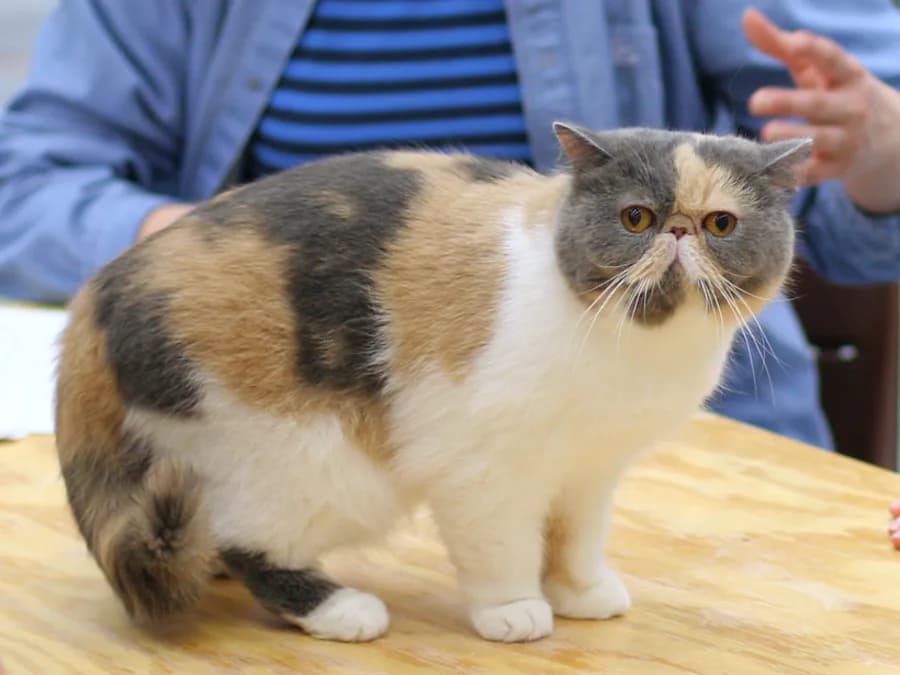
Calico Exotic Shorthair standing on a wooden table, flat face and plush coat
Photo: Heikki Siltala or catza.net · CC BY 3.0 · via Wikimedia Commons
Got an Exotic Shorthair? Share them with the community. Photos from our members round out this page.
 Vital stats
Origin
United States
United States, 1960s. American Shorthair breeders crossing to Persians produced plush, round-faced shorthairs so popular that in 1966 established them as a breed, championship in 1967. Originally intended to be silver only; the palette opened to everything. CFA's official name for the breed is simply 'Exotic'.
Weight
Female
7-12 lb (3.2-5.4 kg)
Male
12-14 lb (5.4-6.4 kg)
Life expectancy
Roughly 8 to 15 years is the convention, not a measurement. 's own box says 8-11, says 12-15 or more, and the big pet sources fill the span between. None cites a study, and no UK life table gives this breed its own row. The measured literature that does exist is condition-specific (PKD, airway, eyes), carried in the health file with its samples.
Coats
Silver tabby
Black
Blue
Red tabby
Cream
Bicolor
Calico
White
The Persian palette, literally: four of five registries define the Exotic's color list by cross-reference to the Persian standard. Whites subdivide by eye color (blue, copper, odd) everywhere.
Understanding the coats (and their genetics)Size
Only one registry anywhere publishes a figure. GCCF's own box says 7-14 lb (3.2-6.4 kg), females 7-12 and males 12-14 in its narrative. TICA, CFA, CCA-AFC and ACF's formal standards state no weight at all. The one measured breed-split cohort (Kienzle & Moik 2011) weighed males at 4.0 kg (n=12) and females at 2.9 kg (n=5), both slightly lighter than the Persians in the same cohort: small samples, stated as such. A cobby, heavy-boned, medium cat whose plush coat adds visual bulk.
Did you know
Asked what breed Garfield is, his creator Jim Davis has answered in his own words: 'an orange tabby cat', an amalgam of the farm cats of his childhood. The Exotic Shorthair fandom claims him anyway. With the round face and the appetite, you can see the case; we print the quote and let you judge.
 Personality
 Affection5/5
 Energy2/5
 Intelligence3/5
 Friendliness4/5
 Independence3/5
 Vocal1/5
 Shedding3/5
Compatibility
 Good with children4/5
 Good with other pets4/5
 Apartment friendly5/5
Editorial ratings on our five-point scale, anchored in the registry descriptions and the measured behaviour studies cited on this profile; individual cats vary, and our members' own ratings below are the counterweight.
Still torn between this breed and another?Compare the Exotic Shorthair trait by trait, or filter every breed by what matters to you. What our members say
What our members say
Nobody has described their Exotic Shorthair here yet. As soon as the first profiles come in, this is where the community averages will show up: temperament, food, lifestyle.
Describe my Exotic Shorthair Pros & cons
Strong points
- The Persian look on a weekly-comb schedule instead of a daily one
- Gentle, quiet, adaptable: the registries' own portrait, consistent across all five
- A DNA-testable kidney file: PKD paperwork is askable, and UK-mandatory since 2016
- The full Persian color palette by registry design
- Apartment-perfect energy level
Things to consider
- The flat face carries the Persian's airway and eye files: daily eye wiping, fold cleaning, the anesthesia conversation
- NOT the healthier Persian: the shared risks travel with the head, not the coat
- Sheds heavily in season despite the short coat (the Persian undercoat underneath)
- No measured lifespan exists; the quoted ranges are conventions
- Longhair kittens arrive routinely and registries file them four different ways
 Is an Exotic Shorthair right for you?
Someone who loves the Persian's company but not the Persian's grooming hour. A calm, indoor, routine-loving household that will keep up the eye-and-fold care the flat face asks for, and ask breeders the PKD question by name.
Is the Exotic Shorthair right for YOUR home?
Answer a few questions and we'll email you your personalized result.
Take the quiz · 2 min Getting to know the Exotic Shorthair
Start with a shortcut that worked. In the early 1960s, American Shorthair breeders crossing to Persians for the silver coat got kittens too charming to be a side effect: round, plush, flat-faced shorthairs. made them a breed in 1966 (championship 1967), carried them from its founding, and Britain followed in 1986. The official CFA name is simply 'Exotic'. The breed is administered everywhere as what it is: the Persian's short-coated line, its color list defined by cross-reference to the Persian standard at four of five registries.
The comparison that matters is the one inside the family. By 's own words the Exotic and the Persian are structurally identical, one coat paragraph apart, and our comparison carries the sentence this profile will not soften: the health risks travel with the head and the ancestry, not the coat. PKD and the flat-face files belong to both breeds.
The honest difference is grooming time, weekly here against daily there. The coat does one magic trick. Most breeding Exotics carry one hidden longhair gene, so genuinely longhaired kittens arrive routinely, and our Exotic Longhair page maps the four different ways registries file them (own variety at , separate breed in Canada, simply a Persian in Australia, unnamed elsewhere).
The cat itself is the quiet one. Gentle, small-voiced, playful in bursts, adaptable: every registry says some version of it. The measured literature mostly pools the breed with the Persian, with one split finding (the Persian scored higher on trainability) printed rather than resolved. What one costs runs $2,000-3,500 at named US catteries, and the price page carries the four markets and the strangest structural finding in this silo: catteries cannot agree which coat length is the premium one.
 Health: what to watch for
A few predispositions are well documented. The good news: they can be screened for or avoided by choosing a reputable breeder and keeping an eye on the right signals.
This is information, not veterinary advice, and it cannot tell you what is wrong with your cat. Our rule is a simple one: if something is wrong with your cat, call your vet, and call an emergency clinic if it is out of hours. Nothing you read here is a reason to wait.
Polycystic kidney disease (PKD)
HIGHThe Persian family's flagship condition, and it comes with the ancestry. Two breed-split studies found this breed's PKD rate close to the Persian's own (Australia 50%, France 39.1%). A small 2023 Japanese study found the PKD1 variant in 2 of 6 Exotics tested (33.3%), the highest odds ratio of any breed in that paper, on a sample that must be called small every time. The DNA test exists, and GCCF has made PKD-clear status a UK registration requirement since 1 January 2016. The paperwork is askable everywhere.
Symptoms to spot
Often silent for years; increased thirst and urination in an adult cat is a vet visit
How common
Breed-split studies: 50% (Australia), 39.1% (France); 33.3% carriage in a 6-cat Japanese sample
Screening & prevention
Both parents' PKD results, by name, before any purchase
Genetic test
Yes: the PKD1 DNA test; UK Active-Register cats must test clear since 2016
Brachycephalic airway and anesthesia
MODERATEThe flat face is the standard's defining trait, and it carries the airway file. Pooled anesthesia research puts extremely flat-faced cats at roughly 2.3 times the mortality risk. The one Exotic-labeled row (31 cats, zero deaths) is explicitly warned by the paper's own authors as too small to read as protection. Noisy breathing, exercise intolerance or heat stress are vet conversations. Any planned anesthesia deserves the flat-face mention to your vet beforehand.
Symptoms to spot
Snoring at rest, open-mouth breathing after play, heat intolerance: worth a vet assessment
How common
Pooled RR ~2.33 for extremely brachycephalic cats under anesthesia
Screening & prevention
Mention the flat face before any sedation or anesthesia; choose moderate-faced lines
Genetic test
No: a conformation file, not a mutation
Eye conformation (tearing, entropion)
MODERATEThe shallow-orbit face waters. A mixed Persian-and-Exotic sample found 83% epiphora (tear overflow) and 32% entropion, the paper itself never separating the two breeds, and we do not either. A South Korean study of eye disorders found this breed at sharply elevated odds for entropion (OR 16.6) and periorbital fat prolapse (OR 57.0), both on very small case counts. Daily eye wiping is the routine. A painful, squinting or cloudy eye is a same-day vet call.
Symptoms to spot
Tear staining is routine care; squinting, rubbing, redness or cloudiness is a vet visit
How common
83% epiphora / 32% entropion in one mixed Persian-Exotic sample, breeds not separated
Screening & prevention
Daily eye care from kittenhood; ask the breeder about entropion in the line
Genetic test
No
Ringworm (the against-assumption finding)
LOWOne dermatophytosis study found this breed at 9.1% against the Persian's 21.2%: LOWER, not the same. A genuine finding against the everything-matches-the-Persian assumption, and a reminder that the twin breeds do diverge where a study actually splits them. Ringworm remains a treatable, transmissible skin fungus in any cat.
Symptoms to spot
Circular hair loss or scaling, especially in kittens: a vet visit and a lamp test settle it
How common
9.1% vs Persian 21.2% in one comparative study
Screening & prevention
Nothing special; normal new-kitten vet checks
Genetic test
No
Go deeper on health
Prevention, warning symptoms, costs and insurance: our guides, researched and sourced.
The Exotic Shorthair also appears in
Our criteria-based guides, to compare this breed with the ones most like it.
 Grooming & living with one
Grooming
Weekly combing with a metal comb, stepped up during the spring molt. Counterintuitively, MORE shed hair than a Persian in season, per 's own material: the shared undercoat releases a shorter coat. The flat-face routine is daily and non-negotiable: eye wiping, and facial-fold cleaning with saline or cooled boiled water on a clean cloth. Persistent redness, odor or discharge is a vet visit, not a cleaning problem.
Living together
Good with children and other pets by the registry portraits: a tolerant, placid companion that prefers calm handling to rough play. Its quiet voice and low energy make it one of the easiest breeds to share small spaces with.
 Food & diet
No registry publishes a feeding figure, though 's own material addresses the Persian Breed Group's needs collectively. Two independent veterinary sources flag the flat face's dental misalignment as a chewing consideration. The one direct measurement found eating trouble RARE (1 of 73 show-cat owners asked). Feed to body condition on a complete diet. Kibble shape marketing is a product claim, not an institutional one.
 Price & budget
$2,000 to 3,500
Price of a kitten from a registered breeder, in the United States
This price reflects the quality of the breeding program: parents' health tests, registry pedigree, socialization. A very low price should raise a red flag. The real cost, though, plays out over the years.
Find a verified breederKitten price, by market
United States
$2,000 to 3,500
United Kingdom
£800 to 1,200
the GCCF-registered cluster across two full live samples (Pets4Homes 42/42 read £150-1,500; UKPets 7/7 read £300-850); the sites' own FAQ figures shown separately in-page
Canada
CA$1,500 to 3,000
two named catteries, two provinces, flat per-litter pricing with no coat-length gap at either
Australia
A$2,000 to 4,500
two published sources disagree: one cattery at $2,500-4,500 (combined Exotic-and-Persian), a directory-listed second at $2,000; printed as two figures, never blended
Each figure is that country's real market price, researched separately, not a conversion of the others. The smaller line is only there so you can gauge one against your own money: European Central Bank reference rates of 2026-09-18, refreshed daily.
Work out your food budget
Type of food
Estimated monthly budget
$15
≈ 2.6 oz (74 g) per day
A ballpark figure, food only, using the same arithmetic as our portion tool (resting energy requirement × 1.2, a neutered adult). Real needs vary with age, activity level and body condition. Ask your veterinarian for advice.
 Verified catteriesThe registry-checked directory, plus a kitten alert near you. Filter it by breed.
 Should you insure an Exotic Shorthair?
Our sources list several predispositions in the Exotic Shorthair: Polycystic kidney disease (PKD), Brachycephalic airway and anesthesia, Eye conformation (tearing, entropion), among others. A predisposition is not a foregone conclusion, and many of these cats live their whole lives without ever developing anything. It does change the nature of the follow-up, though: you monitor, sometimes for life, and it's that monitoring that weighs on a budget, more than a one-off accident.
One thing to weigh before deciding: this is a cat you will live alongside for well over a decade, and that is the span the real cost is spread across, premiums and care alike. Where a breed has a measured life expectancy that differs from the figure usually quoted, we say so in the lifespan section above rather than repeating the quoted one here.
 Exotic Shorthair cats in our community
This breed is barely covered by free photo libraries: we only found 3 photos we could verify. Your cats are especially welcome here.
No Exotic Shorthair here yet
Got one? Add a photo and yours gets to open this page.
 The vet's take

Veterinary review
Are you a vet?
Your professional read belongs here: every verified practitioner can leave a note, published once our editors have reviewed it.
Sign in and get your license number verified. We check it in the public register, we never ask for or keep a copy of your diploma, and your number is never published.
 Frequently asked questions
+Are Exotic Shorthairs healthy?
They carry the Persian family's files: PKD (DNA-testable, UK-mandatory to test since 2016), the flat-face airway and eye routines, with each figure and its sample on this page. The one study that split the twins on skin disease found the Exotic LOWER than the Persian. Buy from tested parents and budget for the daily face care.
+How much is an Exotic Shorthair?
US named catteries cluster $2,000-3,500; UK registered kittens £800-1,200 across two full live samples; Canada CAD $1,500-3,000 flat; Australia's two published figures read $2,000 and $2,500-4,500. Our price page carries the detail, including the coat-length premium that points in opposite directions at different catteries.
+How long do Exotic Shorthairs live?
Honestly unmeasured: 8-15 years spans the registry conventions (TICA says 8-11, GCCF 12-15+), none study-based, and no life-table study gives the breed its own row. The testable part is the kidney file: PKD status is DNA-askable.
+Do Exotic Shorthairs shed?
Yes, genuinely, and seasonally more than you would guess: CFA's own material notes Exotics shed more heavily than Persians in the molt, the same undercoat releasing a shorter coat. Weekly combing, stepped up in spring.
+Are Exotic Shorthairs hypoallergenic?
No, and no study measures this breed's allergen levels. The short coat changes the housework, not the Fel d 1 protein. No cat is hypoallergenic.
+Is Garfield an Exotic Shorthair?
Jim Davis says Garfield is 'an orange tabby cat', an amalgam of childhood farm cats, and names no breed. The Exotic's round face makes the fan theory understandable; the creator's own words are the answer we print.
+What is the difference between an Exotic Shorthair and a Persian?
One paragraph of the standard: the coat. Same body, same face, same color list by cross-reference, same health file. The daily difference is grooming: weekly combing here, the full daily ritual there. Our comparison page carries it in full.
+Why does my Exotic Shorthair have a longhaired kitten?
Because most breeding Exotics carry one hidden copy of the Persian longhair gene: two carriers produce longhaired kittens routinely. Registries file these kittens four different ways; our Exotic Longhair page maps them.
+Do Exotic Shorthairs have breathing problems?
The flat face carries a real airway file: pooled research puts extremely flat-faced cats at roughly double the anesthesia risk, and snoring or heat intolerance deserves a vet assessment. Mention the flat face before any procedure involving sedation; nothing here diagnoses your cat.
+Are Exotic Shorthairs cuddly and quiet?
The registries agree on the portrait: gentle, quiet-voiced, affectionate, adaptable. The measured surveys mostly pool the breed with the Persian, so take breed-level personality claims with that pooling in mind; individuals vary more than breeds do.
 Community questions
Got a question this page doesn't cover? Ask it: the best ones get published here with their answer.
Sources & references
Data checked against reference sources (TICA and CFA standards, genetics laboratories, veterinary schools).
- TICA: Exotic Shorthair breed
- TICA Persian Breed Group standard (PDF, covers Persian, Himalayan, Exotic)
- CFA: Exotic breed page
- CFA Exotic show standard (PDF)
- GCCF: Exotic Shorthair breed
- GCCF Exotic Breeding Policy (PDF)
- GCCF Exotic Standard of Points (PDF)
- CCA-AFC Exotic breed standard (PDF)
- ACF Exotic Shorthair standard (PDF)
- Kienzle & Moik 2011, breed-split weights incl. Exotic Shorthair (Br J Nutr)
- Shitamori et al. 2023, PKD1 variant rates by breed, Japan (J Vet Med Sci)
- Salonen et al. 2019, breed behaviour (pools Persian and Exotic) (Sci Rep)

Worth keeping a paw on
Pin this profile
To compare later, or to show someone still torn between two breeds. One click and it sits in your board.
Pin it on Pinterest
 Purr or Pass
Still deciding? Find the perfect breed for your home.
A quick quiz that factors in your lifestyle, your kids and your other pets.
Which breed fits my home?Keep exploring
The floor belongs to our members. Keep it kind, links are not allowed, and images go through moderation before anyone else sees them.