

Balinese
“The Siamese in an evening gown”
 By Priya · The careful one
Published August 21, 2026Updated August 26, 20269 min read

Contents
 Balinese photos
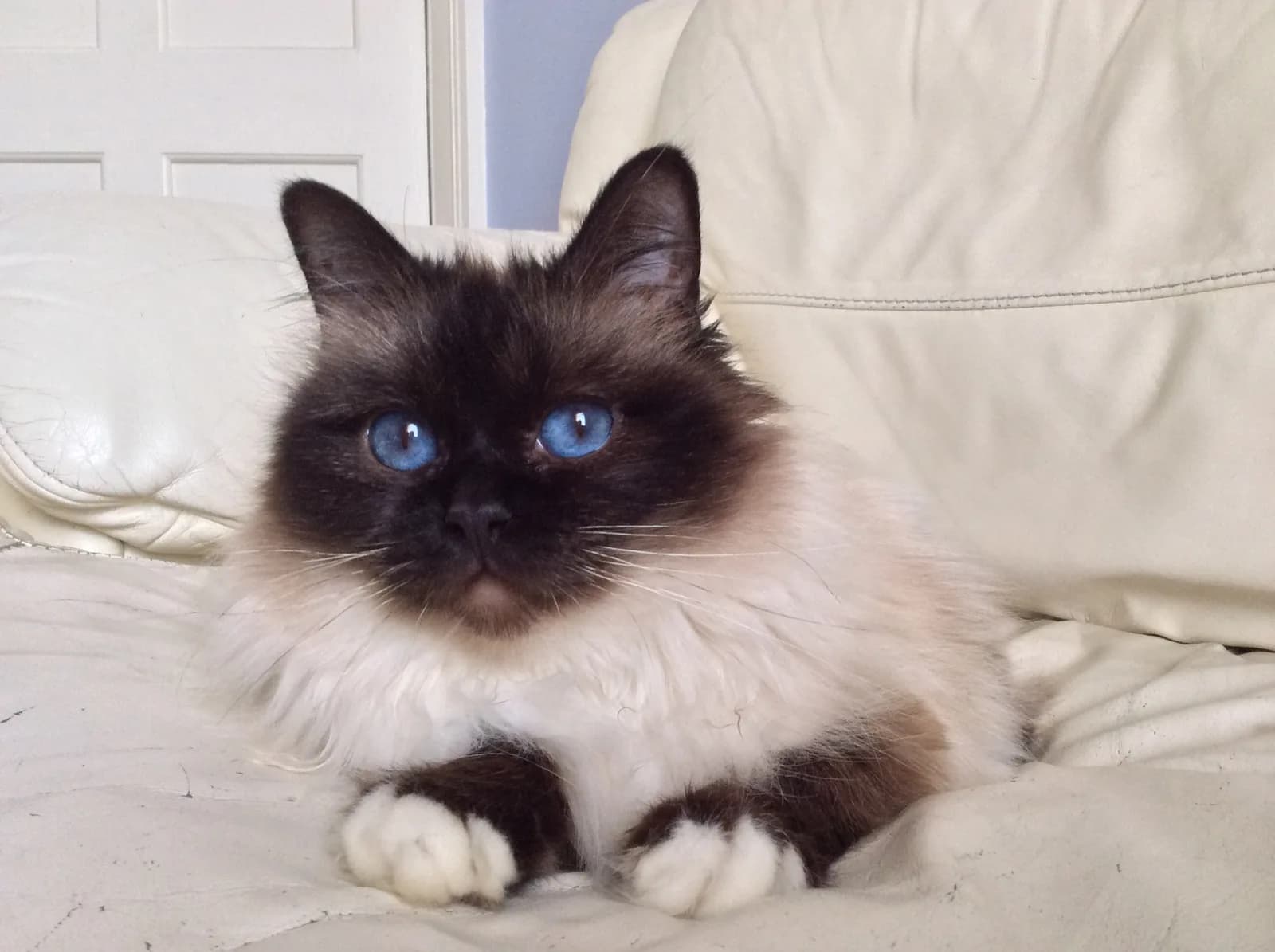
Real photos, so you can see what the breed actually looks like: coats, ear tufts, ruff and build.
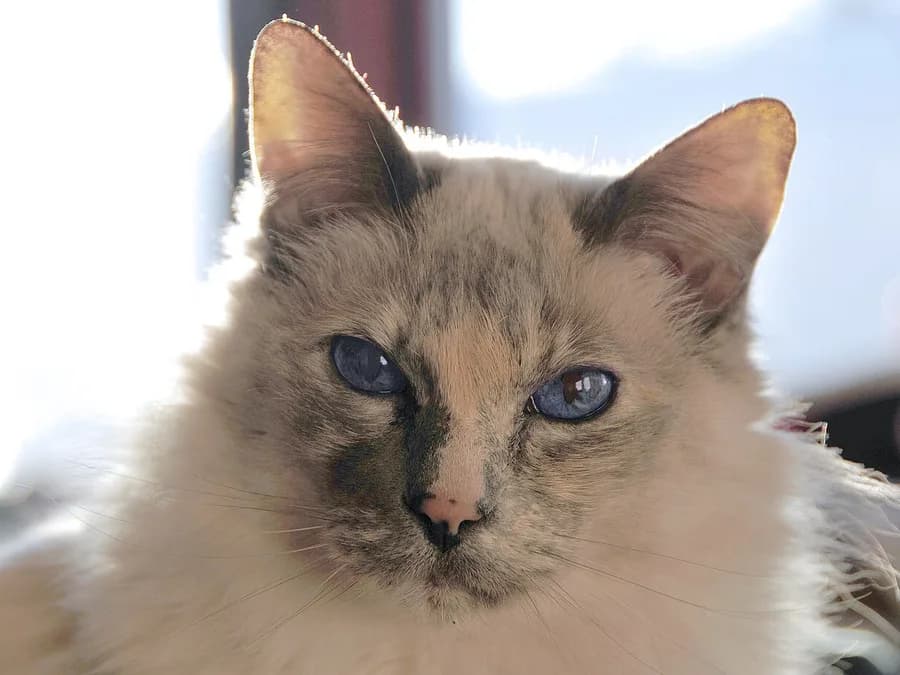
Close-up of a tortie point Balinese cat's face, bright blue eyes and long silky fur
Photo: Mike McBey · CC BY 2.0 · via Wikimedia Commons
 Vital stats
Origin
United States
United States, 1950s: longhaired kittens appearing spontaneously in pedigreed Siamese litters (the longhair gene is recessive, so two shorthaired parents can carry it) were developed into a breed by Marion Dorsey and Helen Smith. Sylvia Holland became central to recognition from the late 1950s on. 's own short breed page compresses this to "the 1940s, Smith and Holland". CFA's own richer breed article, 's history and 's history all tell the 1950s Dorsey-and-Smith version. So that better-corroborated account leads here.
Weight
Female
5-7 lb (2.3-3.2 kg)
Male
6-8 lb (2.7-3.6 kg)
Life expectancy
No measured, breed-isolated lifespan study exists for the Balinese anywhere we reached. So the 9-22 band above is the SPAN of four disagreeing published claims, not a finding. says 9-13, Purina UK 9-15, a flat 18-22, and reaches for "into the 20s" (PetMD's figure is a self-cited echo of GCCF's, not a fifth source). All are commonly cited estimates; no measured study exists. The one measured cohort that touches the breed (Egenvall 2009, Sweden) pools it into a six-breed Siamese group with the highest all-cause mortality of seventeen groups. That was twenty years ago, and it is not isolable to the Balinese.
Coats
Seal point
Blue point
Chocolate point
Lilac point
Every Balinese is pointed and blue-eyed. The four classics every registry accepts: seal, blue, chocolate and lilac point. Beyond them the chart opens, and the registries genuinely diverge in structure. : one open list (cinnamon, fawn, red, cream, , , smoke and silver variants included). : one standard split into Balinese and Javanese divisions. : one unified 34-color list. : the largest list read. : a cross-reference to its own Siamese standard.
Understanding the coats (and their genetics)Size
TICA's consumer box gives the Balinese the identical range as its Siamese box, to the pound (females 5-8 lb, males 8-12 lb): a shared breed-group template. TICA's own body text and GCCF's figures agree on a lighter, Balinese-specific picture: females 5-7 lb (2.3-3.2 kg) and males 6-8 lb (2.7-3.6 kg). The one measured Balinese data point in the literature (a single cat, 4 kg, Kienzle & Moik 2011) sits with them. The lighter narrative figures lead here, the box named for what it is. No measured, breed-isolated weight study exists.
Did you know
The name has nothing to do with Bali. Breeder Helen Smith thought the cats' grace recalled Balinese temple dancers, and the name stuck. The breed has never had an Indonesian chapter; its story runs through American Siamese catteries.
 Personality
 Affection5/5
 Energy4/5
 Intelligence5/5
 Friendliness4/5
 Independence1/5
 Vocal4/5
 Shedding2/5
Compatibility
 Good with children4/5
 Good with other pets4/5
 Apartment friendly4/5
Editorial ratings on our five-point scale, anchored in the registry descriptions and the measured behaviour studies cited on this profile; individual cats vary, and our members' own ratings below are the counterweight.
Still torn between this breed and another?Compare the Balinese trait by trait, or filter every breed by what matters to you. What our members say
What our members say
Nobody has described their Balinese here yet. As soon as the first profiles come in, this is where the community averages will show up: temperament, food, lifestyle.
Describe my Balinese Pros & cons
Strong points
- The Siamese conversation at lower volume: every registry describes the same voice, softer
- A semi-long coat with a single-coat grooming bill: no true undercoat, little matting
- Measured top-of-the-chart sociability toward humans (as part of the pooled Siamese/Balinese group)
- A DNA test exists for the breed's named eye condition (PRA rdAc), so breeders can test parents
Things to consider
- Quieter than a Siamese is still not quiet: CFA's own warning, verbatim territory
- Demanding of company: TICA and GCCF both say it should not be left alone for long periods
- The same pooled data measuring its sociability also measures elevated shyness toward novelty: individuals vary widely
- Thin breeder population outside North America: expect waiting lists, and in Australia genuine scarcity
 Is a Balinese right for you?
A household that is actually home, wants a conversational, people-glued cat, and would take the Siamese personality if it came with a volume dial and an evening gown. Fine with gentle children and cat-friendly dogs, by its registries' own account ( adds a caveat about very young children).
Is the Balinese right for YOUR home?
Answer a few questions and we'll email you your personalized result.
Take the quiz · 2 min Getting to know the Balinese
Start with a kitten that was not supposed to happen. The longhair gene is recessive, so two shorthaired Siamese can both carry it and throw a longhaired kitten. For decades such kittens were quietly rehomed. Then 1950s American breeders Marion Dorsey and Helen Smith decided the accident was the point, and bred for it. ('s own short breed page dates this to the 1940s and names Smith and Holland. CFA's own richer breed article, and all tell the 1950s Dorsey-and-Smith version, with Sylvia Holland joining from 1958 and carrying the breed to recognition. We publish the better-corroborated account and note the other.)
The name is a dancer, not an island. Helen Smith thought the cats moved like Balinese temple dancers. "Balinese" replaced the working label "longhaired Siamese", which breeders of the shorthair found unflattering. registered the breed in 1966, granted provisional status in 1967 and full championship in 1970.
One gene from its famous relative, and honestly compared. The coat is the single axis 's shared standard names: shorthair Siamese, semi-longhair Balinese, whippy tail against full plume. Beyond the coat, the registries' own documents quietly disagree between the breeds on weight and stated lifespan, and split on one health question, all of which our comparison page shows with sources rather than ironing flat.
The color chart is a governance story. Four classic points everywhere, and then five registries giving three structurally different answers on the rest. That includes filing the extended colors as its "Javanese Division": the residue of a breed that was refused the Balinese name in 1979, lived as its own CFA breed for three decades, and merged back in 2008. The colors page maps who counts what, and the Javanese page untangles the name that means two different cats.
The voice is the selling point stated honestly. Every registry describes the Siamese conversation at lower volume, never off. If you want the personality without the full opera, this is the breed the registries themselves point at. If you want silence, keep walking.
 Health: what to watch for
A few predispositions are well documented. The good news: they can be screened for or avoided by choosing a reputable breeder and keeping an eye on the right signals.
This is information, not veterinary advice, and it cannot tell you what is wrong with your cat. Our rule is a simple one: if something is wrong with your cat, call your vet, and call an emergency clinic if it is out of hours. Nothing you read here is a reason to wait.
Progressive retinal atrophy (PRA, the rdAc mutation): a DNA test exists
MODERATEThe one condition with a test to ask for. GCCF names PRA for the Balinese and states DNA tests are available. UC Davis's veterinary genetics laboratory independently lists the Balinese among breeds appropriate for its rdAc (CEP290) test. Neither TICA nor CFA mentions PRA on their Balinese pages at all, a three-way registry split we state rather than smooth. No published Balinese-specific case series or allele frequency exists. The buyer's question is simply both parents' rdAc results.
Amyloidosis: two registries, opposite statements
MODERATEA genuine current disagreement, published both ways. TICA's Balinese page says the breed "can be susceptible" to amyloidosis (no test available). GCCF's own Balinese Breeding Policy, written by the breed's advisory committee, says Balinese "seem to be free of amyloidosis which has been found in some Siamese and Oriental lines." Neither cites a study, a date or a population. This describes the breed's paperwork, not any individual cat.
Squint and nystagmus: the family's visual wiring
LOWGCCF's own two documents name squint for the Balinese with two different frequency words: "commonly" (Breeding Policy) and "occasionally" (breed page). We report both rather than average them. A lifelong, developmental squint or mild eye tremor is a recognized feature of this pointed family's visual wiring. Anything sudden-onset, in a cat that did not have it before, is a different matter and a vet visit.
Feline asthma: named jointly with the Siamese
MODERATEGCCF's breeding policy names asthma with Balinese and Siamese in the same sentence, describing over-representation and a suspected hereditary component. No peer-reviewed study names the Balinese specifically (a targeted search returned zero results). So this stands as an institutional claim, stated as such. Laboured or open-mouth breathing in any cat is an urgent vet matter.
Our full guide on this topicAnesthesia sensitivity: a tell-your-vet line
LOWTICA's page carries the same sentence it gives the Siamese and Oriental: a tendency to be sensitive to anesthesia, worth telling your veterinarian before any procedure, including routine ones. No study quantifies it; it belongs in your vet conversation, not in your worry budget.
Mammary tumors: GCCF's increased-risk note
MODERATEGCCF's breeding policy states Balinese are at increased risk of mammary carcinomas, with a younger-than-average onset. No Balinese-specific peer-reviewed study was located; the claim is institutional and reported as such. Any lump near a nipple, most urgently in an unspayed female, is a prompt vet visit.
Go deeper on health
Prevention, warning symptoms, costs and insurance: our guides, researched and sourced.
 Grooming & living with one
Grooming
The best-kept secret in longhaired cats: a single coat without true undercoat. A weekly comb-through keeps the silk moving, and matting is rare. suggests weekly; 's own cadence is lighter still, several times a month. One genuinely unusual note, attributed to GCCF alone: coat length often improves after neutering.
Living together
Good with children and other pets per and alike, with 's specific caveat about very young children. What it does not tolerate is absence. Both TICA and GCCF state it should not be left alone for long periods. A companion animal helps a working household.
 Food & diet
No breed-specific feeding science exists. 's nutrition material for the breed is shared Siamese-group boilerplate, and no registry names an obesity tendency. The general framework applies: a complete diet meeting / guidance, portioned, with body condition checked at the vet rather than guessed under the coat.
 Price & budget
$400 to 2,500
Price of a kitten from a registered breeder, in the United States
This price reflects the quality of the breeding program: parents' health tests, registry pedigree, socialization. A very low price should raise a red flag. The real cost, though, plays out over the years.
Find a verified breederKitten price, by market
United States
$400 to 2,500
United Kingdom
£500 to 1,200
Canada
CA$450 to 1,100
Each figure is that country's real market price, researched separately, not a conversion of the others. The smaller line is only there so you can gauge one against your own money: European Central Bank reference rates of 2026-09-18, refreshed daily.
Work out your food budget
Type of food
Estimated monthly budget
$10
≈ 1.8 oz (50 g) per day
A ballpark figure, food only, using the same arithmetic as our portion tool (resting energy requirement × 1.2, a neutered adult). Real needs vary with age, activity level and body condition. Ask your veterinarian for advice.
 Verified catteriesThe registry-checked directory, plus a kitten alert near you. Filter it by breed.
 Should you insure a Balinese?
Our sources list several predispositions in the Balinese: Progressive retinal atrophy (PRA, the rdAc mutation): a DNA test exists, Amyloidosis: two registries, opposite statements, Squint and nystagmus: the family's visual wiring, among others. A predisposition is not a foregone conclusion, and many of these cats live their whole lives without ever developing anything. It does change the nature of the follow-up, though: you monitor, sometimes for life, and it's that monitoring that weighs on a budget, more than a one-off accident.
One thing to weigh before deciding: this is a cat you will live alongside for well over a decade, and that is the span the real cost is spread across, premiums and care alike. Where a breed has a measured life expectancy that differs from the figure usually quoted, we say so in the lifespan section above rather than repeating the quoted one here.
 Balinese cats in our community
No Balinese here yet
Got one? Add a photo and yours gets to open this page.
 The vet's take

Veterinary review
Are you a vet?
Your professional read belongs here: every verified practitioner can leave a note, published once our editors have reviewed it.
Sign in and get your license number verified. We check it in the public register, we never ask for or keep a copy of your diploma, and your number is never published.
 Frequently asked questions
+Are Balinese cats hypoallergenic?
No cat is, and no study has ever measured allergen levels in the Balinese specifically: the claim is untested marketing in either direction. The single coat is a real grooming advantage, not an allergy guarantee. Our dedicated page carries the full evidence.
+How much does a Balinese cat cost?
US named catteries run from a flat $400 to $2,500 for a singleton, with the marketplace bulk between $500 and $1,650. The UK's one verifiable operator publishes disagreeing figures (£70 to £1,200 across its own pages); Canada's named figure is CA$450; Australia has no verifiable published price at all. Our price page carries every source.
+Is a Balinese just a long-haired Siamese?
In coat, nearly: one recessive gene separates them. But the registries' own documents disagree between the breeds on weight and stated lifespan, and split on one health question, so the honest answer lives on our comparison page.
+How long do Balinese cats live?
Honestly: nobody has measured it. No breed-isolated lifespan study exists, and the published claims disagree spectacularly, from PDSA's 9-13 to GCCF's 18-22 to TICA's "into the 20s". We publish the span and the disagreement, not a fake precise number.
+Do Balinese cats shed?
Less than most longhairs: the coat is single, without a true undercoat, by CFA's, GCCF's and ACF's own standards, so there is less down to drop and less matting. Weekly combing covers it.
+Are Balinese cats vocal?
Yes, at a lower volume than the Siamese: every registry describes the same conversational voice, softer and less insistent, and CFA explicitly warns not to expect a quiet cat.
+Can Balinese cats be left alone?
Not happily for long: TICA and GCCF both state the breed should not be left alone for long periods. A working household does better with a companion animal and real daily attention.
+Are Balinese cats good with dogs and children?
By their registries' own account, yes on both, with CFA adding a caveat about very young children. As always, the individual cat and the introduction matter more than the breed line.
+What is a Javanese cat?
Two different things, which is why the internet confuses you: at CFA, the extended-color division of this very breed; at GCCF, ACF and ANCATS, another name for the Oriental Longhair, a different, non-pointed cat. Our Javanese page untangles it properly.
+Is the Balinese cat from Bali?
No, and it has never been: the breed is American, and the name came from breeder Helen Smith, who thought the cats moved like Balinese temple dancers. The elegant name stuck; the geography was never real.
+Are Balinese cats rare?
Rarer than their fame suggests: the breeder population is thin, many are bred as a sideline of Siamese catteries, and in Australia our research found exactly one reachable dedicated cattery. Expect waiting lists.
 Community questions
Got a question this page doesn't cover? Ask it: the best ones get published here with their answer.
Sources & references
Data checked against reference sources (TICA and CFA standards, genetics laboratories, veterinary schools).
- TICA: Balinese breed page
- TICA Balinese Breed Introduction (PDF)
- CFA: Balinese breed page
- CFA Balinese standard (PDF, the two divisions)
- CFA Balinese rules of registration (PDF, the 2008 merger)
- GCCF: Balinese breed page
- GCCF Balinese Breeding Policy (PDF)
- GCCF Balinese Registration Policy (PDF, April 2026)
- CCA-AFC Balinese standard (PDF)
- ACF Balinese standard (PDF)
- UC Davis VGL: PRA rdAc test page (Balinese listed)
- Mikkola et al. 2021, feline behaviour (the pooled Siamese/Balinese group)
- Kienzle & Moik 2011, measured body weights
- Sparkes et al. 2021, human allergy to cats (J Feline Med Surg)

Worth keeping a paw on
Pin this profile
To compare later, or to show someone still torn between two breeds. One click and it sits in your board.
Pin it on Pinterest
 Purr or Pass
Still deciding? Find the perfect breed for your home.
A quick quiz that factors in your lifestyle, your kids and your other pets.
Which breed fits my home?Keep exploring
The floor belongs to our members. Keep it kind, links are not allowed, and images go through moderation before anyone else sees them.