

Savannah
“The tall one, by Guinness's own tape”
 By Priya · The careful one
Published August 21, 2026Updated August 26, 20269 min read
Contents
 Savannah photos
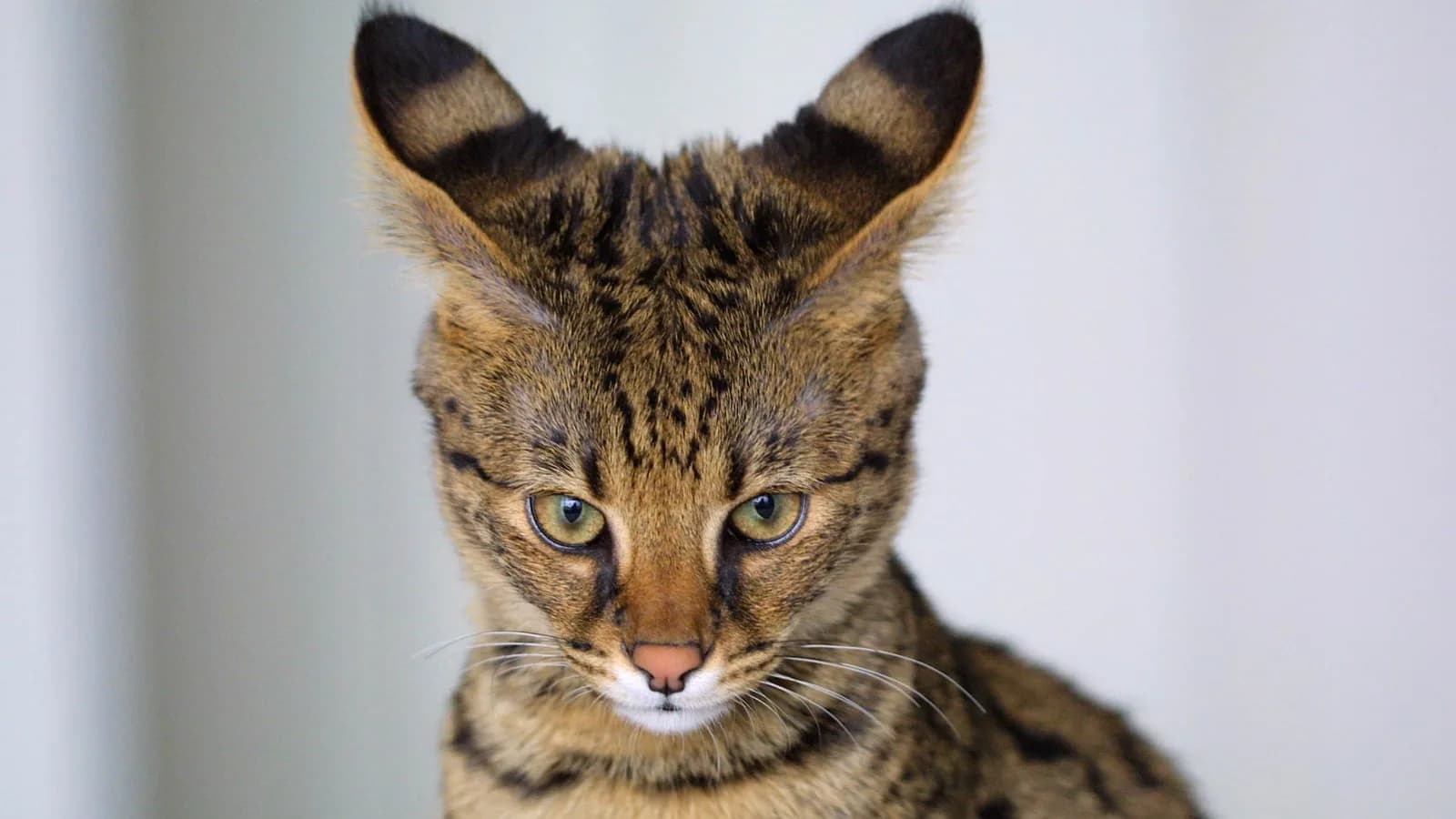
Real photos, so you can see what the breed actually looks like: coats, ear tufts, ruff and build.
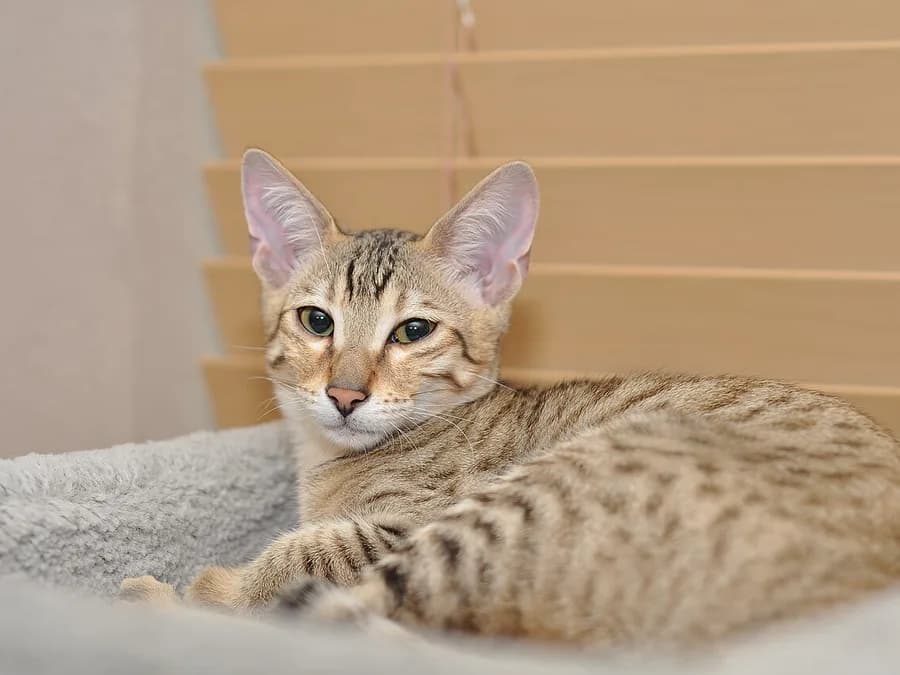
Spotted Savannah kitten curled up on a grey blanket, tall ears turned forward
Photo: gsloan · CC BY 2.0 · via Wikimedia Commons
 Vital stats
Origin
United States
Born 7 April 1986: a domestic female bred to an African serval produced the first kitten. 's own documents never name that first breeder. The fuller account (breeder Judee Frank, the serval Ernie owned by Suzi Wood) comes from a dated breeder timeline citing 1980s club newsletters, and is credited to it here. Patrick Kelly and Joyce Sroufe formalized the breed and wrote the original TICA standard. TICA accepted registration in 2001 and granted Championship on 1 May 2012.
Life expectancy
's own page says 12-15+ years, with no source, sample or methodology attached. Pet sites scatter from 12 to 20 with no two agreeing. No measured lifespan or mortality study of this breed exists anywhere: we read the two largest mortality datasets in full, and neither carries a Savannah row. Even the breed's own advocacy site publishes no lifespan figure. All of it is a commonly cited estimate, no measured study exists. For a breed this young (TICA Championship only since 2012) and this rare, the datasets have not caught up.
Coats
Brown spotted tabby
Silver spotted
Black
Black smoke
Four registry colors and only four: brown (black) , black silver spotted tabby, black, and black smoke. Spotted is the ONLY accepted pattern: rosettes and marble are penalized, the exact opposite of the Bengal rule. Black is a full show color (the standard's own word, never "melanistic"), its spots persisting black-on-black.
Understanding the coats (and their genetics)Size
Tall is the truth, heavy is the marketing. TICA's own box publishes NO weight figure at all, and its text says most Savannahs "weigh less than another cat of similar size". No measured cohort exists anywhere (the repeated 8-11 kg F1 figures trace to two 2007 breeder websites). What is verified: every Guinness tallest-domestic-cat holder since 2009 is a Savannah, and GWR puts the breed's typical shoulder height at 36-43 cm (14-17 in).
Did you know
Every holder of the Guinness World Records "tallest domestic cat" title traced back to 2009 has been a Savannah: Scarlett's Magic, then Arcturus (48.40 cm, the all-time record), then his brother Fenrir, the current living holder. Three cats, one breed, fifteen years of the same tape measure.
 Personality
 Affection4/5
 Energy5/5
 Intelligence5/5
 Friendliness3/5
 Independence3/5
 Vocal3/5
 Shedding2/5
Compatibility
 Good with children3/5
 Good with other pets3/5
 Apartment friendly2/5
Editorial ratings on our five-point scale, anchored in the registry descriptions and the measured behaviour studies cited on this profile; individual cats vary, and our members' own ratings below are the counterweight.
Still torn between this breed and another?Compare the Savannah trait by trait, or filter every breed by what matters to you. What our members say
What our members say
Nobody has described their Savannah here yet. As soon as the first profiles come in, this is where the community averages will show up: temperament, food, lifestyle.
Describe my Savannah Pros & cons
Strong points
- The documented tallest breed on record: three consecutive Guinness title holders
- TICA itself debunks the giant-heavy-cat myth: athletic, not massive
- A registry-graduated breed (TICA's Established category) with a real paper trail
- Intelligent, dog-described: fetch, leashes and harness walks are breed culture
- The four-color palette is the cleanest cross-registry agreement in our research
Things to consider
- Generation decides everything: price, size, legality, and none of it transfers between F-numbers
- No measured weight, lifespan or behaviour study exists: a rare, young breed
- Legal patchwork with real teeth: banned in NYC and Australia, licensed in Georgia and Texas
- Never free-roam outdoors: the single most unanimous instruction in the breed's own literature
- Energy and intensity that outgrow an unprepared household, especially early generations
 Is a Savannah right for you?
A household that wants an athletic, demanding companion and can offer secured space (a catio counts, an open cat flap does not). One that has checked its own jurisdiction's generation rules BEFORE falling in love. And one that prices the animal honestly by its F-number rather than its photo. First-time cat owners are usually better served by the later generations, which is also what most of the market legally sells.
Is the Savannah right for YOUR home?
Answer a few questions and we'll email you your personalized result.
Take the quiz · 2 min Getting to know the Savannah
The Savannah is the cat the tape measure keeps vindicating and the scale keeps embarrassing. A serval-descended hybrid that owns every Guinness tallest-domestic-cat title since 2009, while its own registry writes that most Savannahs "are just the size of a large domestic cat, and weigh less than another cat of similar size." Long legs, huge top-set ears, random solid spots, and a marketing halo this profile spends its time separating from the documents.
The breed is young, and its paper trail is honest about it. The founding cross was born on 7 April 1986 ('s own documents never name the breeder; the fuller story, credited to a dated breeder timeline, names Judee Frank and a serval called Ernie). Patrick Kelly and Joyce Sroufe wrote the original standard. TICA accepted registration in 2001 and granted Championship on 1 May 2012. has never recognized the breed. 's own page declines it by name, citing the wild outcross. Canada's , a fact our research triple-confirmed, registers it.
Everything a buyer needs to know runs through one word: generation. The F1-to-F5 explainer translates the ladder (and the registry vocabulary that never actually uses "F1"). Then the price guide prices it market by market, from $12,000 F1s to $1,200 SBTs at the same cattery. And the legal guide maps the jurisdictions, because nearly every Savannah law on earth is written as a generation test, from New York State's F5 exemption to Australia's flat, court-upheld exclusion of the breed at every generation.
On temperament, the registry voice sells an intelligent, dog-like athlete, and the honest file adds two things. No behaviour study anywhere includes the breed (too rare for the sampling frames). And the single most unanimous sentence in the entire dossier is about the outdoors: never free-roam a Savannah, per the breed's own advocacy association, the veterinary associations and the wildlife literature alike. This is a leash-and-catio breed by its own community's rules.
Health is a study in honest absences. No Savannah-specific heart-disease data, gene marker or DNA test exists (a claim we verified at the testing laboratory's own index; general feline screening applies). The famous male sterility of the early generations is real and measured (fertility returns unpredictably from about the third backcross generation; females are fertile throughout). The breed's thin scientific file is a consequence of youth and rarity, stated plainly rather than papered over with invented numbers.
Two consumer-protection notes round out the profile. The colors page carries the four-color palette and corrects a cattery's own false marbled claim. Next, the mix page retires the "rare Maine Coon Savannah hybrid" myth three documents at a time. And the Ashera story, the $125,000 "new breed" that DNA testing proved was ordinary F1 Savannahs resold under an invented name, remains the best argument this breed offers for reading papers before price tags.
 Health: what to watch for
A few predispositions are well documented. The good news: they can be screened for or avoided by choosing a reputable breeder and keeping an eye on the right signals.
This is information, not veterinary advice, and it cannot tell you what is wrong with your cat. Our rule is a simple one: if something is wrong with your cat, call your vet, and call an emergency clinic if it is out of hours. Nothing you read here is a reason to wait.
Heart disease (HCM): no breed data, no test
Absence-led: screen like any catThe honest headline is an absence our research verified two ways. No Savannah-specific HCM study, gene marker or DNA test exists anywhere (a direct literature search returned zero results, and the reference testing laboratory's own index carries Maine Coon and Ragdoll tests, nothing for Savannah). HCM remains the most common heart disease of cats generally. So the breed is neither proven prone nor proven safe: it is unmeasured. Anyone selling a "Savannah HCM test" is selling paperwork no laboratory issues.
Symptoms to spot
Often nothing early. Laboured or rapid breathing, open-mouth breathing, lethargy or sudden hind-leg pain are emergencies: call your vet immediately, out of hours an emergency clinic.
How common
No Savannah figure exists; any percentage you read is invented.
Screening & prevention
Ask breeders what cardiac screening they actually do (echo reports, not certificates that cannot exist) and discuss screening intervals with your own vet.
Genetic test
None exists for this breed. General feline cardiac screening (echocardiography) is the tool if a vet advises it.
Early-generation male sterility
Documented reproductive biology, not a diseaseThe one genuinely measured finding in the breed's literature: in 103 genotyped and phenotyped Savannahs (Texas A&M, 2015), F1 and early backcross males were reliably sterile (azoospermia, degenerated seminiferous tubules). Fertility returned unpredictably from about the third backcross generation, and reliably later. F1 females are fertile from the start. This is why F1 kittens are scarce and expensive, and why "F1-F4 males are sterile" as a flat sentence overstates what was measured.
Symptoms to spot
Not an illness: relevant to breeding plans, not to a pet's health. An intact male of any generation still sprays and roams like one.
How common
Generation-linked, per the one n=103 study; individual variation is the study's own finding.
Screening & prevention
For pet homes: neuter per your vet's advice regardless of the F-number. For breeding plans: the study, not folklore, sets expectations.
Genetic test
None applicable; fertility is established by breeding records or veterinary semen evaluation.
Single case reports, kept single
n=1 findings, never breed risksThe breed's remaining clinical literature is case-report thin, and this page refuses to inflate it. One reported case of fibrodysplasia ossificans progressiva (FOP) is one cat, not a predisposition. The one ocular study that included Savannahs (a captive rescue population) reported no elevated signal, which is weak evidence of anything in either direction. A young, rare breed simply has a short file; that is the finding.
Symptoms to spot
Nothing breed-specific to watch beyond every cat's list: appetite, breathing, mobility, litter habits. Something wrong with your cat means call your vet, out of hours an emergency clinic.
How common
No rates exist and none should be quoted.
Screening & prevention
Ordinary preventive care, honest breeder disclosure, and skepticism toward any page quoting Savannah-specific disease percentages.
Genetic test
None.
Go deeper on health
Prevention, warning symptoms, costs and insurance: our guides, researched and sourced.
The Savannah also appears in
Our criteria-based guides, to compare this breed with the ones most like it.
 Grooming & living with one
Grooming
The easy part of the breed: a short spotted coat with unremarkable shedding, weekly brushing, ordinary nail and dental care. No source claims below-average shedding or any hypoallergenic property (our hypoallergenic page carries that empty file). The real "care" burden is environmental: secured outdoor access only, and enrichment that survives a cat this athletic.
Living together
The registry portrait is intelligent, playful and dog-like, bonding tightly to its people. The honest asterisk: neither of the two largest cat-behaviour studies includes the Savannah at all, and the 's own hybrid statement concedes no study compares early against later generations before offering its professional consensus. What every source agrees on, the breed's own association in capital letters: NEVER free-roam a Savannah outdoors. Enclosures, catios and harness walks are the breed's own culture. A peer-reviewed wildlife-risk paper corroborates the physical reasons why.
 Food & diet
's own short nutrition note for the breed recommends quality cat food like any other cat and, notably, never mentions raw feeding (unlike its own Bengal page). Named catteries feed their own mixes of raw and premium kibble and say so. Cornell's and 's general cautions on raw diets apply unchanged. No Savannah-specific feeding study exists. Portioning follows body condition and a vet's advice, not serval imagery.
 Price & budget
$1,200 to 4,000
Price of a kitten from a registered breeder, in the United States
This price reflects the quality of the breeding program: parents' health tests, registry pedigree, socialization. A very low price should raise a red flag. The real cost, though, plays out over the years.
Find a verified Savannah breederKitten price, by market
United States
$1,200 to 4,000
United Kingdom
£200 to 1,550
Canada
CA$1,400 to 6,500
Each figure is that country's real market price, researched separately, not a conversion of the others. The smaller line is only there so you can gauge one against your own money: European Central Bank reference rates of 2026-09-18, refreshed daily.
The Savannah in the US, UK, Canada and Australia
| Measure | United States | United Kingdom | Canada | Australia |
|---|---|---|---|---|
| Pet kitten, late generation (F5-SBT) | $1,200-4,000 (A1 Savannahs' own ladder) | £360-900 marketplace | CA$1,400-6,500 (Alberta, flat by law) | No legal market |
| F1 (one serval parent) | $10,000-20,000 named catteries | Absent from the market (DWA licence) | CA$15,000-25,000 where provincially legal | No legal market at any generation |
| Main registries | TICA (Championship 2012); CFA does not recognize | No GCCF recognition (its own page cites the wild outcross) | TICA and CCA-AFC both | None (the breed cannot be kept) |
| Ownership law | State patchwork of generation tests (F4+/F5+); NYC bans outright | F1 needs a DWA licence, F2+ free | Province decides: Alberta F4+, Ontario permissive | Generation-blind federal exclusion since 2008 |
| Measured weight or lifespan study | None exists | None exists | None exists | None exists |
Four markets, four rulebooks, and for this breed GENERATION is as load-bearing as market: the displayed price band is the late-generation (F5-SBT) tier. Prices August 2026.
Work out your food budget
Type of food
Estimated monthly budget
$14
≈ 2.4 oz (68 g) per day
A ballpark figure, food only, using the same arithmetic as our portion tool (resting energy requirement × 1.2, a neutered adult). Real needs vary with age, activity level and body condition. Ask your veterinarian for advice.
 Verified Savannah catteriesThe registry-checked directory, plus a kitten alert near you
 Should you insure a Savannah?
Our sources list several predispositions in the Savannah: Heart disease (HCM): no breed data, no test, Early-generation male sterility, Single case reports, kept single. A predisposition is not a foregone conclusion, and many of these cats live their whole lives without ever developing anything. It does change the nature of the follow-up, though: you monitor, sometimes for life, and it's that monitoring that weighs on a budget, more than a one-off accident.
One thing to weigh before deciding: this is a cat you will live alongside for well over a decade, and that is the span the real cost is spread across, premiums and care alike. Where a breed has a measured life expectancy that differs from the figure usually quoted, we say so in the lifespan section above rather than repeating the quoted one here.
 Savannah cats in our community
No Savannah here yet
Got one? Add a photo and yours gets to open this page.
 The vet's take

Veterinary review
Are you a vet?
Your professional read belongs here: every verified practitioner can leave a note, published once our editors have reviewed it.
Sign in and get your license number verified. We check it in the public register, we never ask for or keep a copy of your diploma, and your number is never published.
 Frequently asked questions
+How much does a Savannah cat cost?
By generation, never as one number: US F1s $10,000-20,000 from named catteries, F2-F3 $2,500-12,000, F5-SBT $1,200-4,000; UK marketplace £200-1,550 (F3 and later only); Canada CA$1,400-6,500 late-generation. Our price guide carries the full ladder, dated August 2026.
+Are Savannah cats dangerous?
No source documents attacks or danger to owners: the registry portrait is an intelligent, bonded athlete. The documented risk runs the other way: to WILDLIFE, which is why every authority, the breed's own association loudest, says never free-roam one, and why Australia excluded the breed entirely.
+Are Savannah cats legal in the US?
Mostly, with a patchwork of generation tests: F5+ exempt in New York State, F4+ in Alaska and Iowa, licensed as wild in Georgia and Texas, banned in Hawaii and New York City. Check our legal guide and your own jurisdiction's current text before buying.
+How big do Savannah cats get?
Tall rather than heavy: typically 36-43 cm (14-17 in) at the shoulder per GWR's own figures, with record cats near 48 cm. TICA itself says most weigh less than they look; no measured weight study exists.
+What is an F1 Savannah cat?
A cat with a serval parent: 50 percent serval, the tallest, most expensive and most legally restricted tier. TICA's own rules never use "F1": that ladder is breeder shorthand, translated on our generations page.
+How long do Savannah cats live?
TICA says 12-15+ years, uncited; pet sites scatter 12-20; and no measured study exists, a checked absence (neither major mortality dataset carries a Savannah row). Treat every figure as a commonly cited estimate.
+Are Savannah cats hypoallergenic?
No evidence even claims it for this breed: no allergen study has measured a Savannah and no registry makes the claim. Every cat produces Fel d 1. Our hypoallergenic page carries the empty file.
+Are Savannah cats good pets?
For the right household: athletic, intelligent, bonded, and demanding of space, enrichment and secured outdoor access. No behaviour study measures the breed, so the honest basis is the breed community's own consistent description, labeled as such.
+Can Savannah cats go outside?
Not loose, ever: never free-roaming is the single most unanimous instruction in the breed's literature, from its own association (in capital letters) to the veterinary bodies. Harness walks, catios and secured enclosures are the breed's own culture.
+What are Savannah cats mixed with?
The African serval, once, at the founding cross; after that, Savannah-to-Savannah down the generations. The standard permits no outcross today, and the "Maine Coon Savannah hybrid" of social media fails every registry check: our mix page retires it.
+What is an Ashera cat?
A DNA-proven hoax: "Ashera" cats sold for up to $125,000 were ordinary F1 Savannahs from a named Pennsylvania breeder, resold under an invented name and exposed by Dutch customs testing in 2008. Our Ashera page tells the whole documented story.
 Community questions
Got a question this page doesn't cover? Ask it: the best ones get published here with their answer.
Sources & references
Data checked against reference sources (TICA and CFA standards, genetics laboratories, veterinary schools).
- TICA: Savannah breed
- TICA Savannah breed standard
- TICA Registration Rules
- CCA-AFC Savannah breed standard
- GCCF: unrecognised breeds
- Guinness World Records: tallest living domestic cat
- Davis et al. 2015, feline hybrid sterility
- AAFP hybrid cats position statement
- Dickman, Legge & Woinarski 2019, hybrid-cat wildlife risk
- Savannah Cat Association
- Business Queensland: Savannah cat prohibited invasive animal
- NYC Health Code Article 161

Worth keeping a paw on
Pin this profile
To compare later, or to show someone still torn between two breeds. One click and it sits in your board.
Pin it on Pinterest
 Purr or Pass
Still deciding? Find the perfect breed for your home.
A quick quiz that factors in your lifestyle, your kids and your other pets.
Which breed fits my home?Keep exploring
The floor belongs to our members. Keep it kind, links are not allowed, and images go through moderation before anyone else sees them.