

Siberian
“Russia's native forest cat”
 By Priya · The careful one
Published August 21, 2026Updated August 26, 202611 min read
Contents
 Siberian photos
Real photos, so you can see what the breed actually looks like: coats, ear tufts, ruff and build.
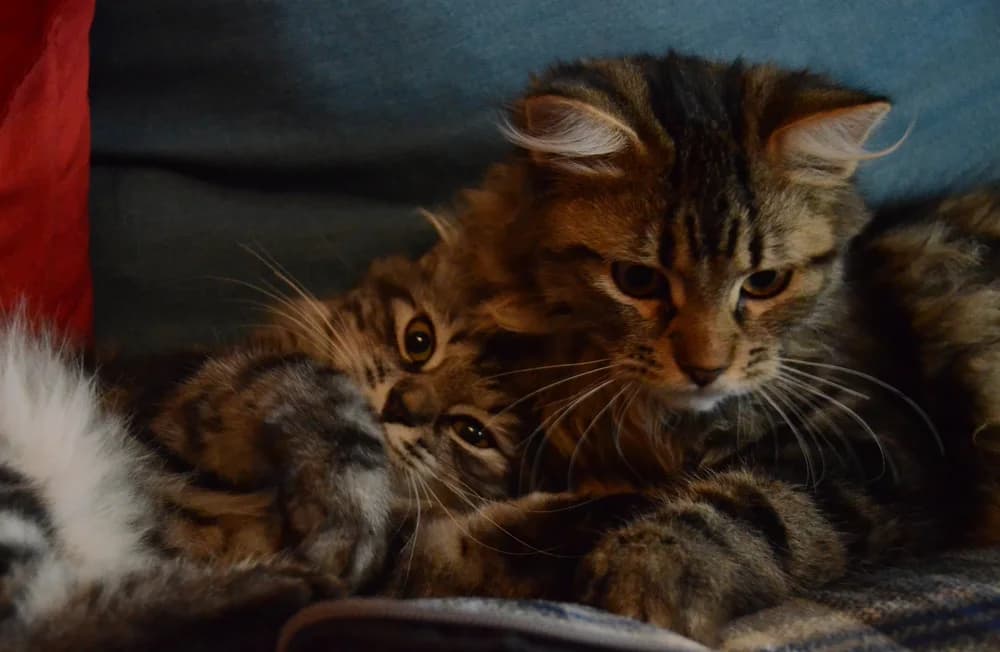
Two brown tabby Siberian kittens cuddled together on a sofa
Photo: TimRudyGit · CC BY-SA 4.0 · via Wikimedia Commons
Got a Siberian? Share them with the community. Photos from our members round out this page.
 Vital stats
Origin
Russia
A Russian landrace formalised by Russia's own cat fancy in the 1980s. The Kotofei club wrote the first standard in the late 1980s. The Soviet Felinological Federation registered the breed on 6 August 1990 as its Certificate No. 1. And the first three US imports landed on 28 June 1990.
Weight
Female
8-12 lb (3.6-5.4 kg)
Male
12-18 lb (5.4-8.2 kg)
Life expectancy
says 11 to 18-plus years and UK insurer Agria says 11 to 18, the closest agreement among the nine sources that state a number. says a narrower 12 to 15 or more. All of it is a commonly cited estimate, no measured study exists. The Siberian has not yet cleared the minimum sample size of any of the three big mortality studies this site cites for other breeds (the 2024 UK life tables included). So unlike our Bengal or Maine Coon pages, no measured figure can honestly appear here.
Coats
Brown tabby
Black
Blue
Red
Cream
Sunshine gold
Silver
Seal point
Black and red with their dilutes blue and cream, tortoiseshell mixes, all four tabby patterns, silver and smoke, every degree of white, and the blue-eyed (Neva Masquerade). The breed's own genetic celebrity is sunshine, a golden wide-band color caused by a CORIN gene variant unique to this breed. It can combine with silver into the "bimetallic" coat. Chocolate, cinnamon, lilac and fawn are excluded by most registries (Canada's is the one exception our research found).
Understanding the coats (and their genetics)Size
Medium to medium-large, with "surprising heft for its size" (CFA's words, echoed near-verbatim by three other registries). Measured: median 4.1 kg (9 lb) pooled across 7,341 screened cats. GCCF's much higher UK range (17-26 lb males) is an outlier against every measured cohort. It is quoted on the size guide as GCCF's own figure, not this site's.
Popularity (CFA)
No. 8
in the CFA ranking for 2026
Did you know
When the Soviet Felinological Federation issued its first-ever breed registration on 6 August 1990, the Siberian was Certificate No. 1, and the Neva Masquerade was Certificate No. 2 the same day. The pointed cats were founders, not a later fashion. Mars, one of the two model cats the first standard was written around, was himself a blue point.
 Personality
 Affection3/5
 Energy3/5
 Intelligence4/5
 Friendliness3/5
 Independence4/5
 Vocal2/5
 Shedding4/5
Compatibility
 Good with children4/5
 Good with other pets4/5
 Apartment friendly3/5
Editorial ratings on our five-point scale, anchored in the registry descriptions and the measured behaviour studies cited on this profile; individual cats vary, and our members' own ratings below are the counterweight.
Still torn between this breed and another?Compare the Siberian trait by trait, or filter every breed by what matters to you. What our members say
What our members say
Nobody has described their Siberian here yet. As soon as the first profiles come in, this is where the community averages will show up: temperament, food, lifestyle.
Describe my Siberian Pros & cons
Strong points
- A documented founding story with named cats and dates, rare among semi-longhairs
- Measured mid-table temperament: no behavioural extreme in the 19-breed Finnish dataset
- The densest coat in the fancy, built for real winters and rarely matting
- PK deficiency, the breed's one peer-reviewed genetic risk, has a $47 DNA test
- Clubs on two continents describe the same gentle, playful, water-loving family cat
Things to consider
- Two heavy seasonal molts a year, with daily combing through each
- The hypoallergenic reputation runs far ahead of the evidence: no published population study exists
- HCM has no DNA test in this breed: screening means echocardiograms and open pedigrees
- One of the slowest breeds to mature: three to five years to full size and coat
- Measurably more reserved with strangers than the brochure prose suggests
 Is a Siberian right for you?
A household that wants a devoted housemate with its own agenda rather than a shadow. The measured data shows a calm, mid-table cat that warms to its own people and takes its time with strangers. Expect real grooming twice a year. Budget honestly (allergen-tested kittens carry steep premiums). And if allergies are the reason you are here, read our hypoallergenic page before any deposit: the honest answer has more labels on it than the marketing does.
Is the Siberian right for YOUR home?
Answer a few questions and we'll email you your personalized result.
Take the quiz · 2 min Getting to know the Siberian
The Siberian is Russia's native forest cat, in its registries' own words: a medium-large, barrel-bodied semi-longhair built from curves where other forest breeds are built from boxes and triangles. It wears the densest coat in the cat fancy, and carries the most argued-over allergy reputation in the species. Among famous breeds it is also one of the youngest arrivals to Western registries: virtually unknown outside Russia until 1990.
Hold it next to its two look-alikes and the shapes separate cleanly. 's own comparison article calls the Siberian a breed of gentle curves with "no box, no triangle". The Maine Coon is the long rectangle with the squared muzzle (the full comparison). The Norwegian Forest Cat is the triangle, wearing a double coat to the Siberian's triple. One registry rule settles a whole family argument: the Norwegian's standard disqualifies pointed coloring outright, so a blue-eyed, color-pointed forest cat can only be a Siberian.
The history is unusually well documented for a landrace, and it starts in the 1980s, not the middle ages. Russia's cat fancy organized late in that decade. The Kotofei club wrote the first standard around two model cats: Roman (a brown tabby and white born in 1987) and Mars (a blue point born in 1988). The Soviet Felinological Federation registered the breed on 6 August 1990, Certificate No. 1, with the Neva Masquerade as Certificate No. 2 the same day.
On 28 June 1990, per 's own history, three cats named Kaliostro, Naina and Ofelia landed at the Port of New York, for Elizabeth Terrell's Starpoint cattery in Louisiana. championship followed in 1996, CFA's in 2006, and the UK's first imports entered quarantine in January 2002. The "cats in Russia since the year 1000" line the registries repeat is background lore. The breed's own most detailed historian calls the monastery stories legend, and the documented history starts exactly where this paragraph does.
On personality, the clubs and the data tell two honest halves of one cat. The clubs' half: playful, water-fascinated, chirping rather than loud, "90% placid and 10% mischief" per owners quotes. The measured half (the 5,726-cat Finnish behaviour study): mid-table on every one of ten traits, never a headline extreme, less contact-seeking than eight of eighteen breed groups and more reserved with strangers than most. Both are true to their method. This is a devoted housemate with its own agenda, not a shadow.
Health runs on a gap worth understanding before any breeder conversation. The breed's one peer-reviewed, DNA-testable risk (PK deficiency) and its most-discussed one () have completely different evidence behind them. The PK test costs $47, and both parents should have results. For HCM, no Siberian DNA test exists anywhere. So honest screening means echocardiograms and openly disclosed pedigrees, never a certificate nobody can issue. The famous allergy claim gets its own fully sourced page: all Siberians produce allergen, and the "15 percent suit severe-allergy homes" figure is breeder-collected and was never published in a journal.
Two buying notes. The palette, from everyday brown tabby to the breed's own golden "sunshine" gene and the blue-eyed pointed cats, is mapped with its actual genetics in the colors guide. And the prices are named-source, market by market, on the price guide, including the strangest pricing pattern in our breed research: two catteries in two countries price kittens by their tested allergen level, up to three times the untested figure.
 Health: what to watch for
A few predispositions are well documented. The good news: they can be screened for or avoided by choosing a reputable breeder and keeping an eye on the right signals.
This is information, not veterinary advice, and it cannot tell you what is wrong with your cat. Our rule is a simple one: if something is wrong with your cat, call your vet, and call an emergency clinic if it is out of hours. Nothing you read here is a reason to wait.
Pyruvate kinase (PK) deficiency
Documented, DNA-testableA red-blood-cell enzyme defect (autosomal recessive, gene PKLR) causing intermittent haemolytic anemia of variable onset and severity, and the Siberian's one peer-reviewed, breed-named genetic finding. A 2012 multi-breed study screened 377 Siberian samples and found 16 to 18 carriers and at most one affected cat: counts stated as counts, never rounded into a rate. Its own conclusion recommends PK testing for Siberians by name. UC Davis VGL's current test page lists the Siberian among breeds appropriate for testing.
Symptoms to spot
Intermittent lethargy, weakness, pale gums, or a cat that tires unusually fast, especially young: any of these is a reason to call your vet. Severity cannot be predicted for an affected cat, per the testing laboratory itself.
How common
377 Siberian samples screened in the 2012 study: 16-18 carriers, 0-1 affected (two overlapping subsets). No population-wide rate exists.
Screening & prevention
Both breeding cats DNA-tested; two carriers should not be paired. For a pet kitten, one tested-clear parent rules the disease out.
Genetic test
Yes: PKLR DNA test, swab or blood, $47 at UC Davis VGL. Ask a breeder for both parents' results.
Hypertrophic cardiomyopathy (HCM)
Breeder-tracked, no DNA test existsThe most common heart disease of all cats, and in this breed a case study in honest labels. No peer-reviewed study names HCM in Siberians (the one PubMed hit is a false positive from a search-term quirk), and no Siberian DNA test exists anywhere (UC Davis VGL's full index carries only Maine Coon and Ragdoll HCM tests). What exists is breeder-run pedigree tracking. Siberian Research, a breed organization, traces self-reported cases to six distinct geographic points of origin rather than one gene, and PawPeds runs an echocardiogram screening program. All of that is breeder-reported, not measured prevalence, and this page says so rather than inventing a rate.
Symptoms to spot
Often nothing at all in early disease. Laboured or rapid breathing, open-mouth breathing, lethargy or sudden hind-leg pain are emergencies: call your vet immediately, out of hours an emergency clinic.
How common
No measured figure exists. Anyone quoting a Siberian HCM percentage is quoting a guess.
Screening & prevention
Ask breeders for echocardiogram results read by a cardiologist and for open pedigree disclosure; prefer catteries that disclose cases over ones that claim none.
Genetic test
None exists for this breed. A breeder offering an "HCM DNA certificate" for a Siberian is selling paperwork no laboratory issues.
Polycystic kidney disease (PKD)
Line-dependent, DNA-testableLong considered a Persian disease, PKD entered some Siberian lines through deliberate Persian outcrosses used decades ago to thicken coats and round faces, per the breed's own research organization. Most Siberian cases submitted for testing came back positive for the Persian PKD1 mutation, for which a commercial DNA test exists. The case counts behind this are roughly twenty years old and self-reported. No current prevalence figure exists, and this page does not restate the era's worldwide extrapolations as current fact.
Symptoms to spot
Kidney cysts are silent for years; increased thirst, weight loss or appetite loss in an adult cat is a call-your-vet sign regardless of breed.
How common
About 35 cases were self-reported to the breed organization by 2005; no measured current figure exists.
Screening & prevention
Ask whether the line carries Persian outcrosses and for PKD1 results or kidney ultrasound history on the parents.
Genetic test
Yes: the PKD1 test used for Persians. Lines with Persian-outcross history are the ones to ask about.
Pyometra (intact females)
Relevant to unspayed queensA Swedish insured-cat study (1999-2006) lists the Siberian among seven breeds with a pyometra incidence above 60 cases per 10,000 cat-years, against an all-cat mean of about 17. This is a uterine infection of intact females. It concerns breeding queens and unspayed pets, is prevented by spaying, and the figure is Swedish insurance data, not a four-market rate.
Symptoms to spot
In an unspayed female: lethargy, drinking more, appetite loss or discharge, typically weeks after a heat, is a same-day vet call. Pyometra can be fatal untreated.
How common
Above 60 per 10,000 cat-years in intact Swedish females (study mean across all cats: about 17). Sweden-scoped.
Screening & prevention
For breeding queens, know the signs and the post-heat risk window; for pets, spay per your vet's advice.
Genetic test
Not a genetic test matter: prevention is spaying a cat not intended for breeding.
Go deeper on health
Prevention, warning symptoms, costs and insurance: our guides, researched and sourced.
The Siberian also appears in
Our criteria-based guides, to compare this breed with the ones most like it.
 Grooming & living with one
Grooming
Two to three combings a week with a steel comb, rising to daily through the spring and autumn molts. Underside, tail and are the mat zones worth checking by hand. Baths are rarely necessary ('s own words), because the coat is water-resistant. The full machinery, including the judging detail that a Siberian losing its triple texture in summer is faulted for it: our shedding guide.
Living together
The clubs describe a patient, playful cat that settles in with children and dogs. The measured Finnish data (5,726 cats, 19 breeds) backs the calm half: unremarkable aggression on every axis. It adds the honest half the brochures skip. The Siberian tested LESS contact-seeking than eight of eighteen breed groups, and more reserved with strangers than most. So let it make the first move with visitors. A cat can be intensely loyal to its own household and still test average on contact-seeking frequency: both readings are true to their method.
 Food & diet
No registry or veterinary body publishes Siberian-specific feeding guidance, and that absence is the finding. This breed eats like a large, slow-maturing cat, with growth feeding running longer than most (full size takes three to five years, closer to five). One genuinely breed-adjacent strand exists, with its label attached: industry-funded studies (the pet-food maker's own researchers) show an egg-derived antibody food ingredient measurably reduces active in cats generally, never tested in Siberians specifically.
 Price & budget
$1,950 to 2,900
Price of a kitten from a registered breeder, in the United States
This price reflects the quality of the breeding program: parents' health tests, registry pedigree, socialization. A very low price should raise a red flag. The real cost, though, plays out over the years.
Find a verified breederKitten price, by market
United States
$1,950 to 2,900
United Kingdom
£500 to 1,600
Canada
CA$1,500 to 2,625
Australia
A$3,500 to 5,000
Each figure is that country's real market price, researched separately, not a conversion of the others. The smaller line is only there so you can gauge one against your own money: European Central Bank reference rates of 2026-09-18, refreshed daily.
The Siberian in the US, UK, Canada and Australia
| Measure | United States | United Kingdom | Canada | Australia |
|---|---|---|---|---|
| Pet-quality kitten (published prices) | $1,950-2,900 (9 named catteries) | £500-1,600 (live listings) | CA$1,500-2,625 flat; allergen tiers to CA$5,990 | A$3,500-5,000 plus GST (2 catteries) |
| Main registries | CFA, TICA | GCCF | CCA-AFC | ACF, ANCATS |
| The pointed variety (Neva Masquerade) | Same breed at CFA and TICA | GCCF's page is silent | Two breeds for showing, freely interbred | Separate breed at ACF; unmentioned at ANCATS |
| DNA tests that exist | PK deficiency ($47 at UC Davis VGL); no Siberian HCM test exists anywhere | Same PK test; no GCCF requirement found | Same PK test | Same PK test |
| Measured breed life expectancy | No measured figure exists | No measured figure exists | No measured figure exists | No measured figure exists |
Four markets, four rulebooks; none of these figures converts into another. Prices are August 2026 and expire with the quarter.
Work out your food budget
Type of food
Estimated monthly budget
$17
≈ 3.0 oz (85 g) per day
A ballpark figure, food only, using the same arithmetic as our portion tool (resting energy requirement × 1.2, a neutered adult). Real needs vary with age, activity level and body condition. Ask your veterinarian for advice.
 Verified catteriesThe registry-checked directory, plus a kitten alert near you. Filter it by breed.
 Should you insure a Siberian?
Our sources list several predispositions in the Siberian: Pyruvate kinase (PK) deficiency, Hypertrophic cardiomyopathy (HCM), Polycystic kidney disease (PKD), among others. A predisposition is not a foregone conclusion, and many of these cats live their whole lives without ever developing anything. It does change the nature of the follow-up, though: you monitor, sometimes for life, and it's that monitoring that weighs on a budget, more than a one-off accident.
One thing to weigh before deciding: this is a cat you will live alongside for well over a decade, and that is the span the real cost is spread across, premiums and care alike. Where a breed has a measured life expectancy that differs from the figure usually quoted, we say so in the lifespan section above rather than repeating the quoted one here.
 Siberian cats in our community
This breed is barely covered by free photo libraries: we only found 4 photos we could verify. Your cats are especially welcome here.
No Siberian here yet
Got one? Add a photo and yours gets to open this page.
 The vet's take

Veterinary review
Are you a vet?
Your professional read belongs here: every verified practitioner can leave a note, published once our editors have reviewed it.
Sign in and get your license number verified. We check it in the public register, we never ask for or keep a copy of your diploma, and your number is never published.
 Frequently asked questions
+Are Siberian cats hypoallergenic?
No breed is proven hypoallergenic and all Siberians produce Fel d 1, the main cat allergen. Breeder-run testing, never independently published, reports about half of Siberians measure lower than typical cats and about 15 percent low enough for severe-allergy homes; the only academic study covered 4 cats. The full evidence file, strand by strand: our hypoallergenic guide.
+How big do Siberian cats get?
Measured: a median 4.1 kg (9 lb) across 7,341 screened cats, with males averaging 5.3 kg (11.7 lb) in the one sex-split cohort. CFA's stated range reaches 18 lb (8.2 kg) for a large male. The triple coat and dense build make the breed read a full size class above what the scale says.
+How long do Siberian cats live?
TICA and UK insurer Agria both quote 11 to 18 years; GCCF says 12 to 15 or more. Treat all of it as a commonly cited estimate, no measured study exists: the breed has not yet cleared the sample-size thresholds of the big mortality datasets that give our Bengal and Maine Coon pages their measured figures.
+What is a Neva Masquerade?
The colorpoint, blue-eyed Siberian: genetically the same population, one temperature-sensitive pigment allele apart. Whether it counts as a separate breed depends on the registry (one breed at TICA, CFA and WCF; a separate breed at FIFe and Australia's ACF; two-for-showing in Canada), and our Neva Masquerade page maps every position.
+Do Siberian cats shed a lot?
Twice a year, seriously: the dense winter coat drops in spring (the heavy molt) and the summer coat in autumn. Between molts the routine is two to three combings a week, rising to daily during the sheds. The full machinery is on our shedding guide.
+Are Siberian cats good with children and dogs?
The clubs say emphatically yes, and the measured Finnish data supports the calm half: unremarkable aggression on every axis. The same data shows a breed more reserved with strangers than its reputation suggests, so expect patience at home rather than instant friendship with every visitor.
+How much does a Siberian kitten cost?
From named published prices (August 2026): roughly $1,950 to $2,900 at US catteries, £500 to £1,600 in most UK listings, C$1,500 to C$2,625 flat in Canada, and A$3,500 to A$5,000 plus GST in Australia. Allergen-tested kittens run far higher: up to $6,400 in Oregon and C$5,990 in Quebec.
+Are Siberian cats related to Maine Coons?
No: per a 2008 population-genetics study (cited via Wikipedia's reading of it), the resemblance is convergent evolution, two cold climates building the same cat twice. The Siberian is genetically close to the Norwegian Forest Cat and northern European cats; the Maine Coon descends from British cats brought to New England.
+When did Siberian cats come to the United States?
On 28 June 1990, per CFA's own history: three cats named Kaliostro, Naina and Ofelia, imported by Elizabeth Terrell to her Starpoint cattery in Louisiana after 18 months of correspondence with Russian breeders. TICA granted the breed championship status in 1996, CFA in 2006.
+What health problems do Siberian cats have?
PK deficiency leads the list: peer-reviewed, breed-named, and DNA-testable for $47. HCM is actively tracked by breeders but has no Siberian DNA test and no published study, so screening means echocardiograms and open pedigrees. PKD entered some lines via old Persian outcrosses and has a DNA test. Ask breeders for paperwork on all three.
+Do Siberian cats like water?
The breed clubs consistently describe a genuine water fascination, from playing with taps to supervising baths. The water-resistant triple coat is the flip side: TICA notes a bath is rarely necessary, and when one is, soaking through that coat takes real effort.
 Community questions
Got a question this page doesn't cover? Ask it: the best ones get published here with their answer.
Sources & references
Data checked against reference sources (TICA and CFA standards, genetics laboratories, veterinary schools).
- TICA: Siberian breed
- CFA: Siberian
- CFA: Siberian history article (2008 Yearbook)
- TICA Siberian standard (rev. May 2026)
- GCCF: Siberian
- Häggström et al. 2025, screening body weights (56,169 cats)
- Salonen et al. 2019, breed behaviour study
- Grahn et al. 2012, PK deficiency across breeds
- UC Davis VGL: PK deficiency test
- Sadovnikova, The Siberian Cat (PawPeds)

Worth keeping a paw on
Pin this profile
To compare later, or to show someone still torn between two breeds. One click and it sits in your board.
Pin it on Pinterest
 Purr or Pass
Still deciding? Find the perfect breed for your home.
A quick quiz that factors in your lifestyle, your kids and your other pets.
Which breed fits my home?Keep exploring
The floor belongs to our members. Keep it kind, links are not allowed, and images go through moderation before anyone else sees them.