

Pixie-bob
“The legend cat: a bobcat look on paper-documented domestic genetics”
 By Priya · The careful one
Published August 21, 2026Updated August 26, 20268 min read
Contents
 Pixie-bob photos
Real photos, so you can see what the breed actually looks like: coats, ear tufts, ruff and build.
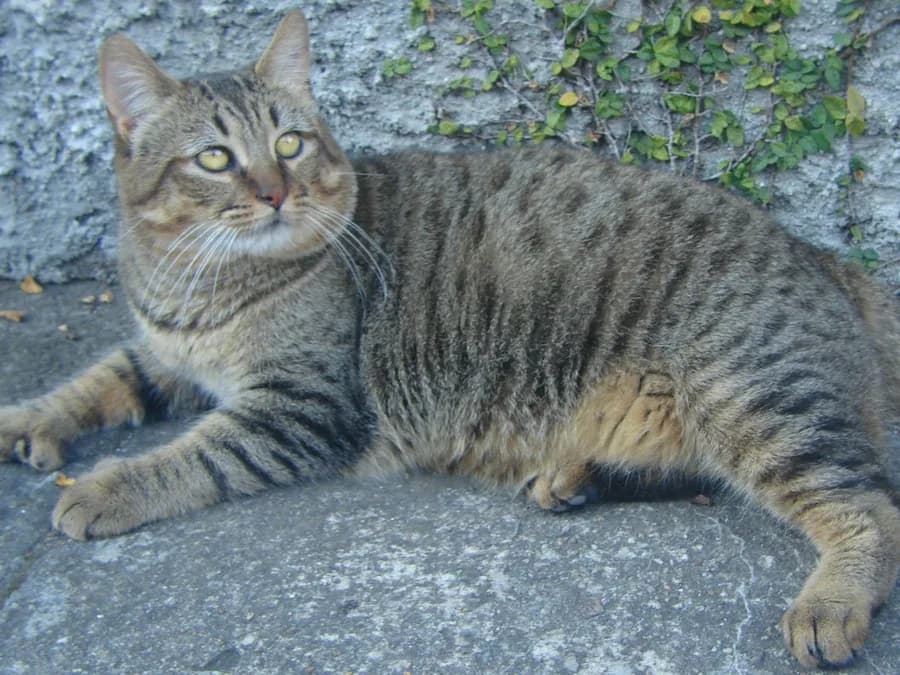
Spotted brown tabby Pixie-bob cat lying on stone, amber eyes alert
Photo: Simone Johnsson from Curitiba, Brazil · CC BY-SA 2.0 · via Wikimedia Commons
 Vital stats
Origin
United States
Washington State, 1985-86: Carol Ann Brewer acquired barn cats she believed were natural bobcat crosses ('legend cats') and founded a breed named for a kitten called Pixie. 's own timeline: approached in 1993, Exhibition Status 1994, New Breed effective 1 May 1996, Championship granted 1997 for the 1998 season. The founding story and the genetics are two separate things our bobcat-mix page keeps apart. And the breed's own paperwork history includes a genuine oddity: a breeder's 1999-2012 attempt to PATENT the breed itself, rejected on anticipation grounds (two 1994-95 newspaper profiles of Brewer counted as prior art) and finally lost at the Federal Circuit in 2012.
Weight
Female
8-12 lb (3.6-5.4 kg)
Male
12-17 lb (5.4-7.7 kg)
Life expectancy
's own stated figure is 13-15+ years, labeled as TICA's estimate: no peer-reviewed mortality study of any kind includes this breed, checked directly in four large multi-breed cohorts. A commonly cited registry figure; no measured study exists.
Coats
Brown spotted tabby (the only color)
Muted spotting
One closed palette: Brown Spotted Tabby, confirmed identically across four independently worded registry standards and structurally closed by a universal no-outcross rule. Never 'black ' (Wikipedia's phrase, contradicted by every primary standard). The famous paws are part of the look. Polydactyly is ALLOWED to seven toes per foot, a genuinely rare registry accommodation four registries converge on.
Understanding the coats (and their genetics)Size
No registry standard (TICA, ACF, CCA-AFC, all three read in full) puts a number in its judging text: the figures live in consumer prose only. TICA's narrative range leads as TICA's stated figure: males 12-17 lb (5.4-7.7 kg), females 8-12 lb (3.6-5.4 kg). Some sources report exceptional males at 20-25 lb, a recurring figure unverified by any registry or study, labeled exactly that. No measured weight study exists.
Did you know
This is the one breed where a court weighed in on who owns a cat. A breeder spent 1999-2012 trying to patent the Pixie-bob itself, and lost, partly because two mid-1990s newspaper profiles of founder Carol Ann Brewer counted as prior art. The 'Legend Cat' trademark attached to the founding story is real, and lapsed.
 Personality
 Affection4/5
 Energy3/5
 Intelligence4/5
 Friendliness4/5
 Independence3/5
 Vocal3/5
 Shedding3/5
Compatibility
 Good with children4/5
 Good with other pets4/5
 Apartment friendly3/5
Editorial ratings on our five-point scale, anchored in the registry descriptions and the measured behaviour studies cited on this profile; individual cats vary, and our members' own ratings below are the counterweight.
Still torn between this breed and another?Compare the Pixie-bob trait by trait, or filter every breed by what matters to you. What our members say
What our members say
Nobody has described their Pixie-bob here yet. As soon as the first profiles come in, this is where the community averages will show up: temperament, food, lifestyle.
Describe my Pixie-bob Pros & cons
Strong points
- The bobcat look on fully domestic paperwork: no hybrid law anywhere reaches this breed
- A dog-like, leash-and-fetch portrait three sources state independently
- The fancy's most generous polydactyly allowance: up to seven toes, four registries converging
- A tail genetics finding no competitor page states: the Manx's own mutation, found in 8 of 14 tested
Things to consider
- GCCF excludes the breed, in its own words over polydactyly: no mainstream UK show path
- PK-deficiency carrier rates around one in four in the one measured panel: the DNA question is real
- No measured weight, lifespan or behaviour study exists: registry prose, labeled as such
- Thin supply outside the US: confirmed-zero Canada, dark Australian storefronts
 Is a Pixie-bob right for you?
A household that wants the wild silhouette with none of the hybrid-law baggage. One that will ask breeders for PK-deficiency results by name, budgets by toes and paperwork rather than legends, and enjoys a chirping, dog-mannered companion.
Is the Pixie-bob right for YOUR home?
Answer a few questions and we'll email you your personalized result.
Take the quiz · 2 min Getting to know the Pixie-bob
The look says bobcat; the paperwork and the genetics say domestic cat, and this site says both precisely. The founding story (Carol Ann Brewer's 1985-86 'legend cats') and the DNA-disproof claim (one 2008 newspaper quote, no study named) are two separate things. The best genetics available points somewhere nobody's legend predicted: 8 of 14 short-tailed Pixie-bobs tested carry the Manx's own domestic tail mutation, absent from all 8 bobcats tested. Our bobcat-mix explainer tells all three pieces at their true sizes, which no page currently ranking for the question does.
One color, many toes. Brown is the breed's single, structurally closed palette (a universal no-outcross rule guards it), while the paws run the other way. Polydactyly is allowed to seven toes per foot, the fancy's most generous accommodation, priced accordingly (the toe-split price bands are this market's signature). It is also behind 's exclusion, which is about polydactyly in GCCF's own words, not wild ancestry.
The honest files: no registry standard states a weight, no mortality study includes the breed, the behaviour surveys omit it, and the measured health signals are specific. PK-deficiency carriers at roughly one in four of the one tested panel (DNA-testable: ask breeders). A single carrier among twelve longhairs tested, against Wikipedia's unsourced '50% ' figure. And a polydactyly gene (Hw) documented in the breed's own tested cohort. Where a claim has one uncited consumer-page source or none, we say so and stop.
 Health: what to watch for
A few predispositions are well documented. The good news: they can be screened for or avoided by choosing a reputable breeder and keeping an eye on the right signals.
This is information, not veterinary advice, and it cannot tell you what is wrong with your cat. Our rule is a simple one: if something is wrong with your cat, call your vet, and call an emergency clinic if it is out of hours. Nothing you read here is a reason to wait.
PK deficiency: the one measured carrier signal, DNA-testable
MODERATEAnderson 2022's panel, tables read directly, reports PK-deficiency (PKLR) carrier frequencies of 5 of 19 Pixiebobs (26.3%) and 4 of 11 Pixiebob Longhairs. Population carrier figures from one panel, never a diagnosis. And roughly one in four is enough to make the commercial DNA test the standing breeder question. A lethargic, pale or off-color cat of any breed means call your vet.
HCM: the unsourced 50% figure, corrected to what was actually measured
LOWWikipedia's own article carries a '50% HCM' figure with no source, verifier-confirmed unsourced, and we print the real measurement instead: 1 of 12 Pixiebob Longhairs in Anderson 2022's panel carried a MYBPC3 variant. No breed-specific echo study exists. Murmurs or breathing changes in any cat are vet territory; no swab rules HCM out.
Our full guide on this topicPolydactyly: an allowance, a gene, and a nail-care consequence
LOWThe many-toed paw is a registry ALLOWANCE (to seven toes per foot, four registries converging) with documented genetics (Hamelin 2020 found the Hw variant in 5 of 5 tested polydactyl Pixie-bobs). GCCF's exclusion of the breed cites exactly this trait, in its own words. The practical consequence is grooming, not disease: extra claws grow at odd angles and need deliberate per-toe trimming.
The claims we checked and will not print as fact
LOWCryptorchidism and difficult births trace to one uncited consumer page each: named here as unsourced, not published as breed facts. 'Blocked tear ducts' has no source of any kind and does not appear on this site at all. And the Manx literature's homozygous-lethality finding describes the Manx. No source tests it in Pixie-bobs, so it is never imported, despite the shared mutation.
Go deeper on health
Prevention, warning symptoms, costs and insurance: our guides, researched and sourced.
The Pixie-bob also appears in
Our criteria-based guides, to compare this breed with the ones most like it.
 Grooming & living with one
Grooming
The double coat wants weekly-to-regular brushing in both lengths (the long variety more). The breed-specific fact worth more than any schedule: paws need deliberate NAIL attention. Extra toes mean extra claws growing at odd angles that miss the scratching post: check every toe, every trim. Routine teeth and ears as for any cat.
Living together
The portrait is sociable and family-steady, good with children and cat-friendly dogs, with the fetch-and-leash energy of the breed's dog-like reputation. Published tension included: one source reads the breed as sedate where two read it as active; meet the individual cat. No measured study exists behind any of it.
 Food & diet
's own statement: no particular nutritional needs. The standing caution is the marketing, not the food. The wild look invites invented raw-diet claims no source supports for this breed. A complete diet portioned by body condition, with the usual toxic-food list, is the whole plan.
 Price & budget
$1,200 to 5,500
Price of a kitten from a registered breeder, in the United States
This price reflects the quality of the breeding program: parents' health tests, registry pedigree, socialization. A very low price should raise a red flag. The real cost, though, plays out over the years.
Find a verified breederKitten price, by market
United States
$1,200 to 5,500
United Kingdom
£600 to 1,500
Each figure is that country's real market price, researched separately, not a conversion of the others. The smaller line is only there so you can gauge one against your own money: European Central Bank reference rates of 2026-09-18, refreshed daily.
Work out your food budget
Type of food
Estimated monthly budget
$16
≈ 2.8 oz (79 g) per day
A ballpark figure, food only, using the same arithmetic as our portion tool (resting energy requirement × 1.2, a neutered adult). Real needs vary with age, activity level and body condition. Ask your veterinarian for advice.
 Verified catteriesThe registry-checked directory, plus a kitten alert near you. Filter it by breed.
 Should you insure a Pixie-bob?
Our sources list several predispositions in the Pixie-bob: PK deficiency: the one measured carrier signal, DNA-testable, HCM: the unsourced 50% figure, corrected to what was actually measured, Polydactyly: an allowance, a gene, and a nail-care consequence, among others. A predisposition is not a foregone conclusion, and many of these cats live their whole lives without ever developing anything. It does change the nature of the follow-up, though: you monitor, sometimes for life, and it's that monitoring that weighs on a budget, more than a one-off accident.
One thing to weigh before deciding: this is a cat you will live alongside for well over a decade, and that is the span the real cost is spread across, premiums and care alike. Where a breed has a measured life expectancy that differs from the figure usually quoted, we say so in the lifespan section above rather than repeating the quoted one here.
 Pixie-bob cats in our community
No Pixie-bob here yet
Got one? Add a photo and yours gets to open this page.
 The vet's take

Veterinary review
Are you a vet?
Your professional read belongs here: every verified practitioner can leave a note, published once our editors have reviewed it.
Sign in and get your license number verified. We check it in the public register, we never ask for or keep a copy of your diploma, and your number is never published.
 Frequently asked questions
+What is a Pixie-bob?
A fully domestic breed bred for the bobcat look: heavy-boned, brown spotted tabby (the only color), bobbed tail, often many-toed, founded from Carol Ann Brewer's Washington State 'legend cats' in 1985-86 and holding TICA Championship status since the 1998 season.
+Is a Pixie-bob part bobcat?
The registry answer is no; the evidence answer is layered, and our bobcat-mix page tells it honestly: a founding legend, a one-quote DNA disproof, and a peer-reviewed finding tying the breed's tail to the Manx's own domestic mutation (8 of 14 tested, and absent from all 8 bobcats tested).
+How much does a Pixie-bob cost?
US: $1,200-2,300 straight-toed and $2,300-4,000 polydactyl at the cattery pricing the split, or up to $5,500 on a show ladder. UK: aggregators cluster £600-1,500. Canada: confirmed zero purebred supply. Australia: recognition without live storefronts. Our price page has every source.
+Why do Pixie-bobs have extra toes?
Polydactyly runs in the founding lines and the registries chose to allow it, up to seven toes per foot, the fancy's most generous accommodation, with the Hw gene variant documented in the breed's tested cohort. It prices as a premium feature and grooms as extra claws.
+Why doesn't GCCF recognize the Pixie-bob?
Polydactyly, in GCCF's own words: its Red Status reasoning names the trait, treating the breed like polydactyl Maine Coons rather than like wild hybrids. Its row's 'Bengal, Toyger' alternative-breed suggestion does not follow from that reason and reads as a template artifact, worth knowing so nobody infers a hybrid classification.
+How big do Pixie-bobs get?
TICA's stated range: males 12-17 lb (5.4-7.7 kg), females 8-12 lb (3.6-5.4 kg), with no registry standard putting a number in its judging text. The circulating 20-25 lb exceptional-male figure is unverified by any registry or study, and we label it exactly that.
+Do Pixie-bobs meow?
Less than most: TICA and its corroborating sources describe chirps and chatters more than classic meows, part of the breed's dog-like portrait, with the usual caveat that no measured behaviour study includes the breed.
+Are Pixie-bobs healthy?
The measured file is small and specific: PK-deficiency carriers around one in four of one tested panel (ask breeders for the DNA test), one MYBPC3 carrier in twelve longhairs tested (against an unsourced 50% figure we corrected), and nothing else documented. Anything wrong with your cat means call your vet.
+Pixie-bob vs Manx: what do they share?
A real gene: 8 of 14 short-tailed Pixie-bobs tested carry the Manx's own c.998delT tail mutation. What they do NOT share on any page of ours is the Manx's homozygous-lethality finding, which no source tests in Pixie-bobs.
+Pixie-bob vs American Bobtail: same breed?
No: two separately founded, separately registered bobbed-tail breeds with different standards (the Pixie-bob's single brown-spotted palette against the Bobtail's open one). Reader confusion is real, and the paperwork settles any individual case.
+How long do Pixie-bobs live?
TICA states 13-15+ years; no mortality study anywhere includes the breed (four large cohorts checked directly). A registry estimate, labeled as one.
 Community questions
Got a question this page doesn't cover? Ask it: the best ones get published here with their answer.
Sources & references
Data checked against reference sources (TICA and CFA standards, genetics laboratories, veterinary schools).
- TICA: Pixiebob breed introduction
- GCCF: unrecognised breeds page (the polydactyly reason, verbatim)
- Buckingham et al. 2013, Mamm Genome: the shared c.998delT tail mutation (PMID 23949773)
- Hamelin et al. 2020, J Feline Med Surg: the Hw polydactyly variant cohort (PMID 32067556)
- Anderson et al. 2022, PLoS Genet: PK-deficiency and MYBPC3 carrier rows, tables read directly (PMID 35709088)
- Cascade Pixiebobs: the toe-split pricing page

Worth keeping a paw on
Pin this profile
To compare later, or to show someone still torn between two breeds. One click and it sits in your board.
Pin it on Pinterest
 Purr or Pass
Still deciding? Find the perfect breed for your home.
A quick quiz that factors in your lifestyle, your kids and your other pets.
Which breed fits my home?Keep exploring
The floor belongs to our members. Keep it kind, links are not allowed, and images go through moderation before anyone else sees them.