

Bengal cat
“The living-room leopard”
 By Priya · The careful one
Published August 20, 2026Updated August 26, 202612 min read
Contents
 Bengal photos
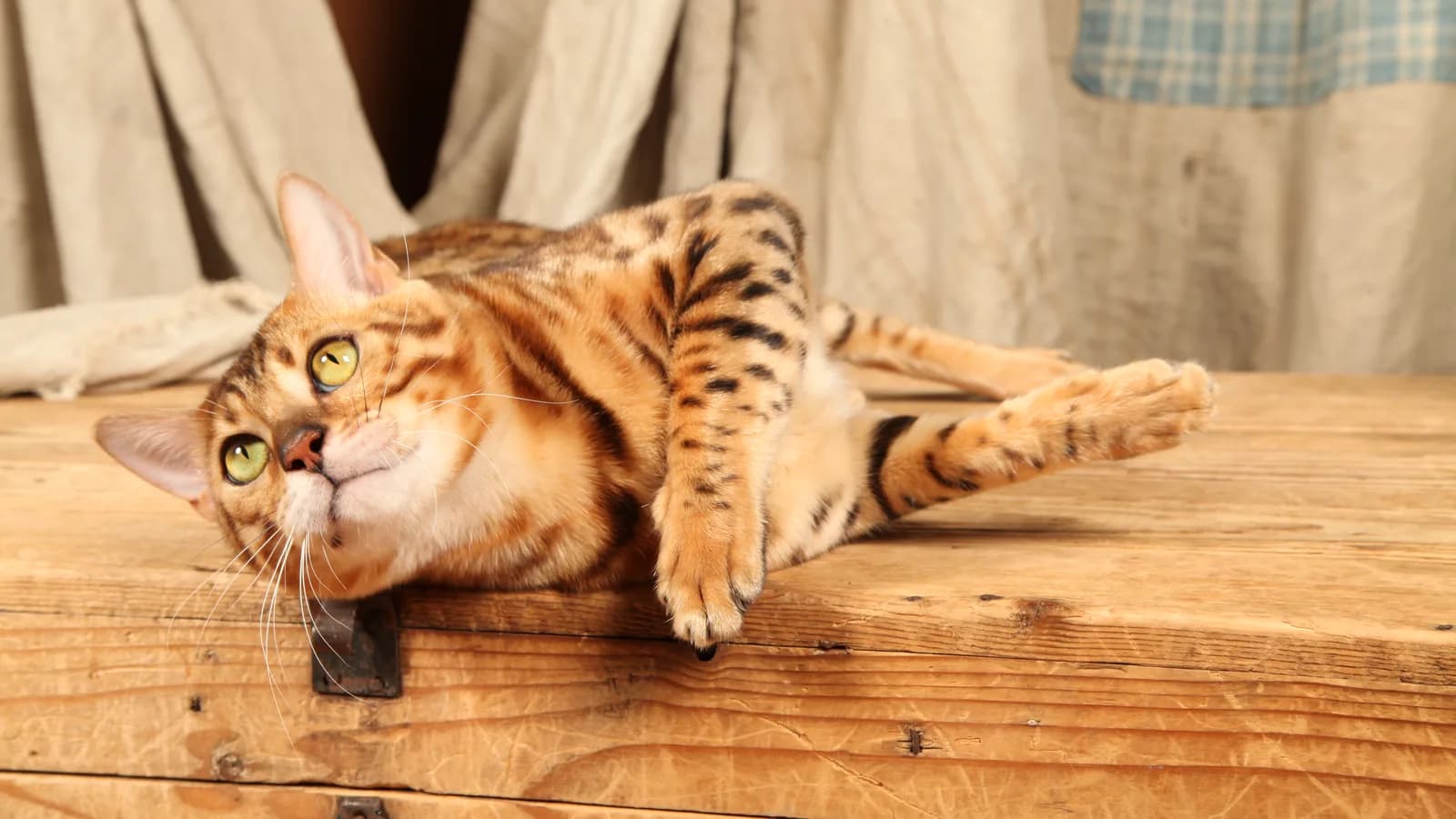
Real photos, so you can see what the breed actually looks like: coats, ear tufts, ruff and build.
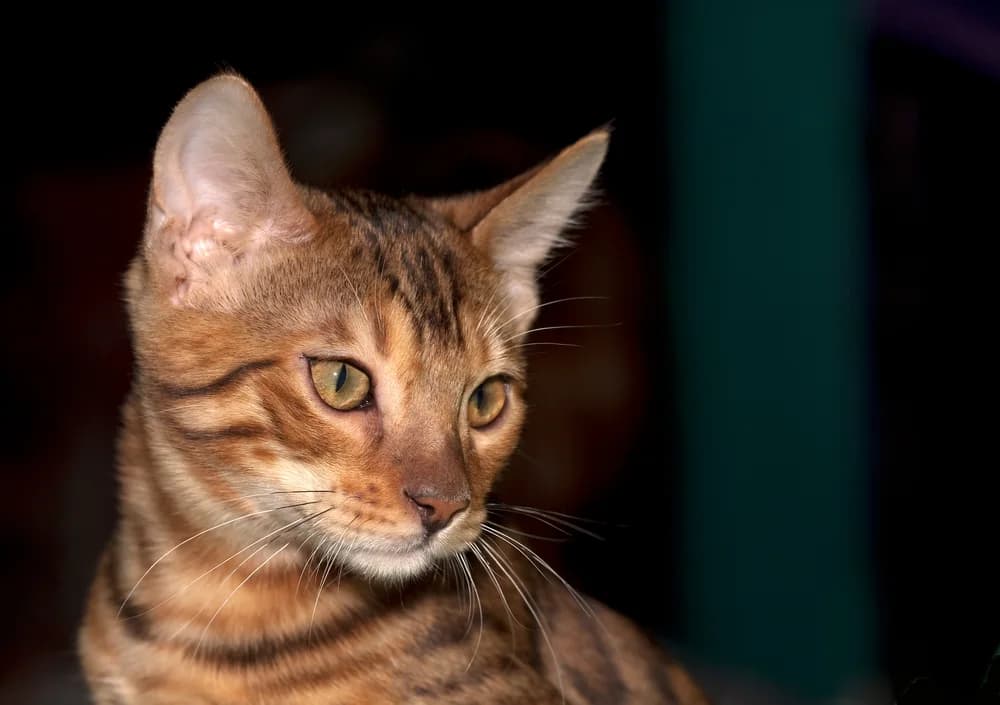
Golden-brown Bengal kitten in profile against a dark background, first rosettes forming
Photo: Nickolas Titkov · CC BY-SA 2.0 · via Wikimedia Commons
 Vital stats
Origin
United States
Two independent 1960s beginnings, told by the registries themselves. Jean Sugden (later Mill) crossed a domestic cat with an Asian leopard cat in 1963, aiming for the leopard look. Dr Willard Centerwall's Loma Linda program bred the same cross researching the leopard cat's apparent resistance to feline leukemia. Mill's Millwood cattery, restarted in 1980 with Centerwall's F1 females, became the breed's cradle.
Weight
Female
6-12 lb (2.7-5.4 kg)
Male
9-15 lb (4.1-6.8 kg)
Life expectancy
Two kinds of numbers, and they disagree. Measured: a UK life expectancy at birth of 8.51 years (73 deaths, 2019 data, CI 7.12-9.90), second-shortest of twelve breed groups, and an earlier UK median of 7.3 years from 15 cats. A Swedish insured population found the OPPOSITE, the joint-lowest mortality in its table, with a confidence interval too wide to settle anything. Quoted: "12 to 16 years" on four major pages word-identically, a commonly cited estimate with no measured study behind it. Observed lifespans in the 2024 study ran to 21.2 years: the low average is not a destiny. The full story: our lifespan guide.
Coats
Brown rosetted
Snow (lynx point)
Silver
Charcoal
Blue (dilute)
Melanistic (black)
Brown is the reference. The three-genotype snow family and silver are core everywhere, and the registries genuinely split on the rest. Charcoal (a sequenced leopard-cat-plus-domestic gene pairing) is a show effect at and , but UK-registrable only since February 2026. Blue is "(Preliminary)" at , and the melanistic black is showable nowhere. Two patterns only, spotted/rosetted and marbled. Every coat, gene by gene: the colors guide.
Understanding the coats (and their genetics)Size
No breed standard in any of our four markets states a weight. All five say "medium to large," and TICA's and ACF's torso clauses add "not quite as large as the largest domestic breed." The largest measured sample anywhere (3,484 screened Bengals) has a median of 4.0 kg (8.8 lb), the average pet cat's weight. The breed looks bigger than it weighs, by muscle density and gait, exactly as TICA's judging seminar intends.
Did you know
The glitter some Bengals wear is real and sequenced. A 2024 whole-genome study mapped the iridescent sparkle to reduced expression of the Fgfr2 gene, and the sweep is DOMESTIC cat DNA, not leopard cat. The breed's wildest-looking feature turns out to be homegrown.
 Personality
 Affection3/5
 Energy5/5
 Intelligence5/5
 Friendliness3/5
 Independence3/5
 Vocal4/5
 Shedding2/5
Compatibility
 Good with children4/5
 Good with other pets3/5
 Apartment friendly2/5
Editorial ratings on our five-point scale, anchored in the registry descriptions and the measured behaviour studies cited on this profile; individual cats vary, and our members' own ratings below are the counterweight.
Still torn between this breed and another?Compare the Bengal trait by trait, or filter every breed by what matters to you. What our members say
What our members say
Nobody has described their Bengal here yet. As soon as the first profiles come in, this is where the community averages will show up: temperament, food, lifestyle.
Describe my Bengal Pros & cons
Strong points
- The most active breed in both large behavior studies: an athlete that trains, fetches, walks on harness and solves puzzles
- Measured NOT more aggressive toward people than an ordinary house cat, whatever the wild look implies
- Low-shedding short coat on a one-brush-a-week schedule, per four sources independently
- The two big genetic diseases both have DNA tests, and the UK registry makes them mandatory for breeding stock
Things to consider
- The measured UK life expectancy (8.51 years) sits years below the quoted range; read the lifespan page before the deposit
- No validated HCM DNA test exists for this breed: only echocardiogram screening protects, and 'DNA tested for HCM' is a red flag
- An under-stimulated Bengal invents its own projects, at your furniture's expense: this energy budget is not apartment wallpaper
- Legal at home does not mean legal everywhere: Hawaii, New York City and Northern Ireland all read differently
 Is a Bengal right for you?
Someone who wants a project partner, not a lap warmer: climbing space, real play sessions, ideally a wheel or harness habit, and the patience for a clever, watchful cat that is measured shyer with strangers than the marketing admits. First rigorous act: buy only from a breeder who shows heart-screening reports and both DNA test results.
Is the Bengal right for YOUR home?
Answer a few questions and we'll email you your personalized result.
Take the quiz · 2 min Getting to know the Bengal
The Bengal is what happens when the leopard print is real: a breed built from the Asian leopard cat crossed into domestic cats in 1960s California, carrying today a measured 3.48 percent of wild DNA and one hundred percent of the marketing that comes with it. Under the rosettes sits the cat the studies actually describe, and it is better reading than the folklore: the full history runs from a leukemia-research program to 's 1988 naming vote.
Start with the engine, because it is measured. In the two large behavior studies that exist (5,726 and 4,316 cats), the Bengal ranks among the most active breeds in both, top of the scale in the second. The same data holds the two corrections worth paying for. Toward people, Bengals measured NO more aggressive than ordinary house cats. And beside the registries' "confident and curious" prose sits a measured shyness toward strangers that files the breed, in the researchers' own cluster, as "fearful and extroverted." High engine, watchful temperament: plan for both.
The look is a twelve-coat story with real genetics: charcoal is a sequenced leopard-cat-plus-domestic gene pairing, the three snows are told apart by eye color, silver is warm pigment switched off, and the black Bengal is the coat no registry will show. The body underneath weighs less than it looks: the size page has the 3,484-cat median that embarrasses the folklore.
Health runs on three facts every buyer should carry. makes the PRA-b and PK deficiency DNA tests MANDATORY for its active register (both tests exist commercially everywhere). No validated DNA test exists for this breed, so screening is the only meaningful answer. And the measured UK life expectancy of 8.51 years deserves reading in full, caveats included, before anyone quotes 12-16 at you. The health section below carries the numbers with their samples.
Buying one: four-market prices from named catteries, the breeder checklist with the registries' own scam guides, what F1 to F5 actually mean (nearly every pet Bengal is SBT, fourth generation or later), and where the law draws lines: Hawaii bans the cross outright, New York City's code has no exemption its own state grants, and Australia closed imports in March 2025.
And the questions everyone asks on the way in: are they hypoallergenic (no, and the coat story fails on the science), do they shed (lightly, one brush a week), is that spotted shelter cat part Bengal (the standard's checklist beats the DNA kits' own disclaimers), and what to name one (the breed's own history names better than any list).
 Health: what to watch for
A few predispositions are well documented. The good news: they can be screened for or avoided by choosing a reputable breeder and keeping an eye on the right signals.
This is information, not veterinary advice, and it cannot tell you what is wrong with your cat. Our rule is a simple one: if something is wrong with your cat, call your vet, and call an emergency clinic if it is out of hours. Nothing you read here is a reason to wait.
Progressive retinal atrophy (PRA-b)
Serious, DNA-testableThe registry rule leads. GCCF has run a mandatory testing scheme since June 2016 (still current in its February 2026 policy): a Bengal enters the Active Register only tested normal, itself or by full parentage, for PRA-b and PK deficiency, and TICA names the same test among what its breeders provide. The disease itself is an early-onset, recessive photoreceptor degeneration (the KIF3B variant, published 2020). Signs are typically evident by around 8 to 20 weeks, progressing to blindness within the first years. There is no treatment, and affected cats generally adapt remarkably well to indoor life.
Symptoms to spot
A kitten more hesitant at night, dilated pupils, a strong reflective glow in the eyes. Any vision doubt in a kitten is a vet visit; nothing here is a home diagnosis.
How common
Carriage, not disease: about 18% carriers across nearly 2,500 European Bengals screened by one UK laboratory, with affected cats about 1.7% in the UK-and-Ireland subgroup. No equivalent US breed-wide screening figure has been published.
Screening & prevention
Ask any breeder for both parents' PRA-b results by name; in the UK, active-register registration already requires them.
Genetic test
PRA-b DNA test (KIF3B), offered commercially by Langford (UK) and UC Davis VGL (US) among others.
Pyruvate kinase (PK) deficiency
Manageable, DNA-testableA red-blood-cell enzyme defect causing episodic, often mild hemolytic anemia, shared with several other breeds. Recessive, and fully screenable before breeding. GCCF's mandate covers it alongside PRA-b, which is why the UK figures exist at all. The carrier numbers explain the rule: roughly three Bengals in ten in test-submitted samples carry one copy.
Symptoms to spot
Often nothing for years; episodes of lethargy, pale gums or poor appetite deserve a same-day vet call. Anemia is a laboratory diagnosis, never a home one.
How common
Carriage, not disease: 29.1% of 1,340 US and 29.3% of 1,210 UK test-submitted Bengals carried the variant (affected: 1.9% and 2.4%); a less-selected subset measured 22.8% carriage, and test-submitted samples run high by construction.
Screening & prevention
Both parents' results, by name, before any deposit; carriers exist safely in breeding programs when never paired together.
Genetic test
PKLR DNA test, commercial at multiple laboratories; GCCF names its approved labs in the registration policy.
Hypertrophic cardiomyopathy (HCM): no DNA test exists
Serious, screenable by ultrasound onlyThe protective fact is the absence. Unlike the Maine Coon and Ragdoll, the Bengal has NO validated HCM gene test, and GCCF's own policy says so in writing ("no commercial DNA test is yet available in the Bengal"). The MYBPC3-A74T variant is a marker under study from two small Thai cohorts (14 and 42 cats): associative, not proven causal. Consequence: echocardiogram screening of breeding cats by a cardiologist is the standard TICA, CFA and GCCF all describe. A breeder claiming "DNA tested for HCM" on this breed is describing a test that does not exist.
Symptoms to spot
Often none. Labored or rapid breathing, open-mouth breathing or lethargy can appear when fluid builds; a clot can cause sudden hind-leg pain or paralysis. Open-mouth breathing or hind-leg paralysis is an emergency; the rest is a same-day call.
How common
No measured Bengal HCM prevalence exists anywhere; a Japanese insurance dataset flags the breed among seven with above-crossbred cardiovascular claim rates, without a Bengal-specific figure.
Screening & prevention
Ask for the parents' echocardiogram reports (date, cardiologist) and expect repeat scans across a breeding career, per the registries' own guidance.
Genetic test
None validated for this breed; the A74T marker is research, not a screening tool.
Hereditary cataracts
Common, rarely sight-stealing in the dataEvery sample read finds cataracts common and early in this breed: 45% of 51 cats in a French observational cohort (median age at diagnosis 1.9 years), 33-34% of 223 Bengals in the closest thing to an unselected survey (Poland, five clinics), and 72% in a US/Canada eye-registry dataset whose referral-enriched sampling inflates the figure by construction. The three studies agree on the reassuring core: no loss of functional vision was reported in any of them, and the early onset plus pedigree patterns point to a hereditary, likely congenital lesion. No DNA test exists; breeding decisions rest on eye exams.
Symptoms to spot
Usually nothing an owner sees; a cloudy or bluish lens reflection in photos is worth mentioning at the next vet visit rather than waiting on.
How common
33-72% across three differently-sampled studies (Poland 33-34% is the least selected; the 72% US/Canada figure comes from a registry cats are submitted to when an issue is already suspected).
Screening & prevention
An annual eye check is enough for a pet; breeding cats deserve an ophthalmologist's exam.
Genetic test
None; clinical eye examination and pedigree tracking are the tools.
Thoracic wall deformity in kittens (FCKS, pectus excavatum)
Kitten-stage, breeder conversationTwo studies put numbers on what breeders call flat-chested kitten syndrome and related rib-cage deformities. 12 of 244 Bengal kittens (4.9%) in a UK clinical comparison, with pedigree analysis pointing to a familial component. And 38 of 311 litters (12%) in a Swedish breeder survey, where affected litters also had more stillbirths and about two-thirds of affected kittens survived. GCCF's policy adds the warning that matters at home: owner-tried supplements (taurine, potassium) have no veterinary evidence and can be toxic at excessive doses. Mild cases can resolve as the kitten grows; no source states a rule for which will.
Symptoms to spot
A visibly flattened, dented or asymmetric rib cage in a very young kitten, labored breathing, or failure to gain weight: any of these means a prompt veterinary examination, never home supplementation.
How common
4.9% of 244 UK Bengal kittens (one study); 12% of 311 Swedish litters affected (breeder-reported, one study).
Screening & prevention
Ask a breeder whether their lines have produced flat-chested kittens and what their vet found; an honest answer is the good sign.
Genetic test
None; frequency varying by sire suggests a genetic background, per the Swedish authors.
Go deeper on health
Prevention, warning symptoms, costs and insurance: our guides, researched and sourced.
The Bengal also appears in
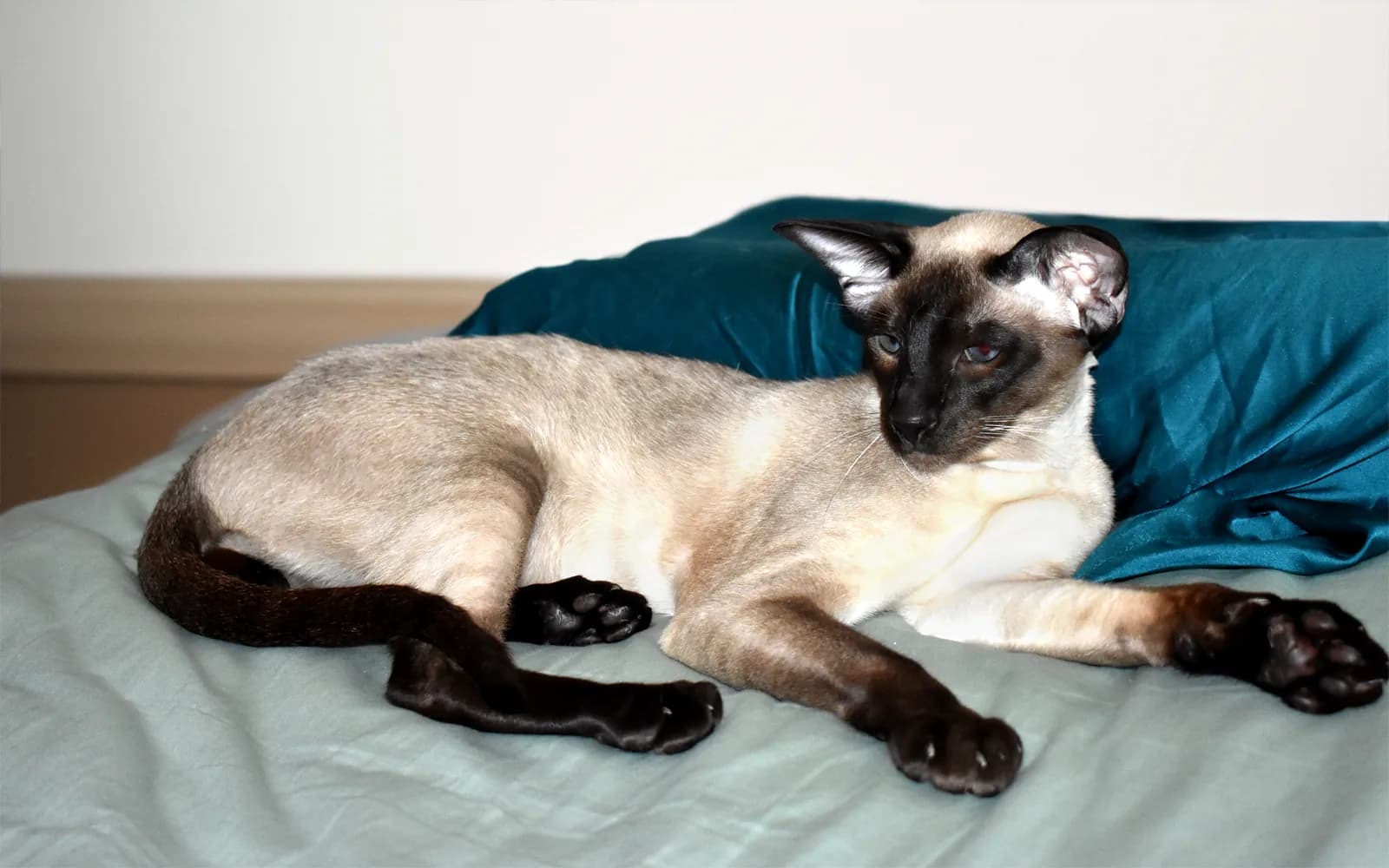
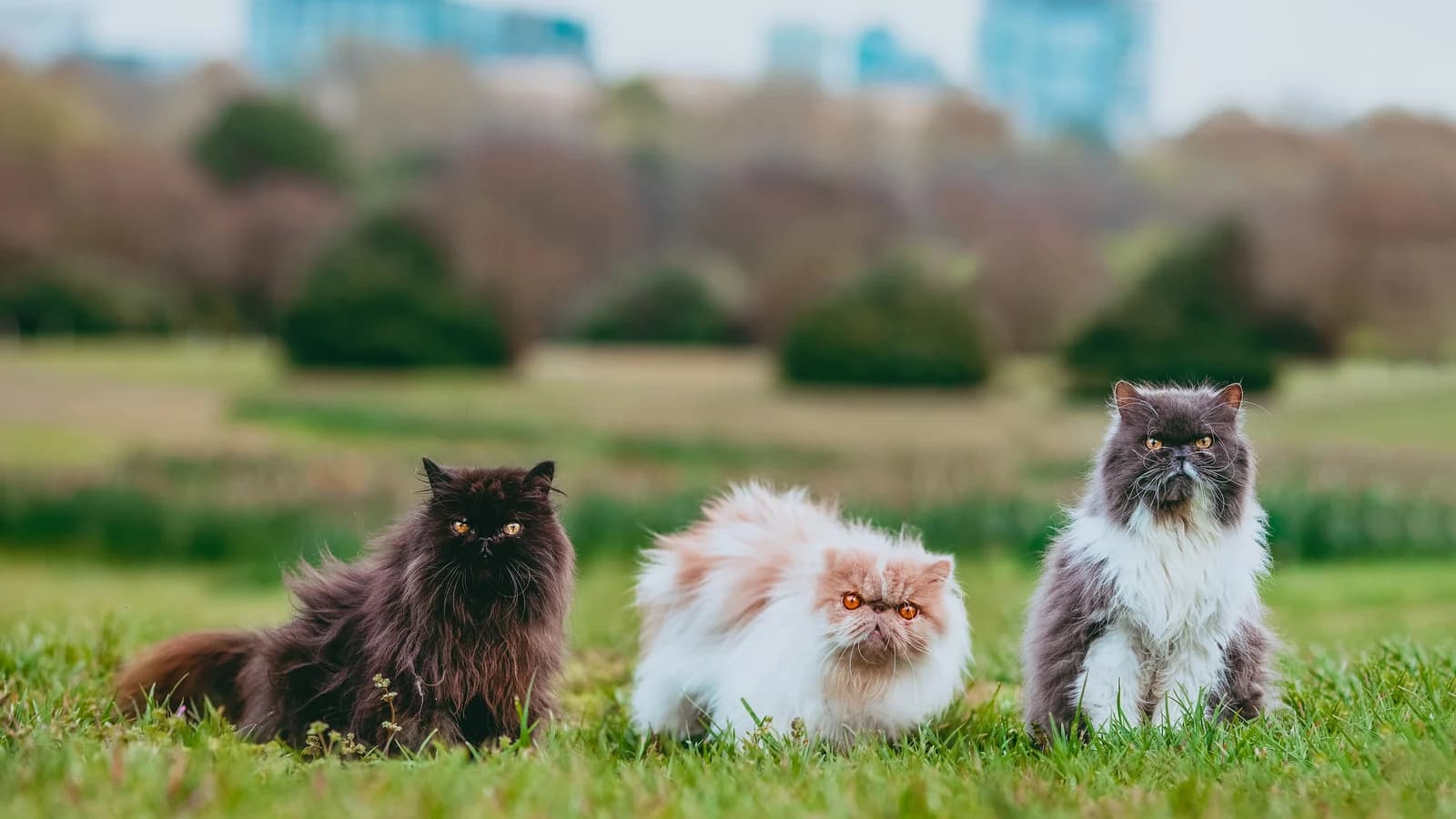
Our criteria-based guides, to compare this breed with the ones most like it.
 Grooming & living with one
Grooming
One brush a week with soft bristles or a comb. , , and give the same figure independently, the most consistent number in our research. Expect heavier brushing at the spring and autumn molts, monthly nail trims per TICA, and bathing only on condition (CFA: not necessary unless you show). The "single-layer coat" story is marketing: the standards themselves tolerate a light "mousy undercoat." Details: the shedding guide.
Living together
The measured picture beats the folklore in both directions. In 5,726 Finnish cats, the Bengal ranked among the most active breeds AND showed no higher aggression toward family or strangers than house cats, while scoring shyer toward strangers than about half the breeds compared. Cat-to-cat friction ran higher than several placid breeds (Maine Coon, Ragdoll, Persian) in the same data, so introductions deserve patience. With respectful children the athleticism is a feature. With a busy, noisy household, the measured shyness is worth planning around: escape routes, high perches, no forced greetings.
 Food & diet
's own feeding paragraph: high-quality, protein-proper diet, watch weight after neutering, avoid free feeding, and "Bengals also do well on a raw diet." Publish the other side beside it, attributed: Cornell and advise against raw feeding, citing contamination documented in a 2025 Cornell study of commercial raw cat foods. The arithmetic: resting energy for a 5 kg Bengal is about 234 kcal/day, adjusted by body condition with your vet. TICA also notes Bengals are "commonly misdiagnose[d]" with IBD when parasites or diet are the real issue. A young Bengal's diarrhea that does not clear quickly is a vet call, not a wait.
 Price & budget
$1,400 to 4,000
Price of a kitten from a registered breeder, in the United States
This price reflects the quality of the breeding program: parents' health tests, registry pedigree, socialization. A very low price should raise a red flag. The real cost, though, plays out over the years.
Find a verified Bengal breederKitten price, by market
United States
$1,400 to 4,000
United Kingdom
£950 to 2,000
Canada
CA$700 to 2,500
Australia
A$3,000 to 3,500
Each figure is that country's real market price, researched separately, not a conversion of the others. The smaller line is only there so you can gauge one against your own money: European Central Bank reference rates of 2026-09-18, refreshed daily.
The Bengal in the US, UK, Canada and Australia
| Measure | United States | United Kingdom | Canada | Australia |
|---|---|---|---|---|
| Pet-quality kitten (registered breeder) | $1,400-4,000 (six named catteries) | £950-2,000 registered (live marketplace sample) | CA$700-2,500 (5 catteries, 3 provinces) | A$3,000-3,500, desexed (3 catteries, 3 states) |
| Main registries | TICA (since 1986), CFA (since 2016) | GCCF (since 1997) | CCA-AFC, TICA | ACF-federated bodies, ANCATS |
| DNA testing required | Breeder practice: PRA-b + PK-def, ask for results | GCCF mandate since June 2016: PRA-b + PK-def normal for the Active Register | Breeder practice: ask for results | Breeder practice: ask for results |
| Legal status | No federal ban; Hawaii bans the cross, NY State exempts F5+ registered, NYC's code has no exemption in its text | GB: F2+ needs no licence (F1 does); NI guidance requires a licence for all Bengals | Quebec: morphology test; Alberta: F4+ per official correspondence; Toronto/BC codes silent on hybrids | Imports closed 1 March 2025; resident cats under ordinary cat law |
| Popularity, each registry's own words | Not in CFA's top 10 (three editions checked); TICA's most-registered breed since 1993 by its own history | 21st at GCCF: 86 registrations in 2025 | No registry ranking exists | No registry ranking exists |
Four markets, four registries, four legal regimes; none of these figures converts into another. Prices are August 2026 and expire with the quarter.
Work out your food budget
Type of food
Estimated monthly budget
$15
≈ 2.6 oz (74 g) per day
A ballpark figure, food only, using the same arithmetic as our portion tool (resting energy requirement × 1.2, a neutered adult). Real needs vary with age, activity level and body condition. Ask your veterinarian for advice.
 Verified Bengal catteriesThe registry-checked directory, plus a kitten alert near you
 Should you insure a Bengal?
Our sources list several predispositions in the Bengal: Progressive retinal atrophy (PRA-b), Pyruvate kinase (PK) deficiency, Hypertrophic cardiomyopathy (HCM): no DNA test exists, among others. A predisposition is not a foregone conclusion, and many of these cats live their whole lives without ever developing anything. It does change the nature of the follow-up, though: you monitor, sometimes for life, and it's that monitoring that weighs on a budget, more than a one-off accident.
One thing to weigh before deciding: this is a cat you will live alongside for well over a decade, and that is the span the real cost is spread across, premiums and care alike. Where a breed has a measured life expectancy that differs from the figure usually quoted, we say so in the lifespan section above rather than repeating the quoted one here.
 Bengal cats in our community
No Bengal here yet
Got one? Add a photo and yours gets to open this page.
 The vet's take

Veterinary review
Are you a vet?
Your professional read belongs here: every verified practitioner can leave a note, published once our editors have reviewed it.
Sign in and get your license number verified. We check it in the public register, we never ask for or keep a copy of your diploma, and your number is never published.
 Frequently asked questions
+How much is a Bengal cat?
From named breeders, August 2026: roughly $1,400 to $4,000 US pet tier across six catteries, £950 to £2,000 registered on UK live listings, CA$700 to CA$2,500 across five Canadian catteries, and A$3,000 to A$3,500 in Australia, desexed before sale. Breeding rights run two to three times the pet tier everywhere; no figure converts into another, and a kitten far below your market's floor is a question, not a bargain.
+Are Bengal cats hypoallergenic?
No. All cats produce the Fel d 1 allergen, no study has ever measured it in Bengals, and the peer-reviewed reviews state plainly that no data supports any breed's hypoallergenic claim. What is true: the breed sheds comparatively little, which some allergic households report as easier to live with. Spend time with the specific cat before committing.
+Why are Bengal cats illegal in some places?
Because of the leopard cat ancestry, and the tests differ by jurisdiction: Hawaii bans the cross by name at any generation, New York State exempts registered cats five generations out while New York City's Health Code carries no exemption in its text, Great Britain licenses only the F1, Northern Ireland's guidance licenses them all, and Australia closed imports on 1 March 2025. There is no US federal ban.
+How big do Bengal cats get?
TICA's consumer ranges run about 6 to 12 lb (2.7-5.4 kg) for females and 9 to 15 lb (4.1-6.8 kg) for males. The largest measured sample, 3,484 screened Bengals, has a median of 4.0 kg (8.8 lb), the average pet cat's weight: the breed looks bigger than it weighs. Full size arrives around age two.
+How long do Bengal cats live?
Measured in the UK: life expectancy at birth of 8.51 years (73 deaths, 2019 data), with an earlier median of 7.3 years; a Swedish insured population pointed the opposite way with a very wide confidence interval. The 12 to 16 years quoted everywhere is a commonly cited estimate with no measured study behind it. Individual Bengals in the same data lived past 21.
+Do Bengal cats shed?
Lightly, by every source read: CFA's own words are "does not shed heavily, especially in comparison to other shorthair breeds," and Cats Protection lists the Bengal among low-shedding breeds while noting no cat is non-shedding. One brush a week, heavier at the season turns.
+Are Bengal cats good pets?
For the right home, measurably yes: the studies rank them among the most active breeds with no elevated aggression toward people. They need climbing space, real play and engagement; the same data measures them shyer with strangers than about half the breeds compared, so a calm introduction culture helps.
+Are Bengal cats dangerous or aggressive?
Measured, no: in 5,726 cats, Bengals were not significantly more aggressive toward family or strangers than ordinary house cats, and less aggressive toward strangers than the most aggressive breeds in the table. Cat-to-cat friction ran somewhat higher than several placid breeds; slow introductions matter.
+What is a Bengal cat mixed with?
The breed descends from the Asian leopard cat crossed into domestic cats, with Egyptian Mau, Abyssinian, Burmese and other named breeds in its foundation. The modern breed carries a measured mean of 3.48% leopard cat DNA. Today TICA permits no outcross at all, and GCCF permits exactly one: a DNA-cleared Abyssinian program, since February 2026.
+Can Bengal cats go outside?
No registry mandates indoor life. What the documents say: GCCF describes harness training as workable for the breed, many breeders contract for indoor-only or enclosure homes, and parts of Australia require cat containment for every breed. The energy budget makes a catio or harness habit the honest middle ground.
+Is a Bengal cat legal in Australia?
Owning one already in the country: yes, under ordinary companion-animal rules. Importing one: no, since 1 March 2025, when the five-generation import exemption ended pending a Live Import List decision; the public consultation on that application closed in October 2025.
 Community questions
Got a question this page doesn't cover? Ask it: the best ones get published here with their answer.
Sources & references
Data checked against reference sources (TICA and CFA standards, genetics laboratories, veterinary schools).
- TICA: Bengal breed
- TICA Bengal Breed Group standard (PDF)
- CFA: Bengal
- GCCF: Bengal breed page
- GCCF Bengal Registration Policy, Feb 2026 (the DNA-testing mandate)
- Salonen et al. 2019, breed behaviour study (5,726 cats)
- Mikkola et al. 2021, feline behaviour traits study
- Teng et al. 2024, VetCompass life tables (the 8.51-year figure)
- O'Neill et al. 2015, English primary-care mortality study
- Häggström et al. 2025, the 56,169-cat bodyweight comparison
- Kaelin et al. 2024, Bengal ancestry and trait selection (947 genomes)
- Gershony et al. 2014, the charcoal ASIP study (148 Bengals)
- Grahn et al. 2012, PK-deficiency carrier survey
- Langford Vets: Bengal PRA-b test and carrier data
- AAFP position statement: hybrid cats (2017)

Worth keeping a paw on
Pin this profile
To compare later, or to show someone still torn between two breeds. One click and it sits in your board.
Pin it on Pinterest
 Purr or Pass
Still deciding? Find the perfect breed for your home.
A quick quiz that factors in your lifestyle, your kids and your other pets.
Which breed fits my home?Keep exploring
The floor belongs to our members. Keep it kind, links are not allowed, and images go through moderation before anyone else sees them.