

Australian Mist
“Dr Straede's people-centered indoor cat, misted in seven colors”
 By Priya · The careful one
Published August 21, 2026Updated August 26, 20268 min read
Contents
 Australian Mist photos
Real photos, so you can see what the breed actually looks like: coats, ear tufts, ruff and build.
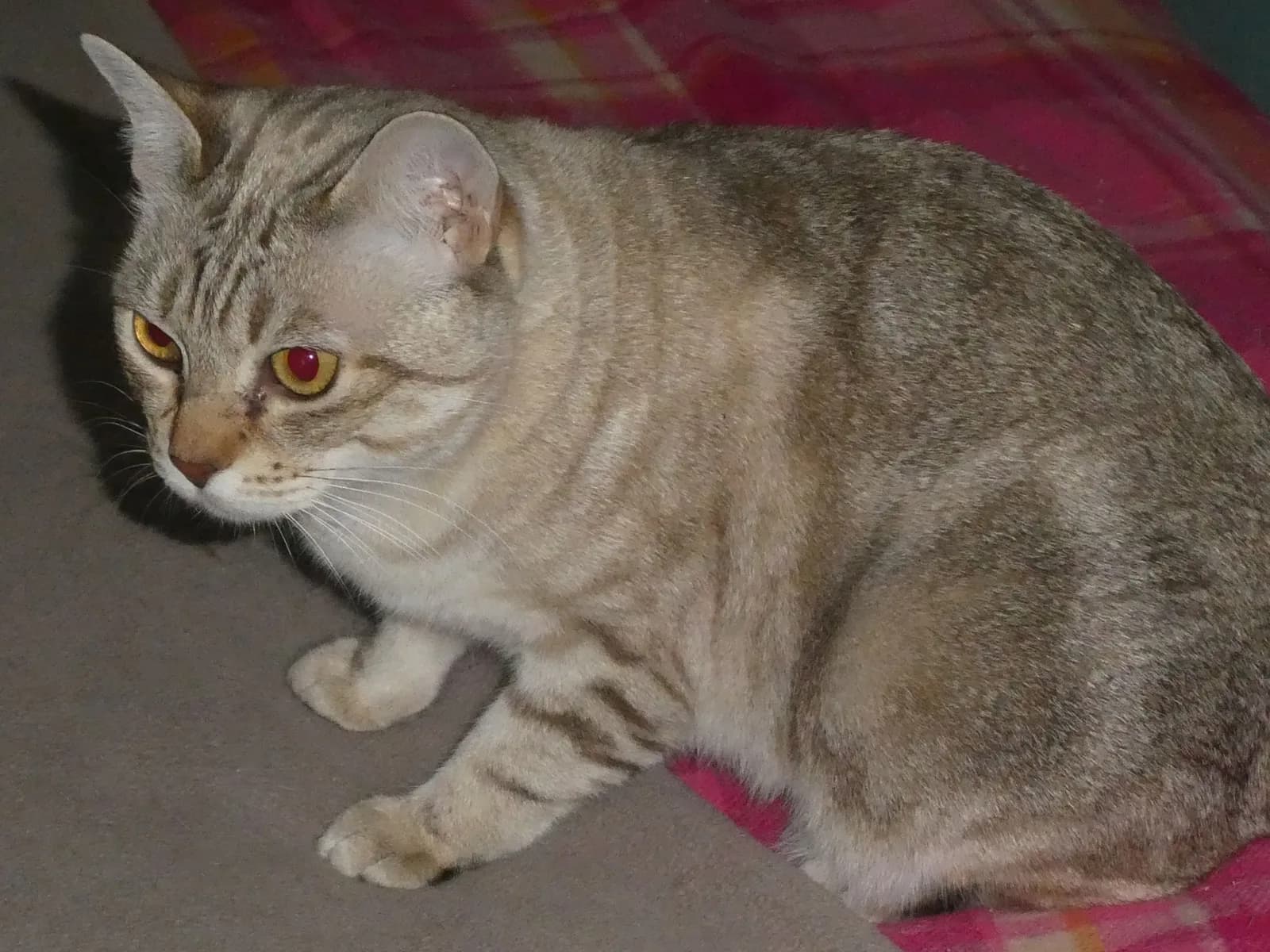
Chocolate marbled Australian Mist resting on a pink blanket, the misted veil over the pattern
Photo: Dr Truda Straede · CC0 · via Wikimedia Commons
Got an Australian Mist? Share them with the community. Photos from our members round out this page.
 Vital stats
Origin
One of the best-documented founding stories in the fancy, from the founder's own pages. Dr Truda Straede began the program in 1977 after RASCC approval. The first kittens were born in January 1980, and the breed reached full register status in April 1986 (independently corroborated by ' own '1986' recognition line). The founding ratio is confirmed word for word by two separate sources: half Burmese, a quarter Abyssinian, a quarter Domestic. Originally the 'Spotted Mist', renamed Australian Mist in 1998 when the marbled pattern joined the spotted. International recognition is reported as WCF in August 2004 and on 1 May 2014.
Weight
Female
8-15 lb (3.6-6.8 kg)
Male
8-15 lb (3.6-6.8 kg)
Life expectancy
12 to 18 years is the full spread of six unsourced editorial figures, and no measured study exists (four flagship cohort papers checked directly, zero mentions). 's own page contradicts itself ('15+' in its box, '15-18' in its text: both stated here). says 15-18. The two Australian consumer sources sit lower, at 12-15. The spread is the honest figure.
Coats
Brown spotted (the classic)
Blue
Gold (cinnamon)
Peach (fawn)
Three full scored standards (, , ) converge on SEVEN colors, independently worded three times: brown, blue, chocolate, lilac, cinnamon/gold, fawn/peach and caramel (in three genetic renderings), each in TWO patterns, spotted and marbled. The 'misted' veil is described by GCCF's own SOP as ' invasion of the overlying darker pattern'. That is a phenotypic description, because no source anywhere names a specific gene for it, an absence we state rather than fill. Full adult color is not reached until around two years, a three-registry convergence. The breed began as the 'Spotted Mist' and was renamed Australian Mist in 1998, when the marbled pattern was accepted.
Understanding the coats (and their genetics)Size
None of the three full judging standards (TICA, GCCF, ACF) gives a numeric weight, length or height anywhere in the scored text. All three size this breed in words only ('medium-sized', 'heavier than it appears'). The 8-15 lb (4-7 kg) range shown here traces to GCCF's consumer-facing page, not its scored standard. The consumer boxes that repeat it appear to echo GCCF rather than measure anything. It is the best-anchored figure available, labeled for what it is.
Did you know
The breed's founder still breeds it. Nintu Cattery, whose published kitten price anchors our price page, is Dr Truda Straede's own operation, nearly fifty years after she crossed the first Burmese, Abyssinian and domestic cats in 1977. And the photos on this page are the founder's own, released to the public domain.
 Personality
 Affection5/5
 Energy3/5
 Intelligence4/5
 Friendliness5/5
 Independence2/5
 Vocal2/5
 Shedding1/5
Compatibility
 Good with children5/5
 Good with other pets4/5
 Apartment friendly5/5
Editorial ratings on our five-point scale, anchored in the registry descriptions and the measured behaviour studies cited on this profile; individual cats vary, and our members' own ratings below are the counterweight.
Still torn between this breed and another?Compare the Australian Mist trait by trait, or filter every breed by what matters to you. What our members say
What our members say
Nobody has described their Australian Mist here yet. As soon as the first profiles come in, this is where the community averages will show up: temperament, food, lifestyle.
Describe my Australian Mist Pros & cons
Strong points
- An indoor-suited temperament that is the breed's own documented design goal, in the founder's words
- Easy-care, low-shedding misted coat in seven colors and two patterns, by three converging standards
- A test-heavy breeding culture: GCCF's ancestry-conditional DNA scheme is written into the breed's rules
- One of the fancy's best-documented founding stories, with a live founder still breeding
Things to consider
- Genuinely hard to buy: two numbered catteries in Australia, a stale UK list, no confirmed US cattery, a closed Canada
- No measured weight, lifespan or behaviour study includes the breed: every figure on this page is labeled opinion or consumer-range
- Full adult color takes about two years: the kitten you choose is not the coat you will live with
- CFA and FIFe do not recognize the breed, which limits showing outside its recognized registries
 Is an Australian Mist right for you?
A household looking for an affectionate, adaptable, genuinely indoor-suited companion, and willing to do the one hard part: finding one. Expect a two-cattery numbered market at home in Australia. The UK route starts with emailing a breed club, and everywhere else it is an import project.
Is the Australian Mist right for YOUR home?
Answer a few questions and we'll email you your personalized result.
Take the quiz · 2 min Getting to know the Australian Mist
This breed's story is its founder's own words, and we quote them rather than paraphrase. Dr Truda Straede designed the Australian Mist from 1977 as, in her own sentence, 'a people centred indoor cat': half Burmese temperament base, a quarter Abyssinian ticking, a quarter domestic vigour, a ratio two of her own pages confirm word for word. The misted coat comes in seven colors and two patterns, by three registries' converging standards. 's own phenotypic description ( invasion) stands in for the gene no source names.
The sharpest institutional finding is the outcross split. and both close the register ('Allowable outcross: none'), while alone keeps it open to named Abyssinian, Burmese and Domestic Shorthair colors, with its stated reason that the gene pool still needs width: three current registry rules, reported as written.
The market is inverted. Australia is the only country with live numbered prices, and our price page maps the three different shapes of everywhere else's emptiness. One correction to the internet while we are here: the claim that this breed is 'not yet recognized by cat fancier organizations' is false. Six of nine World Cat Congress member bodies recognize it, and we read their standards.
 Health: what to watch for
A few predispositions are well documented. The good news: they can be screened for or avoided by choosing a reputable breeder and keeping an eye on the right signals.
This is information, not veterinary advice, and it cannot tell you what is wrong with your cat. Our rule is a simple one: if something is wrong with your cat, call your vet, and call an emergency clinic if it is out of hours. Nothing you read here is a reason to wait.
GCCF's ancestry-conditional testing scheme (the structural fact)
MEDIUMGCCF runs a genuinely breed-specific mandatory DNA-testing scheme whose logic follows the founding ratio. Burmese ancestry within 5 generations triggers testing for hypokalaemic polymyopathy, the Burmese head defect gene and Burmese gangliosidosis. Abyssinian ancestry within 5 generations triggers PRA testing. PK deficiency and the longhair gene are tested regardless of ancestry. The conditionality is the point: ask a breeder which tests applied to THEIR lines, and for the results.
PK deficiency: a testing consideration, never a rate
MEDIUMThree data points that sit alongside each other, none cancelling another. GCCF's own breeding policy states testing has found one PK-deficiency carrier in the breed (no denominator given). One academic sample found 0 of 27 UK Australian Mists carrying the allele (Grahn 2012). Another found 0 of 2 for the Burmese hypokalaemia allele (Gandolfi 2012). Small convenience samples and one undated carrier: a reason to see test results, not a prevalence.
Blood groups A and B: the NI risk named by GCCF itself
MEDIUMBoth A and B blood groups are present in the Australian Mist population, a documented neonatal isoerythrolysis risk GCCF's own text names directly. It is a breeding-pair fact (and a transfusion fact) rather than an owner's daily worry. And it is one more reason the breed's paperwork culture is test-heavy.
The missing literature, stated plainly
LOWNo dedicated peer-reviewed health study of the Australian Mist exists anywhere. Our PubMed sweep ran three independent ways (both surname spellings included) and found zero. What exists are rows inside multi-breed genetics papers, reported above at their true size. For your own cat, the usual rule: anything wrong means your vet, out of hours an emergency clinic.
Go deeper on health
Prevention, warning symptoms, costs and insurance: our guides, researched and sourced.
Also worth a look
Minuet
“The Napoleon: a Persian's face on a Munchkin's legs, renamed but never quite”
Dragon Li
“China's own landrace tabby: a real breed with no Western registry left”
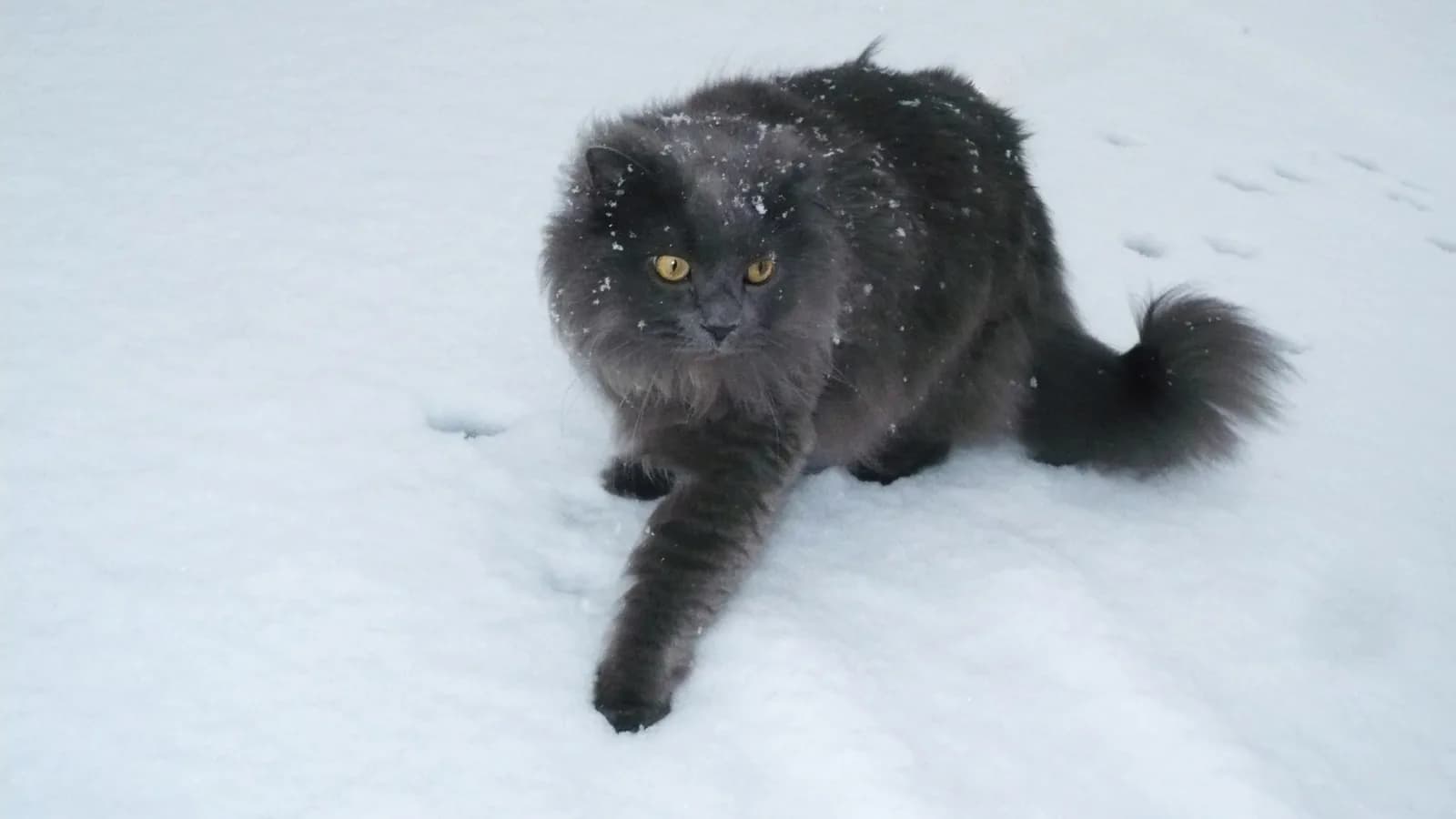
Chantilly-Tiffany
“The chocolate longhair that ran out of cats: a history, not a listing”
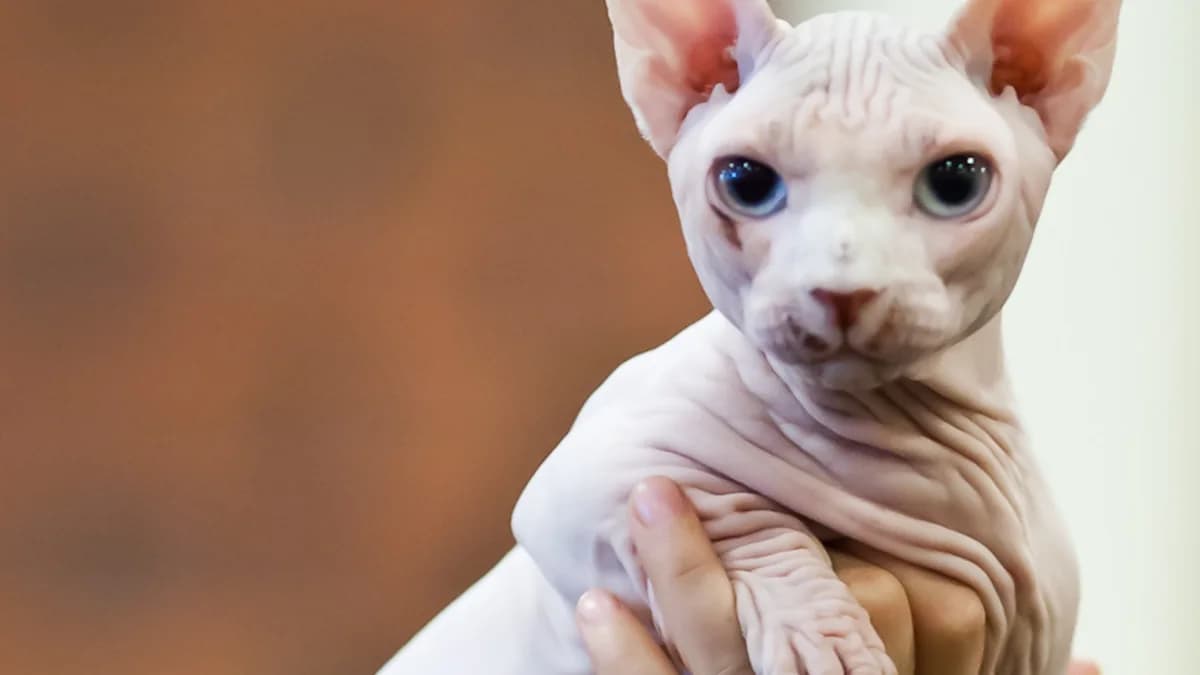
Bambino
“The Sphynx x Munchkin cross with more registry history than registry recognition”
 Grooming & living with one
Grooming
Short, glossy and genuinely low-maintenance. The standard and four Australian sources agree on an easy-care, low-shedding coat needing only a weekly once-over. No hypoallergenic claim or measurement exists anywhere for this breed. So the flat line holds: no cat, including this one, is hypoallergenic.
Living together
The six-source portrait is a family cat: sociable, playful, good with children and other pets, attributed as registry and brand opinion since no measured study includes the breed. Its indoor suitability is the breed's own design story, told in three attributed voices on this page. That makes the Mist one of the easier breeds to keep well in an apartment.
 Food & diet
No breed-specific feeding literature or registry nutrition guidance exists. The standards are judging documents and say so by their silence, which we report rather than fill. General life-stage feeding with portion control applies, set with your vet. The two-year color maturity is a reminder that this breed finishes slowly. Nothing here is a prescription for a specific cat.
 Should you insure an Australian Mist?
Our sources list several predispositions in the Australian Mist: GCCF's ancestry-conditional testing scheme (the structural fact), PK deficiency: a testing consideration, never a rate, Blood groups A and B: the NI risk named by GCCF itself, among others. A predisposition is not a foregone conclusion, and many of these cats live their whole lives without ever developing anything. It does change the nature of the follow-up, though: you monitor, sometimes for life, and it's that monitoring that weighs on a budget, more than a one-off accident.
One thing to weigh before deciding: this is a cat you will live alongside for well over a decade, and that is the span the real cost is spread across, premiums and care alike. Where a breed has a measured life expectancy that differs from the figure usually quoted, we say so in the lifespan section above rather than repeating the quoted one here.
 Australian Mist cats in our community
This breed is barely covered by free photo libraries: we only found 3 photos we could verify. Your cats are especially welcome here.
No Australian Mist here yet
Got one? Add a photo and yours gets to open this page.
 The vet's take

Veterinary review
Are you a vet?
Your professional read belongs here: every verified practitioner can leave a note, published once our editors have reviewed it.
Sign in and get your license number verified. We check it in the public register, we never ask for or keep a copy of your diploma, and your number is never published.
 Frequently asked questions
+What is an Australian Mist cat?
A breed developed in Australia by Dr Truda Straede from 1977: half Burmese, a quarter Abyssinian, a quarter domestic, bred deliberately as a people-centered indoor companion. Its 'misted' coat comes in seven colors and two patterns (spotted and marbled), and it reached full register status in April 1986.
+Are Australian Mist cats hypoallergenic?
No, and no source even claims it: our research found zero hypoallergenic claims or Fel d 1 measurements for this breed anywhere. The coat is low-shedding and easy-care, which is a different thing from low-allergen.
+Do Australian Mist cats shed?
Less than most: the coat is short, glossy and consistently described as low-shedding and easy-care across the ACF standard and four Australian sources. A weekly once-over covers the grooming.
+How big do Australian Mists get?
The honest answer is that no scored judging standard gives a number: all three describe a medium-sized cat that is 'heavier than it appears'. GCCF's consumer page offers 8-15 lb (4-7 kg), the best-anchored range available, and the consumer boxes that repeat it appear to echo GCCF rather than measure.
+How long do Australian Mist cats live?
No measured study includes the breed, so the honest figure is the spread: 12 to 18 years across six unsourced sources. TICA's own page says both '15+' and '15-18'; GCCF says 15-18; the Australian consumer sources sit lower at 12-15.
+How much does an Australian Mist cost?
The only live numbered prices are Australian: A$1,500-1,700 at the two catteries that publish figures, one of them the founder's own. No current UK, US or Canadian price exists; our price page maps each market's actual shape.
+Are Australian Mists indoor cats?
By design, per the founder's own words: 'the primary aim of the breed was to create a people centred indoor cat'. TICA adds (in TICA's voice alone) that indoor keeping protects native wildlife, and GCCF observes more softly that the breed is 'happy to live as indoor cats'. Three sources, three framings, all pointing the same way.
+What health problems do Australian Mists have?
No dedicated health study exists; what is documented is a testing culture: GCCF mandates DNA tests conditioned on Burmese or Abyssinian ancestry within five generations, plus PK deficiency and longhair testing for all. One PK carrier has been found in the breed (no denominator); both A and B blood groups exist in the population. Ask breeders for their lines' results.
+When was the Australian Mist recognized as a breed?
Full register status came in April 1986 (corroborated by ANCATS' own recognition line). Internationally, recognition is reported as WCF in August 2004 and TICA on 1 May 2014. Six of nine World Cat Congress member bodies recognize it today; CFA, FIFe and SACC do not.
+Was the Australian Mist called something else before?
Yes: it began as the 'Spotted Mist' and was renamed Australian Mist in 1998 when the marbled pattern was accepted alongside the spotted, a change three primary sources confirm independently.
 Community questions
Got a question this page doesn't cover? Ask it: the best ones get published here with their answer.
Sources & references
Data checked against reference sources (TICA and CFA standards, genetics laboratories, veterinary schools).
- Nintu Cattery / australianmist.net (Dr Truda Straede): the founder's own history, aims and current kittens
- TICA: Australian Mist breed page
- GCCF: Australian Mist breed page (the consumer weight range, the indoor framing)
- GCCF: Australian Mist Standard of Points (the 'agouti invasion' misted-effect description)
- GCCF: Australian Mist Breeding Policy (the ancestry-conditional testing scheme, the PK carrier, the blood groups)
- GCCF: Australian Mist Registration Policy (the open outcross register and its stated reason)
- ACF: Australian Mist standard (the 'Allowable outcross: none' line)
- Grahn et al. 2012, BMC Vet Res: PK deficiency across breeds, the Australian Mist (UK) n=27, 0% row (PMID 23110753)
- Gandolfi et al. 2012, PLoS One: the WNK4 hypokalaemia model, the Australian Mist n=2, 0% supplementary row (PMID 23285264)

Worth keeping a paw on
Pin this profile
To compare later, or to show someone still torn between two breeds. One click and it sits in your board.
Pin it on Pinterest
 Purr or Pass
Still deciding? Find the perfect breed for your home.
A quick quiz that factors in your lifestyle, your kids and your other pets.
Which breed fits my home?Keep exploring
The floor belongs to our members. Keep it kind, links are not allowed, and images go through moderation before anyone else sees them.