

Bambino
“The Sphynx x Munchkin cross with more registry history than registry recognition”
 By Priya · The careful one
Published August 26, 20268 min read
Contents
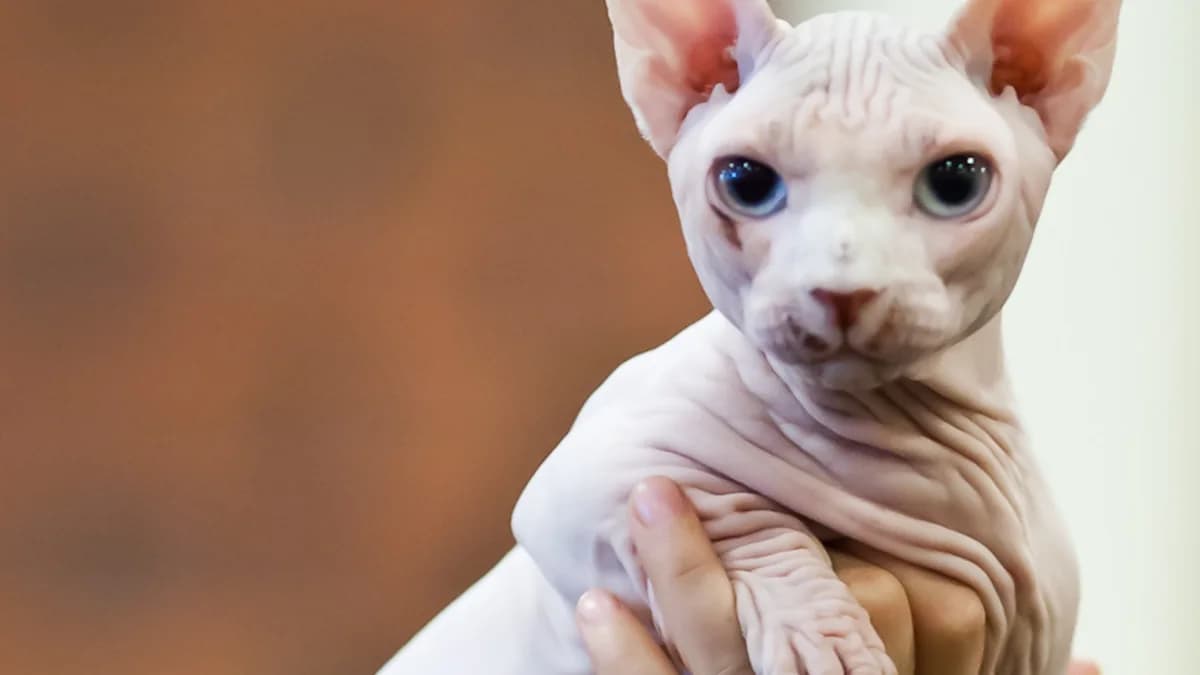
 Bambino photos
Real photos, so you can see what the breed actually looks like: coats, ear tufts, ruff and build.
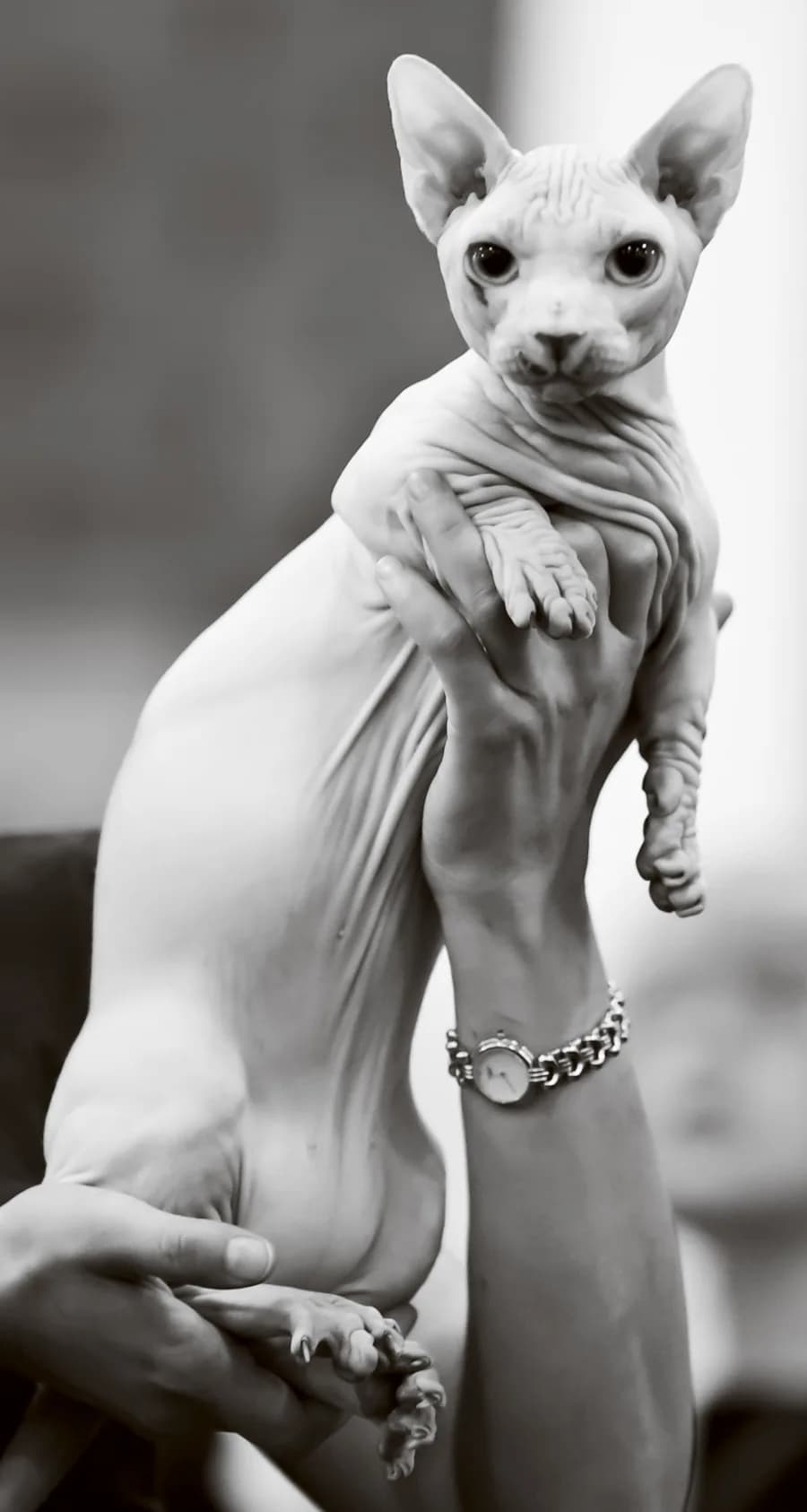
A Bambino cat held up for judging at a cat show, in black and white
Photo: Heikki Siltala / catza.net · CC BY 3.0 · via Wikimedia Commons
Got a Bambino? Share them with the community. Photos from our members round out this page.
 Vital stats
Origin
United States
Founded around 2005 by Pat and Stephanie Osborne at their Holy Moly Cattery in Arkansas, since defunct, and named from the Italian for baby for its small, kittenish build. The cross: Sphynx hairlessness (recessive) deliberately combined with Munchkin short legs (dominant), which is why litters typically contain both short- and long-legged kittens. tracked it as Experimental from 2005 or 2006 (the two circulating dates, each attributed to its source), until August 2025.
Coats
Pink-skinned white
Grey (blue) skin
Black skin
Tortie-patched skin
No major registry publishes a color standard, because none recognizes the breed. REFR's own standard, the only registry text there is, says the Bambino may come in all colors or patterns, and the parent Sphynx standards it borrows from exclude nothing either. As with the Sphynx, color on a hairless cat is read on skin pigment rather than a coat, which is why two of the commonest looks are pink-skinned white and grey.
Understanding the coats (and their genetics)Size
No registry publishes a weight figure for the Bambino, and no measured cohort exists; that absence is the finding, not a gap. A converging but unsourced cluster of nine pet-content sites states roughly 5 to 9 lb (2.3 to 4.1 kg), with no source named by any of them and no split by sex; we publish it as exactly that, popular convention. For scale, the parents' own registry boxes (their figures, never Bambino's): Sphynx 7-12 lb, Munchkin 5-10 lb.
Did you know
Wikipedia has no Bambino article: the URL redirects to a list of experimental breeds. The registry story on this page comes from 's own 2025 board minutes instead, a primary document most pages about this breed have never read.
 Personality
 Affection5/5
 Energy4/5
 Intelligence4/5
 Friendliness5/5
 Independence1/5
 Vocal3/5
 Shedding1/5
Compatibility
 Good with children4/5
 Good with other pets4/5
 Apartment friendly5/5
Editorial ratings on our five-point scale, anchored in the registry descriptions and the measured behaviour studies cited on this profile; individual cats vary, and our members' own ratings below are the counterweight.
Still torn between this breed and another?Compare the Bambino trait by trait, or filter every breed by what matters to you. What our members say
What our members say
Nobody has described their Bambino here yet. As soon as the first profiles come in, this is where the community averages will show up: temperament, food, lifestyle.
Describe my Bambino Pros & cons
Strong points
- A striking, affectionate, people-oriented companion by every account, with both parents' sociable portraits behind it
- This page's registry history is sourced from TICA's own board minutes, a story most competing pages cannot tell
- Mixed litters mean long-legged Bambinos exist: same cat, same care, without the dwarfism trait
Things to consider
- Two structural mutations in one cat, and the one commissioned expert assessment of the combination says the welfare risks stack
- No major registry recognizes the breed; the only papers available come from one small specialty registry
- The full Sphynx care load applies: weekly bathing, sun protection, indoor-only, and the parent breed's own measured health findings deserve reading before any deposit
 Is a Bambino right for you?
Someone who has read the health section first and still wants exactly this cat: an indoor home, a bathing and skin-care routine accepted as weekly life, money set aside for the vet follow-up the two traits invite, and no illusions about registry papers, since the only registration available is a small specialty registry's.
Is the Bambino right for YOUR home?
Answer a few questions and we'll email you your personalized result.
Take the quiz · 2 min Getting to know the Bambino
This breed's story is a registry paper trail, and this page tells it from the primary documents. tracked the Bambino as an Experimental breed for two decades, then a unanimous Board motion of 27-29 August 2025 terminated it, alongside eighteen other experimental breeds, citing TICA's own rule that breeds defined by a structural mutation must not be combined into a new breed. and never name the Bambino, and both state in their own general policies that they will not recognize a breed combining hairlessness with shortened limbs, each applying that reasoning to directly analogous named crosses; we quote the policies rather than putting the breed's name in their mouths. One small US specialty registry, REFR, recognizes it with a full standard.
The welfare question is the page's second spine: a Utrecht University expert declaration, commissioned by the Dutch regulator specifically about this cross, states that the risks of hairlessness and short legs stack across movement, thermoregulation and skin health, a reasoned expert opinion by named veterinary-faculty authors, not a clinical study, and we present it as exactly that.
The Netherlands now reaches this breed through two separate instruments, a 2014 breeding ban and a 2026 ownership ban; none of our four markets bans it, and a 2025 peer-reviewed welfare paper notes the Bambino has so far escaped the public attention its close relatives draw under the bully-cat name.
 Health: what to watch for
A few predispositions are well documented. The good news: they can be screened for or avoided by choosing a reputable breeder and keeping an eye on the right signals.
This is information, not veterinary advice, and it cannot tell you what is wrong with your cat. Our rule is a simple one: if something is wrong with your cat, call your vet, and call an emergency clinic if it is out of hours. Nothing you read here is a reason to wait.
The evidence base itself, stated once
MEDIUMNo peer-reviewed study of the Bambino cross exists anywhere we searched: every measured figure below belongs to a parent breed and is labeled with it. The one source addressing the combination directly is a Utrecht University expert declaration commissioned by the Dutch regulator: it states the two traits' welfare risks stack across movement, thermoregulation and skin health. That is a reasoned expert opinion by named veterinary-faculty authors, never a measured rate, and no source anywhere quantifies the combination.
The hairless half (Sphynx evidence)
HIGHMeasured in Sphynx cats, never in Bambinos: corneal sequestrum at 8 times the odds of other cats and entropion at 4 times, both diagnosed young; heavier skin-yeast colonisation; narrow temperature tolerance and real sunburn risk; and the UK's measured Sphynx life expectancy of 6.68 years, the shortest of the 12 breeds in that table. On the heart: the Sphynx ALMS1 gene finding has not replicated as a predictor in three later studies, so screening is by echocardiography, never a DNA test.
The short-legged half (Munchkin evidence)
MEDIUMThe UGDH mutation is dominant, and litters routinely contain both short- and long-legged kittens. What is measured is thin: one CT-scanned cat with elbow and wrist joint incongruity, and no arthritis or lameness rate ever published. The registries split three ways on the trait, TICA reassuring, GCCF and FIFe refusing and calling it a defect, and neither side cites a measured rate; the absence of that rate is the most honest sentence available.
What to observe, and when to call
MEDIUMEyes first, given the parent findings' young ages: a cloudy, watery, squinting or dark-spotted eye is a vet call. Reluctance to jump, a stiff gait, or pain on handling the limbs or spine is a veterinary orthopaedic question, never something to settle at home in either direction. Sun and cold exposure are management, not treatment: indoor life, warm resting spots, and a vet's advice before any sunscreen product, since none carries a cat-specific US safety approval.
Go deeper on health
Prevention, warning symptoms, costs and insurance: our guides, researched and sourced.
 Grooming & living with one
Grooming
The routine is the Sphynx's, inherited with the trait: bathing to manage the sebum bare skin cannot shed into a coat (with the registry's own caution that over-bathing rebounds into oilier skin), weekly ear checks, and strict sun care, since one veterinary source names the Bambino directly among the breeds at greatest sunburn risk. Indoor life is the standing recommendation of every Bambino-specific source we read.
Living together
The parent-derived picture, labeled as such: people-oriented and unlikely to do well left alone for long days, expected to get on with children and other pets per every consumer source (uncited, and consistent with both parents' own portraits). The practical constraints come from the body, not the temperament: an indoor-only life and warm resting places are non-negotiable.
 Food & diet
No feeding literature names this breed. Each parent carries its own unconfirmed folk claim, a hairless cat burns more calories, a short-legged cat needs closer weight care, and neither is backed by a measured study even in its own breed; we state both, attributed, and refuse to stack them into a Bambino rule. What applies is what applies to every cat: complete-and-balanced food for the life stage, portions from body condition rather than the bag.
 Price & budget
$2,400 to 3,500
Price of a kitten from a registered breeder, in the United States
This price reflects the quality of the breeding program: parents' health tests, registry pedigree, socialization. A very low price should raise a red flag. The real cost, though, plays out over the years.
Find a verified breederKitten price, by market
United States
$2,400 to 3,500
United Kingdom
£450 to 800
Canada
CA$800 to 2,200
Australia
A$3,500
Each figure is that country's real market price, researched separately, not a conversion of the others. The smaller line is only there so you can gauge one against your own money: European Central Bank reference rates of 2026-09-18, refreshed daily.
Work out your food budget
Type of food
Estimated monthly budget
$14
≈ 2.4 oz (68 g) per day
A ballpark figure, food only, using the same arithmetic as our portion tool (resting energy requirement × 1.2, a neutered adult). Real needs vary with age, activity level and body condition. Ask your veterinarian for advice.
 Verified catteriesThe registry-checked directory, plus a kitten alert near you. Filter it by breed.
 Should you insure a Bambino?
Our sources list several predispositions in the Bambino: The evidence base itself, stated once, The hairless half (Sphynx evidence), The short-legged half (Munchkin evidence), among others. A predisposition is not a foregone conclusion, and many of these cats live their whole lives without ever developing anything. It does change the nature of the follow-up, though: you monitor, sometimes for life, and it's that monitoring that weighs on a budget, more than a one-off accident.
 Bambino cats in our community
This breed is barely covered by free photo libraries: we only found 1 photos we could verify. Your cats are especially welcome here.
No Bambino here yet
Got one? Add a photo and yours gets to open this page.
 The vet's take

Veterinary review
Are you a vet?
Your professional read belongs here: every verified practitioner can leave a note, published once our editors have reviewed it.
Sign in and get your license number verified. We check it in the public register, we never ask for or keep a copy of your diploma, and your number is never published.
 Frequently asked questions
+Is the Bambino recognized by TICA?
Not anymore, and the history is precise: TICA tracked it as an Experimental breed from about 2005-2006, and a unanimous Board motion of 27-29 August 2025 terminated that status, citing TICA's rule that breeds defined by a structural mutation must not be combined into a new breed. Experimental status was tracking for statistics, never championship recognition. Today one small US specialty registry, REFR, recognizes the breed; CFA, GCCF, CCA-AFC, ACF, ANCATS and FIFe do not.
+Is it legal to own a Bambino cat?
In the US, UK, Canada and Australia, yes: no instrument in any of our four markets bans owning or breeding the cross, though Victoria's breeding code names the Munchkin's leg trait among heritable defects. The Netherlands, outside our markets, is the exception worth knowing as context: a 2014 breeding ban applies to the Bambino Sphynx by name in the regulator's guidance, and a separate 2026 ownership ban reaches any permanently hairless cat, with a transition for cats already microchipped.
+What is the difference between a Bambino and a Bully Cat?
Related, but not interchangeable. The bully cat or XL bully cat is described in a 2025 welfare paper as a similar Sphynx x Munchkin cross, and UK charity material describes cats under that name with a third trait, curled ears, closer to the three-way Dwelf cross. The recipes overlap substantially, the names do not map one-to-one, and the UK press attention since 2024 has run under the bully-cat name while, as the same paper notes, the Bambino has so far escaped it.
+How much does a Bambino kitten cost?
In the US, $2,400 to $3,500 at the four named catteries publishing their own rates, with marketplace listings from about $1,790 and one platform kitten at $5,390; Bambino prices above plain Sphynx wherever both are sold. In the UK and Canada we found no clean purebred price at all, only cross litters (roughly £450-800 and CA$800-2,200); in Australia, one cattery prices from A$3,500.
+Do Bambino cats have health problems?
The honest answer has three parts. The hairless half carries the Sphynx's measured findings: eye conditions at several times the odds of other cats, skin and temperature care for life, and a short measured lifespan in the parent breed. The short-legged half carries a documented mutation with no measured arthritis rate, in either direction. And the combination has never been studied; the one commissioned expert assessment says the risks stack, as reasoned opinion. Anything worrying on a specific cat is a vet call, not a page.
+Can Bambino cats jump?
Yes. Every source that actually addresses it, including the parent Munchkin's own registry text and one detailed owner account, describes jumping as adapted rather than absent: multi-step routes instead of single bounds. Whether the mechanics carry a long-term joint cost is a genuinely open question no study has measured, which is exactly how we state it.
 Community questions
Got a question this page doesn't cover? Ask it: the best ones get published here with their answer.
Sources & references
Data checked against reference sources (TICA and CFA standards, genetics laboratories, veterinary schools).
- TICA, 2025 Annual Meeting Minutes (Motion 8: the termination of 19 experimental breeds, Bambino named)
- TICA, Registration Rules, Version A, December 2025 (the structural-mutation rule; zero Bambino occurrences)
- GCCF, Breeding Policy 2015 (the no-recognition policy for shortened limbs and hairlessness, and the doubling warning)
- GCCF, unrecognised breeds (the Red Status entries for dwarf breeds and Sphynx crosses)
- FIFe, health and welfare rules (the dwarfism and hairlessness clauses, Munchkin named)
- REFR, the Bambino breed standard (the one registry that recognizes the breed)
- Utrecht University Faculty of Veterinary Medicine, expert declaration on breeding designer cats such as the Bambino Sphynx, 2018 (read in full)
- RVO (Dutch government), breeding with cats (the dedicated Bambino Sphynx section and video)
- Besluit houders van dieren (the Dutch breeding ban, art. 3.4, and the 2026 keeping ban, art. 3.33-3.36, statutory text)
- Roberts et al 2025, a framework to refocus the conversation around the welfare of UK purebred cats (the Bambino attention-gap observation), Animal Welfare 34
- Cats Protection, extreme traits: hairless cats (the five-breed list and the bully-cat description)
- BBC News, July 2025: Alfred, a rescued bambino cat, and the extreme-breeding warning
- The Guardian, October 2024, UK experts warn against buying XL bully cats (the same cross under the adjacent name)
- Sarfaty et al 2022, ocular findings in Sphynx cats (the corneal sequestrum and entropion odds ratios), Vet Ophthalmol 25
- Struck et al 2020, the UGDH short-leg variant in Munchkin cats (read by our Munchkin research), BMC Genetics 21
- Meurs et al 2021, the Sphynx ALMS1 HCM candidate variant, Orphanet J Rare Dis 16
- DutchNews.nl, 2019: the first NVWA warning to a Bambino Sphynx breeder
- Heikki Siltala / catza.net, the photographs on this page (CC BY 3.0, a registered Bambino at a TICA-umbrella show)

Worth keeping a paw on
Pin this profile
To compare later, or to show someone still torn between two breeds. One click and it sits in your board.
Pin it on Pinterest
 Purr or Pass
Still deciding? Find the perfect breed for your home.
A quick quiz that factors in your lifestyle, your kids and your other pets.
Which breed fits my home?Keep exploring
The floor belongs to our members. Keep it kind, links are not allowed, and images go through moderation before anyone else sees them.