

Why Does My Cat Lick Me? The Science of the Sandpaper Kiss
Being licked is mostly a compliment: bonding, shared scent and the salt on your skin. What grooming really negotiates between cats, and the one moment a lick should actually worry you.
Published August 28, 2026Updated September 8, 2026 7 min read
Contents
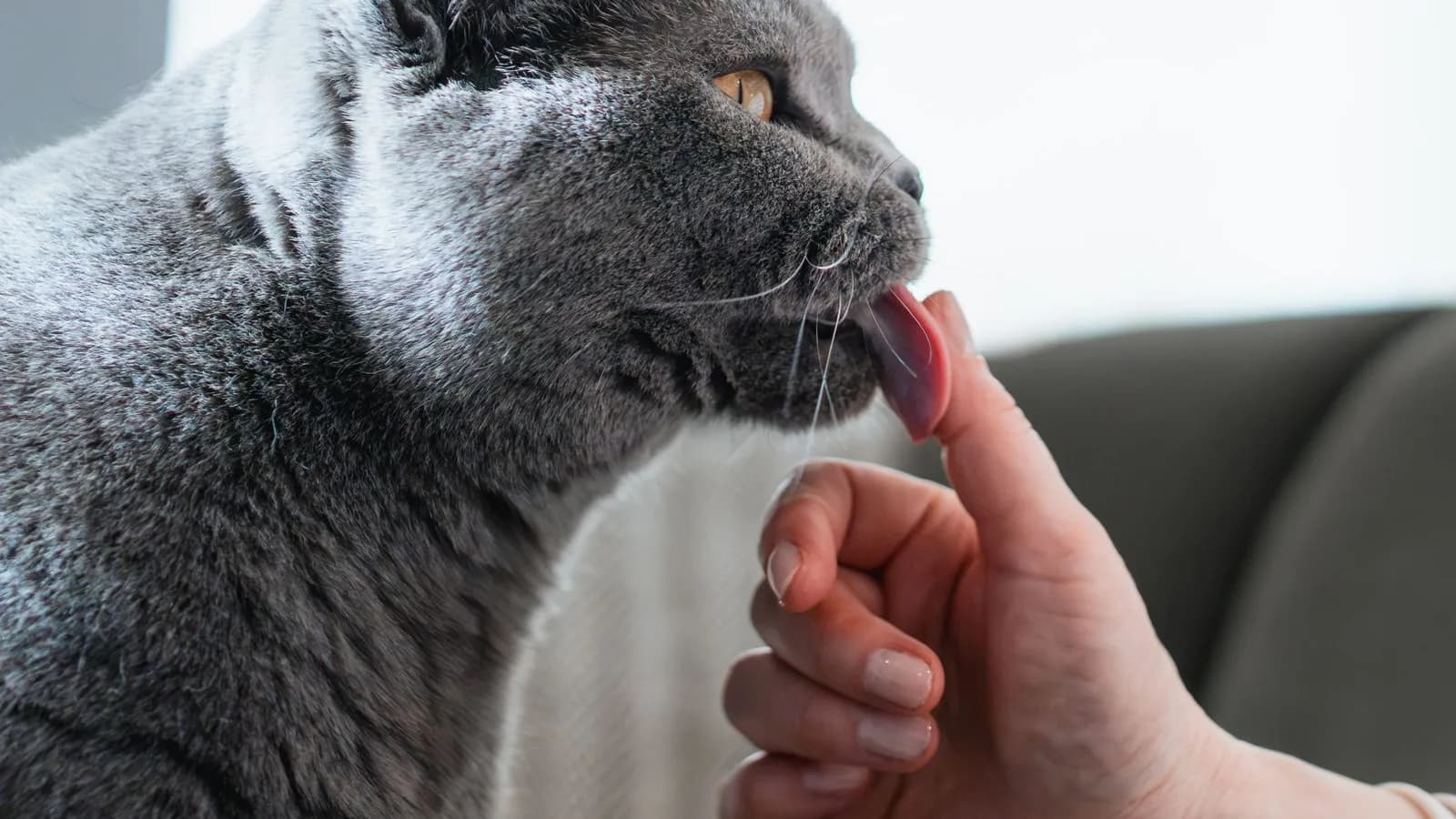
Let us settle the important part first: if a cat licks you, you have been noticed by management. Cats do not hand out tongue time to furniture. Veterinary behaviorists file licking a person under , the friendly kind, the same category as grooming a littermate: your cat is maintaining a relationship it considers worth maintaining. I do it myself, sparingly, for staff who perform well. The science behind the habit is better than the internet's usual shrug, and it runs from nursing memories to colony politics to the chemistry of your own skin. It also comes with exactly one situation worth taking seriously, which we will get to calmly, near the end, after the flattery.
A compliment, delivered by tongue
The habit starts at day one. A mother cat bathes her kittens from birth, licking them clean, and grooming stays wired to comfort and family for the rest of a cat's life. Veterinarians describe adult cats grooming the people they live with as an extension of that early bond: it strengthens social ties and spreads a shared, familiar scent through the household, a kind of ongoing group membership renewal. In plainer terms, you smell like family, and your cat intends to keep it that way.
Some cats add the full nostalgia package: settling on your lap, kneading with their front paws, and licking you or the blanket at the same time. The kneading half is well documented as a nursing behavior that adult cats keep for comfort. Cats that knead often lick at the same time, which fits the same nursing-memory explanation, though nobody has run a study on the combo itself.
You are also, frankly, delicious
Affection is not the only motive, and a cat would want you to know that. Human sweat leaves salt residue on your skin, sodium, chloride and potassium, and cats can taste and smell what your workout left behind. Your skin also carries whatever you rubbed onto it: veterinary behaviorists note that an appetizing lotion, shampoo or other topical product is reason enough for a thorough investigation. So a dedicated evening licking session may be devotion, or it may be that your moisturizer smells fascinating. A cat sees no reason to pick one.
One precision our own cat tongue guide insists on: cats cannot taste sweetness at all, the receptor gene is broken in the whole cat family. Whatever your skin has going for it, it is the salt and the smells, never the sugar.
That guide also explains why the kiss exfoliates. A cat's tongue is covered in hundreds of backward-facing spines, and a 2018 study showed each one is a hollow scoop that wicks saliva into fur in under a tenth of a second. It is precision grooming hardware, built for pelts, and your bare arm gets the industrial treatment.
Cats groom each other too, and it is not just cuddling
Here is where the science gets properly interesting. The classic study on cat-to-cat grooming, called , watched a colony of 25 neutered cats for six months, 83 grooming interactions on video. The findings do not read like a greeting card. Grooming overwhelmingly targeted the head and neck. It almost never flowed both ways: 91.6 percent of interactions were strictly one cat grooming another. And it tracked the pecking order: in pairs with a clear rank difference, the higher-ranking cat did the grooming in 78.6 percent of them, not the other way around.
The study's conclusion is that lets cats redirect tension that would otherwise become a fight, keeping the group livable while still building short-term and long-term bonds. Diplomacy and affection, delivered by the same tongue. A 2026 video study of cats living in two-cat households reads as an update rather than a reversal: grooming happens in two contexts, genuine bonding and social tension, and you can often tell them apart by posture. Cats lying or sitting in sync, trading licks around the head and ears, are bonding. Flattened ears, head shaking or a paw swipe mid-groom point the other way.
So when your cat grooms you, which reading applies? You are not competing for their spot on the sofa, you feed them, and you are family-scented. For a relaxed cat licking a relaxed human, the reading is the honest default.

Priya · Health desk
A footnote from the health desk before anyone frames this as pure romance. In the 1998 colony study, 91.6 percent of grooming interactions went one way, the higher-ranking cat did the grooming in 78.6 percent of unequal pairs, and about a third of sessions included some aggression, mostly from the groomer. Affection and diplomacy share a tongue.
Cookie · Editor-in-chief
I groom my staff constantly, so this checks out. Leadership is a wet, thankless job and someone has to do it. You are welcome.

When the lick turns into a bite
A classic scene: your cat licks your hand, purring, and forty seconds later nips it. This is not betrayal, it is overstimulation, and it is well described. A cat's skin is threaded with fine, highly sensitive whisker-like hairs, and long full-body petting sessions can simply become too much input. The energy discharges as a sudden nip, what shelters call a love bite, and it almost always announces itself first. The warning signs, per the Los Angeles animal services handout:
- The purring stops.
- The skin along the back twitches or ripples.
- The tail starts swishing or thumping.
- The ears rotate back toward airplane position.
- The head turns toward your hand.
- The body stiffens, or the pupils go wide.
Stop petting at the first of these, not the fourth, and most love bites never happen. Cats also tolerate the head, chin and cheeks far better than the flank or belly, so park your hand in approved territory. Our guide to why cats bite covers the whole escalation ladder, and the body language guide reads the rest of the cat. One useful flag from the same handout: a cat that suddenly overstimulates much faster than usual may be uncomfortable or in pain, and that change is worth a veterinary conversation rather than a shrug.
A different boundary matters on the cat's own body. Ordinary self-grooming is hours of normal daily cat business, but a cat licking one spot into thin or bald patches has crossed into medical territory: our cat hair loss guide and the cat anxiety guide take it from there.
Is it safe to let a cat lick you?
For a healthy adult with intact skin, the veterinary literature has no documented complaint about ordinary licking. The risks it does document are specific and narrow, and they deserve one honest paragraph. Cat mouths, like dog mouths, carry bacteria of the Pasteurella family. The infections on record cluster around two situations: a lick landing on broken skin, an open wound or a fresh scratch, and people whose immune defenses are lowered, whether by age, diabetes, liver disease, cancer treatment or immunosuppressive drugs. A 2019 review in the CDC's own journal notes that in immunocompromised patients these infections can turn severe, and researchers explicitly recommend that elderly and immunocompromised owners take pet exposure seriously.
The playbook that falls out of this is short: enjoy the affection, keep licks off any broken skin, wash promptly if it happens anyway, and raise your caution level if your immune system is compromised. That is the entire list. The sandpaper kiss on your intact forearm stays what it always was, a slightly abrasive compliment.

The Vet's Take · Veterinary review
The practical line, since it matters: never let a cat lick an open wound, a fresh scratch, or any broken skin, and wash the area promptly if it happens. If your immune system is weakened by age, illness, or treatment, be stricter still. The documented Pasteurella infections cluster around exactly those two situations.
Cookie · Editor-in-chief
Fine. No wound licking. I will express my devotion in other currencies: headbutts, slow blinks, and itemized invoices.
What to take away
- Licking a person is : veterinary behaviorists read it as bonding, group scent maintenance and a habit wired in by maternal grooming from birth.
- Your skin sweetens the deal with salt from sweat and interesting product smells, but never sugar: cats cannot taste sweetness at all.
- In the classic colony study of cat-to-cat grooming, 91.6 percent of interactions went one way, and the higher-ranking cat did the grooming in 78.6 percent of unequal pairs.
- A 2026 two-cat-household study found grooming happens in two contexts, bonding and social tension, distinguishable by posture: synced, head-focused grooming reads as bonding.
- The lick-then-bite pattern is overstimulation, and it announces itself: stopped purring, twitching skin, a swishing tail or airplane ears mean stop petting now.
- Never let a cat lick an open wound or broken skin, and be stricter if your immune system is weakened: documented Pasteurella infections cluster around exactly those cases.
 The vet's take

Veterinary review
Are you a vet?
Your professional read belongs here: every verified practitioner can leave a note, published once our editors have reviewed it.
Sign in and get your license number verified. We check it in the public register, we never ask for or keep a copy of your diploma, and your number is never published.
Frequently asked questions
Why does my cat lick me?
Mostly because it likes you and considers you part of its group. Veterinary behaviorists class licking people as affiliative behavior: it strengthens the bond, refreshes a shared family scent, and echoes the grooming your cat received from its mother from day one. Salt from sweat and interesting skin products add a practical bonus motive.
Why does my cat lick me and then bite me?
That sequence is usually overstimulation, not aggression. Long petting sessions overload a cat's highly sensitive skin, and the excess discharges as a sudden nip. Watch for the warnings that come first: purring stops, skin twitches, the tail swishes, the ears rotate back. Stop petting at the first sign and most of these bites never happen.
Why do cats groom each other?
The classic colony study found allogrooming is mostly one-way, aimed at the head and neck, and done more often by the higher-ranking cat, reading it as tension management that doubles as bonding. A 2026 study adds that bonding grooming and tension grooming look different: relaxed, posture-synced cats trading head licks are bonding; flattened ears and paw swipes mid-groom signal friction.
Is it safe to let my cat lick me?
On intact skin, for a healthy adult, the literature documents no problem. The real risks are narrow: licks on open wounds or broken skin, and people with weakened immune systems, where bacteria like Pasteurella can cause serious infection. Keep licks off wounds, wash if it happens, and be stricter if you are immunocompromised.
Why does my cat's tongue feel like sandpaper?
The tongue is covered in hundreds of backward-facing keratin spines called papillae. A 2018 imaging study showed each spine is a hollow scoop that wicks saliva deep into fur within a tenth of a second. It is grooming machinery built for a fur coat, which is why it feels abrasive on bare human skin.
Why does my cat lick my hair?
Hair grooming is the full family treatment: it is how cats groom each other, aimed at the head, and your head is the most head-like part of you. Interesting smells help too, since shampoo and styling products reward investigation. A few licks are normal; a cat obsessively grooming your hair every night may simply have decided you cannot be trusted to do it yourself.
 Community questions
Got a question this page doesn't cover? Ask it: the best ones get published here with their answer.
This is information, not veterinary advice, and it cannot tell you what is wrong with your cat. Our rule is a simple one: if something is wrong with your cat, call your vet, and call an emergency clinic if it is out of hours. Nothing you read here is a reason to wait.
Medical information applies to every reader. Prices, legal duties and common practice do not: unless stated otherwise, they are given for the United States, and they differ in the UK, Canada and Australia, and often between states or provinces. Check with your own vet and your own local authority.
Our sources
- van den Bos 1998, the function of allogrooming in domestic cats (Journal of Ethology; the 25-cat colony study)
- Ghent University and University of Lincoln 2026, video-based observational study on allogrooming in domestic cats (Applied Animal Behaviour Science; read via press coverage)
- PetMD (Dr. Alison Gerken, DVM, DACVB), why does my cat lick me (affiliative behavior, taste, product-licking, overstimulation)
- VETzInsight (Veterinary Information Network), why cats lick people (sweat chemistry, maternal-grooming origin)
- LA Animal Services, petting-induced overstimulation in cats (the pre-bite warning signs handout)
- iCatCare, grooming your cat (stress signals during grooming and handling)
- AAHA, why do cats knead (the nursing origin of kneading)
- Noel, Hu 2018, cats use hollow papillae to wick saliva into fur, PNAS (tongue mechanics)
- Li et al 2005, pseudogenization of a sweet-receptor gene (cats cannot taste sweetness), PLoS Genetics
- Davis, Rasnake 2024, Pasteurella infection case report (Cureus; wound-licking infection mechanism and immunocompromised risk factors)
- Körmöndi et al 2019, human pasteurellosis health risk for elderly persons living with companion animals (Emerging Infectious Diseases, CDC)

Worth keeping a paw on
Pin this guide
So you can find it the day you need it, and share it with someone whose cat does the same thing. One click and it sits in your board.
Pin it on PinterestAlso worth reading
All behavior →
Article
Why Do Cats Like Boxes? The Science of Sitting in Cardboard
Boxes cut shelter-cat stress in randomized trials, warm a home that runs cold by cat standards, and serve the ambush instinct. The science of sitting in cardboard, told from inside one.
Read
Article
Why Do Cats Get the Zoomies? The Truth About the 3 a.m. Grand Prix
Zoomies are normal cat physics: pent-up energy, twilight biology, the litter box victory lap. What science actually knows, what is still theory, and the one change that means a vet visit.
Read
Article
Why Do Cats Drool? Bliss, Mostly. Sometimes a Message
Some cats drool when they are blissed out on your lap, and that is harmless. New, heavy or constant drooling is a symptom with named causes. The full sorting guide, tier by tier.
Read
The floor belongs to our members. Keep it kind, links are not allowed, and images go through moderation before anyone else sees them.