

Why Do Cats Knead? The Science of Making Biscuits
Kittens knead to start the milk flowing. Adult cats never stop: comfort, naps, maybe scent. What the science really shows, and the one thing kneading does not say about your cat.
Published August 28, 2026Updated September 8, 2026 6 min read
Contents
Cookie here, editor-in-chief. The humans on my staff keep calling this move "making biscuits," as if pressing your paws into a blanket, one after the other, over and over, produced anything edible. It does not. I have checked. Repeatedly. What it produces is one of the oldest habits a cat owns, and for once the internet's favorite explanation is mostly right: kneading starts at the milk bar, and we simply never saw a reason to stop. The details, though, are stranger and less settled than the confident listicles let on. My team fact-checked all of it, mostly to annoy me.
It starts at the milk bar
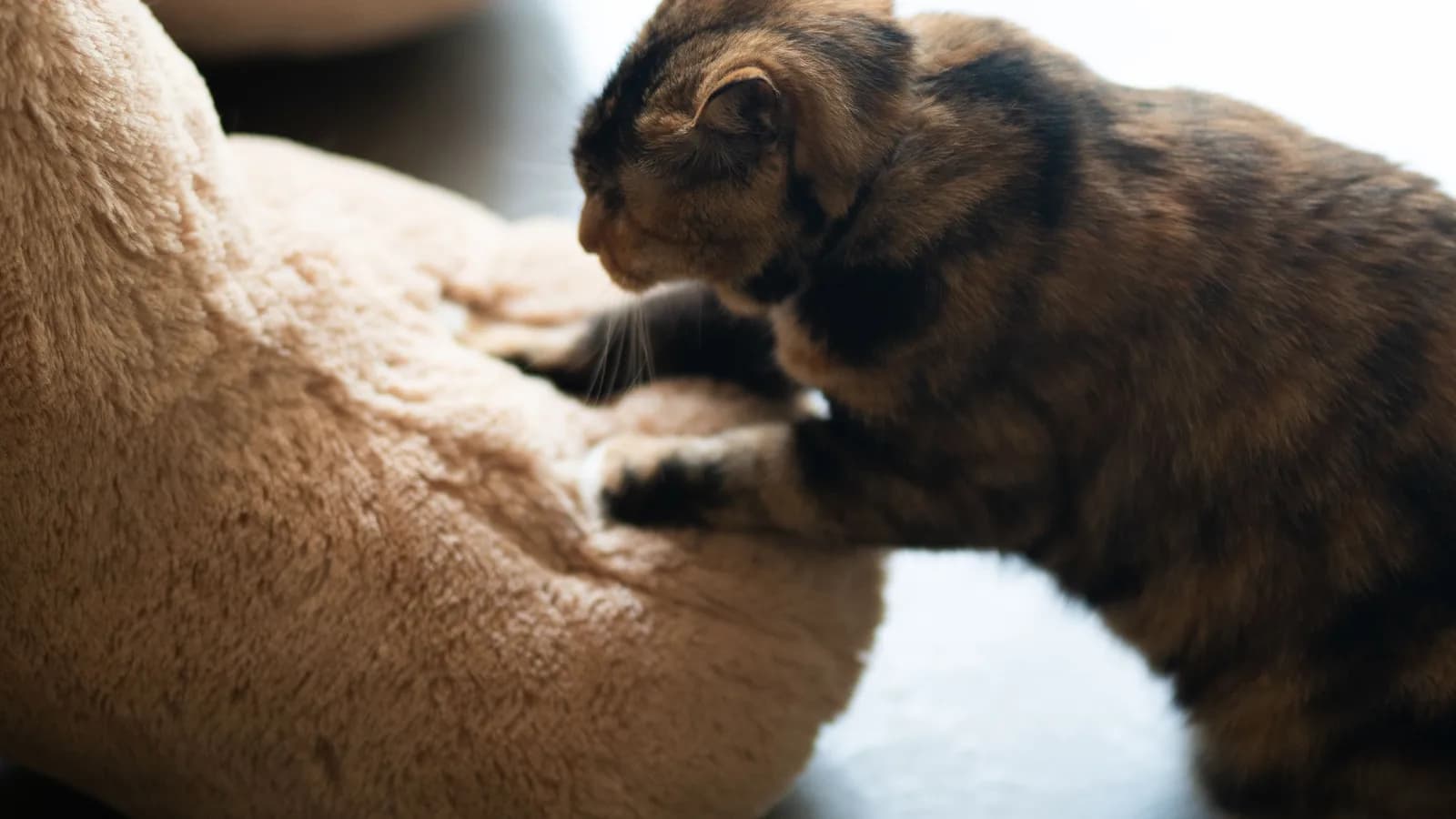
Every kitten kneads. Pressing rhythmically against the mother's belly helps get milk flowing while nursing, which is why the zoologist Desmond Morris called the move "." Nursing winds down around two months old, says Julia Albright, a veterinary behavior professor at the University of Tennessee, and yet the pressing carries on for life. Frankly, of course it does. It worked. Why would any of us retire a winning move?
One honest wrinkle, because my health desk insists: the most credentialed voice in our research file, Tracy Kroll, a veterinary behavior resident quoted in Cornell's Catwatch newsletter, says kittens knead "for reasons not fully known." It may pull milk. It may simply feel like home. Science, it turns out, has not fully audited the biscuit.
Why grown cats never stop kneading
Your adult cat kneading your lap is, in the least insulting sense available, being a kitten at you. Researchers describe kneading as a juvenile behavior that adult cats keep, the way domestication left many of us with a lifetime pass to act young: the same explanation offered for why grown cats meow at humans at all. Kristyn Vitale, an animal behaviorist at Unity Environmental University, puts it carefully: behaviors once aimed at the mother may now be aimed at the owner. You are, functionally, a large warm mom substitute who controls the fridge. Congratulations.
So when a cat kneads you, the working reading is comfort, safety, and a compliment of the highest order. Albright calls a kneading cat "calm, content and ready to settle down." I call it quality control of the sleeping surface. Both are true.
Priya · Health desk
Interrupting before someone repeats a myth: kneading is not a sign your cat was weaned too early. I read the 2017 Finnish study everyone cites for that claim, in full. It measured aggression, shyness, wool sucking and grooming in early-weaned cats. Kneading appears nowhere in it, and the states outright that the link is false.
Cookie · Editor-in-chief
I commissioned that fact-check personally, between two naps. You are welcome. My invoice says two treats, payable immediately. Three if you also learned something.

The scent theory: often repeated, rarely measured
Almost every article on kneading tells you, flatly, that cats have scent glands in their paws and knead to mark you as territory. Here is what our file actually shows: cats do have glands between the paw pads, and the marking idea is plausible, which is why vets keep raising it. But every credentialed voice that raises it hedges. Kroll says kneading "may also mark a spot," with affection as the primary reading. Albright writes "may." Nobody in twenty sources cites a study that measured scent deposited by kneading, because as far as we could find, none exists. So: suspected, sensible, unproven. You may still consider yourself claimed. That part I endorse personally.

Tess · Behavior desk
Reality check before anyone prints "science has shown": no study has ever measured scent marking during kneading. Every vet who raises the idea says may. What kneading reliably tells you is simpler: the cat is relaxed and settling in. Read the whole body, not one behavior.
Cookie · Editor-in-chief
Fine. The science is unfinished. The biscuits are not. Next section.
Biscuits before bed: comfort, purring, and the drool question
The 's advice page lists the everyday reasons plainly: cats knead to show contentment, and some knead when stressed, as a way of self-soothing. Styles vary by cat: loud purr or quiet one, claws in or out, front paws only or, in committed professionals, all four. The trance face some cats wear mid-knead is, per the same page, just deep relaxation. Kneading also tends to arrive bundled with purring and slow blinks, the full settling-down suite. If yours does the whole routine on your lap, our cat body language guide can translate the rest of the performance, and our purring article covers the soundtrack.
And the droolers. Some cats drip while they knead, and science offers two stories it has never reconciled: a Kansas State veterinarian, Susan Nelson, reads it as the mark of "the really happy guys," while International Cat Care frames it as anticipation, the mouth remembering that kneading once predicted milk. Nobody has tested either. If your cat is a mid-biscuit drooler, our drooling article sorts the charming version from the kind a vet should hear about.
Surviving the bakery: claws, laps, and what not to do
- Never punish a kneading cat. The is blunt: they cannot help this behavior. Punishing it buys you stress and zero fewer biscuits.
- Redirect, do not forbid. Feline behavior specialists advise keeping a thick blanket where the cat kneads you, and letting the blanket take the claws.
- Keep the nails trimmed. Our own practical advice, not any single expert's: a blunt claw turns kneading from acupuncture back into a compliment.
- Fragile skin gets a barrier. Cornell's Catwatch newsletter notes kneading scratches can matter for vulnerable skin, such as in diabetics, the elderly, or infants. A folded blanket solves it.
- One aside you will meet online: that unspayed females knead more when in heat. Two of our sources mention it in passing; neither cites data. We pass it along at exactly that weight.
When kneading is worth a vet call
Kneading itself is normal at any volume your lap can absorb. What earns a call is change: kneading that suddenly increases sharply, or turns obsessive alongside other behavior shifts, is worth a veterinary conversation, per Zoetis veterinarian Sam Gilbert and the American Animal Hospital Association's advice page. Cats routinely knead more when anxious, so a cat that suddenly lives at the biscuit station may be telling you something about its stress levels; our cat anxiety guide covers what to look for. Something clearly wrong with your cat means the vet, today, not this page.
What to take away
- Kneading ("making biscuits") starts in nursing: kittens press their mother's belly to help milk flow, a move the zoologist Desmond Morris named .
- Adult cats keep kneading as a retained kitten behavior aimed at their humans; behaviorists read it as comfort and contentment, the cat settling somewhere it feels safe.
- The claim that kneading scent-marks you is suspected but unproven: cats do have glands between their paw pads, yet no study has ever measured scent marking during kneading.
- Kneading does not mean a cat was weaned too early: the 2017 Helsinki study cited for that claim never measured kneading, and the states the link is a myth.
- Some cats drool while kneading; the two proposed explanations, pure contentment versus conditioned milk anticipation, have never been tested against each other.
- Punishing kneading is pointless and unfair; the fixes are a thick blanket, trimmed nails, and a vet call only if kneading suddenly increases or turns obsessive.
 The vet's take

Veterinary review
Are you a vet?
Your professional read belongs here: every verified practitioner can leave a note, published once our editors have reviewed it.
Sign in and get your license number verified. We check it in the public register, we never ask for or keep a copy of your diploma, and your number is never published.
Frequently asked questions
Why do cats make biscuits?
The behavior starts in nursing: kittens knead their mother's belly to stimulate milk flow. Adult cats keep the move as a comfort behavior, typically directed at soft surfaces and trusted humans when they feel safe and ready to settle. The rhythmic look of it, paws pressing dough, earned the biscuit name.
Does kneading mean my cat was weaned too early?
No. The scientific study most often cited for that claim, a 2017 Finnish paper on early weaning, measured aggression, shyness, wool sucking and grooming, and never kneading. The MSPCA states directly that kneading is not a sign of early weaning. Nearly all cats knead, whatever their nursing history.
Why does my cat knead me and then bite gently?
Kneading arrives bundled with other settling behaviors, and some owners report a soft nip in the same affectionate package. It usually reads as overflowing contentment rather than aggression. If biting is hard or escalating, that is a different behavior with different causes worth reading up on.
Why does my cat drool while kneading?
Two explanations circulate: some vets read drooling as extreme relaxation in a very happy cat, while International Cat Care frames it as anticipation left over from nursing, when kneading predicted milk. Neither has been tested. Occasional mid-knead drool in a relaxed cat is normal; drooling at other times deserves a vet check.
Why do cats knead blankets before lying down?
Soft surfaces get the most biscuits because kneading is a settling ritual: the cat is comforting itself and prepping its spot before sleep. Many cats pick one favorite blanket and work it nightly, purring, sometimes in a visible trance of relaxation. It is normal, and it is a good sign about how safe the cat feels.
Do all cats knead?
Kneading is close to universal, but style varies widely: claws in or out, front paws or all four, loud purr or silence, daily ritual or rare event. A cat that rarely kneads is not broken, and a cat that kneads constantly is not defective either, unless the habit changes sharply, which is worth a vet conversation.
 Community questions
Got a question this page doesn't cover? Ask it: the best ones get published here with their answer.
This is information, not veterinary advice, and it cannot tell you what is wrong with your cat. Our rule is a simple one: if something is wrong with your cat, call your vet, and call an emergency clinic if it is out of hours. Nothing you read here is a reason to wait.
Medical information applies to every reader. Prices, legal duties and common practice do not: unless stated otherwise, they are given for the United States, and they differ in the UK, Canada and Australia, and often between states or provinces. Check with your own vet and your own local authority.
Our sources
- Catwatch Newsletter (Cornell University College of Veterinary Medicine), When Your Cat Kneads You (Tracy Kroll, DVM)
- Scottish SPCA, Why do cats make biscuits?
- Julia Albright (University of Tennessee, veterinary behavior), Why do cats knead with their paws? (The Conversation)
- Ahola, Vapalahti & Lohi 2017, Early weaning increases aggression and stereotypic behaviour in cats (Scientific Reports; read in full: kneading is not among its measured behaviors)
- Scientific American, Why Do Cats Knead Like They're Making Biscuits? (Fanucchi, Vitale and Nelson quotes)
- Zoetis Petcare, Why Do Cats Knead? (Sam Gilbert, VMD)
- PetMD, Why Do Cats Knead?
- COAPE, Understanding why cats knead and bunt (Katie Armour, MSPCA, on the early-weaning myth)
- AAHA, Is My Cat's Kneading Normal?

Worth keeping a paw on
Pin this guide
So you can find it the day you need it, and share it with someone whose cat does the same thing. One click and it sits in your board.
Pin it on PinterestAlso worth reading
All behavior →
Article
Why Do Cats Purr? The Owner of the Sound Opens the Hood
Cats purr when content, when hungry, and even in pain. Our editor-in-chief opens the hood on his signature sound: the 2023 larynx study, the kitten purr, and the healing legend, checked.
Read
Article
Why Do Cats Hate Water? A Dry Cat Is a Cat in Control
Wet fur is heavy, cold and slow to dry, and nobody asked the cat first. The real reasons cats hate water, the science that is missing, and the breeds that swim anyway.
Read
Article
Why Does My Cat Lick Me? The Science of the Sandpaper Kiss
Being licked is mostly a compliment: bonding, shared scent and the salt on your skin. What grooming really negotiates between cats, and the one moment a lick should actually worry you.
Read
The floor belongs to our members. Keep it kind, links are not allowed, and images go through moderation before anyone else sees them.