

Why Do Cats Hate Water? A Dry Cat Is a Cat in Control
Wet fur is heavy, cold and slow to dry, and nobody asked the cat first. The real reasons cats hate water, the science that is missing, and the breeds that swim anyway.
Published August 28, 2026Updated September 8, 2026 6 min read
Contents
Cookie here, editor-in-chief. The humans keep typing this question into search engines, usually while holding a towel and an opinion. So let me settle it. Cats do not hate water. Cats hate what water does to a perfectly engineered fur system, and we especially hate that nobody asks before turning the faucet on us. There is real science in here, some surprisingly missing science, and a shortlist of cats who read the rules and swam anyway. My team will interrupt me at intervals. They always do.
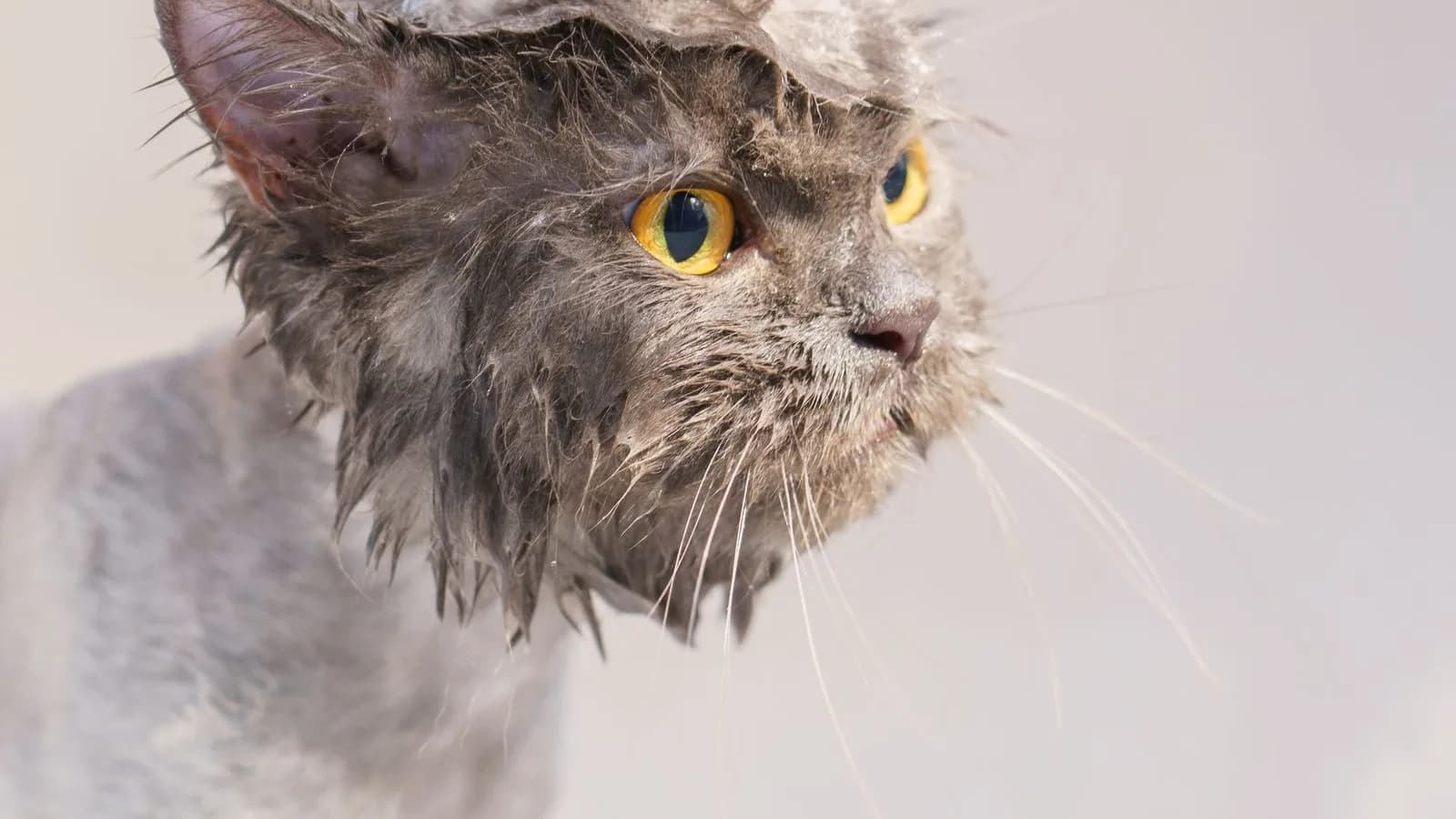
A wet cat is heavy, cold, and slow, and cats know it
Start with the equipment. A cat's coat traps air, and that trapped air is the insulation layer, the point of the whole garment. Soak it and the system fails at once: Scientific American's veterinary behaviorists note that wet fur leaves a cat vulnerable to cold, exactly because the coat works by holding air. Cats Protection, the UK's largest cat charity, adds the part I find personally offensive: wet fur becomes heavy and restricts movement, which for an animal that is both predator and prey is not a styling problem, it is a security breach.
There is more. The coat carries natural oils that keep the skin underneath healthy, and a full soaking can wash them away, leaving dry, itchy skin behind. And a drenched coat dries slowly, hours of it, per the veterinary write-ups, during which the cat runs cold. Cats Protection flags that chill as genuinely dangerous for elderly cats, sick cats and young kittens. So when I decline the bath, I am not being dramatic. I am protecting critical infrastructure. You would not throw your winter coat in a lake and then wear it.
Blame the desert, partly
Now the history lesson, which I will keep short because history contains very few snacks. Every domestic cat descends from the African wildcat, , a small desert predator from hot, dry places. Feline behaviorist Kristyn Vitale points out that African wildcats are not known for hunting near or in water: their diet is mostly terrestrial, rodents and similar. Cats Protection draws the same line: our ancestors met very little standing water, and most of us never evolved the water-shedding coat that swimming animals carry. Millions of years of dry-land engineering, and you propose a bath.

Tess · Behavior desk
Quick reality check before the desert story hardens into fact: it is the standard expert explanation, and it is plausible, but when we went looking for the study behind it we could not find one. No peer-reviewed paper has directly tested why domestic cats avoid water. Expert consensus, yes. Tested science, not yet.
Cookie · Editor-in-chief
Of course there is no study. Scientists know better than to put forty of us in bathtubs and take notes. The consensus stands because I endorse it, which is the strongest form of peer review available. Moving on.

Control: why the faucet is a toy and the bath is a betrayal
Here is the piece that actually explains the famous contradiction, the cat who bats at the dripping faucet every morning and then fights the bathtub like it owes him money. The behaviorists quoted by Scientific American put it plainly: cats are averse to new things they cannot control, a sensible policy for an animal that has spent its history being both hunter and hunted. A paw dipped into running water is an experiment the cat is running. A bath is an experiment being run ON the cat, with the cat as the only unwilling participant. Same water. Entirely different contract.
The pet-industry explainers all repeat the same illustration, a cat dipping a paw into a stream controls the interaction, a cat lowered into a tub controls nothing, and for once the industry and I agree. Vets add one practical corollary: never use water as a punishment, a spray bottle included. PetMD's Dr. Sandra Mitchell notes that forced water exposure frightens cats precisely because the control is gone, and a cat that learns water arrives by surprise trusts both the water and you a little less.
The cats that never got the memo
Every rule I issue, some cat appeals. The Turkish Van is the famous one: the Cat Fanciers' Association describes the breed as well known for its affinity to water and says even Van kittens will play and swim in pools or lakes, voluntarily. The Maine Coon gets a registry note too, fond of water, prone to watching a dripping faucet in fascination, washing toys, even trying to join you in the shower. The Bengal earns the same shower warning. And out in the wild, the fishing cat of South and Southeast Asia dives for fish for a living, with hind-foot webbing the IUCN's cat specialists describe as only marginally more developed than a bobcat's. Even the professional swimmer is mostly running on attitude, not special equipment.

Nora · Adoption desk
The Turkish Van deserves its footnote. The breed comes from the Lake Van region of eastern Turkey, and the romantic version says the cats learned to swim in the lake to cool off in hot summers. That origin tale is repeated everywhere, but it is breed lore: the registry documents the water affinity itself, not the legend. Lovely story. Label it a story.
Cookie · Editor-in-chief
And who taught them, hmm? A cat with vision, whose name history has conveniently lost. Anyway, swimming is a niche discipline, like fetching. We let the Vans have it so they feel special.
Do you ever actually need to bathe a cat?
Rarely, and I want that in the record. A healthy cat runs a full grooming operation with a barbed tongue that works like a comb, self-cleaning, solar-powered, no appointment needed. Dogs get taken to salons. We ARE the salon. The 's position is that a bath becomes necessary when a cat is very dirty or gets into something sticky or smelly, and their protocol is worth following to the letter:
- Step 1: Time it for when the cat is mellow, ideally after a play session has burned the zoom out of her.
- Step 2: Put a rubber mat in the sink or tub so nothing slips, and fill with three to four inches of lukewarm water, not hot.
- Step 3: Wet the coat with a hand-held spray hose, keeping water out of ears, eyes and nose.
- Step 4: Rinse thoroughly, towel gently, and keep the freshly wet cat in a warm room until dry.
Two honest additions from the charity side: the chill risk is real for kittens, seniors and sick cats, so when in doubt about whether a bath is safe for YOUR cat, that is a question for your vet, not for a website, even mine. And if a cat who always kept herself immaculate stops grooming, that change itself is worth a vet conversation, because cats rarely resign from self-care without a reason.
The water bowl footnote
One last watery mystery, because readers keep asking: the cat who paws at the water bowl, or refuses it entirely in favor of the faucet. The marketing industry has an answer to sell you, wide "whisker-friendly" bowls, on the theory that whiskers touching the bowl rim cause distress. Our whiskers article took that theory to the only peer-reviewed study that exists, forty cats in the Journal of Feline Medicine and Surgery in 2021, and the measurements came back flat: no difference in time spent eating, food dropped, or amount eaten. The one real finding was a mild preference for the wider dish when both were offered. Preference, yes. Proven distress, no. Buy the wide bowl if your cat likes it, not because anyone proved the narrow one hurts.

Priya · Health desk
The numbers, since Cookie rounds everything to delicious: Slovak and Foster, Journal of Feline Medicine and Surgery, 2021, forty cats. Time spent eating, food dropped, amount eaten: no significant difference between an ordinary dish and a whisker-friendly one. The single positive finding was a preference for the wider dish when both were offered. That is the entire evidence base for the product category.
Cookie · Editor-in-chief
I also prefer the wider dish, because it holds more. My consulting fee for this insight is two salmon treats, payable immediately. Three if you already bought the special bowl.
What to take away
- Cats avoid soaking because a wet coat fails at its job: fur insulates by trapping air, and wet fur is heavy, cold, slow to dry and strips protective skin oils (Scientific American, Cats Protection).
- The standard evolutionary explanation is desert ancestry: domestic cats descend from the African wildcat, , which rarely met standing water. It is expert consensus, and no peer-reviewed study has ever directly tested it.
- The faucet-versus-bathtub contradiction is about control: a cat dipping a paw runs the experiment, a cat in a tub has no exit, and cats are averse to what they cannot control.
- The documented exceptions are real: the describes the Turkish Van as known for swimming voluntarily, and notes water fascination in the Maine Coon and Bengal.
- Healthy cats almost never need baths; the reserves them for a very dirty or sticky coat, with lukewarm water, a non-slip mat and a gentle hand-held rinse.
- Wet chill is genuinely risky for kittens, elderly and sick cats, so bathing questions about a fragile cat go to your vet first.
 The vet's take

Veterinary review
Are you a vet?
Your professional read belongs here: every verified practitioner can leave a note, published once our editors have reviewed it.
Sign in and get your license number verified. We check it in the public register, we never ask for or keep a copy of your diploma, and your number is never published.
Frequently asked questions
Why do cats hate water?
Two sourced reasons and one honest gap. Physics: a soaked coat is heavy, cold and slow to dry, and it strips the skin's natural oils. Control: cats are averse to situations they cannot control, and a bath is exactly that. The popular third reason, desert ancestry from the African wildcat, is the standard expert explanation but has never been directly tested in a published study.
Do all cats hate water?
No, and the absolute version of the claim is folklore. Plenty of cats play with running water, and the Cat Fanciers' Association itself describes the Turkish Van as well known for its affinity to water, with kittens swimming voluntarily. Aversion is the default setting, not a law of nature.
Which cat breeds like water?
The registry-documented names are the Turkish Van, described by the CFA as swimming voluntarily, plus the Maine Coon and the Bengal, both noted by the CFA for fascination with faucets, water play and showers. That last group likes playing WITH water more than being IN it.
Should I bathe my cat, and how often?
Almost never on a schedule. A healthy cat self-grooms thoroughly, and the ASPCA reserves baths for a coat that is very dirty, sticky or smelly. When one is needed: lukewarm water a few inches deep, a rubber mat, a gentle hand-held rinse away from the face, and a warm room afterward. For kittens, seniors or sick cats, ask your vet before bathing at all, because wet chill is a real risk for them.
Why does my cat play with the faucet but hate baths?
Because the two are opposite situations to a cat. Dipping a paw into running water is an interaction the cat starts, controls and can end. Being placed in water removes all of that control at once, and behaviorists identify loss of control as a core trigger of feline aversion. Same water, different contract.
Is whisker fatigue the reason my cat paws at the water bowl?
Unproven. The only peer-reviewed study, forty cats published in 2021, found no measurable difference in eating behavior between ordinary and "whisker-friendly" dishes, just a mild preference for the wider bowl when cats were given the choice. A wide bowl is a fine purchase; the distress theory it is marketed on has never been demonstrated.
 Community questions
Got a question this page doesn't cover? Ask it: the best ones get published here with their answer.
This is information, not veterinary advice, and it cannot tell you what is wrong with your cat. Our rule is a simple one: if something is wrong with your cat, call your vet, and call an emergency clinic if it is out of hours. Nothing you read here is a reason to wait.
Medical information applies to every reader. Prices, legal duties and common practice do not: unless stated otherwise, they are given for the United States, and they differ in the UK, Canada and Australia, and often between states or provinces. Check with your own vet and your own local authority.
Our sources
- Cats Protection, why do cats hate water (Daniel Warren-Cummings, clinical animal behaviourist, 2025)
- Scientific American, why do cats hate water (veterinary behaviorists Wailani Sung and Carlo Siracusa)
- Big Cat Rescue, feline fears and wild roots (feline behaviorist Kristyn Vitale on Felis lybica)
- PetMD, why do some cats hate water (Dr. Brittany Klesznyski, DVM; Dr. Sandra Mitchell, DVM, DABVP)
- ASPCA, cat grooming tips (the bathing protocol)
- CFA breed page, Turkish Van (the registry's water-affinity characterization)
- CFA breed page, Maine Coon (fond of water, faucet fascination)
- CFA breed page, Bengal (water fascination note)
- IUCN SSC Cat Specialist Group, fishing cat (swimming adaptations)
- Slovak and Foster 2021, evaluation of whisker stress in cats (Journal of Feline Medicine and Surgery, the 40-cat bowl study)
- GreatPetCare, why do cats hate water (JoAnna Pendergrass, DVM; the tap-versus-immersion illustration)
- Cats.com, whisker fatigue: does it really happen (veterinary skepticism survey)

Worth keeping a paw on
Pin this guide
So you can find it the day you need it, and share it with someone whose cat does the same thing. One click and it sits in your board.
Pin it on PinterestAlso worth reading
All behavior →
Article
Why Does My Cat Lick Me? The Science of the Sandpaper Kiss
Being licked is mostly a compliment: bonding, shared scent and the salt on your skin. What grooming really negotiates between cats, and the one moment a lick should actually worry you.
Read
Article
Why Do Cats Like Boxes? The Science of Sitting in Cardboard
Boxes cut shelter-cat stress in randomized trials, warm a home that runs cold by cat standards, and serve the ambush instinct. The science of sitting in cardboard, told from inside one.
Read
Article
Why Do Cats Get the Zoomies? The Truth About the 3 a.m. Grand Prix
Zoomies are normal cat physics: pent-up energy, twilight biology, the litter box victory lap. What science actually knows, what is still theory, and the one change that means a vet visit.
Read
The floor belongs to our members. Keep it kind, links are not allowed, and images go through moderation before anyone else sees them.