

Cat Whiskers: What They Do, and Two Myths to Drop
Cats have whiskers in five places, not one. And the two claims you have read most often, gap-measuring and whisker fatigue, are not what the research shows.

Published August 25, 2026Updated September 8, 2026 9 min read
Contents
Almost everything written about cat whiskers comes down to two claims. That a cat's whiskers are as wide as its body, so it can measure whether it fits through a gap. And that eating from a deep bowl gives a cat something called whisker fatigue.
We went looking for the studies behind both. One of them has never been measured at all. The other has been measured exactly once, and the result is not what the bowls are sold on.
What is left after that is better than the myths, because it is real: a sense organ wired more densely than almost anything else on a cat's body, sitting in five places most people cannot name, with two centuries of experiments behind the one instruction that genuinely matters.
The whisker is dead. The follicle is the organ
A whisker is , exactly like the rest of the coat. There are no nerves inside the shaft. Cut one and the cat feels nothing at the moment of cutting, for the same reason you feel nothing when you cut a fingernail.
What makes it a sense organ is what it is planted in. A whisker sits in a , a structure built quite differently from an ordinary hair follicle: it is wrapped in a blood-filled sinus and packed with nerve endings. In the species examined so far, cats included, each of these follicles carries roughly 100 to 200 primary sensory nerve fibres, and in the cat specifically those fibres end in at least eight distinct types of mechanoreceptor.
That single fact reorganises everything else on this page. The whisker is an antenna. The follicle is the instrument reading it. Bending the antenna moves the follicle, and the follicle reports it in eight different vocabularies at once.
It also explains a distinction people get backwards. Trimming a whisker does not hurt. Plucking one does, because plucking pulls on the follicle, which is nothing but nerve and blood. And trimming still costs the cat something, which we come to below.
Cats have whiskers in five places, and you can probably name one
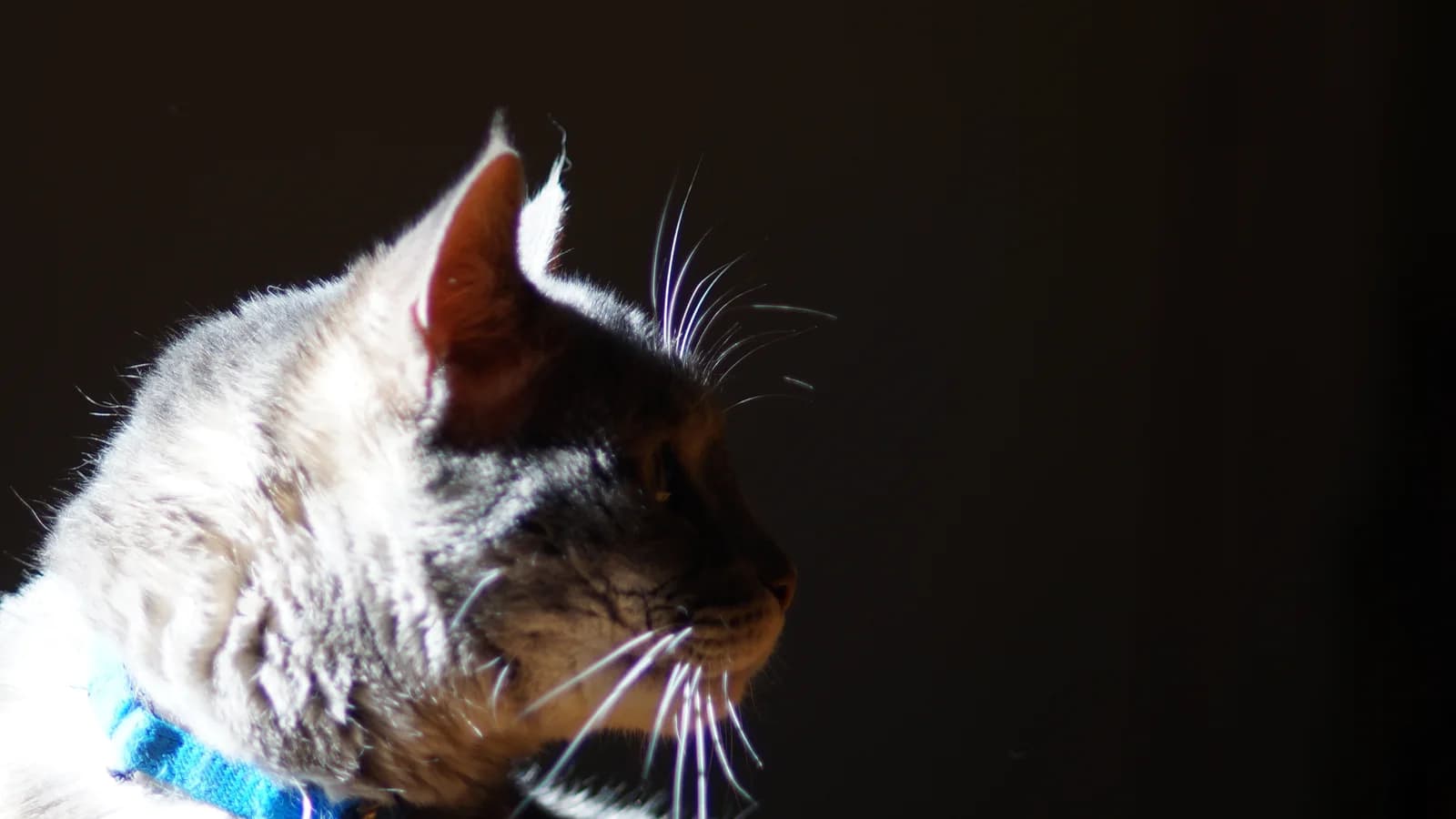
Ask anyone where a cat's whiskers are and they will point at the muzzle. Those are the whiskers, the long obvious ones. They are one group out of five.
| Group | Where | What it is for |
|---|---|---|
| Mystacial | The muzzle, in rows either side of the nose | The main array: close-range shape and position, prey handling |
| Superciliary | Above the eyes, like eyebrows | Triggers a protective blink when something approaches the eye |
| Genal | On the cheeks | Widens the sensed field to the side of the head |
| Mandibular | Under the chin | Reads what is directly below the muzzle, which the eyes cannot see |
| Carpal | On the back of the front legs, above the paw | Reads prey held under the paws |
The last row is the one nearly no page carries, and it is the most interesting. The are four to six short whiskers, 20 to 30 mm long (roughly 1 inch), on the back of the lower foreleg. They have their own nerve supply, the ulnar nerve, and their follicles are dense enough with blood sinuses to show up as increased opacity on an X-ray.
They exist in predators that catch prey with their front legs, and hold it there. A dog does not have them. When a cat pins something struggling under its paws and cannot see it, the whiskers are what tell it where the animal is and which way it is facing.
What whiskers actually do, separated out
"Sixth sense" is where most articles stop. It is worth pulling apart, because the jobs are genuinely different.
- Reading air. A whisker deflects in moving air. In rats, where the mechanism has been studied in the most detail, the whiskers above the eyes work as wind-sensing antennae. The mechanism is not species-specific, but the measurement was made in rats and we say so.
- Seeing what is too close to see. A cat cannot focus on anything at nose range. The whiskers cover that blind zone, reporting the position, shape and size of an object the eyes have already lost.
- Placing the bite. Once prey is caught, the whiskers fold forward around it, and together with the set they guide where the killing bite lands. This is the job the array is shaped for.
- Moving in the dark. Not folklore, and the evidence is unusually old. See the next section but one.
Fact check one: do whiskers measure whether a cat fits?
You have read this everywhere. A cat's whiskers span the width of its body, so before it squeezes through a gap it checks with its whiskers.
No study has ever measured a cat's whisker span against its own body width. Not one. We went looking specifically for it and it does not exist.
What does exist is telling. Wikipedia carries the claim with a "citation needed" tag on it. The Cat Fanciers' Association, a registry with no reason to undersell cat anatomy, states on its own whisker page that the idea is not scientifically proven. And the sources usually cited for the sharper version of it, that a fat cat's whiskers no longer match its width, are an archived veterinary association blog post and a magazine reader-question column.
Then there is the one real experiment on the underlying question. In 2024, a study of 30 cats tested whether they judge an opening before entering it. The finding was that cats mostly do not: they approach narrow openings by trial and error, slowing down only for the very tightest ones. The authors mention whisker sensing once, as a possible explanation they did not test, in carefully hedged language.
So the honest version is this. Whiskers are unquestionably involved in navigating tight spaces, because they report what is beside the head. But the neat story, that a cat carries a built-in tape measure calibrated to its own shoulders, is a claim that has been repeated into the shape of a fact without anyone ever measuring it.
Fact check two: is whisker fatigue real?
An entire product category, the wide shallow "whisker-friendly" bowl, rests on the idea that a cat's whiskers touching the sides of a dish causes stress or pain.
One peer-reviewed study exists. Forty cats, published in the Journal of Feline Medicine and Surgery in 2021. It compared a whisker-friendly dish against an ordinary one and measured what actually happened at dinner.
| What was measured | Result |
|---|---|
| Time spent eating | No significant difference (P=0.8) |
| Food dropped outside the bowl | No significant difference (P=0.9) |
| Food eaten | No significant difference (P=0.7) |
| Choice, when both bowls were offered | A mild preference for the wider dish |
That last line is a real finding and worth keeping. Given the choice, the cats in this study leaned towards the wider bowl. That is a preference, measured, and it is a perfectly good reason to buy a wide bowl if you want to.
It is not evidence of stress or pain. The stronger claim, the one the category is actually sold on, has never been tested. A second targeted search for any other study on it returned nothing.
If your cat paws food out of a bowl and eats it off the floor, that behaviour is real and you are not imagining it. What is missing is any measurement showing that whisker contact is the reason. The same marketing-versus-measurement gap runs through the wider subject of cats and water: why cats hate water has expert consensus behind it and, to date, not a single dedicated study.
Never cut them, and this time the evidence is old and cat-specific
Given how much of the folklore around whiskers dissolves on inspection, it would be reasonable to expect this one to go the same way. It does not.
In 1823, and again in 1932, researchers observed blinded cats with their whiskers intact moving confidently around obstacles, while blinded cats whose whiskers had been removed moved cautiously, crawling, feeling their way, bumping into things. In 1986, a modern study confirmed the same effect with instruments: cats deprived of their moved markedly more slowly through a maze in the dark than cats with whiskers.
Note what that evidence does and does not say. The cutting itself is painless, because the shaft is dead. The cost is the loss of a sense, and it lands hardest exactly where a cat is otherwise most capable, which is in the dark.
So: never trim them, never let a groomer tidy them, and if a candle or a hob singes them, they grow back.
Shedding, color, and the one change worth mentioning to your vet
Finding the odd whisker on the floor is normal. They are replaced on a cycle like any other hair. Regrowth after a loss is generally given as anywhere from six weeks to three months, and it is worth saying plainly that this range comes from institutional advice rather than from a peer-reviewed regrowth study, because no such study was found.
Whiskers darkening with age gets repeated a good deal. We found it in one veterinary-affiliated source with no study behind it. Treat it as an observation, not a finding.
There is one change that is genuinely worth flagging, and it is not folklore. A 2023 case series of 358 cats found that wavy or curled whiskers, as distinct from normal straight ones, were significantly associated with feline leukemia virus infection. Of the 56 cats in that series with wavy whiskers, 50 were positive for antigen, and the association held on multivariate analysis. The researchers found viral antigen in the whisker follicle's own tissue.
Read that carefully, because it is an association in one case series, not a test. Wavy whiskers do not mean your cat has . What they mean is that it is worth saying out loud at your cat's next appointment, and sooner if anything else has changed: weight, appetite, energy, gum color, or a wound that will not heal. Anything that worries you about your cat is a reason to call your vet, and out of hours, an emergency clinic. Nothing here is a reason to wait.
What to take away
- Whiskers are dead hair in a living instrument. The follicle does the sensing, and it is wired with 100 to 200 nerve fibres reporting through at least eight kinds of ending.
- There are five groups, not one, and the set on the front legs is the one nobody mentions. Dogs do not have it.
- Nobody has ever measured whisker span against body width. The gap-measuring story is repetition, not evidence.
- Whisker fatigue has been tested once. It found a mild preference for a wider bowl and no difference in how cats actually ate.
- Do not cut them. That one is backed by cat-specific experiments going back to 1823.
The other piece of equipment on a cat's face that is built nothing like it looks is the tongue: its spines turn out to be hollow scoops rather than solid cones. That is what a cat's tongue actually does. And while you are counting, a cat has eighteen toes, unless it is one of the ones that does not.
 The vet's take

Veterinary review
Are you a vet?
Your professional read belongs here: every verified practitioner can leave a note, published once our editors have reviewed it.
Sign in and get your license number verified. We check it in the public register, we never ask for or keep a copy of your diploma, and your number is never published.
Frequently asked questions
Do cats have whiskers on their legs?
Yes, on the back of the front legs just above the paw: four to six short whiskers, about 20 to 30 mm long, called carpal vibrissae. They have their own nerve supply and help a cat feel prey held under its paws. Dogs do not have them, and almost no article about cat whiskers mentions them.
Does cutting a cat's whiskers hurt?
The cut itself does not, because the whisker shaft is dead keratin with no nerves in it, exactly like a fingernail. Plucking one does hurt, because it pulls on a follicle packed with nerve endings. But a cat without whiskers is a cat missing a sense: experiments going back to 1823 show whisker-deprived cats move cautiously and slowly in the dark. Never trim them.
Is whisker fatigue real?
One peer-reviewed study has tested it, on 40 cats. It found no difference in eating time, food dropped or food eaten between a whisker-friendly dish and a normal one, and a mild preference for the wider dish when both were offered. The preference is real. The claim that bowl contact causes stress or pain has not been tested.
Do whiskers tell a cat if it fits through a gap?
No study has ever measured a cat's whisker span against its own body width, and the claim carries a citation-needed tag even on Wikipedia. The one experiment on how cats judge narrow openings, published in 2024, found they mostly use trial and error. Whiskers help a cat sense what is beside its head, which is not the same as carrying a built-in tape measure.
Why do cats have whiskers above their eyes?
Those are the superciliary whiskers. Touching them triggers a protective blink, so anything approaching a cat's eye makes it close before contact. In rats, the same group has been shown to work as a wind-sensing antenna.
How long do cat whiskers take to grow back?
Institutional advice ranges from about six weeks to three months. We could not find a peer-reviewed study measuring regrowth rate in cats, so treat that range as guidance rather than a measurement.
 Community questions
Got a question this page doesn't cover? Ask it: the best ones get published here with their answer.
Our sources
- Ebara, Kumamoto, Matsuura, Mazurkiewicz, Rice 2002, innervation of mystacial vibrissal follicle-sinus complexes in the rat and cat, J Comp Neurol 449(2)
- Rice, Mance, Munger 1986, sensory innervation of the mystacial pad, J Comp Neurol 252(2)
- Slovak, Foster 2021, evaluation of whisker stress in cats (40 cats), J Feline Med Surg 23(4)
- Pongracz 2024, cats selectively rely on body size awareness when negotiating short openings (30 cats), iScience 27(12)
- Cremieux, Veraart, Wanet-Defalque 1986, deprivation of vision and vibrissae and goal-directed locomotion in cats, Exp Brain Res 65
- Gogan, Gueritaud, Horcholle-Bossavit, Tyc-Dumont 1981, the vibrissal pad as sensory information for the oculomotor system of the cat, Exp Brain Res 44
- Morishita et al 2023, wavy changes in the whiskers of domestic cats correlated with feline leukemia virus infection (358 cats), BMC Vet Res
- Mugnaini et al 2023, supra-orbital whiskers act as wind-sensing antennae in RATS (mechanism source, not feline), PLoS Biol
- Doring et al 2025, the canine vibrissal system as a highly innervated sensory organ (canine paper, cited here for the historic cat studies it follows), Sci Rep 15
- Cat Fanciers' Association, The Fascinating World of Cat Whiskers (states the body-width claim is not scientifically proven)
- Cats Protection, Why do cats have whiskers? (regrowth timeline)

Worth keeping a paw on
Pin this guide
So you can find it the day you need it, and share it with someone whose cat does the same thing. One click and it sits in your board.
Pin it on PinterestAlso worth reading
All cat facts →
Article
Why a Cat's Tongue Is Rough, and What It Can Taste
A cat's tongue spines are hollow scoops that wick saliva down to the skin, cats cannot taste sugar at all, and they do not scoop water. What has been measured.
Read
Article
How Many Toes Do Cats Have? The Answer, and the Exceptions
A cat has 18 toes, five in front and four behind. Here is the gene behind the cats born with more, why registries disagree, and the record that changed in 2026.
Read
Article
Cat Paw Pads: A Field Guide to Toe Beans
What toe beans actually are, the sweat glands hiding in them, the three claims no study backs, and the paw problems worth a vet call.
Read
The floor belongs to our members. Keep it kind, links are not allowed, and images go through moderation before anyone else sees them.