

Cat Paw Pads: A Field Guide to Toe Beans
What toe beans actually are, the sweat glands hiding in them, the three claims no study backs, and the paw problems worth a vet call.

Published August 26, 2026Updated September 8, 2026 8 min read
Contents
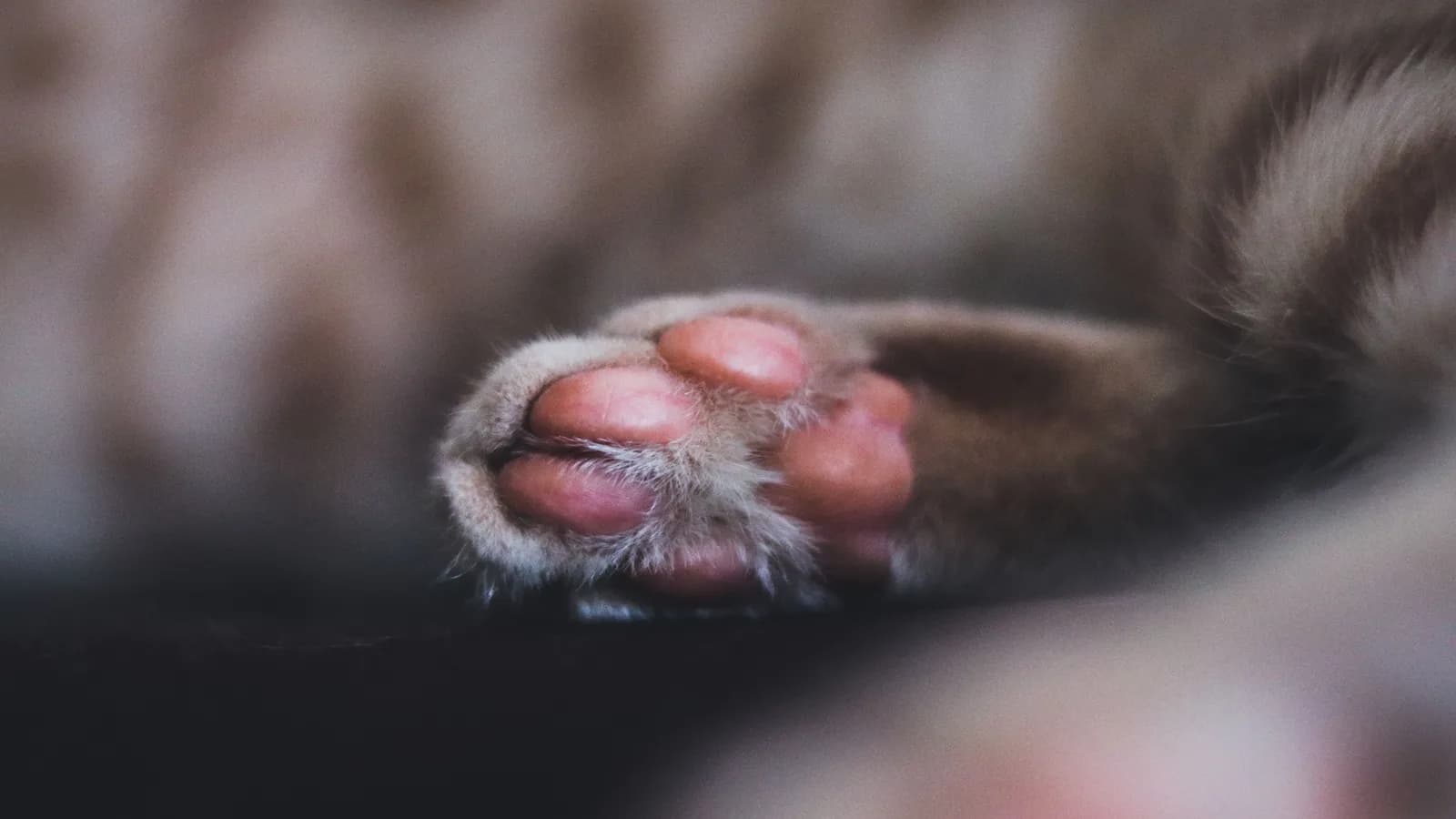
The internet calls them toe beans, anatomy calls them digital pads, and both names describe the same thing: the hairless, pigmented cushions a cat walks its whole life on. This page is the anatomy behind the nickname, and it comes with a warning label the usual listicles lack: three of the most repeated "facts" about paw pads could not be traced to a single study, and we will tell you which three.
The map of a paw
- Each front paw carries five small digital pads, one under each toe, counting the 's little pad that rarely touches the ground; one large central metacarpal pad, the heart-shaped one; and one small pad higher up the leg, near the wrist, which exists on the front legs only.
- Each back paw carries four digital pads and one central metatarsal pad, and no pad at all.
The toe COUNT is its own story, 18 in the standard cat and more in polydactyls, and it lives on our toes guide. One disambiguation worth a sentence, because the names collide: the pad is not the same structure as the carpal WHISKERS our whiskers guide covers. The whiskers sit on the back of the lower foreleg and read prey held in the paws; the pad sits lower, on the palm side. Same region, same word, different equipment.
What the cushions actually do
VCA's veterinary description is a job list: pads are "the thick, cushioned part of the cat's foot that absorb every step and provide traction to prevent slipping", they "protect bones and joints from shocks incurred by running, walking, or pouncing", and they insulate the foot from hot and cold ground. The shock-absorber part is not just clinic wisdom: a 2022 biomechanics study that built a finite-element model of a cat's forelimb across three landing heights confirmed the paw pad as the primary ground-contact, impact-absorbing structure in a landing. When a cat drops off the wardrobe and lands with that soft double thump, the pads are the sound.
Cats do sweat, and this is where
Cats carry true sweat glands, the eccrine kind, in essentially one place: per the Merck Veterinary Manual, in carnivores these glands "are present only on the footpads". Their cooling contribution is minor, which is why a hot cat grooms and seeks shade instead of sweating through it. But the glands respond to more than heat: a stressed or excited cat sweats through its paws, most famously as the little damp paw prints cats leave on a vet's exam table. If you have ever seen those prints, you have watched a cat's stress made visible.
One of the most sensitive surfaces science has measured
A 1993 anatomical study dissected the cat forefoot and counted its pressure sensors, the lamellated Pacinian corpuscles: 667 of them per forefoot on average, 80% packed into the toe region, the rest around the central pad. That density is no accident of one paper: the cat's foot pad was the standard laboratory preparation for classic touch-physiology research across the twentieth century, the model system in which much of what we know about vibration sensing was worked out. A cat stepping onto a surface is reading it in detail, which is one honest reason so many cats object to having their paws held.
Three famous claims, zero sources
The anatomy above is measured. These three claims, repeated on nearly every paw page on the internet, are not, and we checked.
- "Scent glands in the paws mark territory with every scratch." The glands between the toes exist as structures, but a 2025 systematic review of chemical-signal research across the entire order Carnivora, 290+ species, found the interdigital gland the least-studied gland category of all: zero species, zero identified chemicals. What IS documented is the behavior: a 1,060-cat randomized trial describes scratching as communication and maintenance, and it responds to pheromone signalling. The marking function is real behavioral science; the "chemical signature deposited by the pads" detail outruns anything actually measured.
- "The pad is an emergency brake for skids and descents." Plausible, given its position and its documented supply of pressure sensors. But the two most relevant studies, both 2022 papers on feline landing biomechanics, discuss the carpal bones at length and never once describe the carpal pad touching the ground. We found no peer-reviewed source for the braking claim, so we file it as widely repeated, not established.
- "Cats sense earthquakes through their paw pads." Nine consumer pages assert it, several contradicting each other on the mechanism, and none citing a study. No institutional or peer-reviewed source found. The Pacinian corpuscles are real; the seismology is a story.
Pillow foot: when a pad swells
Plasma cell pododermatitis, which owners and vets alike call pillow foot, is a rare immune-mediated condition in which one or more pads become soft, spongy and swollen, often pink to violet with fine white striations, sometimes ulcerating. It usually affects more than one foot, it can be painful enough to cause limping, and some cats show wider signs: poor condition, fever, lethargy. Studies have found a concurrent infection in roughly half of affected cats, with individual studies ranging from 44 to 62%, though whether the virus plays a causal role is unresolved.
The working explanation is an immune-system dysfunction, because immune-modulating treatment helps most cats: as a common first line, or steroids in others, a food-allergy trial in the subset where allergy seems involved, and surgery for the rare pad that does not respond, which the clinical literature calls usually curative. A visibly swollen, discolored or ulcerated pad is a vet appointment, not a wait-and-see.
Burns, frostbite and cuts: the thresholds
Pads are tough and still burnable, in the words of VCA: on "a scorching sidewalk in the middle of the summer", on icy surfaces, on a hot stove. The when-to-call lines below are VCA's own.
- Hot surfaces. The 's warm-weather guidance names asphalt specifically and says plainly to avoid surfaces that can burn a pet's paws. One honest note: the "press your hand to the pavement for seven seconds" test quoted everywhere is consumer advice framed for walking dogs; no institutional, cat-specific temperature threshold exists. For a burned pad: soak in room-temperature water, and if the pad discolors or the tissue under it becomes exposed, call the vet. Chemical spills: several minutes of running water, then mild soap, wearing gloves, because what burns the cat can burn you.
- Cold. Frostbite begins as temperatures drop below 32°F (0°C), and "the paws, ears, and tail are the most common tissues to be affected", more so on a wet cat. Pale, grey or bluish pads that are cold or painful to the touch mean immediate veterinary attention; on the way there, warm the area with water at 98.6 to 113°F (37 to 45°C), water your own hand sits comfortably in, and never dry heat or rubbing.
- Cuts and tears. Remove only shallow, easily grasped debris, disinfect with mild soap, and press to stop bleeding: bleeding that does not stop within 10 to 15 minutes is an emergency-clinic trip. After bandaging, swollen toes, a foul smell or moist discharge mean call the vet, and a wound still bleeding or gaping after three days needs professional care. Torn pads do not hold stitches well and get reopened by every step, which is why VCA advises a prompt vet visit even for minor pad wounds.
If something is wrong with your cat, call your vet; out of hours, an emergency clinic.
Small care, real payoff
Three low-drama habits, from grooming and veterinary-adjacent sources: keep the fur between the pads trimmed if it grows long enough to mat or to turn hard floors into an ice rink, and let a groomer or vet do it if your cat objects, since the webbing between toes is thin and easily nicked. Watch for litter-related irritation, since fragrances, drying clay and fine dust can inflame pad skin, and a cat licking or chewing its paws persistently has earned a vet check. And glance at the pads themselves now and then: dry, cracked or unusually thickened pad surfaces have causes running from dry air to conditions a vet should sort out.
Why toe beans come in colors
Pad color follows the same melanin story as the coat: black cats tend to black pads, white cats to pink ones, and a patchwork cat can carry a different bean on every toe, with the nose leather usually in the matching shade. New dark spots deserve one careful sentence: orange cats commonly develop , harmless freckling that the veterinary sources document on the lips, eyelids, nose and gums; some owners report the same spots on pads, though the institutional sources we checked name only the face. A flat, unchanging dark freckle on an orange cat is typically cosmetic; a RAISED, growing or ulcerated spot on a pad or toe is a vet visit, since the digit and footpad are documented sites where malignancy is a real concern.
What to take away
- "Toe beans" are the digital pads, one per toe, plus a central metacarpal (front) or metatarsal (back) pad; the name is internet slang, the anatomy is real.
- Cats sweat almost exclusively through their footpads (Merck): the damp prints on an exam table are mostly stress, not heat.
- Pillow foot (plasma cell pododermatitis) is a treatable immune condition with soft, spongy, swollen pads, and roughly half of affected cats test -positive across studies: a swollen pad sees a vet.
- Gradual flat darkening on an orange cat is usually benign ; a raised or growing dark spot on a pad deserves a vet's eyes.
- No institution publishes a cat-specific hot-pavement number; the honest rule is that a surface uncomfortable for your hand can burn a pad, and a burned pad shows as limping and licking.
 The vet's take

Veterinary review
Are you a vet?
Your professional read belongs here: every verified practitioner can leave a note, published once our editors have reviewed it.
Sign in and get your license number verified. We check it in the public register, we never ask for or keep a copy of your diploma, and your number is never published.
Frequently asked questions
Why are they called toe beans?
Internet slang, and a good description: the digital pads look like little beans. The name has no anatomical meaning; the structures are the digital pads, one per toe, plus the big central metacarpal pad on the front paw and metatarsal pad on the back.
Do cats sweat through their paws?
Yes, and almost only there: in carnivores, true sweat glands are present only on the footpads, per the Merck Veterinary Manual. The cooling effect is minor; the damp paw prints a nervous cat leaves on an exam table are mostly stress, not heat.
What is pillow foot in cats?
Plasma cell pododermatitis: an uncommon immune-mediated condition where pads swell soft and spongy, sometimes ulcerating, usually on more than one foot. Roughly half of affected cats also test FIV-positive across studies. It is treatable, usually with medication, and a swollen pad should see a vet.
Why are my cat's paw pads changing color?
Gradual, flat darkening on an orange cat is usually lentigo, benign freckling documented mainly on the face. Sudden color change is different: pale, grey or bluish pads in the cold suggest frostbite, and any raised or growing dark spot on a pad or toe deserves a vet's eyes.
How hot is too hot for a cat's paws on pavement?
No institution publishes a cat-specific number; the seven-second hand test everyone quotes is dog-walking advice. The honest rule: if the surface is uncomfortable for your hand, it can burn a pad, asphalt in summer sun most of all. Cats usually self-ration outdoor asphalt better than leashed dogs, but a burned pad shows as limping and licking, and discolored or exposed tissue is a vet call.
 Community questions
Got a question this page doesn't cover? Ask it: the best ones get published here with their answer.
This is information, not veterinary advice, and it cannot tell you what is wrong with your cat. Our rule is a simple one: if something is wrong with your cat, call your vet, and call an emergency clinic if it is out of hours. Nothing you read here is a reason to wait.
Medical information applies to every reader. Prices, legal duties and common practice do not: unless stated otherwise, they are given for the United States, and they differ in the UK, Canada and Australia, and often between states or provinces. Check with your own vet and your own local authority.
Our sources
- VCA Animal Hospitals, injured foot pads in cats (structure, burns, cuts and the when-to-call thresholds)
- VCA Animal Hospitals, frostbite in cats (the 32F onset and rewarming range)
- Merck Veterinary Manual, structure of the skin in cats (sweat glands on the feet)
- Merck Veterinary Manual (professional), the integumentary system in animals (atrichial glands only on the footpads; wet paw prints)
- Merck Veterinary Manual (professional), pigmentary abnormalities in animals (lentigo sites in cats)
- Xu et al 2022, feline paw biomechanics under different landing constraints, Front Vet Sci 9
- Distribution of Pacinian corpuscles in the cat forefoot (667 per forefoot), J Anat 1993
- 2025 systematic review of potentially shared chemical signals in the order Carnivora (the zero-analysis interdigital finding)
- 2023 randomised triple-blind trial on scratching and the facial pheromone diffuser (1,060 cats)
- Melanoma of the dog and cat: 2024 consensus and guidelines (the digit and footpad malignancy-site note)
- Clinician's Brief, feline plasma cell pododermatitis: key signs and treatment
- Mar Vista Animal Medical Center, plasma cell pododermatitis (the independent corroboration)
- AVMA, warm weather pet safety (the asphalt warning)

Worth keeping a paw on
Pin this guide
So you can find it the day you need it, and share it with someone whose cat does the same thing. One click and it sits in your board.
Pin it on PinterestAlso worth reading
All cat facts →
Article
How Many Lives Do Cats Have? One, and a Very Old Story
One, officially. Where the nine-lives saying really comes from on paper, the countries that count seven, and the physics that makes the myth feel true.
Read
Article
Why Do Cats Sleep So Much? A Professional Explains His Craft
Cats sleep more than almost anyone, but the famous 16-hour figure is fuzzier than it looks. What surveys and sleep labs actually measured, plus dreams, twitching, and when to worry.
Read
Article
What Does Catnip Do to Cats? A Ten-Minute Party, Scientifically Catered
What does catnip do to cats? A short euphoric high, an opioid-backed glow, and a built-in mosquito repellent. The science of nepetalactone, the silver vine backup, and the safety notes.
Read
The floor belongs to our members. Keep it kind, links are not allowed, and images go through moderation before anyone else sees them.