

How Many Lives Do Cats Have? One, and a Very Old Story
One, officially. Where the nine-lives saying really comes from on paper, the countries that count seven, and the physics that makes the myth feel true.

Published August 26, 2026Updated September 8, 2026 7 min read
Contents
The literal answer is one, the same as the rest of us, and our lifespan guide carries the real measured numbers for how long that one life runs. The interesting question is the other one: why the entire English-speaking world grants cats NINE lives, why Spain grants them seven, and why the myth refuses to die. The answer involves a Tudor proverb collector, Shakespeare picking a fight, a French scientist dropping a cat in front of a camera in 1894, and a reflex real enough to have its own developmental timetable.
The nine lives, on paper
The saying is older than any page you will find repeating it. The earliest solid written form in English sits in John Heywood's 1546 proverb collection: "a woman hath nine lives like a cat". Notice the construction, because it is the historians' favorite detail: the cat's nine lives are not being introduced, they are being used as the familiar half of a comparison. By 1546 the belief was already old furniture. Half a century later Shakespeare could hang a duel on it: in Romeo and Juliet, Mercutio goads Tybalt with "Good king of cats, nothing but one of your nine lives, that I mean to make bold withal". When a joke works on a full Elizabethan audience, everyone in the room already knows the myth.
Why nine? The origin stories, ranked by their paperwork
Here this page does something the usual listicles skip: it checked.
- The Egypt story, as told, has no sources. Nearly every "nine lives" page repeats that the sun god Atum-Ra and his nine gods, the Ennead, inspired the cat's nine lives. We searched the Egyptology references: detailed accounts of the Ennead everywhere, cats' nine lives in none of them. Even Britannica's own short article skips Atum-Ra entirely and offers only a hedged Bastet angle, that Egypt's reverence for cats "may have contributed" to the idea. Ancient Egypt adored cats; the specific nine-gods connection is a blog tradition, not a documented one.
- The Scottish thread has better paperwork and less publicity. Highland folklore, written down in a named 19th-century compilation, tells of the Cat Sìth: in some tellings a witch who could take cat form nine times, and after the ninth change stayed a cat forever. Our black cat names page tells that story, since the Cat Sìth is black. Honesty requires one more sentence: the folklore fact is sourced, while the line connecting those nine transformations to the nine-lives saying is an inference repeated by folklore sites rather than a documented link. It is a candidate origin, and a good one; it is not a proven one. Nobody's is.
- The likeliest boring truth: cats survive things that would end other animals, people reached for a number with old magic weight in European tradition, and nine stuck in English. The proverb was already "common knowledge" at its first written appearance, which usually means the true origin is unrecoverable.
Not everywhere nine
In Spanish the cat gets seven lives, and the proverb collections have receipts: "siete vidas tiene el gato". Iran also counts seven, per Britannica. The claim that Turkish and Arabic traditions count six circulates widely online, but we could trace it to no proverb dictionary or folklore source, so we report it as exactly that: widely repeated, never footnoted. The pattern underneath is the interesting part: every version picks a culturally loaded lucky number, and every version agrees the cat deserves extra.
The science that keeps the myth alive
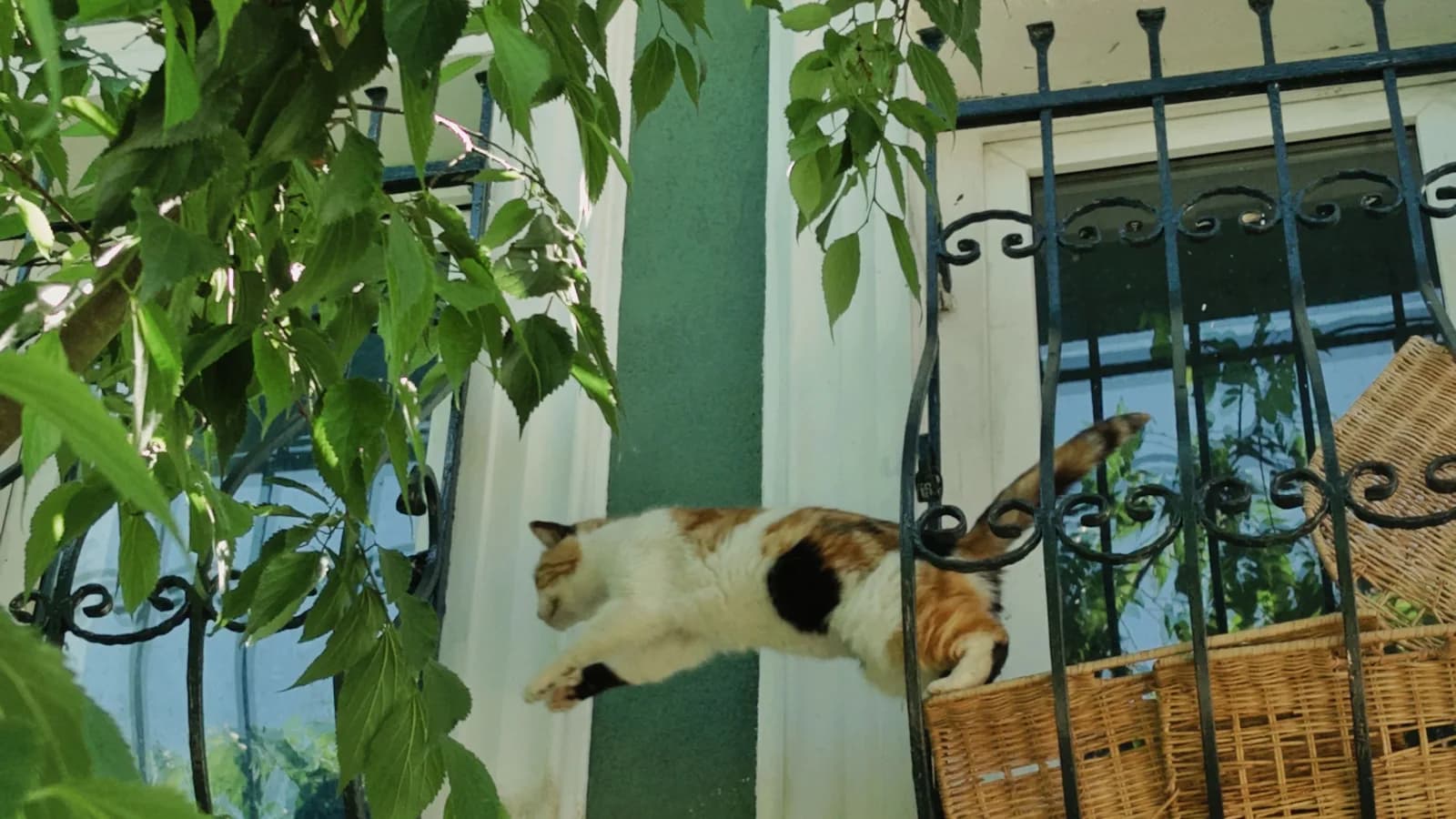
The myth survives because cats really do walk away from falls that should not be walkable, and the machinery behind that is measured.
- The righting reflex is real and runs on the inner ear. Classic experiments established that the air-righting reflex is primarily vestibular, driven by the balance organs rather than the eyes: kittens blind from birth develop it on exactly the same schedule as sighted ones. It matures by 33 to 35 days of age in the two studies that timed it, which means a five-week-old kitten carries a completed piece of aerial equipment.
- A scientist photographed the impossible in 1894. Physicists long insisted a falling cat must push off something to rotate, since a body cannot create its own spin from nothing. Étienne-Jules Marey filmed a dropped cat at 12 frames per second and caught physics being wrong, or rather incomplete: the cat starts with zero rotation and turns anyway, by twisting its front and back halves in opposite directions, tucking the front legs to spin the front half fast while the stretched back half barely moves, then swapping.
- In 2026 the anatomy got its number. A study combining spine mechanics and live motion capture found the secret is built into the skeleton: the spine, behind the shoulders, has a 47-degree free-twisting zone, while the spine has essentially none. The flexible front rotates first, the rigid rear follows, exactly the sequence Marey's photographs show.
The part of the myth cats pay for
Vets have a name for what happens when the myth meets an open window: high-rise syndrome. The survival numbers are genuinely remarkable, and they are also an argument for screens, not for confidence. Across three eras of studies: 90% of treated cats survived in the original 1987 New York series, 96.5% of 119 cats in a 2004 study, and 87% of 1,125 cats in the largest study ever run, published in 2025 from a Berlin clinic. That last study also measured when the falls happen: mostly summer, mostly at night, mostly cats around two years old.
One popular "fact" needs retiring: the tidy claim that cats fall SAFER from higher floors. The studies themselves disagree, and say so. The 2004 study found injuries got worse from the seventh floor up; the 2025 study found the truth depends on the injury type, with some injuries decreasing at height while spinal injuries and fractures increased in its data, and survival holding above 80% up to about 21 meters before dropping. When the largest study in the field writes that "significant inconsistencies remain in the literature", a listicle's single tidy curve is storytelling. What no study disputes: a fallen cat goes to the vet immediately, even one that looks fine, because internal injuries hide, and treated cats survive at 90%.
Prevention is unglamorous and institutional: snug, sturdy window screens, with the adding that childproof window guards are NOT enough, since cats slip through them. In Australia and Canada the balcony leads the advice: the Cat Protection Society of NSW recommends cat netting enclosing the balcony floor to rooftop, and Canadian humane societies say the same after every springtime fall. A cat has one life and a righting reflex; the screen is for the gap between the two. If something is wrong with your cat, call your vet; out of hours, an emergency clinic.
What to take away
- Cats have exactly one life; the nine is an English proverb at least five centuries old (in print by 1546), and its true origin is lost.
- The Egypt story told everywhere has no scholarly source behind it; the common thread is simply that cats survive improbably and people gave it a lucky number.
- The righting reflex is real, inner-ear driven, and mature by about five weeks old, and it fails in documented ways: young cats, and falls interrupted by branches or walls.
- Cats that fall from height and reach a vet survive around 90% of the time in the studies; that is an emergency-medicine statistic, not a safety margin, and every institution says the same thing: screen the windows.
- Spain and Iran give cats seven lives; the six of Turkish and Arabic tradition circulates online without a source we could trace.
 The vet's take

Veterinary review
Are you a vet?
Your professional read belongs here: every verified practitioner can leave a note, published once our editors have reviewed it.
Sign in and get your license number verified. We check it in the public register, we never ask for or keep a copy of your diploma, and your number is never published.
Frequently asked questions
How many lives do cats have really?
One. The measured version of that one life, how long cats actually live and what helps, lives on our lifespan guide. The nine is a proverb at least five centuries old in English.
Why do people say cats have nine lives?
Because by 1546, when the saying first shows up in writing, everyone already said it. The honest answer is that the true origin is lost: the Egypt story told everywhere has no scholarly source behind it, the Scottish witch-transformation folklore is sourced but its link to the saying is inference, and the common thread is simply that cats survive improbably and people gave that a lucky number.
Do cats always land on their feet?
No. The righting reflex is real, inner-ear driven and mature by about five weeks old, but the 2025 Berlin study names its failures plainly: young inexperienced cats, and falls interrupted by branches or walls. Reflex or no reflex, its own authors' conclusion is window screens.
Can a cat survive a fall from a high window?
Often, with immediate veterinary care: treated cats survive around 90% in the studies. That number is an emergency-medicine statistic, not a safety margin, and every institution in the field says the same two things: screen the window or net the balcony, and take any fallen cat to a vet at once, even if it seems unhurt.
Which countries say cats have seven lives?
Spain and the Spanish-speaking world, where the proverb runs "siete vidas tiene el gato", and Iran. The saying that Turkish and Arabic traditions count six circulates online without a source we could trace.
 Community questions
Got a question this page doesn't cover? Ask it: the best ones get published here with their answer.
This is information, not veterinary advice, and it cannot tell you what is wrong with your cat. Our rule is a simple one: if something is wrong with your cat, call your vet, and call an emergency clinic if it is out of hours. Nothing you read here is a reason to wait.
Medical information applies to every reader. Prices, legal duties and common practice do not: unless stated otherwise, they are given for the United States, and they differ in the UK, Canada and Australia, and often between states or provinces. Check with your own vet and your own local authority.
Our sources
- John Heywood, Proverbes (1546), in Sharman's 1874 critical edition, read at the Internet Archive
- Shakespeare, Romeo and Juliet, act 3 scene 1 (Mercutio's nine-lives line), Folger Shakespeare Library
- Britannica, why do they say cats have nine lives? (the hedged Bastet angle and the Iran figure)
- Wikipedia, Cat-sith (the witch-transformation folklore, citing Campbell's 19th-century compilation)
- Refranero Castellano, Spanish cat proverbs (siete vidas tiene el gato)
- Cremieux, Veraart, Wanet 1984, development of the air righting reflex in cats visually deprived since birth, Exp Brain Res
- Villablanca, Olmstead 1979, neurological development of kittens (righting reaction mature by 35 days)
- Higurashi et al 2026, torsional flexibility of the thoracic spine and the falling cat problem, Anatomical Record
- The Public Domain Review, photographs of a falling cat (1894): Marey's chronophotography
- Whitney, Mehlhaff 1987, high-rise syndrome in cats (132 cats, New York), J Am Vet Med Assoc 191
- High-rise syndrome in cats part 1: epidemiology and risk factors (1,125 cats, Berlin), J Feline Med Surg 2025
- High-rise syndrome in cats part 2: injury patterns and survival rate, J Feline Med Surg 2025
- Vnuk et al 2004, feline high-rise syndrome: 119 cases (1998-2001), J Feline Med Surg 6
- ASPCA, high-rise syndrome: lifesaving tips for cat parents (screens; childproof guards insufficient)
- Cat Protection Society of NSW (Australia), balcony safety factsheet
- Global News, BC SPCA advice after a balcony fall (Canada)

Worth keeping a paw on
Pin this guide
So you can find it the day you need it, and share it with someone whose cat does the same thing. One click and it sits in your board.
Pin it on PinterestAlso worth reading
All cat facts →
Article
Why Do Cats Sleep So Much? A Professional Explains His Craft
Cats sleep more than almost anyone, but the famous 16-hour figure is fuzzier than it looks. What surveys and sleep labs actually measured, plus dreams, twitching, and when to worry.
Read
Article
What Does Catnip Do to Cats? A Ten-Minute Party, Scientifically Catered
What does catnip do to cats? A short euphoric high, an opioid-backed glow, and a built-in mosquito repellent. The science of nepetalactone, the silver vine backup, and the safety notes.
Read
Article
The Cat Loaf: Why Cats Turn Into Bread, and How to Read One
The cat loaf, decoded: why cats fold into bread (your house is colder than they want), what tucked paws say about trust, five loaf variants, and the one hunched version that needs a vet.
Read
The floor belongs to our members. Keep it kind, links are not allowed, and images go through moderation before anyone else sees them.