

Black Cat Names, With the Stories Behind Them
Bad luck in America, good luck in Britain and Japan. The superstition splits by country, the adoption research contradicts it, and every name has an origin.

Published August 25, 2026Updated September 8, 2026 6 min read
Contents
Anyone can hand you a list of two hundred names for a black cat. What almost nobody tells you is where they came from, or that whether your cat is lucky depends entirely on which country you are standing in. (Different coat on your lap? We keep orange cat names and grey cat names on their own pages, stories included.)
The superstition splits by country, and that is the good bit
This is the fact that makes a black cat interesting, and it is genuinely market-specific.
| Where | What a black cat crossing your path means |
|---|---|
| United States | Bad luck. The association runs through colonial-era witch panic. |
| United Kingdom | Good luck, with regional variations: in Yorkshire and parts of Scotland a black cat in the house brings fortune, and one was traditionally given to brides. |
| Ireland | Lucky, though an older 1888 folklore record carries a warier version. |
| Japan | Lucky, particularly associated with warding off misfortune. |
| Australia | The imported British reading, with a 1921 Sydney newspaper recording the lucky version. |
| Canada | We could not find an institutional source either way, so we are not going to invent one. |
Same animal, opposite meanings, a few thousand kilometers apart.
The claim we expected to confirm and could not
You will have read that black cats are adopted less often and euthanised more, sometimes called black cat syndrome. It is repeated constantly, including by people who mean well.
Here is what the research actually shows, and it splits in two.
The perception effect is real and replicated. Shown photographs, people consistently rate black cats as less adoptable, less friendly, harder to read.
The outcome effect is much weaker and inconsistent. Market by market: one Ontario study found a clean effect, the largest US study found it weak, studies in Washington DC and Sydney found it absent or reversed, and a 2026 Australian study found black cats rated more adoptable.
There is also a direct empirical answer to the Halloween question: no October adoption penalty was found.
So the honest version is that people say they find black cats less appealing and then, in most places measured, adopt them at roughly the same rate anyway. Which is a nicer story than the one everybody repeats.
The Halloween adoption bans
Those were real US shelter policy, at named organizations including the Maryland SPCA, Denver's Maxfund and the itself: no black cat adoptions in the run-up to Halloween, on the fear of ritual harm.
No actual cases were ever substantiated. The policy has since been disavowed by the successor to the body that promoted it and by Shelter Animals Count. The UK, Canada and Australia never had the same ban culture.
The names
Mythology and folklore, each with what is actually documented:
- Bastet, the Egyptian goddess of protection and the home, who shifted from a lioness form towards a domestic cat by around 1500 BC. Worth saying plainly: she is the cat goddess, and no surviving record specifies her color. The bronze statuettes read dark, which is probably where the modern association comes from.
- Grimalkin, from graymalkin, literally grey plus Malkin, a generic old nickname for a cat. It opens Macbeth: "I come, Graymalkin", spoken by a witch to her familiar. The name is grey-coded and the witch association is what pulls it onto black-cat lists.
- Cat Sìth, the Scottish Highland fairy cat: large, black, with a single white spot on the chest, said to take the soul of the newly dead from an unwatched body. Some tellings make it a witch who could turn into a cat nine times, which is one of the roots of the nine lives idea.
- Pyewacket, a genuine familiar-spirit name confessed during Matthew Hopkins's witch-hunt at Manningtree, Essex, in March 1644. ⚠️ It is often wrongly attributed to the 1566 Elizabeth Style trial, seventy-eight years earlier and a different case entirely. Popularised for modern audiences by the 1958 film Bell, Book and Candle.
- Hecate, Greek goddess of witchcraft and the night. The black cat link runs indirectly, through Galinthias, who was turned into a black cat and taken into Hecate's service.
Black things, from the natural world and the kitchen. Onyx, Obsidian, Jet, Coal, Soot, Ash, Ink, Raven, Crow, Midnight, Eclipse, Shadow, Umbra, Sable, Ebony, Licorice, Espresso, Mocha, Cocoa, Truffle, Olive, Pepper, Caviar, Vanta.
From culture, with the source named: Salem (Sabrina the Teenage Witch), Binx (Hocus Pocus, 1993), Luna (Sailor Moon), Jiji (Kiki's Delivery Service, 1989), Toothless (a dragon, but the cat energy is undeniable), Berlioz (The Aristocats), Isis (Star Trek), Behemoth (Bulgakov's The Master and Margarita, a giant black cat who drinks vodka).
⚠️ Bagheera appears on every black cat name list. He is a black panther in The Jungle Book, not a domestic cat. Use it if you love it, but know what you are naming your cat after.
Names that mean black elsewhere. Kuro (Japanese), Hei (Mandarin), Noir (French), Nero (Italian), Preto (Portuguese), Schwarz (German), Zwart (Dutch), Ciemny (Polish, dark), Dubh (Irish Gaelic, pronounced roughly "doov"), Kara (Turkish), Musta (Finnish). ⚠️ Spanish negro/negra is the accurate translation and carries a loaded history in English-speaking countries; we are naming it here rather than quietly listing it.
Funny. Void, Shadow Beast, Bagel, Panther, Batman, Nyx, Toothless, Meatball, Hole, Vantablack, Sir Sootsalot.
The other coats now have their own pages with the same treatment: white cat names, calico cat names, tuxedo cat names and tabby cat names; and if the question is the sex rather than the coat, boy cat names and girl cat names carry the rankings from every market.
What actually gets used
Real ranking data for black cats specifically is thin. The one genuine survey we found is British: Cats Protection's owner survey names Sooty as the most common name for a black cat. A US dataset from Rover exists but publishes no sample size. Canada and Australia have no published coat-specific ranking at all, and we would rather say that than fill the gap.
Which breeds are actually black
The Bombay is the one breed defined by it: bred deliberately to look like a miniature panther, black to the roots with copper eyes, and recognized as such by both and . Note that the British Bombay recognized by the is a genuinely different breed from the American one.
The British Shorthair and the Persian both accept black in their standards.
And two that are never black, whatever a listing says: the Chartreux and the Russian Blue are blue only.
The ghost stripes
Look at a black cat in strong sunlight and you will often see faint tabby markings underneath, like a watermark.
That is not a trick of the light. Underneath the black, the tabby pattern is still coded; the gene simply fills the banded hairs in solid. In bright light the ghost of the pattern shows through. It is the sort of thing you only notice once, and then see forever. Those hidden stripes have a whole page of their own in our tabby guide, and the black-and-white version of the disguise shows up on tuxedo cats too.
What to take away
- Black cat luck depends on the country: bad luck in much of the US, good luck in Britain, Ireland and Japan, where black cats were traditionally welcome.
- "Black cat syndrome" is half true: people rate photographed black cats as less adoptable (a replicated finding), but the actual adoption-outcome studies are mixed to absent, and a 2026 Australian study found black cats rated more adoptable.
- The only genuine coat-specific name survey we found is British: Cats Protection names Sooty.
- Most black cats are not a breed; the one breed defined by black is the Bombay (black to the roots, copper eyes), while the Chartreux and Russian Blue never come in black.
- The faint stripes on a black cat in sunlight are the tabby pattern that the solid-black gene fills in but does not erase.
 The vet's take
Veterinary review
Are you a vet?
Your professional read belongs here: every verified practitioner can leave a note, published once our editors have reviewed it.
Sign in and get your license number verified. We check it in the public register, we never ask for or keep a copy of your diploma, and your number is never published.
Frequently asked questions
Are black cats bad luck?
Depends where you are, which is the interesting part. Bad luck in much of the United States, good luck in Britain, Ireland and Japan, where a black cat in the house was traditionally welcome and one was given to brides in parts of Yorkshire and Scotland.
Is black cat syndrome real?
Partly. Shown photographs, people do consistently rate black cats as less adoptable, and that finding replicates. The adoption outcomes are a different story: one Ontario study found an effect, the largest US study found it weak, and studies in Washington DC and Sydney found it absent or reversed. A 2026 Australian study found black cats rated more adoptable.
Do shelters really stop adopting out black cats at Halloween?
Some US shelters did, at named organizations, on fears of ritual harm that were never substantiated. The policy has been disavowed since. The UK, Canada and Australia never had the same practice.
What is the most popular name for a black cat?
The only genuine survey we found is British, from Cats Protection, and it names Sooty. There is no published coat-specific ranking for Canada or Australia, and the US dataset that exists gives no sample size.
What breed is an all-black cat?
Most black cats are not a breed at all. The one breed defined by it is the Bombay, bred to look like a small panther, black to the roots with copper eyes. The British Shorthair and Persian also come in black. The Chartreux and Russian Blue never do.
Why does my black cat have faint stripes in sunlight?
Because the tabby pattern is still there underneath. The gene that makes a cat solid black fills in what would otherwise be banded hairs, and strong light reveals the ghost of the pattern beneath.
 Community questions
Got a question this page doesn't cover? Ask it: the best ones get published here with their answer.
Our sources
- Kaelin et al 2012, specifying and sustaining pigmentation patterns in domestic and wild cats (the ghost tabby pattern under solid black), Science 337(6101)
- Cats Protection, UK owner survey naming the most common names by coat color (Sooty for black cats)
- US National Library of Medicine, cats in folklore and superstition (the market split on black cats)
- Cat Fanciers' Association, Bombay breed profile (the one breed defined as solid black)
- TICA, Bombay breed page

Worth keeping a paw on
Pin this guide
So you can find it the day you need it, and share it with someone whose cat does the same thing. One click and it sits in your board.
Pin it on PinterestAlso worth reading
All cat names →
Article
Orange Cat Names, and Why Your Ginger Cat Is Probably a Boy
The gene behind orange fur was only identified in 2025, by two labs at once, and it explains why ginger cats are mostly boys. Plus 60 names with their origins.
Read
Article
Grey Cat Names, and Why Every Registry Calls Them Blue
No cat registry has a color called grey. They all say blue, the genetics explain why, and telling solid from smoke changes which name suits your cat.
Read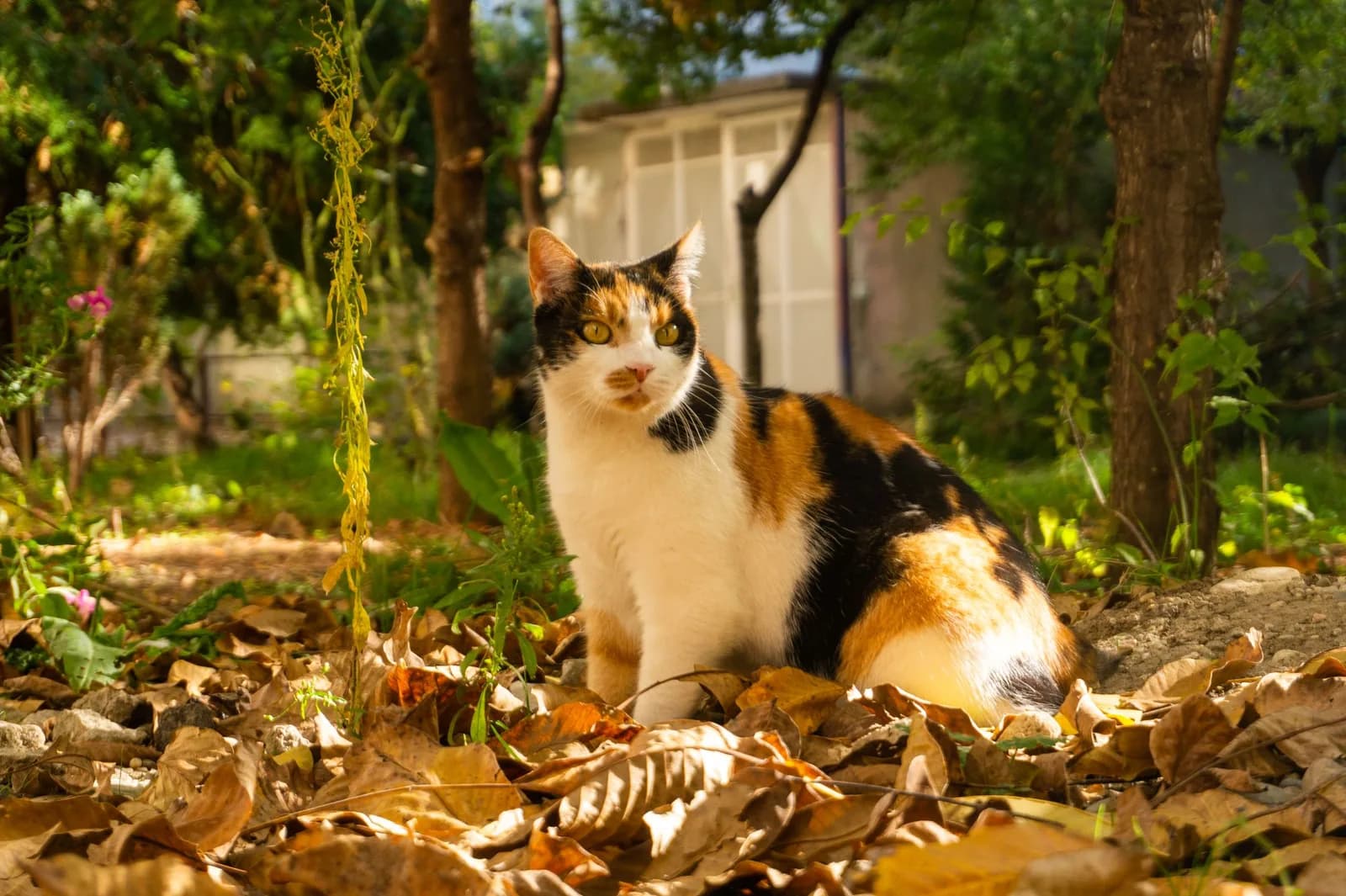
Article
Calico Cat Names, With the Stories Behind Them
Maryland's state cat, Japan's mi-ke and the maneki-neko, the tortitude study read properly, four real famous calicos, and names with their origins. Torties included.
Read
The floor belongs to our members. Keep it kind, links are not allowed, and images go through moderation before anyone else sees them.