

How Many Toes Do Cats Have? The Answer, and the Exceptions
A cat has 18 toes, five in front and four behind. Here is the gene behind the cats born with more, why registries disagree, and the record that changed in 2026.

Published August 25, 2026Updated September 8, 2026 6 min read
Contents
Eighteen. Five on each front paw, four on each back paw.
That is the whole answer, and it takes one line, which is why almost nobody searching for it stops there. What people actually want to know is why the front paws get an extra one, and what is going on with the cats that have considerably more.
The toe that never touches the ground
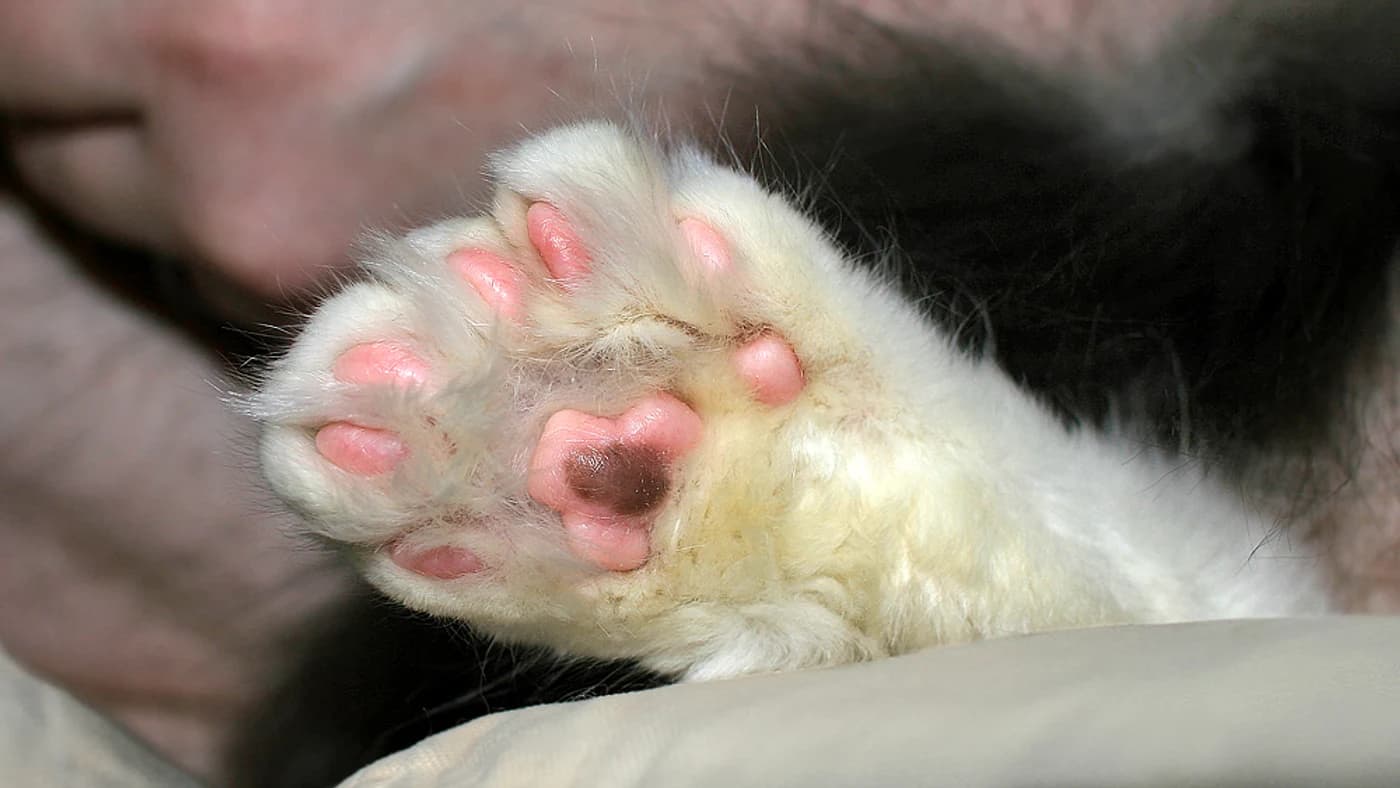
Count a front paw and you will find four toes on the ground and a fifth sitting higher up the leg, set back from the others. That is the , the cat's vestigial first digit, the equivalent of your thumb.
It does not reach the floor. Which matters more than it sounds, because a claw that never contacts a surface never wears down against one. The other claws file themselves as a cat walks and scratches; the does not. Left alone, it keeps growing, and it grows in a curve, back towards the pad.
So the needs its own look, on its own schedule, every time you check your cat's feet. Cats do not have rear dewclaws as standard.
Polydactyly: what is actually happening
A cat is one born with more than the baseline. It ranges from a single extra to several extra full toes, and it can appear on one paw or all four.
The mechanism is genuinely elegant. Limb development is directed by a gene called , switched on in the right place at the right moment by a distant regulatory sequence called the . The ZRS does not even sit inside the Sonic Hedgehog gene: it sits inside an intron of a neighbouring gene, LMBR1, and reaches across to control it. A point mutation in the ZRS switches Sonic Hedgehog on in the wrong part of the developing limb bud, and the limb builds extra digits.
Three of those mutations are documented by name in cats:
| Variant | Where it was identified |
|---|---|
| Hw | The United States, first traced in Hemingway's own cats |
| UK1 | Outbred domestic cats in the United Kingdom |
| UK2 | Outbred domestic cats in the United Kingdom |
The trait is inherited as a dominant, so one copy is enough. But in Maine Coons it shows and variable expression, which is the technical way of saying that carrying the mutation does not guarantee showing it, and showing it does not tell you how much. That is precisely why one litter produces kittens with six toes, seven toes, and a perfectly standard five, all from the same parents.
The record changed in May 2026, and most pages have not noticed
The Guinness World Record for most toes on a cat now stands at 29, held by a cat called Erebus in Kaukauna, Wisconsin, whose owners are Kendra Vandenbloomer and Hunter Nett. The record was set on 13 May 2026.
It replaced a record of 28 that had stood since 2002. If you read almost any other page answering this question today, you will still be told the record is 28.
The Hemingway cats, and a name most sites get wrong
The Ernest Hemingway Home and Museum in Key West, Florida keeps nearly 60 cats today. About half of them physically show extra toes, though the museum states all of them carry the gene.
They descend from a white six-toed cat given to Hemingway by a ship's captain. The museum's own page names her Snow White. A good number of secondary sites call her Snowball instead. When the museum that has kept the colony for decades and a blog disagree about the founding cat's name, we go with the museum.
The ship's captain detail is not incidental, by the way. Polydactyl cats were prized aboard ships, and the concentration of the trait in port cities on both sides of the Atlantic is the fingerprint of cats travelling by sea.
Five registries, five different answers, and it splits by country
This is where the subject stops being a curiosity and starts having consequences, because whether a cat can be registered or shown depends entirely on which body you ask.
| Registry | Position on Maine Coons |
|---|---|
| (US, international) | Accepts it outright, with its own division, Maine Coon Polydactyl. Capped at seven toes on any one foot, and the standard states plainly that there is no preference for more toes rather than fewer. |
| (US) | Disqualifies an incorrect toe count from the show ring. Its registration rules do not mention toe count at all. |
| (UK) | Refuses registration. Its Maine Coon breed committee does not accept cats in UK breeding programs, and imported cats must test negative. |
| (Canada) | States it directly: no Maine Coon allowed. Incorrect toe count withholds awards, with the Pixie-Bob the only exemption. |
| (Australia) | Codes polydactyly in its system for the Pixiebob only. Nothing equivalent for the Maine Coon. |
Read down that column and the pattern is hard to miss. The one registry that embraces the trait is the one whose home country produced the Hemingway cats. Where a breed's history includes polydactyly, the local registry tends to have made room for it; where it does not, the trait reads as a fault.
Living with a cat that has extra toes
Every source agrees on one practical point, and it is the same one as the , multiplied.
Extra toes usually mean extra claws that never touch the ground, so they never wear down. An unclipped claw on a non-weight-bearing toe curls round into the pad, and that hurts long before anyone notices. Check the extra toes every time, not just the ones you can see from above.
Beyond that, polydactyly is generally benign. Cats with extra toes walk, jump, hunt and land like any other cat.
One thing polydactyly is not, and the confusion matters
There is a separate condition called , also known as radial agenesis and sometimes as the twisty cat mutation. It is not extra toes. It is the radius, one of the two bones of the forearm, failing to develop properly, so the foreleg comes out short and twisted, in severe cases so badly that the paw appears to attach near the elbow.
The two get conflated, including by people who should know better, and they are genetically unrelated. A 2023 whole-genome study of an affected Siamese family placed the cause in the CMYA5 and JMY genes, on a chromosomal region with nothing to do with the . It is also inherited recessively, the opposite pattern to polydactyly.
Older breeder literature, written before DNA testing existed, reported an apparent link between certain paw shapes and in offspring. The genetics do not support a shared gene, and even that older material states that Maine Coons do not carry it.
If anything about your cat's legs or feet looks wrong to you, that is a conversation for your vet, and out of hours, an emergency clinic. Nothing on this page is a reason to wait.
What to take away
- Eighteen toes is standard: five in front, four behind.
- The fifth front toe is the . It never touches the ground, so its claw never wears down. Check it.
- Polydactyly comes from a point mutation in a distant switch called the , which turns on in the wrong place. Three variants are named in cats.
- It is dominant, but with , which is why one litter can hold six toes, seven toes and five.
- The record is 29, set on 13 May 2026, not the 28 you will read elsewhere.
- welcomes Maine Coons. The and refuse them. Which registry you ask decides the answer.
- Radial hypoplasia is a different condition with different genes. Do not conflate them.
While you are counting your cat's parts: a cat's whiskers grow in five places, not one, the spines on its tongue are hollow scoops, and its lives number exactly one, a story older than Rome.
 The vet's take

Veterinary review
Are you a vet?
Your professional read belongs here: every verified practitioner can leave a note, published once our editors have reviewed it.
Sign in and get your license number verified. We check it in the public register, we never ask for or keep a copy of your diploma, and your number is never published.
Frequently asked questions
How many toes does a cat have?
Eighteen: five on each front paw and four on each back paw. The fifth front toe is the dewclaw, which sits higher on the leg and never touches the ground.
Why do cats have a dewclaw?
It is the vestigial first digit, the equivalent of a thumb. Cats use it to grip prey and to hold on when climbing. Because it never contacts the ground, its claw never files itself down, so it needs checking and trimming more often than the others.
What causes a cat to have extra toes?
A point mutation in the ZRS, a distant regulatory sequence that controls the Sonic Hedgehog gene during limb development. The mutation switches that gene on in the wrong part of the limb bud and extra digits form. Three variants are documented in cats: Hw in the United States, UK1 and UK2 in Britain.
Is polydactyly harmful to a cat?
Generally no. The one real care point is the claws: extra toes often do not touch the ground, so their claws never wear down and can curl into the pad if nobody clips them. Check every toe, not only the visible ones.
What is the world record for most toes on a cat?
Twenty-nine, held by Erebus of Kaukauna, Wisconsin, since 13 May 2026. The previous record of 28 had stood since 2002, and many pages still quote it.
Can a polydactyl Maine Coon be shown?
It depends entirely on the registry. TICA accepts them in a dedicated Maine Coon Polydactyl division, capped at seven toes per foot. CFA disqualifies an incorrect toe count from the ring. The GCCF in Britain and CCA-AFC in Canada do not permit them at all.
Are Hemingway cats a breed?
No. Hemingway cat is a nickname for a polydactyl cat, after the colony at the Ernest Hemingway Home and Museum in Key West, which keeps nearly 60 today. They descend from a white six-toed cat the museum names Snow White, given to Hemingway by a ship's captain.
 Community questions
Got a question this page doesn't cover? Ask it: the best ones get published here with their answer.
Our sources
- Lettice et al 2008, point mutations in a distant sonic hedgehog cis-regulator generate a variable regulatory output, Human Molecular Genetics 17(7)
- Hamelin et al 2017, clinical characterisation of polydactyly in Maine Coon cats, J Feline Med Surg 19(4)
- Hamelin et al 2020, genetic heterogeneity of polydactyly in Maine Coon cats (the Hw, UK1 and UK2 variants), J Feline Med Surg 22(12)
- Bilgen et al 2023, CMYA5 implicated as a genetic risk factor for radial hemimelia in cats, J Feline Med Surg 25(10)
- Guinness World Records, most toes on a cat (Erebus, 29 toes, 13 May 2026)
- The Ernest Hemingway Home and Museum, our cats (the colony, and the founding cat named Snow White)
- TICA, Maine Coon Polydactyl breed page and standard (accepted, capped at seven toes per foot)
- CFA, Maine Coon breed standard (five toes in front, four in back; incorrect toe count disqualifies)
- International Cat Care, polydactyl cats

Worth keeping a paw on
Pin this guide
So you can find it the day you need it, and share it with someone whose cat does the same thing. One click and it sits in your board.
Pin it on PinterestAlso worth reading
All cat facts →
Article
Cat Paw Pads: A Field Guide to Toe Beans
What toe beans actually are, the sweat glands hiding in them, the three claims no study backs, and the paw problems worth a vet call.
Read
Article
How Many Lives Do Cats Have? One, and a Very Old Story
One, officially. Where the nine-lives saying really comes from on paper, the countries that count seven, and the physics that makes the myth feel true.
Read
Article
Why Do Cats Sleep So Much? A Professional Explains His Craft
Cats sleep more than almost anyone, but the famous 16-hour figure is fuzzier than it looks. What surveys and sleep labs actually measured, plus dreams, twitching, and when to worry.
Read
The floor belongs to our members. Keep it kind, links are not allowed, and images go through moderation before anyone else sees them.