

Why a Cat's Tongue Is Rough, and What It Can Taste
A cat's tongue spines are hollow scoops that wick saliva down to the skin, cats cannot taste sugar at all, and they do not scoop water. What has been measured.
Published August 25, 2026Updated September 8, 2026 8 min read
Contents
Three things are true about a cat's tongue, and most of what you will read about it gets all three wrong.
The rough spines are not solid cones, they are hollow scoops. Cats do not lap water by scooping it. And the taste bud count that every page repeats traces back to no source anybody can check.
None of that is opinion. It was measured, in some cases with CT scanners and high-speed film, and the measurements are worth the read.
The tongue is a hairbrush, and the spines are hollow
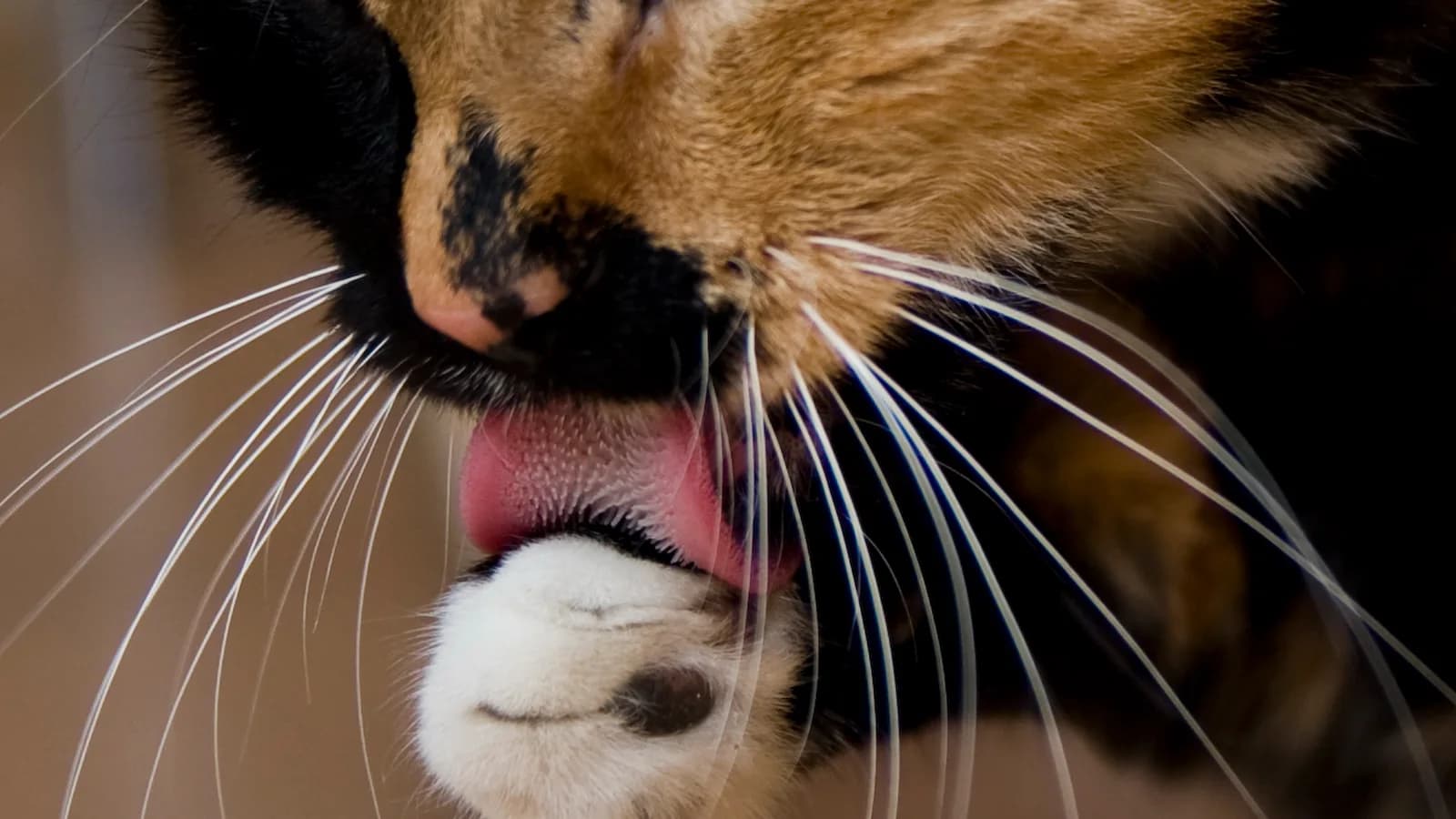
Run a cat's tongue across your hand and you feel hundreds of backward-facing spines. They are called , and until fairly recently everyone assumed they were simple solid cones.
In 2018, a study in PNAS put cat tongues through a CT scanner, across six species from the house cat up to the lion. Each spine turned out to be scoop-shaped, with a hollow U-shaped cavity at its tip. That cavity does something a cone cannot: it wicks saliva up into itself by capillary action, in under a tenth of a second, and carries it down into the coat.
A grooming lick then runs in four phases, in this order:
- The tongue extends.
- It expands and stiffens, so the spines stand up.
- It sweeps through the fur, releasing saliva from the tips as the spines bend.
- It retracts in a U-curl.
Here is the detail that makes the whole thing click. Across those six species, spanning a thirtyfold range in body weight, papilla height stayed almost constant at 2.3 mm (about a tenth of an inch). A lion's tongue spines are the same length as a house cat's. That length is what lets the spines reach past the topcoat and deposit saliva on the skin itself, which is where grooming actually needs to happen.
There was one exception in the study, and it is a useful one: on a long-haired cat whose coat compresses deeper than 2.3 mm, the spines cannot reach the skin. Which is the measured, physical reason a long-haired cat needs your brush and a short-haired one mostly does not. It is also why a healthy cat almost never needs a bath, and half the story of why cats hate water when one is offered anyway.
The cooling system you cannot see
The saliva a cat deposits on its skin does not just clean. It evaporates.
The same 2018 work measured what that is worth: evaporating saliva can hold the skin up to 17°C (about 30°F) cooler than the surface of the coat, and accounts for up to roughly a quarter of the heat a resting cat needs to shed. The rest leaves through the paws, the ears and plain convection.
So a cat grooming itself on a warm afternoon is not only tidying. It is running its air-conditioning. And when that same tongue turns on you, the motives change entirely: our guide to why cats lick people covers the bonding, the salt and the politics.
Cats cannot taste sweetness, and it is written in the DNA
A sweet-taste receptor needs two genes working together. In cats, one of them, Tas1r2, is broken. A 247-base-pair deletion knocks the reading frame out of alignment and premature stop codons follow, so the protein is never built. It is what geneticists call a : a gene that is still there and no longer works.
This is not a housecat quirk. Tiger and cheetah DNA carry the identical deletion, which means the loss happened before cats were ever domesticated and runs through the cat family generally.
Practically, it means a cat has never tasted anything you would call sweet, and never will. When a cat seems to want ice cream or cake, it is after the fat and the dairy, not the sugar. That broken sweet tooth is also why chocolate poisoning is rare in cats, a mercy our chocolate guide explains should never be mistaken for a policy.
What they taste instead is freshness, which is far more interesting
The half of the story most pages skip is what cats taste unusually well.
Their receptor responds directly to purine nucleotides: AMP, GMP, IMP and XMP. It does not respond to the pyrimidine ones, CMP and UMP. And a set of eleven amino acids act only as enhancers, boosting the signal alongside a nucleotide but doing nothing on their own.
Follow that through and it becomes rather elegant. IMP is a breakdown product of ATP, and it accumulates in meat as the meat ages. A cat's palate is reading a freshness gauge. The researchers behind the 2023 study that confirmed all this propose that tuna's famous pull on cats comes from a strong combination of IMP with the amino acid histidine.
A cat refusing a bowl it accepted yesterday is not being difficult. It is using a sense you do not have.
The taste bud number everyone repeats
You will see it stated that a cat has about 470 taste buds, against roughly 9,000 for a human and 1,700 for a dog. We went looking for where that figure comes from.
It traces to no primary source anyone can check. Meanwhile a 2025 study reconstructed a cat's gustatory and their taste buds in three dimensions and arrived at a very different number.
| Figure | Where it comes from |
|---|---|
| About 470 | Repeated across the web, including by pages currently ranking first. No checkable primary source found. |
| About 8,265 | A 2025 three-dimensional reconstruction study in short-hair cats, published in Veterinary Research Communications and openly readable. |
That is an order of magnitude apart, and we are not going to pretend the gap is settled by one study. What we can say plainly: the small number that everybody prints has nothing traceable behind it, and the only recent measurement made with modern methods is far larger. The same study found different regions of the tongue specialised for different jobs, preselecting food, analyzing it during chewing, and a last check before swallowing.
Cats do not scoop water. They exploit inertia
Dogs scoop. Cats do something considerably stranger, and it was filmed and modelled in Science in 2010.
The tongue tip barely touches the surface of the water, then whips upward at roughly one meter per second. That motion drags a column of liquid up behind it by fluid inertia, not by surface tension, which is far too weak to matter at that speed. Then the cat closes its jaw at the precise instant before gravity pulls the column back down.
A house cat does this about four times a second. And the frequency scales with body mass to the power of minus one sixth, which is why a tiger laps noticeably more slowly for exactly the same physical reason, a relationship the same team checked across around eight feline species.
Nothing about this is a scoop, and nothing about it is sucking.
The dangerous side of a one-way tongue
Everything above is why a cat's tongue is superb at grooming. It is also, exactly, why a cat that gets string in its mouth is in trouble.
The spines all point backwards. Anything that lands on the tongue travels one way: down. A cat that starts to swallow thread, string, ribbon, tinsel or dental floss usually cannot spit it back out even when it wants to.
If one end then anchors, most often around the base of the tongue, the free end travels on into the intestine. Normal gut movement cannot shift the anchored end, so the intestine bunches up and climbs the string instead. The string can saw through the intestinal wall from the inside. This is a genuine surgical emergency, called a , and it is resolved under anesthetic.
If you can see string under your cat's tongue, or hanging from its rear, do not pull it and do not cut it. Call your vet immediately, and out of hours, an emergency clinic. Pulling is what turns a bad situation into a torn intestine.
Tongue and gum color, a check worth knowing
This one is genuinely useful, takes five seconds, and is a check, not a diagnosis.
| What you see | What it can point to |
|---|---|
| Pink and moist | Normal |
| Pale or white | Anemia or shock |
| Blue or muddy | Severe lack of oxygen |
| Yellow | Liver trouble |
There is a companion test. Press a fingertip on the gum until it blanches, let go, and count how long the color takes to come back. Longer than about two seconds is abnormal.
None of these tells you what is wrong. They tell you to stop reading and pick up the phone. Anything that worries you about your cat is a reason to call your vet, and out of hours, an emergency clinic. Nothing on this page is ever a reason to wait.
What to take away
- The tongue spines are hollow scoops, not cones. They wick saliva and deliver it to the skin.
- They are 2.3 mm long in a house cat and in a lion alike. On a long coat they cannot reach the skin, which is why long-haired cats need brushing.
- Grooming is also cooling: evaporating saliva sheds up to a quarter of a resting cat's heat.
- Cats cannot taste sweetness at all, and the broken gene is shared with tigers and cheetahs.
- What they taste sharply is meat freshness, through purine nucleotides.
- Lapping is a column of water lifted by inertia and caught before it falls, about four times a second.
- A backward-facing tongue makes swallowed string a surgical emergency. Never pull it.
The tongue is not the only part of a cat that turns out to be measured badly by everyone who writes about it. Two of the most repeated claims about whiskers do not survive a look at the evidence either: what a cat's whiskers actually do. The same goes for how many toes a cat has, where the world record changed in May 2026 and most pages have not caught up.
 The vet's take
Veterinary review
Are you a vet?
Your professional read belongs here: every verified practitioner can leave a note, published once our editors have reviewed it.
Sign in and get your license number verified. We check it in the public register, we never ask for or keep a copy of your diploma, and your number is never published.
Frequently asked questions
Why is a cat's tongue so rough?
Because it is covered in hundreds of backward-facing spines called papillae. A 2018 study using CT scanning found each one is hollow and scoop-shaped rather than a solid cone, with a U-shaped cavity at the tip that draws saliva up by capillary action and releases it into the coat. The roughness is a hairbrush that also carries fluid.
Can cats taste sweet things?
No. The Tas1r2 gene, one of the two needed to build a sweet-taste receptor, is broken in cats: a 247-base-pair deletion means the protein is never made. Tigers and cheetahs carry the same deletion, so the loss is older than domestication. A cat that wants your ice cream wants the fat and the dairy.
How many taste buds does a cat have?
The commonly repeated figure of about 470 traces back to no source that can be checked. A 2025 three-dimensional reconstruction study put the number closer to 8,265. We report both, because one is untraceable and the other is a single recent study.
Why does my cat's tongue feel cold and wet after grooming?
Because it deposits saliva onto the skin, and that saliva evaporates. Measurements published in 2018 found this can keep a cat's skin up to 17°C (about 30°F) cooler than the top of its coat, accounting for as much as a quarter of the heat a resting cat sheds.
My cat has swallowed string. What do I do?
Call your vet straight away, and out of hours, an emergency clinic. Do not pull the string and do not cut it, even if you can see it. Backward-facing tongue spines make string almost impossible for a cat to spit out, and if one end anchors, the intestine can bunch along it and be cut from the inside. It is treated surgically.
Do cats suck up water when they drink?
No. High-speed filming published in 2010 showed the tongue tip barely touches the water before whipping up at about a meter per second, dragging a column of liquid upward by inertia, which the cat catches by closing its jaw just before gravity wins. A house cat does this roughly four times a second.
 Community questions
Got a question this page doesn't cover? Ask it: the best ones get published here with their answer.
Our sources
- Noel, Hu 2018, cats use hollow papillae to wick saliva into fur, PNAS 115(49)
- Li et al 2005, pseudogenization of a sweet-receptor gene accounts for cats' indifference toward sugar, PLoS Genetics 1(1)
- McGrane et al 2023, umami taste perception and preferences of the domestic cat, Chemical Senses
- Barbara, Hanna 2025, three-dimensional reconstruction of gustatory papillae and taste buds in short-hair cats, Veterinary Research Communications 49
- Reis, Jung, Aristoff, Stocker 2010, how cats lap: water uptake by Felis catus, Science 330(6008)
- VCA Animal Hospitals, linear foreign body in cats (the never-pull instruction)
- Merck Veterinary Manual, initial triage and resuscitation of small animal emergency patients (mucous membrane color and capillary refill time)

Worth keeping a paw on
Pin this guide
So you can find it the day you need it, and share it with someone whose cat does the same thing. One click and it sits in your board.
Pin it on PinterestAlso worth reading
All cat facts →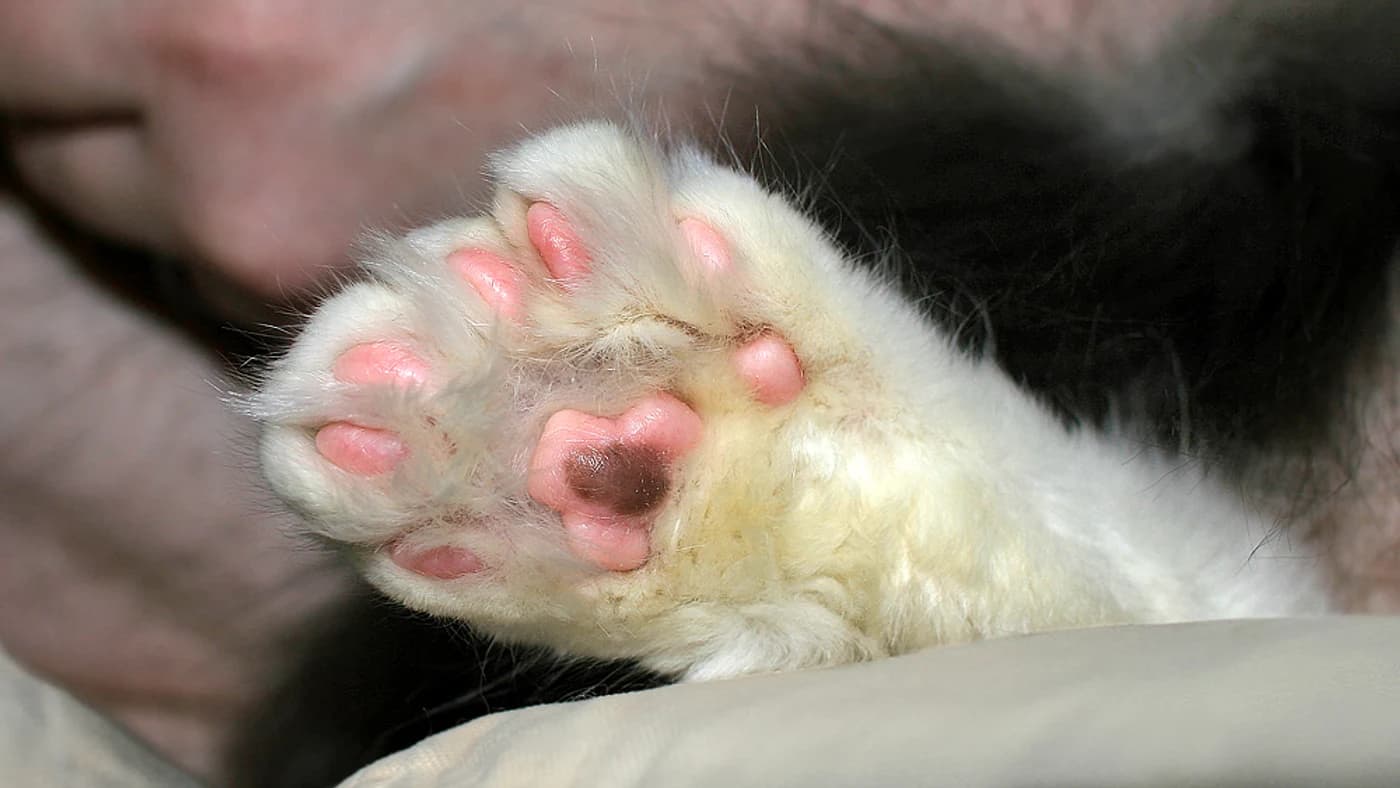
Article
How Many Toes Do Cats Have? The Answer, and the Exceptions
A cat has 18 toes, five in front and four behind. Here is the gene behind the cats born with more, why registries disagree, and the record that changed in 2026.
Read
Article
Cat Paw Pads: A Field Guide to Toe Beans
What toe beans actually are, the sweat glands hiding in them, the three claims no study backs, and the paw problems worth a vet call.
Read
Article
How Many Lives Do Cats Have? One, and a Very Old Story
One, officially. Where the nine-lives saying really comes from on paper, the countries that count seven, and the physics that makes the myth feel true.
Read
The floor belongs to our members. Keep it kind, links are not allowed, and images go through moderation before anyone else sees them.