

Why Do Cats Get the Zoomies? The Truth About the 3 a.m. Grand Prix
Zoomies are normal cat physics: pent-up energy, twilight biology, the litter box victory lap. What science actually knows, what is still theory, and the one change that means a vet visit.
Published August 28, 2026Updated September 8, 2026 6 min read
Contents
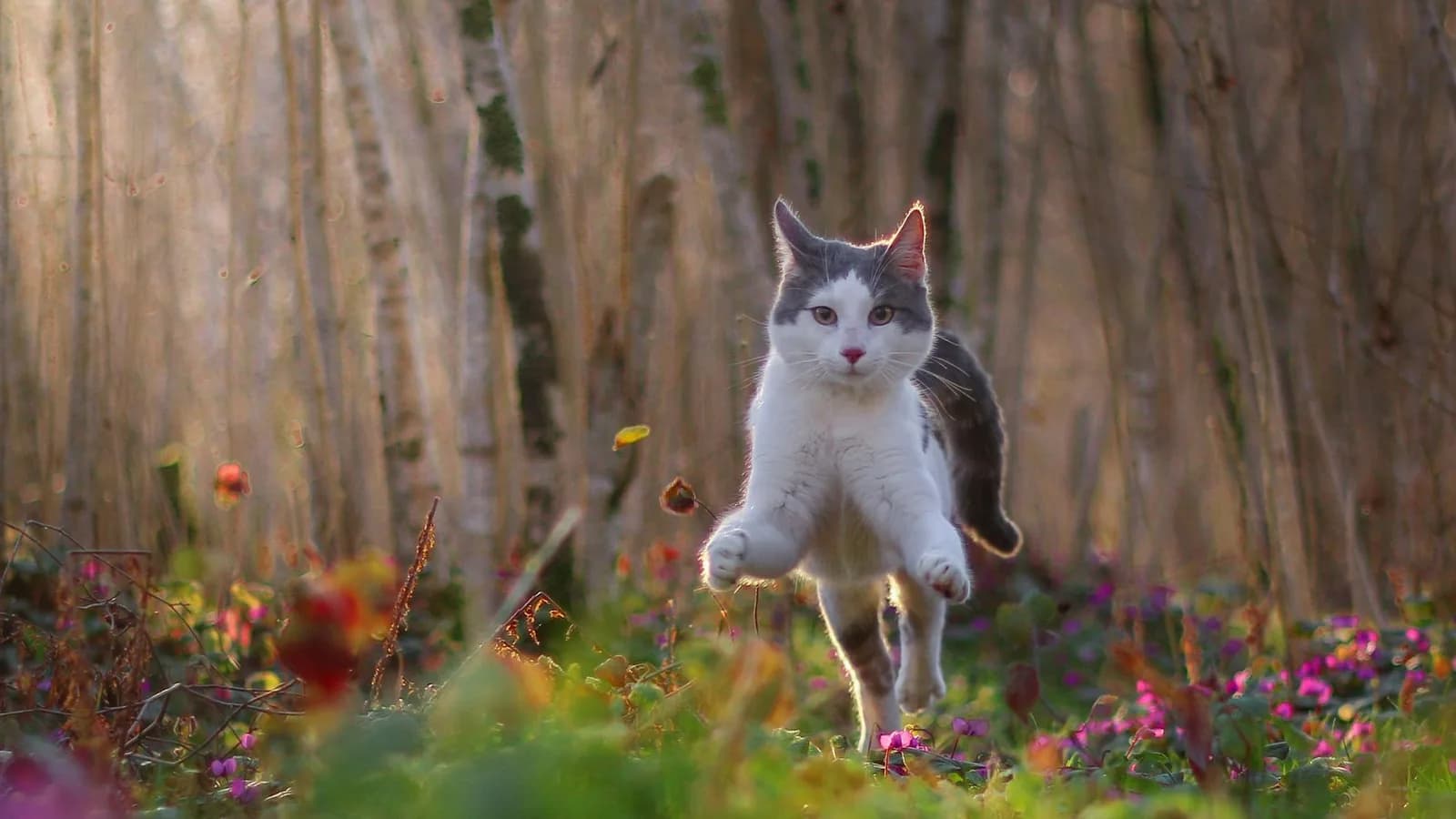
It is 3 a.m. and something with four paws and the acceleration of a startled electron has just taken the hallway corner flat out, bounced off the sofa, and vanished. Editor-in-chief here. That athlete is me, and this page is about my finest discipline: the zoomies. A sudden, glorious sprint session that ends as abruptly as it began. My writers insist we explain it with sources. Fine. The facts happen to be flattering.
First, the reassuring headline: in a healthy cat, zoomies are normal. Behavior professionals describe them as a burst of pent-up energy finding an exit, typically wrapped in relaxed, playful body language: ears neutral or forward, tail up or gently swishing. If you want to read those signals like a professional, our cat body language guide decodes the whole animal.
The name nobody can actually source
Pet media will tell you zoomies have a scientific name: frenetic random activity periods, or FRAPs. It sounds like something printed on a lab coat. The truth is more entertaining: the label shows up all over veterinary-adjacent writing, yet no one can point to the study that coined it.
What matters more than the name: the pattern is real, vets see it constantly, and it has recognizable fuels. Four of them, in roughly descending order of how often they get named by the professionals quoted below.

Tess · Behavior desk
Reality check from the behavior desk. That acronym gets treated as settled science, and it is not: the most citation-dense page on the term leans on two papers about play in general, and neither one defines or even studies FRAPs. Often repeated, rarely sourced. The bursts themselves are real and well described; the lab-coat name is borrowed clothing.
Cookie · Editor-in-chief
I reject the acronym on principle. You do not file a champion sprinter under paperwork. What you witnessed in the hallway last night was performance art, and the review section is closed.

The four fuels of a proper zoomie
- Pent-up energy. A body built for hunting sprints, parked on a windowsill all day, eventually files for an exit. PetMD's framing is exactly that: like humans who need to move after sitting too long, cats need to release stored energy, and zoomies are the outlet.
- Twilight wiring. "Since cats are , meaning they are most active at dawn and dusk, it's no surprise that many pet parents notice zoomies happening during the early morning or evening hours," says Alison Gerken, a veterinary behaviorist at the San Francisco SPCA. Your 5 a.m. wake-up call is not spite. It is scheduling.
- Hunting instinct. Dr. Gerken again: zoomies "may originate from cats' natural predatory instincts, as the bursts of activity with their sudden sprints and sharp turns may represent hunting behaviors." The sprint, the swerve, the ambush from behind the curtain: that is a hunt with no prey invited.
- Boredom. An understimulated indoor cat invents its own entertainment. A racetrack requires no subscription.
And there is measured data behind the timing. A 2022 tracking study followed indoor and outdoor cats for 21 days and found both groups moved and ate more at twilight, with activity bursts consistently triggered by human presence; the outdoor group covered about 4.29 km (2.7 miles) a day. One honesty note: the study measured overall movement rhythms, not zoomies as a labeled event. Nobody has strapped an accelerometer to a cat and isolated the zoomie as a data category yet. Science has unfinished business.
The litter box victory lap
Some cats exit the litter box like it is on fire, and the internet has a name for the theory: poophoria. The term comes from human medicine, coined by gastroenterologist Dr. Anish Sheth for the lightheaded relief a large bowel movement can produce. The proposed mechanism runs through the , which links brain to colon. One veterinary behaviorist, Dr. Elizabeth Stelow of UC Davis, does endorse a soft version: "We know that defecating stimulates the vagus nerve, which can lead to a feeling of release/relief."
But here is the part we like: the strongest article on the subject argues with itself, and admits it. BBC Science Focus, after laying out the theory, notes that "vagal activity is classically thought to make animals more, rather than less, relaxed. So, for the time being, the jury is out." A nerve famous for calming things down is an odd engine for a sprint.
The competing explanations are less glamorous: cats are clean animals that prefer distance from their own bathroom, and in the wild, lingering near strong-smelling waste advertises your address to predators. A quick exit is just good operational security. Or, as one pet-media writer put it, some cats simply run a victory lap. No source settles it. We report the standings; the race is still on.
How to give the zoomies somewhere to go
You do not stop the zoomies. You schedule them. The professionals quoted above converge on the same playbook, and it is pleasantly simple:
- Hunt on demand. Wand toys and anything that mimics prey let the cat run the full stalk-chase-pounce sequence on your schedule instead of the ceiling's.
- Play, then feed. An evening play session that ends in a meal works with the hunting rhythm, not against it. Our cat meowing at night guide uses the same sequence against the 4 a.m. concert, on veterinary advice.
- Feed the brain. Puzzle feeders, scratching posts and window perches drain the boredom tank before it converts to hallway laps.
- Clear the runway. A zooming cat has surprisingly good steering, but breakables near the racing line are entries in a lottery nobody wins.
None of this is a medical protocol; it is standard behavioral advice, and it also buys you quieter nights. A cat that spent the evening hunting a feather sleeps like an athlete after a final. And cats are professionals at that part too; our guide to why cats sleep so much covers the sixteen-hour side of the ledger.
When zoomies stop being funny
Almost always, zoomies are play. The exceptions have a shape, and the shape is change. Veterinary behaviorist Alison Gerken flags "sudden changes in zoomie behavior" as the thing worth attention, because those shifts can signal conditions like hyperthyroidism or mobility problems, especially in older cats. An older cat that suddenly turns frantic, eats ravenously yet loses weight, or starts yowling at night is not discovering fitness late in life; that picture belongs in our hyperthyroidism guide and in a vet's office.
There is also a condition that impersonates zoomies without being them: feline syndrome. Vet-authored descriptions are consistent: episodes of rippling or twitching skin along the lower back, dilated pupils, agitation, frantic grooming or biting toward the tail, sometimes running and vocalizing, each episode lasting seconds to minutes. Itchy skin problems such as flea allergy can mimic or worsen those episodes, which is why the vet checks the skin first. The difference matters, so here it is side by side:
| Ordinary zoomies | Hyperesthesia episode | |
|---|---|---|
| Body language | Relaxed: ears neutral or forward, tail up or softly swishing | Distressed: rippling skin on the back, dilated pupils, tension |
| The run itself | Playful sprint, corners taken with style, ends in a casual stroll | Frantic, often with biting or grooming at the tail base, sometimes vocal |
| Pattern | Any healthy age, often after rest, meals or the litter box | Repeated stereotyped episodes, seconds to minutes, same triggers |
| What to do | Applaud | Book a vet visit |

The Vet's Take · Veterinary review
One serious note before the applause. Zoomies in a healthy cat are normal. What earns an appointment is change: an older cat suddenly frantic, especially with weight loss, a big appetite or night yowling, fits hyperthyroidism, which a blood test finds and treatment controls. And repeated episodes with rippling skin, dilated pupils and biting at the tail base are not zoomies; that pattern has its own name and deserves its own workup.
Cookie · Editor-in-chief
Granted, doctor. My own bursts remain strictly professional, and I will consent to a checkup the day your waiting room invests in a warmer stethoscope and a snack bar.
What to take away
- Zoomies are normal in healthy cats: short bursts of stored energy, usually with relaxed body language (ears forward, tail up or gently swishing).
- The name FRAPs (frenetic random activity periods) is pet-media shorthand: it is often repeated but has no traceable peer-reviewed origin.
- The timing is biology: cats are , and a 2022 tracking study of indoor and outdoor cats measured activity peaks at dawn and dusk in both groups.
- Post-litter-box zoomies are unexplained: the theory exists, one UC Davis behaviorist endorses a soft version, and the main science outlet covering it says the jury is out.
- The management playbook is play sessions that mimic hunting, an evening play-then-meal routine, and puzzle feeders for boredom.
- The red flag is change, not speed: a suddenly frantic older cat (especially with weight loss or night yowling) or episodes with rippling skin and tail-biting deserve a vet visit.
 The vet's take

Veterinary review
Are you a vet?
Your professional read belongs here: every verified practitioner can leave a note, published once our editors have reviewed it.
Sign in and get your license number verified. We check it in the public register, we never ask for or keep a copy of your diploma, and your number is never published.
Frequently asked questions
What are cat zoomies?
Short, sudden bursts of high-speed running, leaping and cornering that healthy cats perform most often after rest, in the early morning or evening, or right after using the litter box. Pet media calls them FRAPs, for frenetic random activity periods, though the term has no traceable scientific origin. In a relaxed cat they are normal play behavior.
Why do cats get the zoomies after pooping?
Nobody knows for certain. The popular theory says defecation stimulates the vagus nerve and produces a wave of relief, and one veterinary behaviorist endorses a soft version of that idea. The counter-argument is that vagal activity classically calms animals rather than energizing them. Simpler explanations exist too: cats prefer distance from their own waste, which in the wild advertises their location. The question is genuinely unresolved.
Are zoomies a sign of a happy cat?
Usually they are a sign of a healthy one with energy to spend. The reliable tell is the rest of the body: playful zoomies come with neutral or forward ears and a tail held up or gently swishing. A cat that runs frantically while its skin ripples, its pupils dilate, or it bites at its own tail base is not playing, and that pattern deserves a veterinary opinion.
How do I stop my cat's zoomies at night?
Work with the biology instead of against it. Cats are most active at dawn and dusk, so schedule a real play session in the evening, end it with a meal, and offer puzzle feeders and daytime enrichment so the energy is spent before your bedtime. Attention paid to nighttime performances teaches the cat that performances work; a boring audience closes the show faster than a scolding.
Do older cats get zoomies?
Yes, and a senior in good health is welcome to sprint. What matters in an older cat is new or changed behavior: a cat that was calm for years and suddenly turns frantic, especially alongside weight loss, a huge appetite or night yowling, fits the picture of hyperthyroidism, which a blood test can find and treatment can control. New chaos in an old cat is a symptom until a vet says otherwise.
When should I worry about zoomies?
Three situations: a sudden change in an older cat, episodes that look distressed rather than playful (rippling skin, dilated pupils, biting at the tail, vocalizing), and zoomies that end in limping or collapse. Everything else is a cat being magnificent at high speed. Something wrong with your cat means call your vet; out of hours, an emergency clinic.
 Community questions
Got a question this page doesn't cover? Ask it: the best ones get published here with their answer.
This is information, not veterinary advice, and it cannot tell you what is wrong with your cat. Our rule is a simple one: if something is wrong with your cat, call your vet, and call an emergency clinic if it is out of hours. Nothing you read here is a reason to wait.
Medical information applies to every reader. Prices, legal duties and common practice do not: unless stated otherwise, they are given for the United States, and they differ in the UK, Canada and Australia, and often between states or provinces. Check with your own vet and your own local authority.
Our sources
- Parker et al 2022, comparison of locomotor and feeding rhythms between indoor and outdoor cats (the 21-day twilight tracking study)
- PetMD, why do cats get the zoomies (quotes from veterinary behaviorists Alison Gerken, DVM, DACVB and Elizabeth Stelow, DVM, DACVB)
- BBC Science Focus, the reasons cats get the zoomies after pooping (the vagus-nerve theory and its own counter-argument)
- Catster, why do cats get zoomies after they poop (vet-reviewed, the poophoria coinage)
- Cats.com, why do cats get the zoomies and when to call your vet
- Cats.com, feline hyperesthesia syndrome (JoAnna Pendergrass, DVM: episode description and the flea-allergy differential)
- PetMD, feline hyperesthesia syndrome (Krista A. Sirois, DVM)
- The Hyperthyroid Cat Centre, symptoms of hyperthyroidism (hyperactivity and restlessness as behavioral signs)

Worth keeping a paw on
Pin this guide
So you can find it the day you need it, and share it with someone whose cat does the same thing. One click and it sits in your board.
Pin it on PinterestAlso worth reading
All behavior →
Article
Why Do Cats Drool? Bliss, Mostly. Sometimes a Message
Some cats drool when they are blissed out on your lap, and that is harmless. New, heavy or constant drooling is a symptom with named causes. The full sorting guide, tier by tier.
Read
Article
Why Do Cats Eat Grass? The Salad Course, Explained
Two UC Davis surveys found grass eating is normal cat behavior, rarely about illness, and probably inherited from wild ancestors. The science, the myths that lost, and the one real danger.
Read
Article
Why Do Cats Knock Things Over? A Professional Explains His Art
Hunting practice, a paw that asks questions, boredom, and you arriving on cue: the four documented reasons cats knock things over, from an editor-in-chief who calls it art.
Read
The floor belongs to our members. Keep it kind, links are not allowed, and images go through moderation before anyone else sees them.