

Cat Anxiety: The Signs Cats Hide, and the Checklist That Actually Helps
Cats bury their stress. The sign lists two charities publish, the five-pillar checklist vets actually use, and the honest evidence on pheromone diffusers.

Published August 26, 2026Updated September 8, 2026 7 min read
Contents
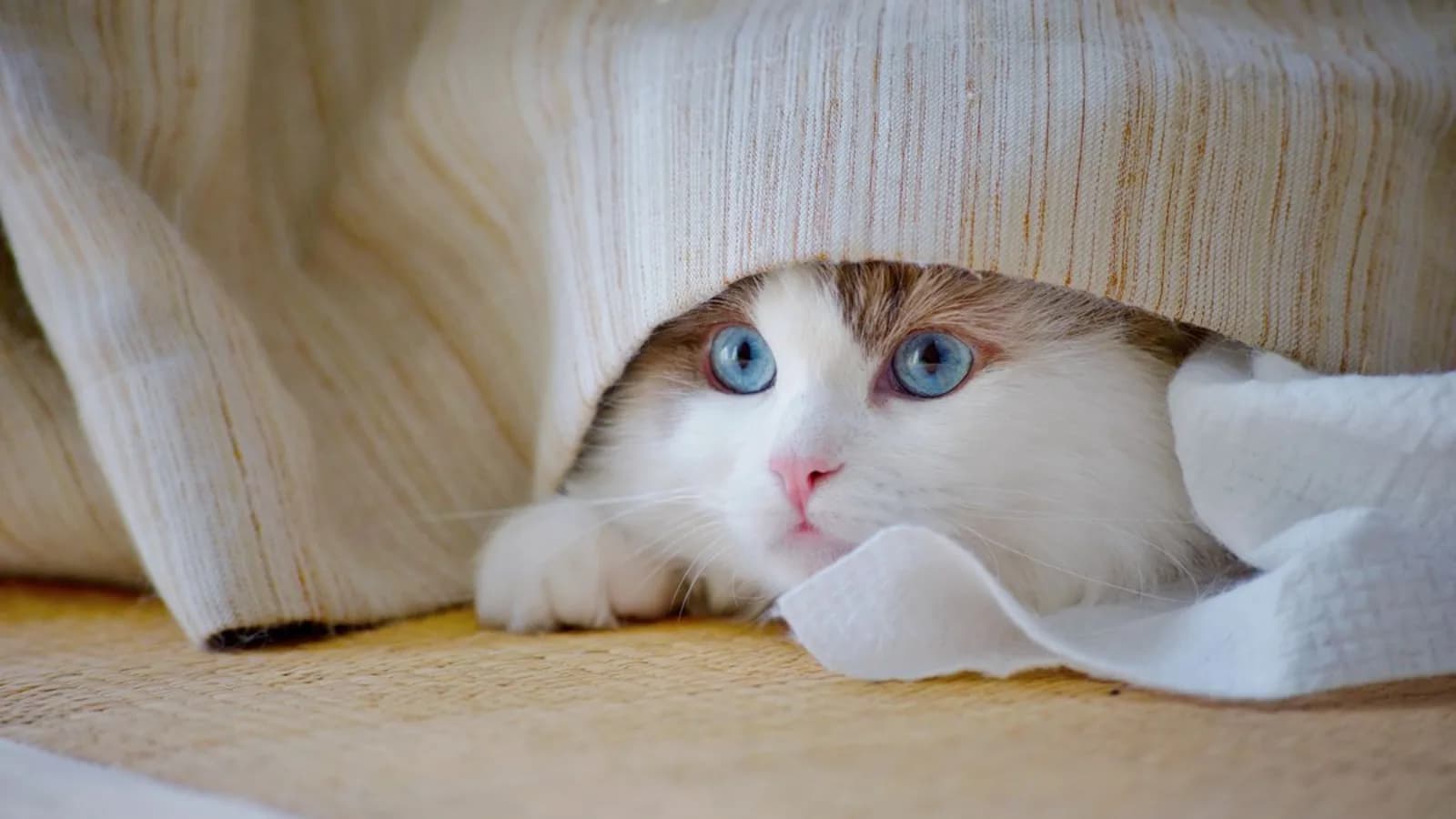
Here is the problem with a stressed cat: it will not tell you. International Cat Care puts it plainly: cats do not show their emotions as overtly as other species, and the signs are often as quiet as withdrawing and going still. The clinical guideline goes further: even stoic-looking cats have been found carrying elevated stress hormones. So this page is not about dramatic panic. It is about the quiet signs, what to rule out first, and the one checklist with actual clinical weight behind it.
The signs, sudden and slow
Anxiety, as International Cat Care defines it, is a cat anticipating something bad, especially in unfamiliar situations; it sharpens into fear when the cat decides a specific thing is dangerous. The signs split into two speeds:
| Sudden (acute) stress | Ongoing (chronic) stress |
|---|---|
| freezing, shaking, crouched tense posture | eating, grooming or toileting off its normal pattern, or over-eating |
| rapid breathing | hiding, resting more, "pretending" to sleep |
| tail tucked tight, head pulled in and low | playing less; clingier than usual, or withdrawn |
| pupils fully dilated, ears flattened, whiskers back | jumpier; reactive toward people or other cats |
| yowling, growling, hissing, or silent tension | toileting problems or urine spraying indoors |
| drooling, nose licking, swallowing | over-grooming; increased facial rubbing and scratching |
| escape attempts; accidents | poor coat quality, weight loss ('s additions) |
The full facial-and-posture picture lives in our body language guide; the hiding-in-a-new-home case is its own normal story, covered in bringing a cat home. This page is about the ongoing kind. The box habit itself, the healthy everyday version of hiding, has real science behind it too: why cats like boxes covers where comfort ends and hiding begins.
And the standing rule comes first, not last. Many of these signs are caused by medical problems as well as stress; 's line is "always contact your vet for advice first" on any sudden change, and it is the same instruction our biting article carries: new defensive behavior is a medical question before it is a behavior question.
"It's just stress" fails a measured test
The best number in this whole subject is about hair. In a study of 21 cats referred to a dermatology service because everyone assumed their bald licked patches were psychological, 76% turned out to have an identifiable medical cause, mostly itch: over half had an adverse food reaction. Only 10% were purely behavioral. The authors' conclusion was blunt: is overdiagnosed, and thorough testing comes before blaming the mind.
Overgrooming itself is common enough that Cornell's dermatologists have a nickname for the cats, "fur mowers", and a scale for it: normal cats already spend 30 to 50% of their day grooming. Two field notes worth having: hair removed by licking leaves stubble that feels spiky and sharp under your fingers, while hair lost to true alopecia leaves the remaining coat soft. And per International Cat Care, most overgrooming cases START with a skin or pain problem and carry a stress component, rather than the reverse; only a small number are stress alone. If the licking targets the belly or genital area, read our urinary page too: bladder trouble grooms exactly there.
The five pillars: the checklist with a guideline behind it
Most stress-reduction advice is a mood board. The exception is the and ISFM environmental needs guidelines, written by a veterinary panel precisely "to reduce stress, the incidence of stress-related disorders, and unwanted behavior". Five pillars, and they come with countable minimums:
- 1. A safe place. At least as many hiding spots, each sized for one cat, as there are cats, in separate locations. The guideline is explicit that hiding is a coping behavior; fighting is the last resort when escape is not possible.
- 2. Multiple, separated key resources. Food, water, litter, scratching, play, rest: a choice of each, minimum two feeding, two resting and two toileting areas, and food separated from water. The working formula, from International Cat Care: one per cat plus one, spread through the home. Our litter box guide applies it to trays; it holds for everything else too.
- 3. Play and predatory behavior. The guideline names what the lack of it produces: boredom and frustration expressed as overgrooming, stress-associated disease or misdirected aggression. Cornell's prescription is small on purpose: ten to fifteen minutes of play a day. Scent is enrichment too: a catnip or silver vine session, which our catnip guide covers, adds novelty for close to zero effort.
- 4. Predictable human interaction. Consistent, on the cat's terms. The relaxed signs to aim for are the ones our body language guide catalogs: slow blinks, head bunting, the lap climb.
- 5. Respect for the sense of smell. Familiar scent is security. adds the practical corollary: strongly scented candles and air fresheners, in the rooms the cat lives in, are a stressor humans never suspect.
The stressor already sitting on your sofa
The guideline's least comfortable paragraph is about multi-cat homes: tension between resident cats "often goes unnoticed unless they fight", and people assume cats like each other because they eat or sleep in the same spot, when they may simply be forced onto a single resource point. The 2024 intercat-tension guidelines repeat it: the signs are subtle, and unrelieved tension ends in stress-related disease or a rehomed cat. That is why pillar two is counted per cat, in separate locations, rather than one nice food station.
Separation anxiety is real in cats, and measured
In a 223-cat questionnaire study, 13.45% met at least one criterion for separation-related problems. Within that affected group, destructive behavior was the most common report (about two thirds), then excessive vocalization, then urinating away from the box; note the frame, those percentages describe the affected cats, not all cats. The study is honest about its limits, owner-reported rather than clinically diagnosed, and an earlier, smaller study found a higher rate with a different sign profile, so treat the exact number as a first estimate. The practical takeaways it found: cats without toys and cats living with no other animal were more likely to be affected. A camera while you are out settles what your cat actually does; guessing does not.
Pheromone diffusers, honestly
You will be offered one within five minutes of searching this topic, so here is the evidence as it stands. The five-pillars guideline itself makes a bounded claim: synthetic pheromones to reduce anxiety and increase grooming, interest in food and litter box use. A 2022 academic review of the whole literature is cooler: results are "inconsistent and non-replicable", with debated efficacy in clinics and shelters. And Cats Protection, a charity that recommends the product, still writes that it "may not be that effective when used as a stand-alone treatment". Read those three together and you get the fair summary: worth trying as one piece alongside the pillars and veterinary advice, never as the plan.
If the scratching looks electric, not anxious
One condition deserves its own name here because owners searching "cat anxiety" sometimes describe it: feline syndrome, an extreme skin sensitivity usually along the back near the tail, with rippling skin, dilated pupils, drooling, frantic digging at the spot, even tail chasing. Cornell's neurology view is that the first job is making sure nothing treatable is causing it, spinal disc problems included; anxiety worsens it, so treatment usually includes a behavioral piece, but it is a vet-first diagnosis, not a stress label.
Who to call, in order
The vet, always first, because pain and illness mimic anxiety and this whole page has been one long argument for that order. If the physical exam comes back clean, ask for a referral to a qualified behavior professional: in the US that credential is a , a veterinarian board-certified by the American College of Veterinary Behaviorists; in the UK, Cats Protection points owners to practitioners registered with the Animal Behaviour and Training Council, with the Association of Pet Behaviour Counsellors as a named route. In Canada and Australia we found no equivalent single body worth naming with confidence, so the honest route is the same one International Cat Care describes everywhere: your vet refers you. And the standing rule: if something is wrong with your cat, call your vet; out of hours, an emergency clinic.
What to take away
- Cat anxiety announces itself by drift, not drama: eating, grooming, toileting, play and hiding moving off their baseline; you are the only one who knows that baseline.
- Separation anxiety is real: about one in seven cats met at least one criterion in a 223-cat study, most often shown as destruction, vocalizing or accidents while the owner was away.
- The invisible classic is another cat: intercat tension usually goes unnoticed because nobody fights, and shared bowls can be scarcity rather than friendship.
- The testable fix is resources: every key resource (food, water, litter, scratching, rest) counted per cat, plus one, in separate places.
- Pheromone diffusers earn a fair verdict of possible helper, not treatment: modest specific effects in the guideline, inconsistent results in the independent reviews.
- Before calling bald patches stress, see a vet: 76% of "stress licking" cats in the key study had a medical cause, most often a food reaction.
 The vet's take

Veterinary review
Are you a vet?
Your professional read belongs here: every verified practitioner can leave a note, published once our editors have reviewed it.
Sign in and get your license number verified. We check it in the public register, we never ask for or keep a copy of your diploma, and your number is never published.
Frequently asked questions
How do I know if my cat has anxiety?
By pattern, not by one sign: eating, grooming, toileting, play and hiding drifting off their normal baseline, per the signs table above. Cats bury the obvious signals, so the baseline is the instrument; you are the only one who knows it.
Can cats have separation anxiety?
Yes; a 223-cat study found about one in seven met at least one criterion, most often reported through destruction, vocalizing or urinating outside the box while the owner was away. A camera answers it for your cat.
Do Feliway diffusers actually work?
The clinical guideline credits pheromones with modest, specific effects; the independent review literature calls the results inconsistent; the charity that recommends them says they are weak as a stand-alone. Fair verdict: a possible helper alongside the five pillars, not a treatment.
Why is my cat licking bald patches?
See a vet before assuming stress: in the study that tested exactly this assumption, 76% of "stress licking" cats had a medical cause, most often an itchy food reaction. Spiky stubble in the patch is the tell that licking, not shedding, removed the hair.
Can another cat be the cause?
Yes, and it is the classic invisible stressor: the clinical guidelines say intercat tension usually goes unnoticed because nobody fights, and eating or even sleeping in the same spot can be scarcity rather than friendship. The testable fix is pillar two: count every resource per cat, plus one, in separate places, and watch what changes.
 Community questions
Got a question this page doesn't cover? Ask it: the best ones get published here with their answer.
This is information, not veterinary advice, and it cannot tell you what is wrong with your cat. Our rule is a simple one: if something is wrong with your cat, call your vet, and call an emergency clinic if it is out of hours. Nothing you read here is a reason to wait.
Medical information applies to every reader. Prices, legal duties and common practice do not: unless stated otherwise, they are given for the United States, and they differ in the UK, Canada and Australia, and often between states or provinces. Check with your own vet and your own local authority.
Our sources
- Ellis et al 2013, AAFP and ISFM feline environmental needs guidelines (read in full), J Feline Med Surg 15
- de Souza Machado et al 2020, identification of separation-related problems in domestic cats (read in full), PLoS ONE 15
- Waisglass et al 2006, underlying medical conditions in cats with presumptive psychogenic alopecia, JAVMA 228
- Zhang et al 2022, dealing with stress in cats: what is new about the olfactory strategy (read in full), Front Vet Sci 9
- 2024 AAFP intercat tension guidelines (abstract), J Feline Med Surg 26
- International Cat Care, stress in cats
- International Cat Care, anxious cats
- International Cat Care, over-grooming in cats
- International Cat Care, multi-cat households
- Cornell Feline Health Center, cats that lick too much
- Cornell Feline Health Center, hyperesthesia syndrome
- PDSA, preventing stress in cats
- Cats Protection, cat stress

Worth keeping a paw on
Pin this guide
So you can find it the day you need it, and share it with someone whose cat does the same thing. One click and it sits in your board.
Pin it on PinterestAlso worth reading
All behavior →
Article
How to Train a Cat: Yes, It Works, and Here Are the Numbers
The 100-cat study behind "yes, cats train", the three-minute session rule, the sit method, and why punishment fails on cats every time.
Read
Article
Cat Body Language: How to Read the Whole Cat
The same ear position means two opposite things depending on the eyes and tail. Read cats as a system, and know which popular signal is not reliable at all.
Read
Article
Cat Tail Language: What Each Position Means, and the Study That Flips the Script
The position guide with the measured studies behind it, the finding that tail-up is mostly aimed at you, and the tail injury signs that cannot wait.
Read
The floor belongs to our members. Keep it kind, links are not allowed, and images go through moderation before anyone else sees them.