

Cat UTI: Why It Is Usually Not One, and When It Is an Emergency
In young cats, the signs everyone calls a UTI are rarely bacterial. The real numbers by age, the male-cat emergency that cannot wait, and what a proper diagnosis looks like.

Published August 26, 2026Updated September 8, 2026 6 min read
Contents
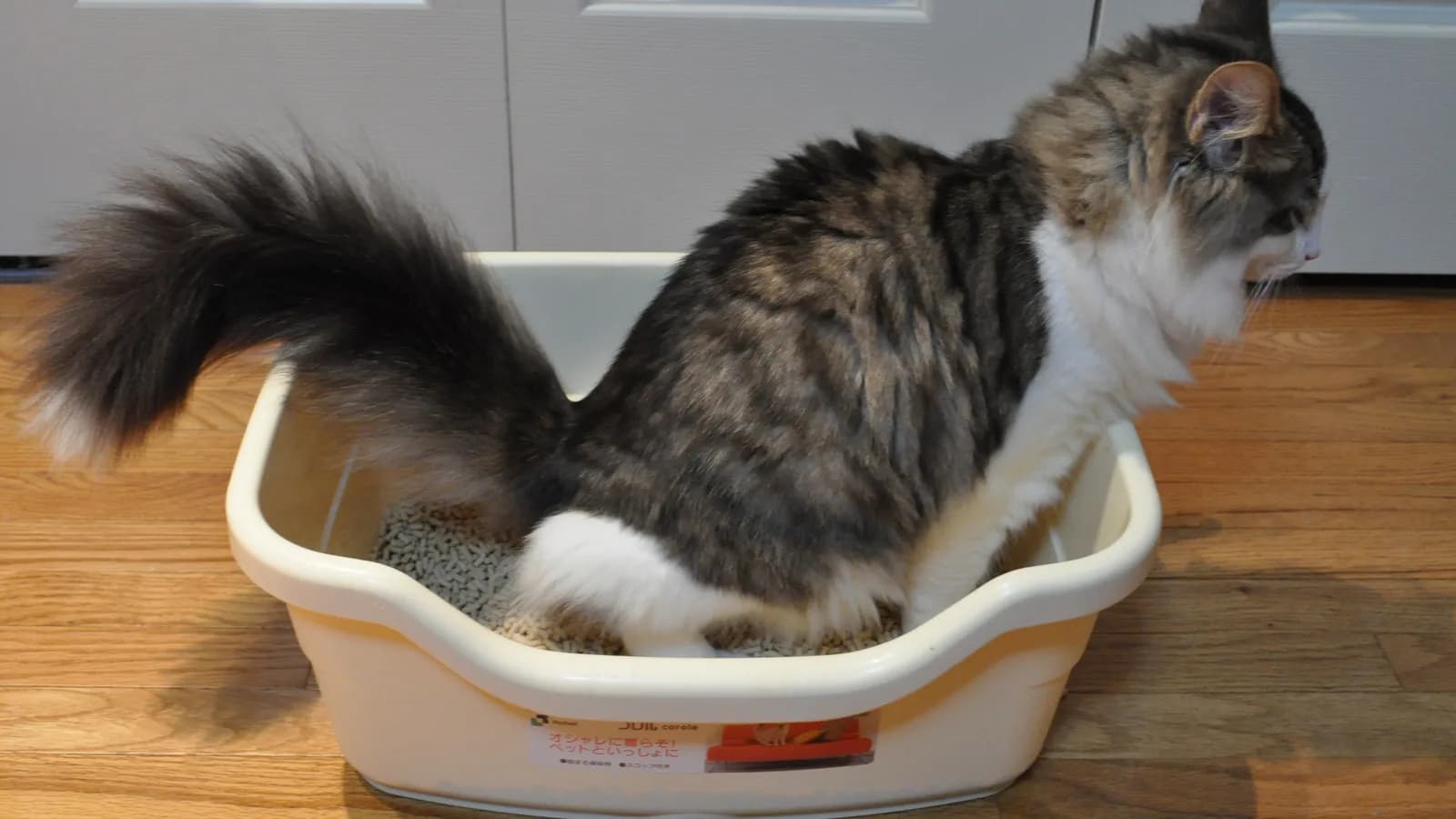
A cat straining in the litter box, going often and producing little, crying, leaving pink urine: everyone, including plenty of websites, calls that a urinary tract infection. In cats, most of the time, it is not one, and the difference decides the treatment. This page carries the real numbers, and then the one situation in this whole subject that is a drop-everything emergency.
The numbers nobody quotes with their frames attached
| Population | Share with a true bacterial UTI | Source |
|---|---|---|
| Younger, otherwise healthy cats WITH urinary signs | under 3% | iCatCare 2025 consensus; Dorsch 2019 |
| All cats, across a lifetime | 1 to 2% | Dorsch 2019 |
| Cats over 10 with urinary signs | 40 to 45% | Dorsch 2019 |
| Cats with chronic kidney disease | 22 to 29% culture-positive | pooled studies, Dorsch 2019 |
| Cats with diabetes | 12 to 13% | same |
| Cats with hyperthyroidism | 12% | same |
So what fills the gap in younger cats? Mostly feline idiopathic cystitis, : a stress-linked bladder inflammation with no infection behind it, accounting for roughly 55 to 70% of feline urinary-sign cases across studies from many countries. It is its own subject, and the practical line, stated flatly by International Cat Care, is that cats with FIC do not have a bacterial infection and should not be given antibiotics.
The age reversal has a mechanism, not just a statistic: young cats' urine is concentrated and acidic, a hostile environment for bacteria. Age and the diseases of age, kidney disease and diabetes above all, change that chemistry. Which produces this subject's strangest fact: in comorbid cats, many true infections cause no urinary signs at all, and the study that measured it concluded that a normal urinalysis alone cannot rule out infection in those cats.
The signs, and why they cannot be sorted from the sofa
The signs cluster is the same regardless of cause, which is precisely the problem:
- Straining, or long scratching sessions in the tray with little produced
- Going more often, in small amounts
- Blood in the urine, sometimes only visible on testing
- Crying out while urinating
- Urinating outside the box, in unusual places
- Overgrooming the belly or genital area
A young cat with these signs most likely has ; an older or diabetic cat may genuinely have an infection; and no owner, and honestly no vet by eye alone, can tell which from the symptoms. That is what the diagnosis section below is for. But first, the exception that cannot wait for any of it.
In an intact , the same two signs after a recent heat can point to pyometra rather than the bladder, which is one reason vets ask whether she is spayed. And blood near the back end of an unspayed female raises a different question entirely: do cats have periods answers it (they do not).
The emergency: a cat that cannot pass urine
A male cat straining and producing nothing is a medical emergency, immediately. The urethra, longer and narrower in males, can block completely, with plugs, stones or spasm. What follows is measured, and four institutions state the same window: without treatment, death can come in less than 24 to 48 hours, from potassium rising to levels that stop the heart.
The picture to act on: repeated straining with no urine, a firm or swollen belly, crying, then vomiting, lethargy and collapse as the hours pass. 's wording deserves quoting because it removes all wiggle room: never wait to see if your cat improves. Any suspicion of a blockage means an emergency clinic now, at 3 a.m. if that is when it is. Female cats block very rarely; male cats are the risk group, neutered or not. A cat that is going outside the box without any of these emergency signs is a different question with its own list of causes, and why a cat pees outside the litter box works through them in the order a vet does.
What a real UTI diagnosis looks like
The proper test is a urine culture, from a sample drawn directly from the bladder with a needle, a quick procedure called , taken before any antibiotics are given. Growth above a threshold (1,000 colony-forming units per ml for these samples) is what counts as significant. A dipstick or a look under the microscope suggests; the culture answers, including which antibiotic the bacteria actually respond to.
The antibiotics conversation your vet may already be having
Veterinary medicine has moved on this subject, and the current guidance surprises people:
- Empirical antibiotics, prescribed on symptoms alone, are rarely indicated for feline urinary signs, per the 2025 iCatCare consensus, precisely because most cases are not bacterial. Pain relief while awaiting culture results is the recommended bridge.
- Treatment got shorter. The 2019 ISCAID guidelines moved sporadic cystitis from the traditional 7 to 14 days of antibiotics to 3 to 5 days, with the longer courses reserved for persistent or relapsing infections.
- Bacteria without signs are generally left untreated. Subclinical bacteriuria is not an automatic prescription, even when the lab report looks alarming.
- The real-world prescribing data, 5,724 North American cases, shows the habit the guidance is pushing against: the most-prescribed drug was a long-acting injectable cephalosporin that the consensus says should be reserved, not used empirically without a culture.
None of this is a home instruction; it is context, so a culture-first, shorter-course, or no-antibiotic recommendation from your vet reads as the current standard it is.
Cranberry, precisely
The evidence for cranberry supplements in cats is not "mixed"; it is nearly nonexistent. A 2026 systematic review, led by the same researcher behind the ISCAID guideline, found three studies in total, covering 122 animals of which 16 were cats, with zero statistically significant findings and low-to-very-low certainty throughout. If a supplement claims otherwise, it is claiming past the evidence.
When to call the vet: urinary signs in any cat are an appointment within a day or two, same-day for a cat in visible distress. A male cat straining with nothing coming out, or any cat that cannot urinate, is an emergency clinic case immediately. And the standing rule: if something is wrong with your cat, call your vet; out of hours, an emergency clinic.
What to take away
- True bacterial urinary infections are rare in young cats (under 3% of otherwise healthy younger cats with urinary signs) and common in older ones (40 to 45% of cats over 10 with the same signs).
- The symptoms of a UTI and of stress cystitis are identical; only a urine culture from a bladder sample separates them and decides whether antibiotics have any role.
- A male cat straining and producing nothing may be blocked: fatal complications arrive within 24 to 48 hours, and it is an emergency now, not a morning appointment.
- Stress-driven cystitis often resolves within about two weeks with or without antibiotics, which is exactly how antibiotics earned an undeserved reputation here.
- Cranberry supplements have no evidence in cats (three studies, 16 cats, no significant findings); water intake through wet food is where the money belongs.
 The vet's take

Veterinary review
Are you a vet?
Your professional read belongs here: every verified practitioner can leave a note, published once our editors have reviewed it.
Sign in and get your license number verified. We check it in the public register, we never ask for or keep a copy of your diploma, and your number is never published.
Frequently asked questions
Can cats get UTIs?
Yes, and it matters who: true bacterial infection is found in under 3% of younger, otherwise healthy cats with urinary signs, but in 40 to 45% of cats over 10 with the same signs, and disproportionately in cats with kidney disease, diabetes or thyroid disease.
How do I know if it is a UTI or cystitis?
You cannot from the symptoms, and neither can anyone else: the signs are identical. A urine culture from a bladder sample is the test that separates them, and it decides whether antibiotics have any role at all.
Will a cat UTI go away on its own?
The stress-driven cystitis that mimics one often resolves within a couple of weeks regardless of treatment, which is exactly how antibiotics got their undeserved reputation here. A true bacterial infection needs culture-guided treatment. And a blocked cat is neither: it is an emergency that resolves nothing on its own.
My male cat keeps going to the box and nothing comes out. Morning vet or now?
Now. If he is genuinely passing nothing, that is the blocked-cat picture, and the measured window between blockage and fatal complications is under 24 to 48 hours. This is the one scenario on this page where waiting is the mistake that cannot be walked back.
Do cranberry supplements help cats with urinary problems?
No evidence says so: three studies, 16 cats among them, no significant findings, per a 2026 systematic review. Money is better spent on water intake, and on the diagnosis.
 Community questions
Got a question this page doesn't cover? Ask it: the best ones get published here with their answer.
This is information, not veterinary advice, and it cannot tell you what is wrong with your cat. Our rule is a simple one: if something is wrong with your cat, call your vet, and call an emergency clinic if it is out of hours. Nothing you read here is a reason to wait.
Medical information applies to every reader. Prices, legal duties and common practice do not: unless stated otherwise, they are given for the United States, and they differ in the UK, Canada and Australia, and often between states or provinces. Check with your own vet and your own local authority.
Our sources
- Taylor et al 2025, iCatCare consensus guidelines on the diagnosis and management of lower urinary tract diseases in cats (read in full), J Feline Med Surg 27
- Dorsch et al 2019, urinary tract infection and subclinical bacteriuria in cats: a clinical update (read in full), J Feline Med Surg 21
- He et al 2022, feline idiopathic cystitis: an update review (read in full), Front Vet Sci 9
- Thassakorn et al 2025, prevalence of bacterial urinary tract infections in dogs and cats: systematic review and meta-analysis, Animals 15
- Weese and Weese 2026, effectiveness of cranberry supplementation in dogs and cats: a systematic review (read in full), J Vet Pharmacol Ther 49
- Weese et al 2022, antimicrobial prescriptions for cats with bacterial urinary tract disease (5,724 visits, US and Canada), J Feline Med Surg 24
- Mayer-Roenne et al 2007, urinary tract infections in cats with hyperthyroidism, diabetes and CKD, J Feline Med Surg 9
- Weese et al 2019, ISCAID guidelines for the diagnosis and management of bacterial urinary tract infections in dogs and cats, Vet J 247
- Cornell Feline Health Center, feline lower urinary tract disease
- Merck Veterinary Manual (cat owners), infectious diseases of the urinary system of cats
- International Cat Care, feline lower urinary tract disease, updated November 2025
- International Cat Care, feline idiopathic cystitis (FIC) in cats
- PDSA, blocked bladder in cats (the never-wait emergency wording)
- AVMA, feline lower urinary tract disease
- Canadian Veterinary Medical Association, lower urinary tract conditions in cats
- Cat Specialist Services (Queensland, AU), urethral obstruction in cats (emergency signs), page dated March 2026

Worth keeping a paw on
Pin this guide
So you can find it the day you need it, and share it with someone whose cat does the same thing. One click and it sits in your board.
Pin it on PinterestAlso worth reading
All health →
Article
Why Is My Cat Losing Hair? The Pattern Is the First Clue
Where the hair is missing is the first clue. The pattern table, the flea trap vets know about, the ringworm rules, and why stress is the last answer.
Read
Article
Signs a Cat Is Dying, and How to Be There for Them
The two phases and their different urgencies, the signs that are not what they seem, a quality-of-life score you can actually use, and who to call tonight.
Read
Article
Why Is My Cat Losing Weight? Start With One Question
Why a downward trend is itself the finding, the appetite question that splits the causes, and the muscle check most owners have never heard of.
Read
The floor belongs to our members. Keep it kind, links are not allowed, and images go through moderation before anyone else sees them.