

How to Train a Cat: Yes, It Works, and Here Are the Numbers
The 100-cat study behind "yes, cats train", the three-minute session rule, the sit method, and why punishment fails on cats every time.

Published August 26, 2026Updated September 8, 2026 6 min read
Contents
Cats train. Not "sort of", not "unlike dogs": in the largest published test, 100 shelter cats were clicker trained on four cues over two weeks, five minutes a day, and made significant gains on all four. The detail worth pinning to the fridge: the cats ranged from 6 months to 12 years old, and age made no measurable difference to learning. Neither did sex. The "you can't teach an old cat" line is not folk wisdom; it is measured wrong. What follows is the method those results came from, the honest numbers per trick, and the one rule every institutional source states flatly.
The method in one paragraph
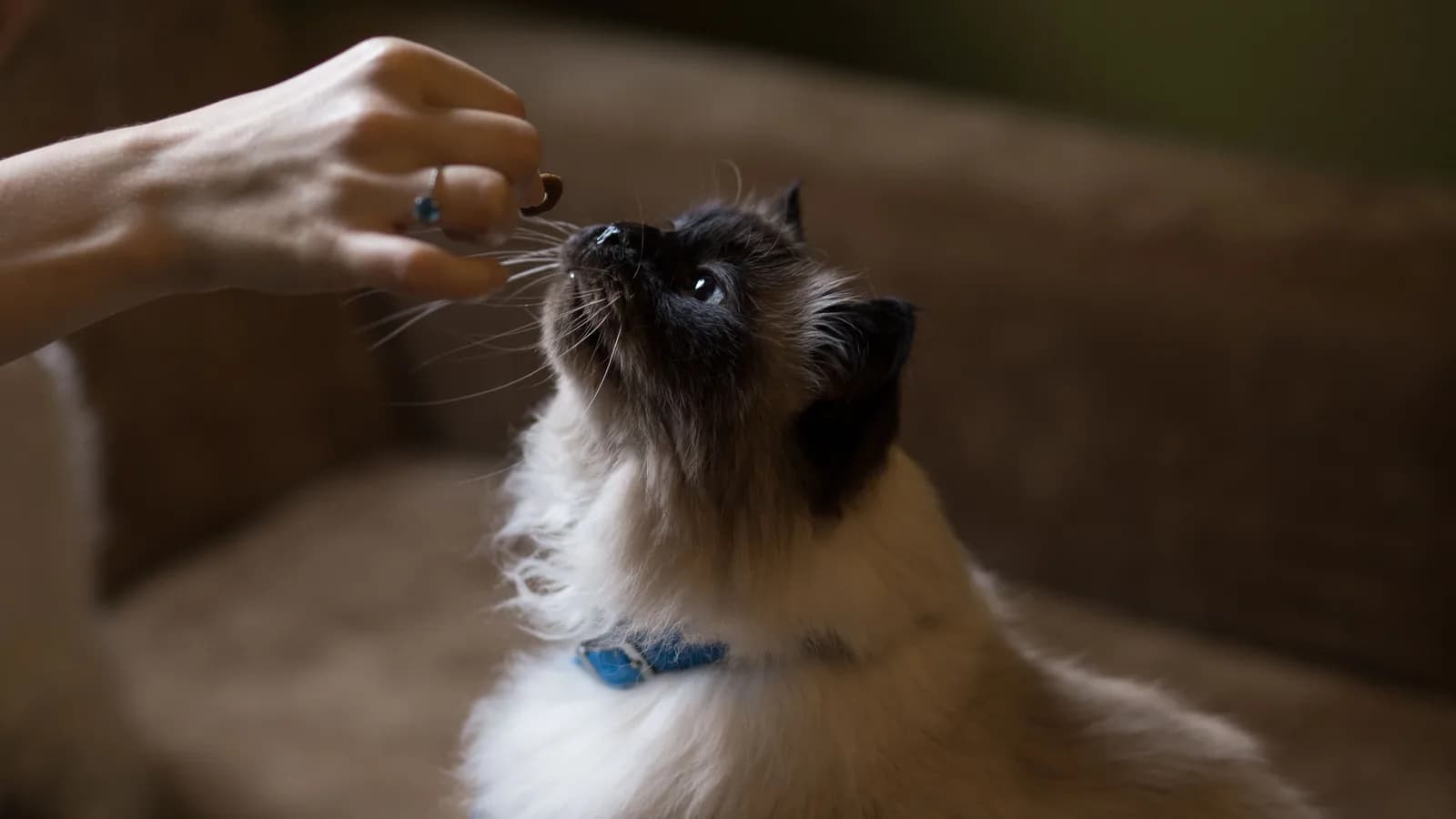
Positive reinforcement, as the feline practitioners' association defines it: something the cat wants, given to make a behavior more likely. Three mechanics carry the whole thing. The reward lands within three seconds, or you are rewarding whatever happened next. The reward is whatever THIS cat rates: treats for most, but catnip, a play burst or brushing work for others. If catnip is the currency, note that only about two cats in three respond to it at all; our catnip guide explains why, and what works for the rest. And the treats live inside the daily budget, at most a tenth of calories, which our feeding guide shows how to count. Sessions stay short: Cats Protection's rule is three minutes at most, up to three times a day, which is also roughly a cat's honest attention span for work.
The clicker, if you want the precision tool
A clicker is just a sharper three-second rule: a sound that marks the exact instant of the behavior, then predicts a treat. Cats Protection's method: charge it first (click, treat, repeat until the cat startles toward you at the click), then click at the exact moment of the behavior, and if you mistime a click, pay the treat anyway, because the clicker only works while it reliably predicts food. Pick treats that swallow fast. Two honest notes from the same sources: nervous and shy cats may find the whole game stressful rather than fun, and the popular claim that clicker training reduces shelter-cat stress was rated "weak evidence" by the formal review that checked, so treat the clicker as a teaching tool, not a therapy.
The worked example: sit, in about a week
The lure method, step by step per Cats Protection: hold a treat at the cat's nose, raise it about 5 cm, then draw it slowly back toward the tail; the head follows, the rear drops; the instant the cat sits, say "yes" and pay. Never push the cat into position; forced handling teaches exactly the wrong lesson. Their owner-facing expectation: a sit on verbal cue within about seven days. For calibration, here is what the 100-cat shelter study measured after two weeks of daily five-minute sessions, on its stricter 4-point mastery bar:
| Cue | Cats at full mastery after 2 weeks |
|---|---|
| Touch a target with the nose | 79% |
| Spin | 60% |
| High-five | 31% |
| Sit | 27% |
Different protocol, different bar than the charity's seven-day figure, same conclusion: some tricks come cheap, some cost a fortnight, and a target touch is the easiest first win you can pick.
Never punish, and it is not a sentiment
Every cat-specific institutional source lands on the same flat sentence; the and life-stage guidelines put it as "cats should not be punished". Yelling, squirt bottles, rattle cans, startling: per the feline practitioners' own position statement, these scare the cat, can trigger flight or fear aggression, inhibit the learning you wanted, and damage the bond; even verbal punishment focuses attention on the unwanted behavior and can accidentally reward it.
What replaces it is ignore-or-redirect, and their worked example is the 5 a.m. meower: feed the cat only when it is NOT meowing, and the meowing stops paying. For scratching, redirect to the post and reward the instant claws meet it; our scratching post guide carries the full placement method. And a behavior that changes suddenly is a medical question before a training question, the same standing rule our biting guide engraves. The same ignore-and-redirect math also settles why cats knock things off your shelves: stop paying the crash in attention, and give the paw a better job.
The training that pays off at the vet
The highest-return cues are not tricks. In a US survey, 42.6% of cats showed aggression at the veterinary clinic; is the training that spends down that number, and the guidelines are concrete about it. Come-when-called becomes carrier training. A go-to-mat cue becomes an exam-table skill. The pill-giving trick is worked out in the guideline itself: let the kitten lick food off the empty pill device, then deliver a morsel with the plunger mid-meal, so mouth handling predicts dinner.
For handling, Cats Protection's cue method: say "touch", touch a liked spot for one second, pay, extend slowly, sessions two minutes, and the cat is never restrained and always free to leave, which International Cat Care's whole interaction framework rests on: choice, a three-second touch then a pause, and stop at the first discomfort signal, the ear rotation and tail-swish vocabulary our body language guide covers. A cat already fearful or aggressive around hands is a vet-then-behaviorist case, not a home project.
Kittens learn fastest; adults learn fine
The , per the 2021 life-stage guidelines, opens at 2 to 3 weeks and may already be closing by 9 to 10, and quality beats quantity inside it: ideally 30 to 60 minutes of pleasant human interaction a day for a young kitten. That window is about comfort with the world; the cue-learning itself has no expiry, which is what the no-age-effect result above measured. One more US number, for the curious: most surveyed owners had never heard of kitten socialization classes, and half said they would join one. The demand exists; the classes barely do.
What not to expect, honestly
Do not expect a dog. Feline motivation runs through food and play, not approval, and the big fetch dataset makes the point beautifully: 40.9% of 8,224 surveyed cats fetch, and in a survey of fetching cats, 94.4% started doing it spontaneously, untrained, usually on the cat's own initiative. You rarely teach a cat to fetch; you notice, and pay for, the fetch it offered. That is , and it is half of cat training in one word: reward what the cat already volunteers, and it will volunteer it again.
What to take away
- Cats learn by the same rules as every animal: a reward within three seconds, sessions of three minutes at most, and no punishment ever.
- The proof of concept is measured: in the four-cue study, all four behaviors improved significantly within two weeks.
- Age is not a barrier: across cats from 6 months to 12 years, age had no significant effect on learning any tested cue.
- Fetching is mostly self-taught (94.4% of fetching cats started on their own): capture and reward what the cat already offers.
- To stop a behavior, make it stop paying and make the alternative pay better; a behavior that appeared suddenly is a vet call before any training plan.
 The vet's take

Veterinary review
Are you a vet?
Your professional read belongs here: every verified practitioner can leave a note, published once our editors have reviewed it.
Sign in and get your license number verified. We check it in the public register, we never ask for or keep a copy of your diploma, and your number is never published.
Frequently asked questions
Can you train a cat like a dog?
Same learning principles, different animal: rewards within three seconds, short sessions, no punishment. What differs is motivation, food and play rather than approval, and pace. The four-cue study is the proof of concept: all four behaviors improved significantly in two weeks.
Can you train an older cat?
Yes, and this one is measured rather than hoped: across cats aged 6 months to 12 years, age had no significant effect on learning any of the four tested cues.
How long should a cat training session be?
Three minutes at most, up to three times a day, per Cats Protection. End while the cat still wants more; a bored or stressed cat is learning that training is bad.
How do I teach my cat to fetch?
Mostly, you don't: 94.4% of fetching cats started on their own. If yours ever carries something toward you, pay it instantly and generously, and you are capturing a behavior instead of building one, which is the easy direction.
How do I stop bad behavior without punishing?
Make the behavior stop paying and make the alternative pay better: ignore the 5 a.m. meowing and feed only the quiet cat, redirect claws to the post and reward there. If a behavior appeared suddenly, call your vet before any training plan; out of hours, an emergency clinic.
 Community questions
Got a question this page doesn't cover? Ask it: the best ones get published here with their answer.
This is information, not veterinary advice, and it cannot tell you what is wrong with your cat. Our rule is a simple one: if something is wrong with your cat, call your vet, and call an emergency clinic if it is out of hours. Nothing you read here is a reason to wait.
Medical information applies to every reader. Prices, legal duties and common practice do not: unless stated otherwise, they are given for the United States, and they differ in the UK, Canada and Australia, and often between states or provinces. Check with your own vet and your own local authority.
Our sources
- Kogan et al 2017, assessment of clicker training for shelter cats (read in full; 100 cats, the mastery rates, no age or sex effect), Animals 7
- Travers 2022, does clicker training reduce stress in shelter cats? (read in full; evidence rated weak), Veterinary Evidence 7
- AAHA and AAFP 2021 feline life stage guidelines (read in full; the socialization window, cooperative care, cats should not be punished)
- AAFP position statement, positive reinforcement for cats, 2012 (the three-second rule and the ignore-or-redirect examples)
- AVSAB, what are reward-based training methods for dogs (and cats)? (the cat-inclusive no-aversives line)
- Cats Protection, tips for clicker training your cat
- Cats Protection, how to train your cat to sit on command (the lure method and the seven-day expectation)
- Cats Protection, how to train your cat to accept handling (the touch-cue cooperative method)
- International Cat Care, cat friendly interaction (choice and control, the three-second rule, the discomfort signals)
- Delgado et al 2024, making fetch happen (read in full; 8,224 cats, the spontaneous-fetching figures), PLOS ONE
- Link and Moody 2025, US owner survey on kitten socialisation programs (read in full), Animal Welfare 34
- US cross-sectional survey 2024, aggression at the veterinary clinic in cats (read in full; the 42.6% figure), J Feline Med Surg

Worth keeping a paw on
Pin this guide
So you can find it the day you need it, and share it with someone whose cat does the same thing. One click and it sits in your board.
Pin it on PinterestAlso worth reading
All behavior →
Article
Cat Body Language: How to Read the Whole Cat
The same ear position means two opposite things depending on the eyes and tail. Read cats as a system, and know which popular signal is not reliable at all.
Read
Article
Cat Tail Language: What Each Position Means, and the Study That Flips the Script
The position guide with the measured studies behind it, the finding that tail-up is mostly aimed at you, and the tail injury signs that cannot wait.
Read
Article
Why Do Cats Knead? The Science of Making Biscuits
Kittens knead to start the milk flowing. Adult cats never stop: comfort, naps, maybe scent. What the science really shows, and the one thing kneading does not say about your cat.
Read
The floor belongs to our members. Keep it kind, links are not allowed, and images go through moderation before anyone else sees them.