

Cat Tail Language: What Each Position Means, and the Study That Flips the Script
The position guide with the measured studies behind it, the finding that tail-up is mostly aimed at you, and the tail injury signs that cannot wait.

Published August 26, 2026Updated September 8, 2026 4 min read
Contents
Our cat body language guide reads the whole cat and hands the tail its own page. This is that page, and it opens with the finding that most tail articles have never met: the raised tail is mostly a message for you.
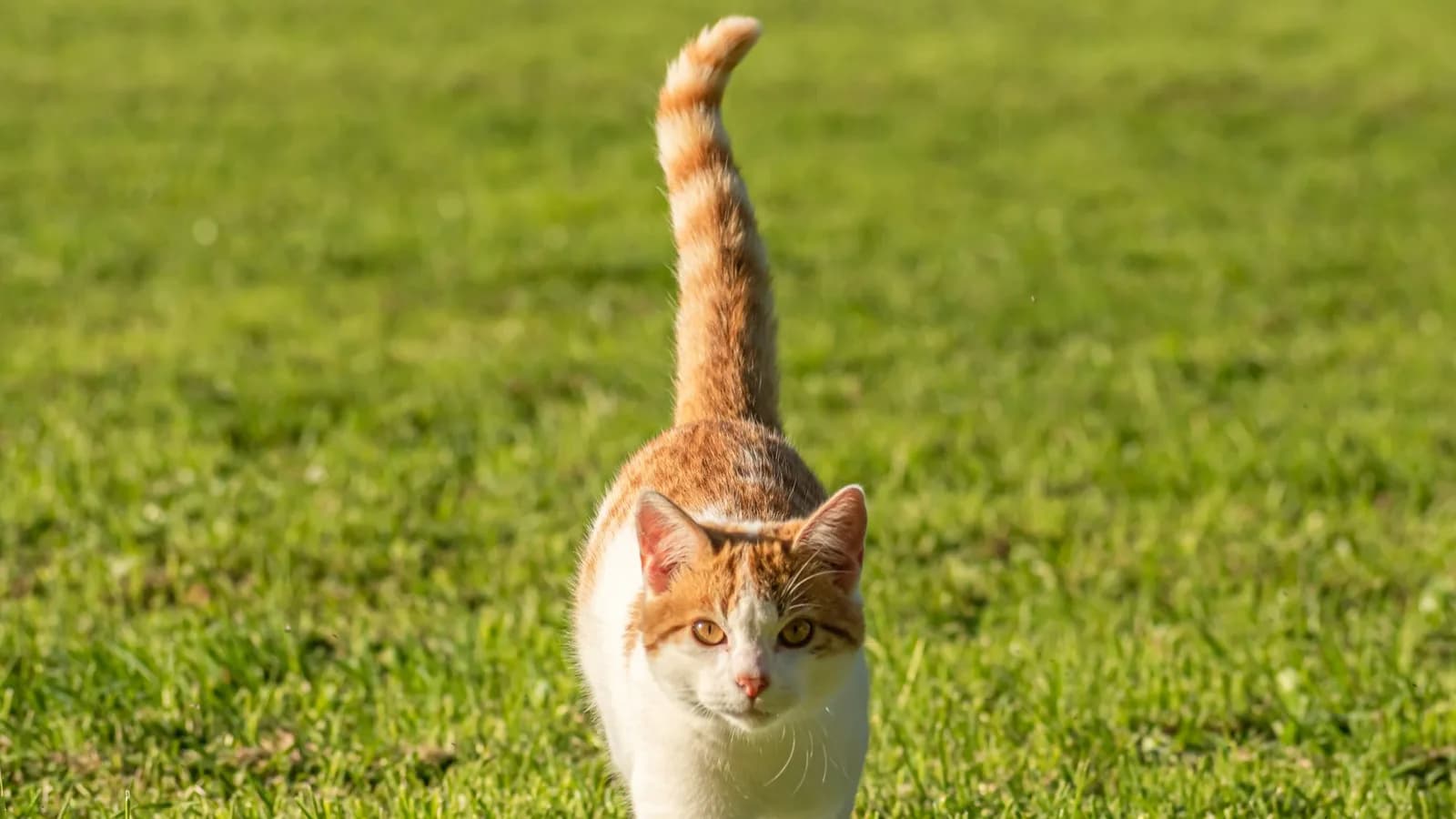
In the largest naturalistic study we found, cats approached humans with the tail up in 97.8% of interactions. Approaching each other? They came in tail-down more than three times out of four, and the ears predicted how the meeting would end better than the tail did. So when your cat walks at you flag-high, take the compliment: it is not the default greeting for everyone. The researchers' own, openly speculative reading is that it resembles how a kitten greets its mother.
The position guide
| Tail | What it usually means | The fine print |
|---|---|---|
| Straight up, tip softly curled | friendly greeting, confident approach | ears usually up, whiskers relaxed; the question-mark curve often invites play |
| Up and quivering | excited greeting | the same quiver during backing-up-to-a-wall spraying is stress or territory, not joy |
| Hanging low, loose | often just neutral | the research used tail-down as the neutral position; some breeds, Persians among them, carry it low by default |
| Tucked between the legs | fear or anxiety | read with the rest: flattened ears, crouch, wide pupils |
| Puffed out, back arched | stay away | making itself bigger; some cats puff reflexively at a sudden fright, then investigate |
| Wrapped around its own feet | wariness | the sitting version of keeping options closed |
| Wrapped around you or another cat | contact | the closest thing cats have to a hug, and it goes with the leg-rub greeting |
| Thumping the ground from a crouch | defensive | International Cat Care calls this posture exactly that |
Movement is a different channel from position
A slow side-to-side swish is a cat thinking, often mid-hunt on a toy. A twitching tail tip is attention. A tail lashing fast and hard is arousal climbing, and it sits inside the same warning ladder our biting guide lays out: tail first, then ears, then skin ripple, then teeth. Cats are not dogs; a moving tail is not a happy tail by default, and reading it as one is how "he bit me out of nowhere" stories get written.
The receipts, because this topic is full of confident guesses
The science on tail-up is real, and it is more interesting than the listicles let on.
In a Rome colony, researchers found tail-up was displayed more by low-ranking cats and received more by high-ranking ones: less "I am happy" and more "I come in peace, and I know who you are". The signal predicted friendly contact, especially rubbing, when it appeared.
A British researcher then did the elegant thing: showed cats life-size silhouettes identical except for the tail. House cats approached the tail-up silhouette faster, with less hesitation, and raised their own tails higher at it. A colony of isolated, indoor-raised cats showed no response at all, which suggests the signal is learned and maintained by actually meeting other cats. The same work argues tail-up does not function as a social signal in undomesticated felids: it may be something domestication itself built, for animals suddenly living close together around humans. For honesty's sake: at least one ethologist has argued tail position is more muscle tone than message, so treat every single-signal reading, this page included, as an input to the whole-cat picture, never a verdict.
The tail is also a body part, and this is the serious paragraph
The tail is a chain of small vertebrae moved by real muscles, and the nerve bundle serving it, the , also serves the bladder, bowel and hind legs. That is why a tail-pull injury, a slammed door, a grabbed tail, a road accident, is never cosmetic. In one congress study, only 21% of tail-pull injuries came alone: 46% arrived with pelvic fractures.
Call the vet the same day if you see: a tail that hangs limp or drags and is never held high, dribbling urine, a wobbling back end, or any bathroom accident from a cat that never had them. Recovery is genuinely possible, nerves heal over weeks to months, but the odds depend on how bad the damage is, and the window for helping is early. 's line covers the softer cases too: quick or unusual tail movements plus hiding, poor appetite or vocalizing is a vet call. And the standing rule: if something is wrong with your cat, call your vet; out of hours, an emergency clinic.
What to take away
- Cats do not wag like dogs: a slow swish is focus, a fast lash is rising irritation, and the dog rule (moving tail equals happy) gets people bitten.
- A tail held high with a quiver at your arrival is an excited greeting; the same quiver while backing up to a wall is spraying, a different message entirely.
- A tail wrapped around your leg is the greeting cats use on each other: membership, with scent attached.
- The tail is one of seven channels: it reads reliably only alongside ears, whiskers, posture, pupils, voice and coat.
- A suddenly limp tail is a same-day vet visit: tail-pull injuries carry nerve damage that can also affect the bladder.
 The vet's take
Veterinary review
Are you a vet?
Your professional read belongs here: every verified practitioner can leave a note, published once our editors have reviewed it.
Sign in and get your license number verified. We check it in the public register, we never ask for or keep a copy of your diploma, and your number is never published.
Frequently asked questions
Why does my cat wag its tail?
Cats do not wag like dogs. A slow swish is focus or deliberation; a fast lash is rising irritation or arousal and a step on the warning ladder. The dog rule, moving tail equals happy, fails on cats often enough to get people bitten.
What does a quivering tail mean?
Held high and quivering at your arrival: an excited greeting. The caveat worth knowing: a similar quiver while a cat backs up to a vertical surface is spraying, which signals stress or territory, not affection.
Why does my cat wrap its tail around my leg?
It is the same affiliative move cats use on each other, part of the rubbing greeting that spreads their scent onto family. Take it as membership.
How do tailless cats like the Manx communicate?
Honestly: no institutional source we read documents a specific compensation, so we will not invent one. A Manx still has the other six channels our body-language guide covers, ears, whiskers, posture, pupils, voice and coat. One practical Manx note from our breed page: the tailless area can be sensitive, so pet shoulders, not the rump.
My cat's tail suddenly hangs limp. Is that urgent?
Yes, same-day. A limp tail after a door, a fall or an outdoor absence can mean a tail-pull injury with nerve damage that also affects the bladder. Early veterinary assessment is the difference between the good and bad outcome groups.
 Community questions
Got a question this page doesn't cover? Ask it: the best ones get published here with their answer.
This is information, not veterinary advice, and it cannot tell you what is wrong with your cat. Our rule is a simple one: if something is wrong with your cat, call your vet, and call an emergency clinic if it is out of hours. Nothing you read here is a reason to wait.
Medical information applies to every reader. Prices, legal duties and common practice do not: unless stated otherwise, they are given for the United States, and they differ in the UK, Canada and Australia, and often between states or provinces. Check with your own vet and your own local authority.
Our sources
- Cafazzo and Natoli 2009, the social function of tail up in the domestic cat (abstract), Behavioural Processes 80
- Deputte et al 2021, heads and tails: an analysis of visual signals in cats (read in full), Animals 11
- Cameron-Beaumont 1997, visual and tactile communication in the domestic cat and undomesticated small felids, PhD thesis, University of Southampton (read via archived PDF)
- International Cat Care, cat communication
- Cats Protection, cat body language
- PDSA, cat body language
- PDSA, tail meaning: what your pet's tail is trying to tell you
- VeterinaryPartner (VIN), tail-pull injuries in cats (the congress co-injury figures and prognosis groups)

Worth keeping a paw on
Pin this guide
So you can find it the day you need it, and share it with someone whose cat does the same thing. One click and it sits in your board.
Pin it on PinterestAlso worth reading
All behavior →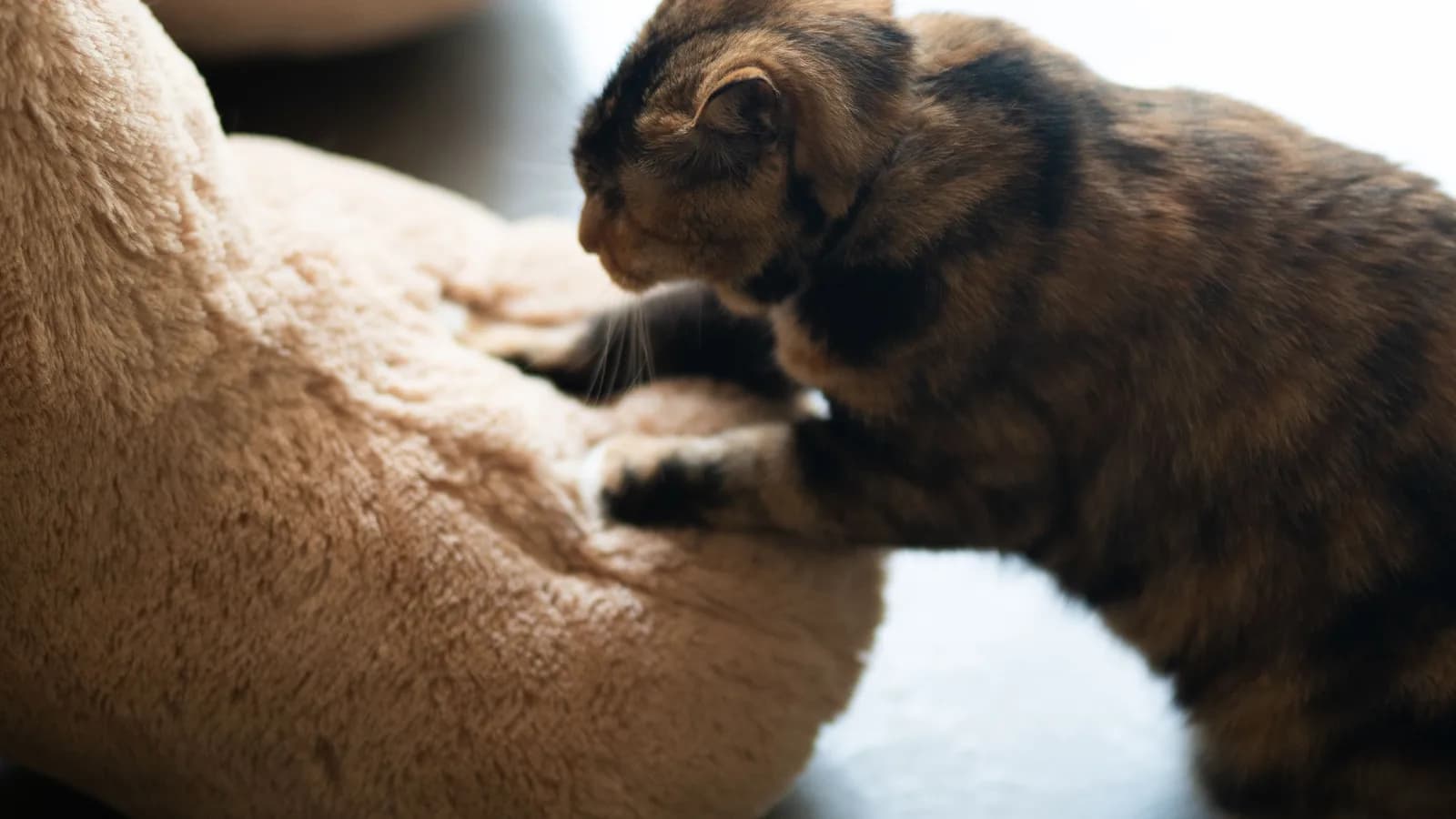
Article
Why Do Cats Knead? The Science of Making Biscuits
Kittens knead to start the milk flowing. Adult cats never stop: comfort, naps, maybe scent. What the science really shows, and the one thing kneading does not say about your cat.
Read
Article
Why Do Cats Purr? The Owner of the Sound Opens the Hood
Cats purr when content, when hungry, and even in pain. Our editor-in-chief opens the hood on his signature sound: the 2023 larynx study, the kitten purr, and the healing legend, checked.
Read
Article
Why Do Cats Hate Water? A Dry Cat Is a Cat in Control
Wet fur is heavy, cold and slow to dry, and nobody asked the cat first. The real reasons cats hate water, the science that is missing, and the breeds that swim anyway.
Read
The floor belongs to our members. Keep it kind, links are not allowed, and images go through moderation before anyone else sees them.