

Why Does My Cat Stare at Me? A Staring Professional Explains
You are being watched, and it is mostly a compliment. Cookie explains the science of cat staring: hunger o'clock, the peer-reviewed slow blink, hard stares, and the stare that needs a vet.
Published August 28, 2026Updated September 8, 2026 8 min read
Contents
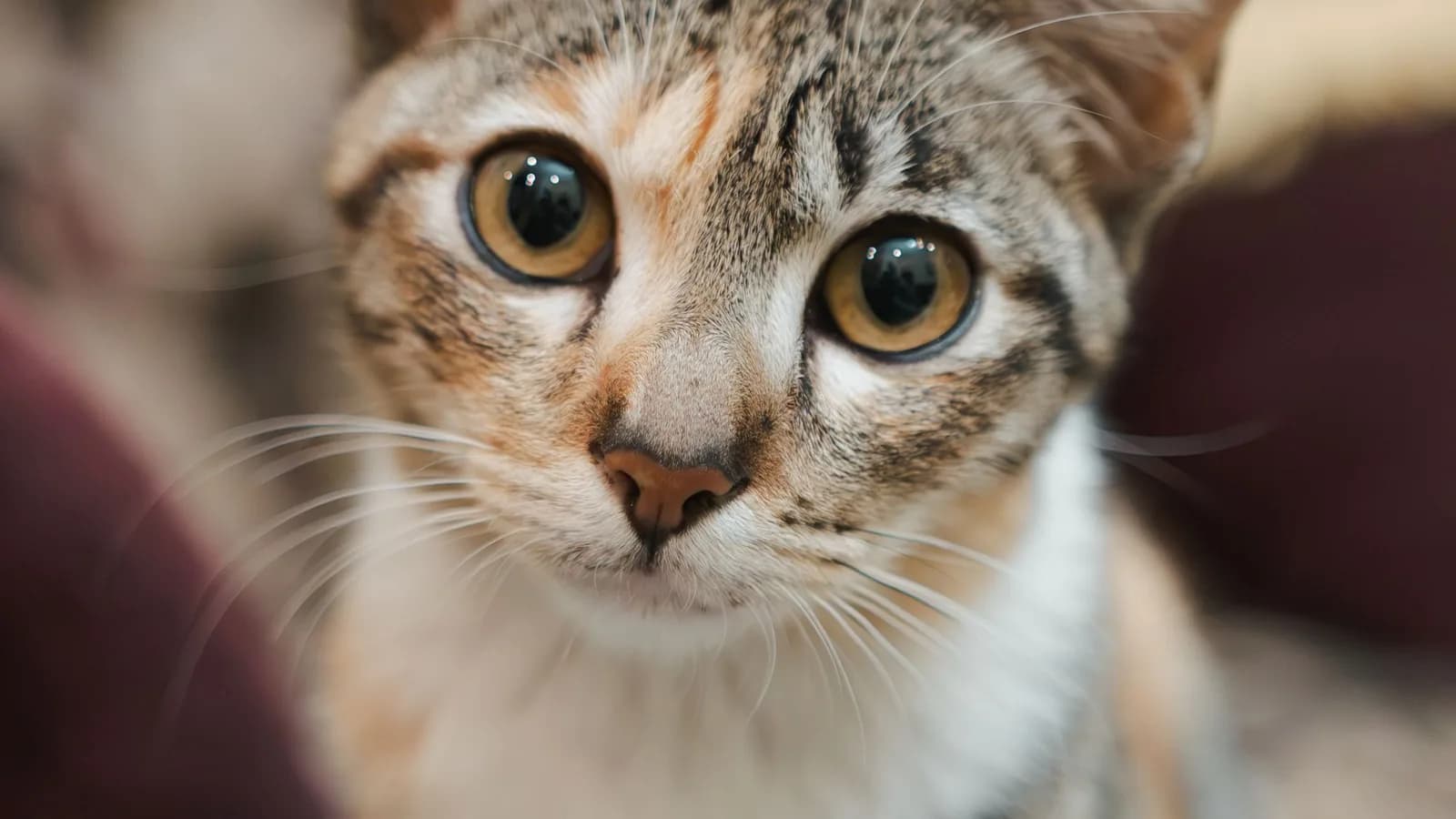
Yes, I stare at you. I am doing it right now, editorially. You walk around my house carrying snacks, operating faucets, dropping cheese, and you want to know why I watch you? You are the most interesting thing I own. The better question is why you keep looking up from your little glowing rectangle to check.
But fine. My publisher says a professional explains his methods, so here is the honest version: cat staring is not one behavior. It is a hunger clock, a research program, a peer-reviewed compliment, an occasional threat, and, rarely, a health flag. Science has weighed in on almost every one of these, which I find flattering. Whole laboratories, studying my gaze.
You are the food person. Of course I watch you
Start with the least mysterious stare in the building. Veterinary behaviorist Dr. Wailani Sung puts it plainly: some cats stare intently at you when they want attention, and some have been known to stare at their pet parents when it is feeding time. That is me, at 6:58 a.m., two minutes before the schedule we agreed on. I am not rushing you. I am supervising.
The hunger stare rarely travels alone. It comes with a meow, a leg rub, an escort service to the kitchen. Cats learn routines fast, and a stare that once produced breakfast gets filed as a working tool. You taught us this. We simply took notes, which is what the staring is.
There is also the simpler version: interest. Veterinarian Dr. Paola Cuevas notes that being stared at by your cat is typically a good thing, because it shows they are interested in you, and that cats understand they rely on you for food, shelter, and entertainment. Relaxed body, soft eyes, loose tail: that stare is attention, not menace. For the whole-cat reading, ears and tail and whiskers together, our cat body language guide is the full decoder.
The science says your cat is studying you
Here is the part humans find surprising. In a 2005 comparative study in the Journal of Comparative Psychology, cats followed human pointing gestures to find hidden food about as well as dogs did, above chance on all four pointing types tested. The species difference showed up elsewhere: when the food was locked away, dogs looked back and forth between the human and the prize, asking for help with their eyes. Cats mostly kept working on the problem alone. We can read you fine. We just prefer self-service.
And the stare is aimed at you, personally, not at humans in general. A 2013 study in Animal Cognition played cats recordings of three strangers calling their name, then their owner's voice. The cats' attention faded across the strangers and snapped back for the owner, ears and head turning, even with nobody in sight. Your cat can pick your voice out of a lineup. The cat staring at you knows exactly who you are.
Nora · Adoption desk
The voice study is my favorite detail in this piece. Twenty cats, and the owner never entered the room: just recordings, three strangers calling the cat's name, then the owner's voice. Attention faded stranger after stranger, then rebounded the moment the owner spoke. The stare Cookie is bragging about is addressed. Your cat singled you out long before you noticed.
Cookie · Editor-in-chief
Of course it is addressed. I memorized your voice in the first week, filed under operates the can opener. I also memorized the fridge seal, the treat drawer and the cheese wrapper, at distance, through a closed door. A professional knows his sources.
The slow blink, the stare that answers back
Now the crown jewel. In 2020, researchers at Sussex and Portsmouth published, in Scientific Reports, the first controlled study of the slow blink: that half-lidded, honey-slow eye narrowing cats do at people they tolerate. In the first experiment, owners slow-blinked at their own cats at home; the cats narrowed their eyes and half-blinked back significantly more than when the owner just sat in the room, not engaging. In the second, a stranger did the blinking, then offered a flat hand. After a slow blink, cats were measurably more likely to blink back and to approach the hand than after a neutral face.
The authors call it a form of "positive emotional communication" between cats and humans. Lead author Tasmin Humphrey also offered a theory I respect: slow blinking may have begun as a way to interrupt an unbroken stare, which is potentially threatening in cat society. In other words, the slow blink might be politeness. An armistice, with eyelids.
Tess · Behavior desk
One correction before this gets out of hand: the slow blink does not mean love. Half the internet says it does. The 2020 paper never uses the word. It measured more eye narrowing and a higher chance of approaching, and the authors call it positive emotional communication. Our body language guide holds the same line. A measured willingness to approach is not a declaration.
Cookie · Editor-in-chief
Love is a strong word and I signed nothing. The blink is an invoice, payable in snacks, terms net immediately. If humans choose to read romance into my eyelids, that is between them and their imagination.
The hard stare: staring as a threat, between cats
Because here is the thing humans miss: among cats, a fixed, unblinking stare is not small talk. Dr. Sung again: a cat giving a hard, unblinking stare paired with stiff body language is telling the other party that if they do not back off, there will be a confrontation. Staring contests are how cats negotiate territory without spending claws on it. The stiffness is the tell: locked body, frozen tail, ears committed. The tail half of that picture has its own full guide.
So when your cat stares at you and then melts into a slow blink, you are getting the de-escalation signal, the one that says this staring contest is friendly. When two cats in your house lock eyes and nobody blinks, that is a different meeting, and it was not called to discuss snacks.
The window stare is a hunting watch
The third stare is not about you at all, which I know is disappointing. A cat parked at the window, motionless, eyes tracking something feathered: that is the watch phase of the hunting sequence every cat ships with. Small, fast-moving things pull our attention on hardware level, and the glass only cancels the chase, not the watching. It is often repeated that this frustrated sequence is why some cats chatter at birds; the honest version is that chattering is real, common, and still short on hard published numbers.
Nothing needs fixing here. Window watching is free entertainment and, for an indoor cat, genuinely good enrichment. If the window show ends in tension, a stressed cat pacing or redirecting a swat at a housemate, our cat anxiety guide covers the pressure-release valves.
The 3 a.m. stare, and the sleep watch
The internet's favorite version: you wake at 3 a.m. and the cat is sitting on the dresser, watching you like a small furry lighthouse. The explanation you will read everywhere, that we are guarding you while you sleep, protecting our defenseless human, is often repeated and rarely sourced. No veterinarian or peer-reviewed study we could find has ever tested it. It is a folk story. A charming one, and I will neither confirm nor deny my reasons.
What is documented: cats are most active at dawn and dusk, your bedroom is prime territory, and a cat that gets a reaction at 3 a.m., even a groggy one, learns the move pays. If the night watching comes with loud crying, especially in a cat past age ten, that is a different page, and we wrote it: our night meowing guide walks the six medical causes.
When a stare belongs at the vet
Two stares earn a professional opinion, and this section is deliberately unfunny.
The first is the blank stare. A senior cat staring at walls or into space for long periods, especially with a scrambled sleep schedule, disorientation, or new night crying, fits the sign list for cognitive dysfunction, feline dementia. Cornell's veterinary college puts the age where signs tend to become clearly noticeable at 10 years or older; the prevalence numbers our night meowing guide unpacks climb steeply past 15. It is a recognized diagnosis, it is manageable, and "he's just old" is the least useful response to it.
The second is the fixed pupil. Pupil size on its own means nothing, light and excitement move it all day. The flag is persistence: pupils that stay fully dilated regardless of light, paired with disorientation, bumping into furniture, or sudden blindness, are on the published sign list for feline high blood pressure, which often develops silently. Vets recommend blood pressure checks yearly for healthy cats aged 7 to 10, and every 6 to 12 months from 11. A stare that never adjusts is not a mood. It is a measurement waiting to be taken.
The stare decoder
| The stare | The context around it | What it usually means | What to do |
|---|---|---|---|
| Locked on you, near feeding time | Meowing, leg rubs, kitchen escort | The hunger clock | Feed on schedule, not on demand |
| Soft eyes, loose body | Slow blinks, relaxed tail | Interest, attention, comfort | Enjoy it; blink back slowly |
| Hard and unblinking, stiff body | Frozen tail, committed ears | A threat display, usually cat-to-cat | Do not stare back; break the line of sight |
| Motionless at the window | Chirps or chattering | The hunting watch | Nothing; it is enrichment |
| Blank, at a wall, senior cat | Sleep changes, night crying | A cognitive dysfunction flag | Book a vet visit |
| Pupils fixed wide in bright light | Disorientation, bumping into things | A blood pressure flag | Book a vet visit promptly |
How to stare back politely
The 2020 study doubles as an instruction manual, and it is the rare piece of science you can run tonight from the couch. Professor Karen McComb, one of its authors, describes the technique: narrow your eyes as you would in a relaxed smile, then close them fully for a couple of seconds.
- Step 1: Sit about 3 feet (1 m) away, calm, not looming over the cat.
- Step 2: Meet the cat's gaze softly, no wide-eyed fixed stare.
- Step 3: Narrow your eyes slowly, half-blink once or twice, then close your eyes for a couple of seconds.
- Step 4: Look slightly away and wait. A blink back, or an approach, is your answer.
In the study, cats were more likely to slow-blink back and to approach an outstretched hand after exactly this routine than after a neutral face. It works on strangers' cats too, which is why it is worth learning before visiting anyone who owns one of us. We notice who has manners.
What to take away
- A cat's stare is several different behaviors: a learned hunger signal, genuine interest, a peer-reviewed social gesture, an occasional threat display, and rarely a medical flag.
- Cats read human cues well: in a 2005 study they followed human pointing to hidden food about as well as dogs, and a 2013 study showed cats recognize their own owner's voice among strangers.
- The 2020 Scientific Reports slow-blink study found cats narrow their eyes back at slow-blinking humans and approach them more readily; the authors call it positive emotional communication, not proof of love.
- A hard, unblinking stare with a stiff body is how cats threaten each other; never answer a tense cat with a fixed stare of your own.
- The claim that cats watch sleeping humans to protect them is often repeated and rarely sourced; no credentialed study supports it.
- Two stares warrant a vet: long blank wall-staring in a cat past 10 (a cognitive dysfunction sign per Cornell), and pupils that stay fully dilated regardless of light (on the published sign list for feline hypertension).
 The vet's take
Veterinary review
Are you a vet?
Your professional read belongs here: every verified practitioner can leave a note, published once our editors have reviewed it.
Sign in and get your license number verified. We check it in the public register, we never ask for or keep a copy of your diploma, and your number is never published.
Frequently asked questions
Why does my cat stare at me without blinking?
Usually attention or anticipation: cats learn that watching the human who controls food and doors pays off, and a relaxed unblinking gaze with a loose body is interest, not aggression. The exception is a hard stare with a stiff body, frozen tail and committed ears, which is a threat display cats mostly aim at other cats. Read the whole body, not just the eyes.
Why does my cat stare at me while I sleep?
Nobody has properly studied it. The popular explanation, that cats guard their sleeping humans, comes from blogs, not from veterinarians or peer-reviewed research. What is documented is that cats are most active around dawn, your bedroom is core territory, and any reaction a cat gets at 3 a.m. teaches it that the move works.
Should I stare back at my cat?
Not with a fixed, wide-eyed stare: between cats that is how confrontations start. The studied alternative is the slow blink: narrow your eyes as in a relaxed smile, close them for a couple of seconds, then look slightly away. In a 2020 study, cats both returned the gesture and approached more readily after it.
What does it mean when my cat slow blinks at me?
A 2020 study in Scientific Reports found cats slow-blink back at humans who slow-blink at them and are more likely to approach afterward; the authors describe it as positive emotional communication. It is a friendly, low-threat signal. What the study does not show, despite what many sites claim, is that it means love.
Why does my cat stare at the wall?
Brief wall-staring is usually just a cat tracking a sound or a shadow you cannot perceive. Long, blank, repeated staring into space in a senior cat is different: it sits on the sign list for feline cognitive dysfunction, alongside sleep changes and night crying, and it deserves a vet visit rather than a shrug.
Why does my cat stare at me while I eat?
Because you are holding food and history says staring sometimes converts it. It is the same learned hunger stare as the breakfast vigil: the cat has associated your meals with opportunity. Feeding on a fixed schedule, and never from the plate, is what retires it. Persistence is the cat betting on your consistency breaking first.
 Community questions
Got a question this page doesn't cover? Ask it: the best ones get published here with their answer.
This is information, not veterinary advice, and it cannot tell you what is wrong with your cat. Our rule is a simple one: if something is wrong with your cat, call your vet, and call an emergency clinic if it is out of hours. Nothing you read here is a reason to wait.
Medical information applies to every reader. Prices, legal duties and common practice do not: unless stated otherwise, they are given for the United States, and they differ in the UK, Canada and Australia, and often between states or provinces. Check with your own vet and your own local authority.
Our sources
- Humphrey et al 2020, the role of cat eye narrowing movements in cat-human communication (Scientific Reports; the slow-blink study)
- Phys.org coverage of the 2020 slow-blink study, with the research team's own quotes (McComb, Humphrey, Proops)
- Miklósi et al 2005, use of human visual signals by dogs and cats (Journal of Comparative Psychology; the pointing study)
- Saito and Shinozuka 2013, vocal recognition of owners by domestic cats (Animal Cognition)
- PetMD, why does my cat stare at me (reviewed by Dr. Wailani Sung, DVM, DACVB; the attention, feeding and hard-stare readings)
- Catster, why does my cat stare at me (Dr. Paola Cuevas, MVZ; the interest reading)
- Cornell Feline Health Center, cognitive dysfunction (the blank-stare sign list and age of onset)
- PetMD, hypertension in cats (the fixed-dilated-pupil sign and screening cadence)

Worth keeping a paw on
Pin this guide
So you can find it the day you need it, and share it with someone whose cat does the same thing. One click and it sits in your board.
Pin it on PinterestAlso worth reading
All behavior →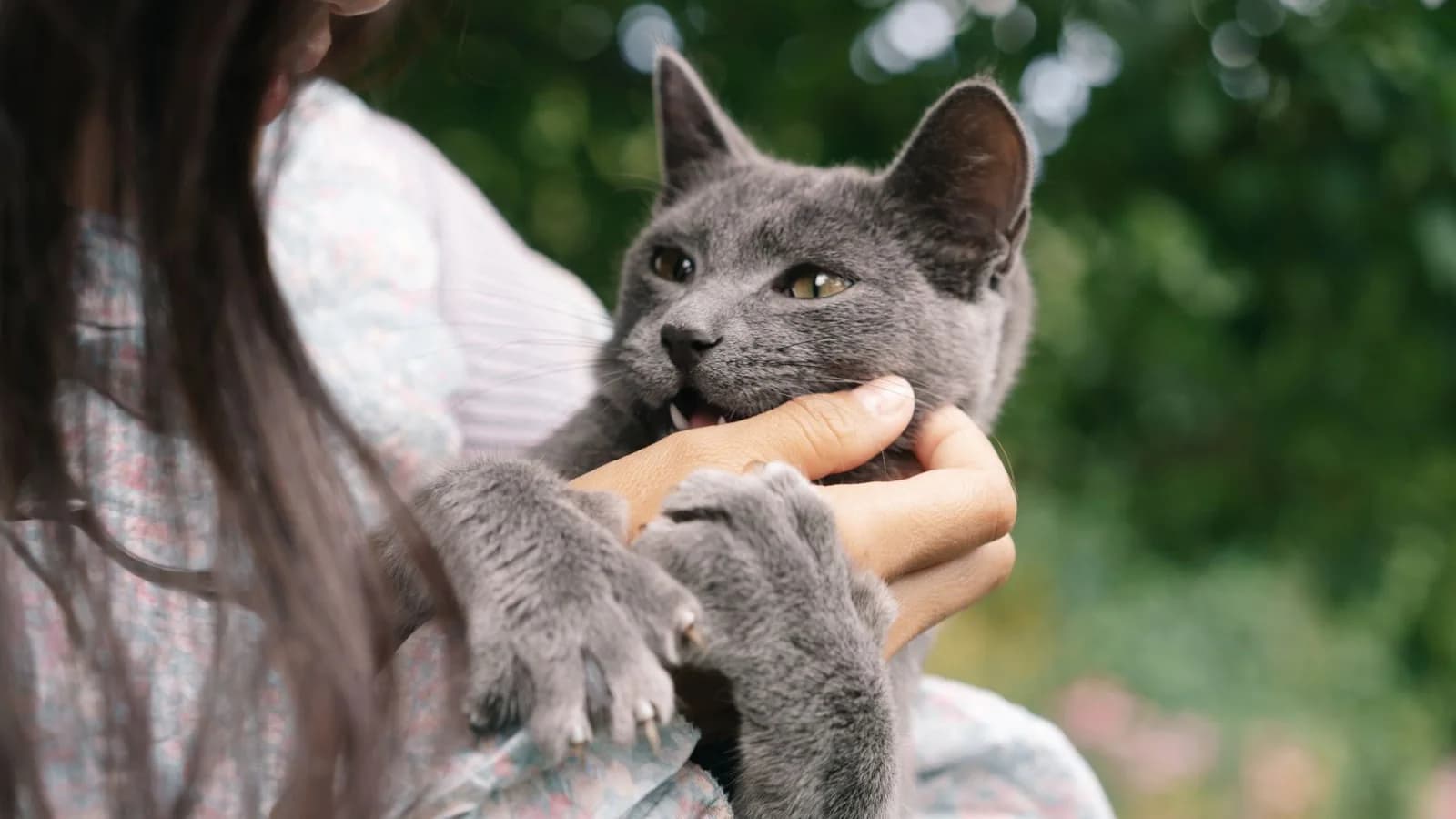
Article
Why Does My Cat Bite Me? The Five Different Reasons
A play bite, a fear bite and a pain bite need three different responses, and the wrong one makes it worse. How to tell them apart, and when it is a vet visit rather than a training problem.
Read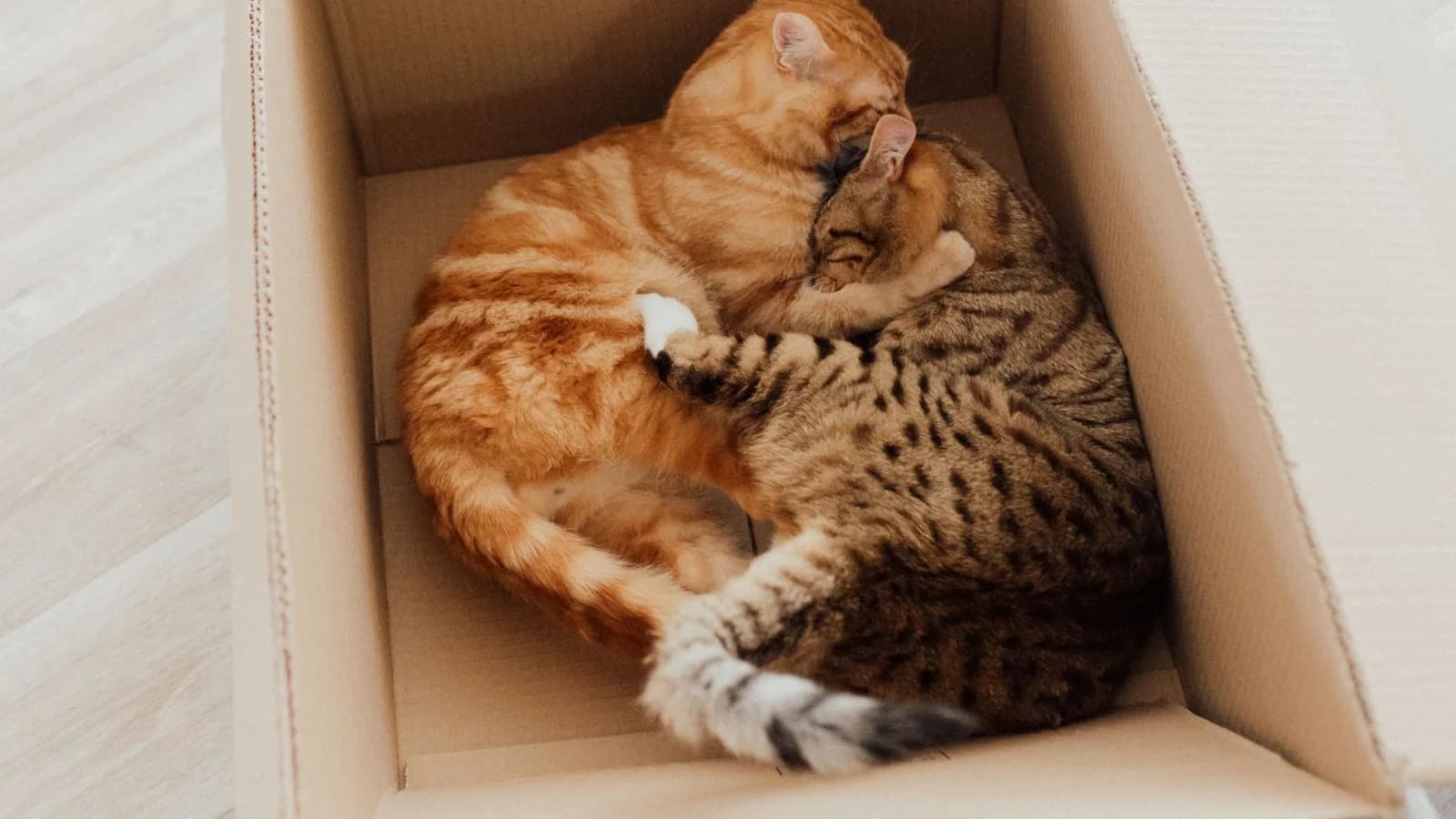
Article
How to Introduce Cats: The Staged Protocol That Works
Two cats do not work it out. The 2024 veterinary guidelines give a staged process with one governing rule: at the first sign of tension, go back a step.
Read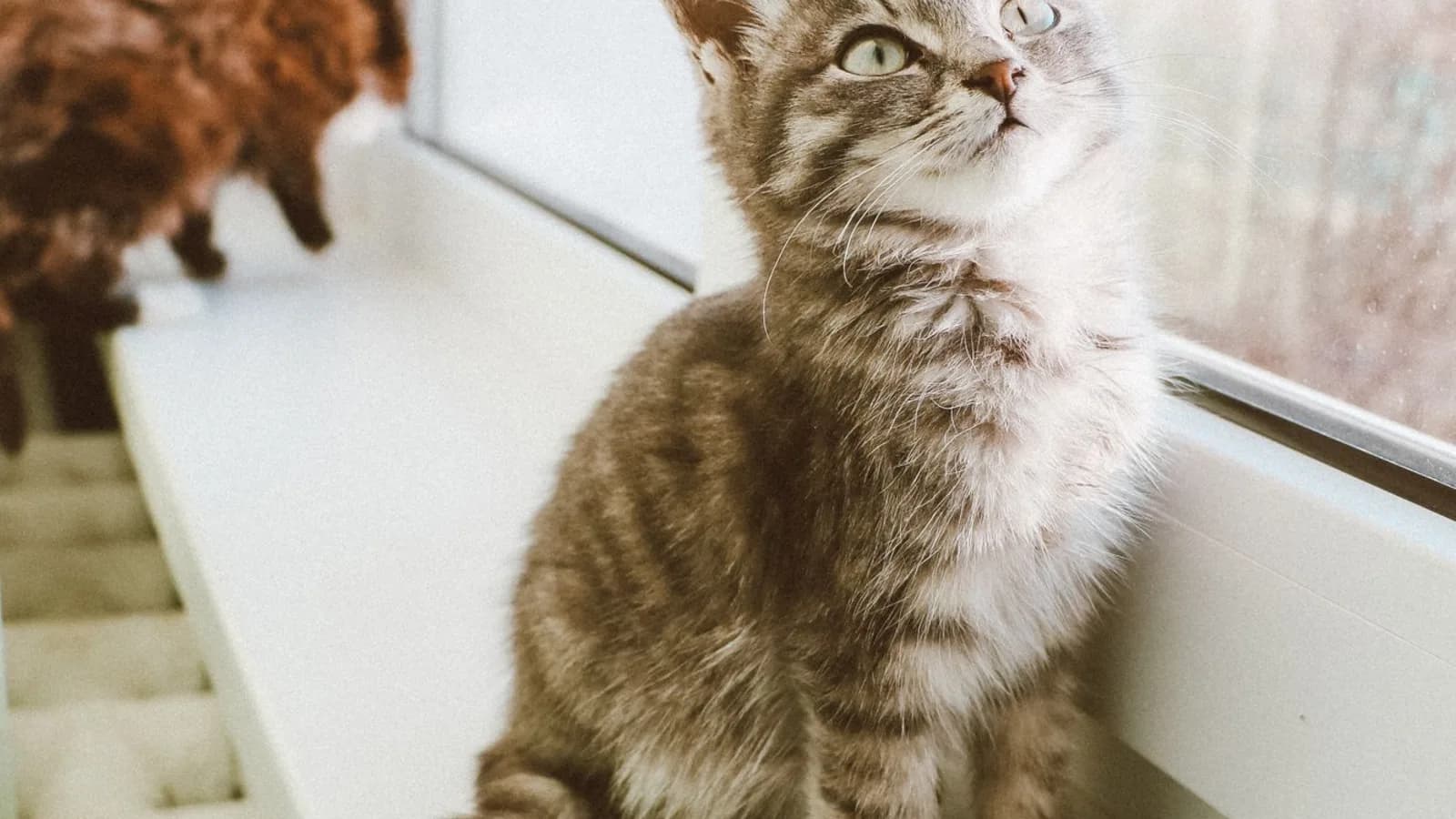
Article
Cat Spraying: What the Puddle on the Wall Is Trying to Say
Yes, female cats spray too. How to tell marking from a medical problem in one look, what the spot on the wall tells you, and the fixes with data behind them.
Read
The floor belongs to our members. Keep it kind, links are not allowed, and images go through moderation before anyone else sees them.