

Chartreux vs Russian Blue: Check the Eyes First
Two famous grey breeds, one glance apart: copper eyes or green. The coat-word test, the shared wartime story, and the British Blue in the middle.

Published August 21, 2026 5 min read
Contents
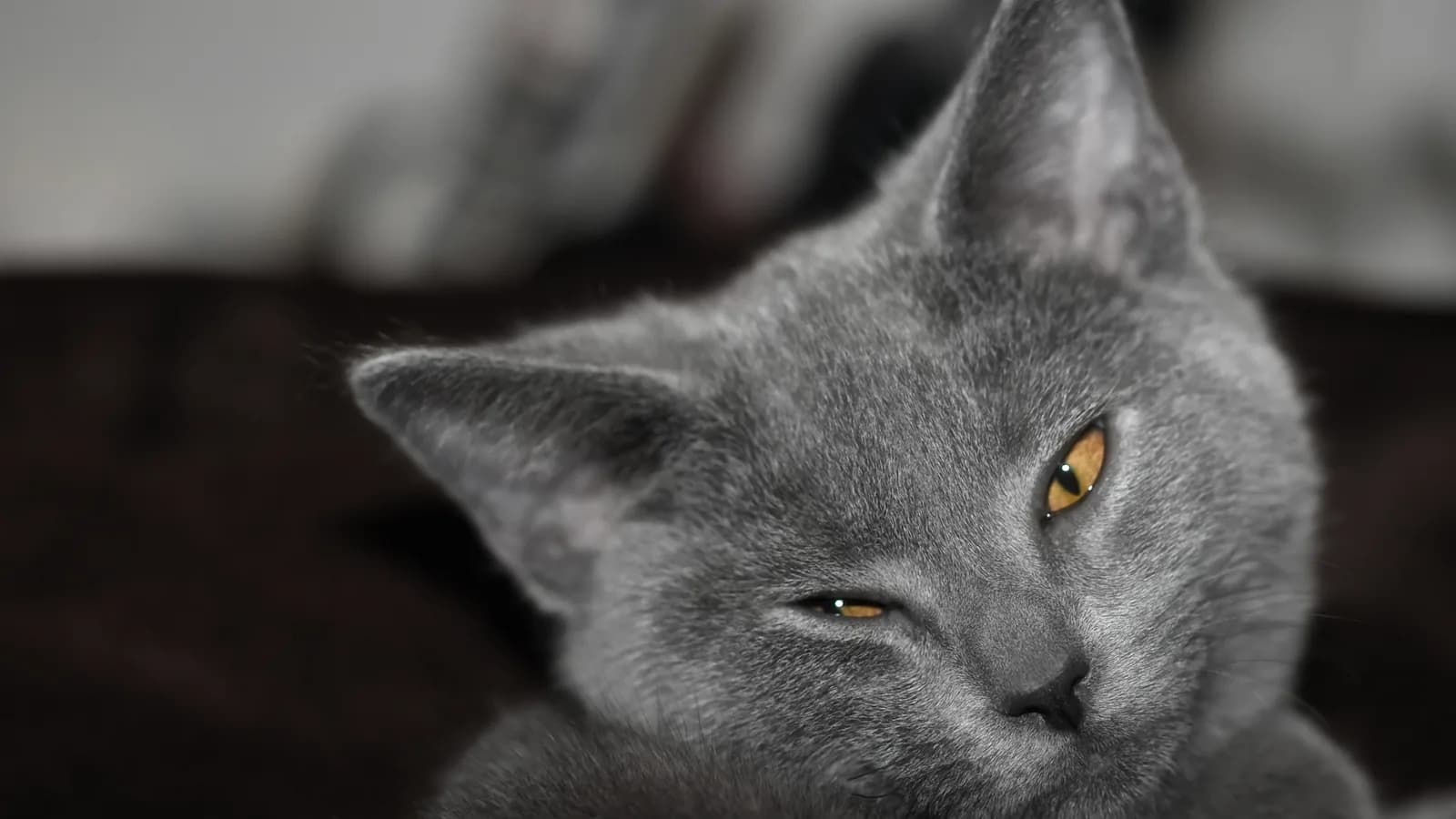
Two celebrated grey breeds, one glance to separate them: the Chartreux looks at you through gold-to-copper eyes, the Russian Blue through green, and each breed's registries treat the other's eye color as a hard disqualification. Everything else on this page is refinement; that first check settles most cases. Here is the full field guide, with the British Blue, the grey everyone forgets is standing in the middle.
The eyes: a rule that runs both ways
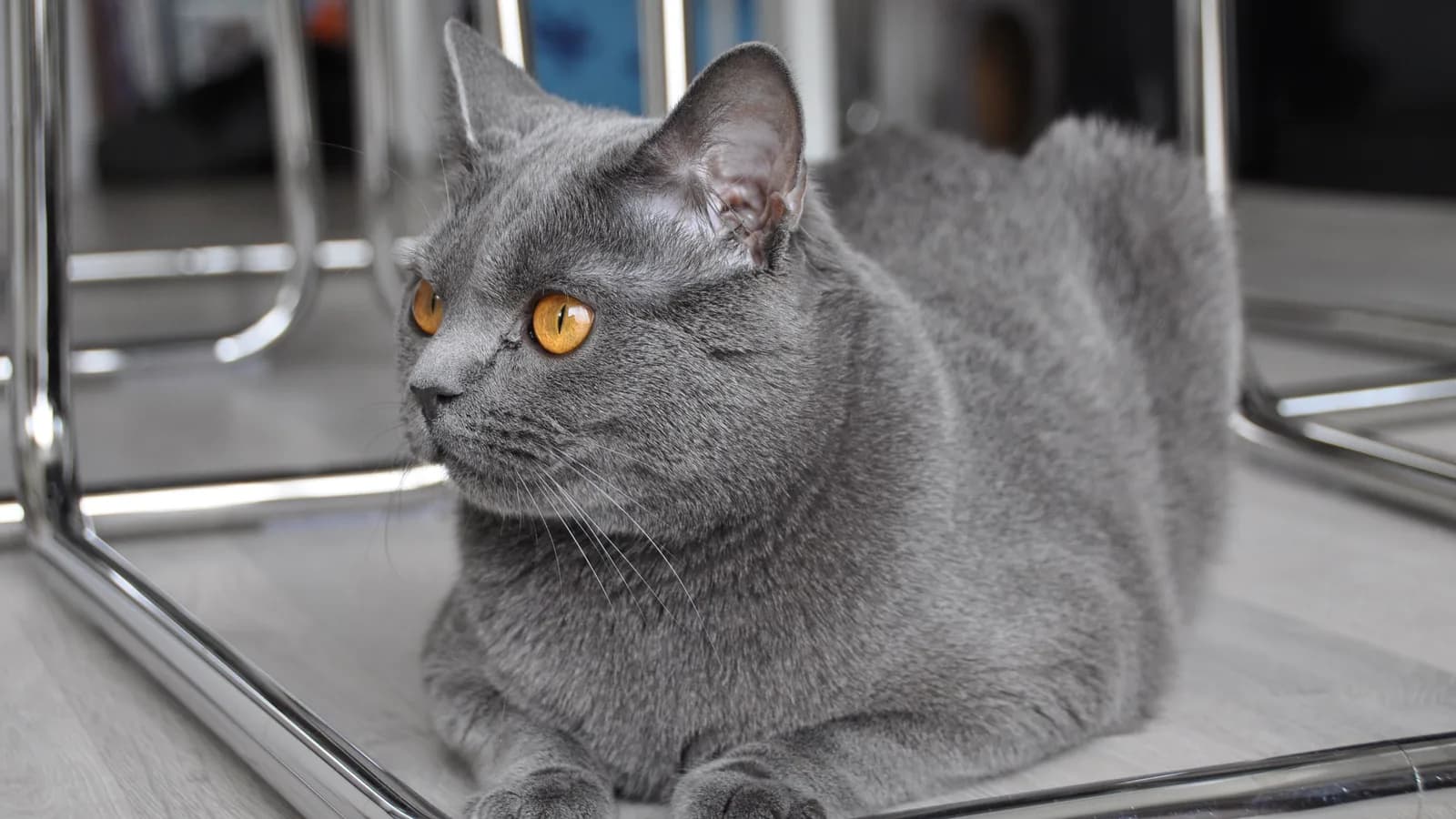
Every western registry that judges the Chartreux demands gold-to-copper eyes and disqualifies green; the Russian Blue's standards demand green. This is the rare comparison where each breed's defining feature would end the other's show career, and it makes the identification unusually kind to amateurs: in good light, the eye color answers first. (The British Shorthair's blue variety, the British Blue, sits in the copper camp with the Chartreux, which is why the SECOND check matters.)
The coat: woolly, plush, or explicitly neither
The registries did the work here by choosing different words on purpose. The Chartreux coat is "woolly" at every registry that describes it, a dense, sheep-like texture that breaks over the joints. The Russian Blue is the plush DOUBLE coat, silvery-tipped, standing off the body. And the British Shorthair's own standard explicitly denies both: "not double coated or woolly," a crisp, dense single texture. Three greys, three deliberately different coat vocabularies, quotable and checkable by hand.
Build and weight: a real gradient, honestly sourced
The British Shorthair is the uncontested heavyweight, cobby at every registry. The Chartreux sits a step lighter in a genuinely contested middle ( and decline to call it cobby, says semi-cobby): the breed's own nickname, a potato on toothpicks, captures the strong body on fine legs. The Russian Blue is the lightest and the least documented (TICA publishes no figure for it at all). One convergence worth trusting: TICA's and Canada's standards agree on the Chartreux's weight to the decimal, males 10-14 lb, females 6-9, a two-registry agreement rare anywhere in the grey family.
Origins: legends, and one honest denial
All three breeds carry origin legends their own registries hedge. The Chartreux's is the famous one, cats of the Carthusian monks, and the most concrete fact our research holds is the monastery's own answer: in 1972 the Grande Chartreuse stated it has no archival record of the monks ever keeping the breed. We lead with the denial rather than the legend, and the Russian Blue's Archangelsk-docks story and the British Shorthair's Roman one get the same treatment on their own pages.
The documented history is better anyway: all three registries' own pages tell a three-way wartime story, British Shorthair blood entering BOTH the Chartreux's and the Russian Blue's postwar recovery lines, and Russian Blue blood entering the British Shorthair's in return. A one-time, scarcity-driven exchange, and firmly historical: all three breeds read "permissible outcrosses: none" today.
Where you can actually get each one
Recognition maps unevenly. The Chartreux holds , and (since 2023, at championship) status, but Australia's states plainly that no Australian standard exists because no exhibits currently live in the country. The Russian Blue and British Shorthair are recognized everywhere, Australia included. If you are reading this from Sydney, two of these three greys are real options; the third is an import project.
And the Korat, to complete the family
's own "blue cat" checklist names a third breed alongside these two: the Korat, the silver-tipped Thai cat with the heart-shaped head, green eyes (amber tolerated), and a SINGLE coat unlike all three cats above. Our Korat comparison carries the full four-breed identification card.
The three greys on one card
| Chartreux | Russian Blue | British Blue | |
|---|---|---|---|
| Eyes | Gold-to-copper (green disqualifies) | Green (strict) | Gold-to-copper |
| Coat, in each registry's own word | WOOLLY | Double, plush, silvery | Explicitly neither woolly nor double |
| Build | Contested middle: robust body, fine legs | Foreign: fine-boned | Uncontested cobby, the heavyweight |
| Weight | M 10-14 lb ( = , to the decimal) | Lightest, least documented | Heaviest |
| Status | Own breed; no Australian exhibits | Own breed, everywhere | A color of the British Shorthair |
 The vet's take

Veterinary review
Are you a vet?
Your professional read belongs here: every verified practitioner can leave a note, published once our editors have reviewed it.
Sign in and get your license number verified. We check it in the public register, we never ask for or keep a copy of your diploma, and your number is never published.
Frequently asked questions
What is the difference between a Chartreux and a Russian Blue?
Eyes first: gold-to-copper (Chartreux) versus green (Russian Blue), each a disqualification at the other breed's registries. Then the coat: woolly versus silvery double-plush. The Chartreux also runs heavier.
Can a Chartreux have green eyes?
Not per any western registry: green eyes disqualify the Chartreux everywhere, exactly as copper eyes would disqualify a Russian Blue. A green-eyed grey is telling you to look at the other columns.
Are Chartreux and Russian Blues related?
Not by breeding programs: both are closed to outcrossing today. Their registries document one shared historical moment: postwar recovery in which British Shorthair blood entered both breeds' lines, a one-time scarcity event, not kinship.
Which is bigger, a Chartreux or a Russian Blue?
The Chartreux: TICA and CCA-AFC agree on 10-14 lb males and 6-9 lb females, while the Russian Blue is the lightest and least-documented of the greys. The British Blue outweighs them both.
Did Carthusian monks really breed the Chartreux?
The monastery itself said in 1972 that it holds no archival record of it. The legend is lovely and its own registries hedge it; we print the denial as the concrete fact.
Is a British Blue a Chartreux?
No: the British Blue is the blue variety of the British Shorthair, cobbier and heavier, with a coat its own standard insists is neither woolly nor double. The copper eyes are the shared trait that confuses people; the build and coat words separate them.
 Community questions
Got a question this page doesn't cover? Ask it: the best ones get published here with their answer.
This is information, not veterinary advice, and it cannot tell you what is wrong with your cat. Our rule is a simple one: if something is wrong with your cat, call your vet, and call an emergency clinic if it is out of hours. Nothing you read here is a reason to wait.
Medical information applies to every reader. Prices, legal duties and common practice do not: unless stated otherwise, they are given for the United States, and they differ in the UK, Canada and Australia, and often between states or provinces. Check with your own vet and your own local authority.
Our sources
- TICA Chartreux breed page (weights; the postwar recovery account)
- GCCF Chartreux Standard of Points (green eyes withhold all awards)
- TICA Russian Blue breed page (green eyes, double coat)
- CFA British Shorthair standard (not double coated or woolly)
- CFA: Got the Blues? (the three-breed identification checklist)
- ACF standards index (no current Chartreux standard: no exhibits in Australia)

Worth keeping a paw on
Pin this guide
So you can find it the day you need it, and share it with someone whose cat does the same thing. One click and it sits in your board.
Pin it on Pinterest
 Purr or Pass
The cat newsletter
Our verified guides, no spam. Unsubscribe in one click.
The floor belongs to our members. Keep it kind, links are not allowed, and images go through moderation before anyone else sees them.