

American Curl vs Scottish Fold: Why Curled-Back Is Not Folded-Forward
American Curl vs Scottish Fold, precisely: a pinna-only gene against a cartilage-wide one, the DNA-tested cross case read correctly, and why only one breed faces welfare bans.
Published August 21, 2026 5 min read
Contents
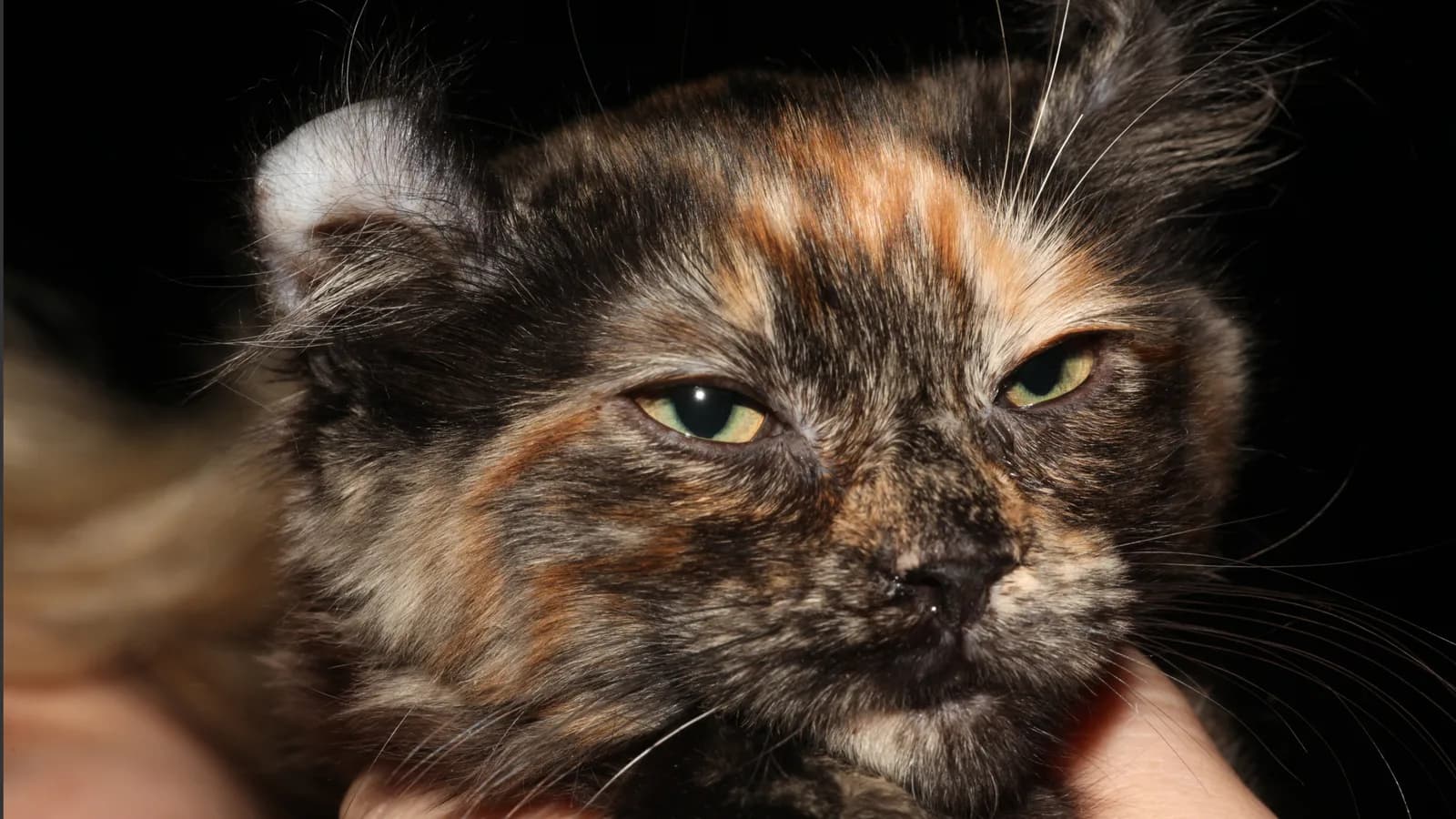
These two breeds get lumped together as "the funny-eared cats", and the lumping is exactly what this page exists to undo, because their genetics run in opposite directions. The Curl's ears curve BACK from a gene that, as far as anyone has documented, changes the pinna and nothing else. The Fold's ears fold FORWARD from a gene that changes cartilage body-wide and causes a documented, painful joint disease. Same shelf in a listicle, different welfare universes. Every sentence below is sourced.
| American Curl | Scottish Fold | |
|---|---|---|
| Ear direction | Curves BACK | Folds FORWARD |
| Gene | Cu, autosomal dominant, pinna only; no molecular test exists | TRPV4, autosomal dominant, cartilage BODY-WIDE |
| Documented disease from the gene | None in any peer-reviewed study (restated 2025) | Osteochondrodysplasia: progressive, painful, documented for decades |
| position | 'Name recognition': registrable, no health objection | Excluded, osteochondrodysplasia named as the reason |
| Government breeding rules (NL x2, Flanders, Victoria) | Named in none | Named explicitly (with Munchkin) |
The two mechanisms, side by side
The American Curl's curl comes from the Cu gene: autosomal dominant, identified in the breed's earliest litters by two independent geneticists, and affecting the ear pinna only. No molecular test exists for it even today. And no peer-reviewed study has documented a body-wide skeletal, joint or cartilage disease caused by the gene itself, a statement independently restated in the literature as recently as 2025.
The Scottish Fold's fold comes from a TRPV4 mutation: also autosomal dominant, but expressed in cartilage throughout the body. It causes osteochondrodysplasia, a progressive, painful joint disease documented across decades of studies and covered in full on our Scottish Fold profile. One gene shapes an ear; the other disorders a skeleton.
The paper that confuses people, read correctly
One published case report (Takanosu & Hattori 2020) describes osteochondrodysplasia in a cat REGISTERED as an American Curl, and it is quoted regularly as evidence against the Curl. Read the paper. DNA testing found that cat carried the Scottish Fold's own TRPV4 disease mutation, through crossbreeding. Its disease traces to that Fold ancestry, not to anything intrinsic to the Cu gene.
The same paper states plainly that skeletal abnormalities have not been reported in the American Curl breed itself. What the case actually teaches is a buyer lesson: a registration paper is not a genome, and a "Curl" from lines crossed with Folds can carry the Fold's disease. Ask breeders about Fold ancestry. A reputable Curl breeder will have none.
The regulatory scoreboard, name by name
The pattern across every body we checked is consistent, and it is the strongest independent evidence for the distinction. excludes the Scottish Fold for a stated welfare reason, naming osteochondrodysplasia explicitly. It gives the American Curl "name recognition" status, a mild administrative tier with no health objection attached (registrable, showable on exhibition, no championship yet).
Four government instruments that restrict breeding (two in the Netherlands, one in Flanders, one in Victoria, Australia) name the Scottish Fold or Munchkin explicitly. None reaches the American Curl. And the welfare bodies: RSPCA, Cats Protection and iCatCare all discuss the Scottish Fold's condition explicitly, and all are checked-silent on the American Curl. We name the silent ones because a checked silence is evidence; an unchecked one is nothing.
Honesty about the thin file
The Curl's clean sheet is an absence of documented evidence in a small, young, lightly studied breed, not a clean bill of health from research that does not exist. No measured cohort has ever followed Curls for joint outcomes. That is a genuinely different statement from the Fold's file, where the disease is documented, mechanism to X-ray. If you want the precautionary version: the Curl has nothing on record; the Fold has decades of records. A buyer who cares about welfare is not choosing between two unknowns.
 The vet's take
Veterinary review
Are you a vet?
Your professional read belongs here: every verified practitioner can leave a note, published once our editors have reviewed it.
Sign in and get your license number verified. We check it in the public register, we never ask for or keep a copy of your diploma, and your number is never published.
Frequently asked questions
Are American Curl and Scottish Fold ears the same mutation?
No: the Curl's Cu gene curves the ear pinna backward and has no documented effect elsewhere; the Fold's TRPV4 mutation folds the ear forward and disorders cartilage body-wide, causing documented osteochondrodysplasia.
Do American Curls get the Scottish Fold's bone disease?
Not from their own gene: no peer-reviewed study documents skeletal disease from the Cu gene. The one published "Curl" case carried the Fold's own disease mutation through crossbreeding, which the paper's DNA testing established, and which makes Fold-free lines the buyer's question.
Why are Scottish Folds banned in places American Curls are not?
Because the regulations are keyed to the documented disease: the Netherlands, Flanders and Victoria instruments name the Fold (or Munchkin) explicitly, and none reaches the Curl. GCCF makes the same split: Fold excluded on named welfare grounds, Curl at simple name recognition.
Is the American Curl proven healthy, then?
Proven is too strong, and we say so: the breed's file is an absence of documented problems in a thin literature, not a completed study. What is fair to say: nothing on record ties the Cu gene to disease, and every welfare body that condemns the Fold is silent on the Curl.
Which should I choose?
On welfare evidence alone, the comparison is not close: one breed's defining gene has a documented painful disease attached and the other's does not. Whatever you choose, the paperwork question is the same: no Fold ancestry in a Curl, and for a Fold, read our profile's welfare section first.
 Community questions
Got a question this page doesn't cover? Ask it: the best ones get published here with their answer.
This is information, not veterinary advice, and it cannot tell you what is wrong with your cat. Our rule is a simple one: if something is wrong with your cat, call your vet, and call an emergency clinic if it is out of hours. Nothing you read here is a reason to wait.
Medical information applies to every reader. Prices, legal duties and common practice do not: unless stated otherwise, they are given for the United States, and they differ in the UK, Canada and Australia, and often between states or provinces. Check with your own vet and your own local authority.
Our sources
- Takanosu & Hattori 2020, J Vet Med Sci: the DNA-tested cross case, read in full (PMID 33162427)
- Robinson 1989, J Hered: the founding Cu-gene genetics paper (PMID 2614061)
- TICA: American Curl breed page
- CFA: American Curl breed page
- GCCF: unrecognised breeds page (Curl at 'name recognition'; Fold excluded on named welfare grounds)
- iCatCare: American Curl page (the checked welfare-body position)

Worth keeping a paw on
Pin this guide
So you can find it the day you need it, and share it with someone whose cat does the same thing. One click and it sits in your board.
Pin it on Pinterest
 Purr or Pass
The cat newsletter
Our verified guides, no spam. Unsubscribe in one click.
The floor belongs to our members. Keep it kind, links are not allowed, and images go through moderation before anyone else sees them.