

European Burmese: A Real Split, Not a Naming Quirk
The European Burmese is a documented separate lineage since 1949: its own CFA standard, more colors, and a different genetic test list. What each registry decides, and why it matters.

Published August 21, 2026 4 min read
Contents
Most breed "types" are marketing. This one has paperwork: the European Burmese is a documented, decades-long separate breeding lineage, with its own breed standard, its own color chart, and, the part that matters most when buying, its own genetic-testing expectations. CFA's own history tells the origin in one sentence: "Starting in 1949, American-bred Burmese were exported to England, where the evolution of the European Burmese began... The breed spread throughout Europe, Africa, Australia, and New Zealand, and finally returned to the U.S. when it was accepted for CFA registration in 1993."
What actually differs
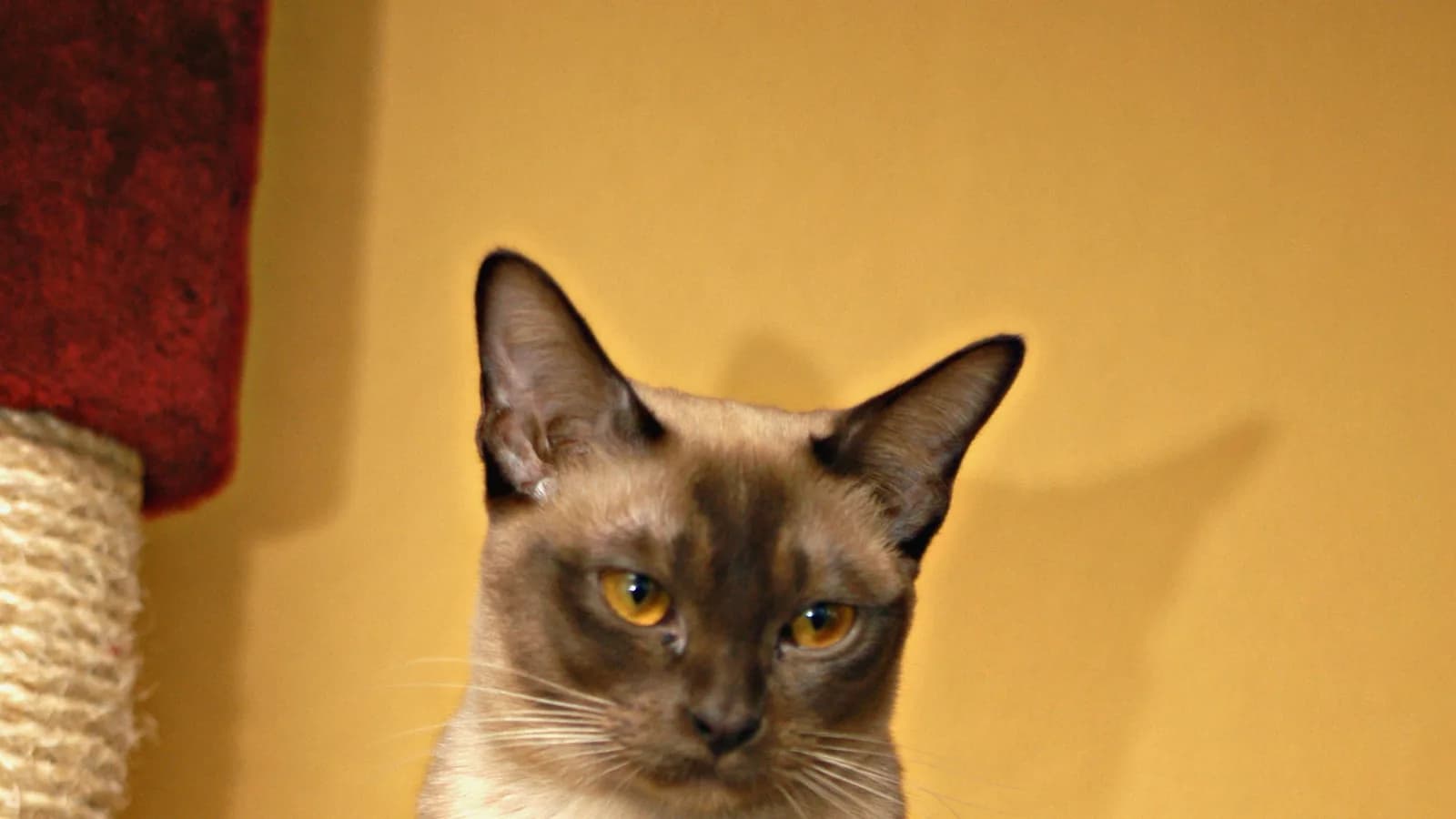
The European type carries a moderately wedge-shaped, gently contoured head against the American type's rounder, shorter-muzzled look, and a wider color chart: ten colors in 's own European Burmese standard (including Red, Cream and the torties) against the American standard's four. It is NOT a coat-length split: both types are shorthaired, and any "fluffy European Burmese" you meet online is a different claim entirely. Our colors page carries the full count-by-registry map.
How each registry draws the line
| Registry | Its mechanism |
|---|---|
| (US) | Two breeds; color plus closed (no American-standard Burmese in the background) |
| (UK) | One breed, no second name: the European shape IS the UK default |
| (Canada) | "Foreign Burmese", permitting an F1 cross to Burmese (the reverse of 's rule) |
| (Australia) | Two separate standards from two source documents ( 2013, 1987), restricted mutual outcross |
| Category VI Experimental: the process is genuinely unfinished, not just unpublished |
Five registries, five different mechanics, none interchangeable. runs two separate breeds and decides by color plus background: no American-standard Burmese is permitted in a CFA European Burmese's own background. Canada's registers a "Foreign Burmese" and permits an F1 cross TO the Burmese, the exact opposite direction from CFA's closed rule. Australia's prints two fully separate standards from two different source documents (one CFA-derived 2013, one -derived 1987) with a restricted mutual outcross. Britain's has no second name at all: the word "European" appears nowhere in four GCCF Burmese documents we read in full, because from the UK's vantage the European shape simply IS the Burmese, and the American type is the outlier.
And , precisely stated, has not finished the process: its own registration rules carry "European Burmese" as a Category VI Experimental breed, a genuine registration status short of full recognition, not merely a missing web page.
Why the split matters: the testing list
Here is the concrete, non-cosmetic reason to know which type you are buying. GM2 gangliosidosis, a serious inherited neurological disease, is documented specifically in European Burmese lines and named in no US-type source we reached; the UK's Langford veterinary laboratory sells a Burmese-specific GM2 test. 's own current Registration Policy (approved June 2026) requires an imported Burmese to test clear of GM2 alongside hypokalaemic polymyopathy and the craniofacial defect before registration. If you are buying a European-line kitten, the parents' results on that three-test list are the questions to ask; if a seller cannot say which line their cats descend from, that is itself an answer. Nothing here diagnoses any cat: it is paperwork that protects kittens, and your vet is the reader of any individual result.
The price footnote
In the US market the European line trades at a documented premium: $2,000 to $3,000 against the standard pet-quality band of $600 to $1,500, or stated as a $1,000 to $1,500 markup. Our price page carries the full four-market picture with its sources.
 The vet's take

Veterinary review
Are you a vet?
Your professional read belongs here: every verified practitioner can leave a note, published once our editors have reviewed it.
Sign in and get your license number verified. We check it in the public register, we never ask for or keep a copy of your diploma, and your number is never published.
Frequently asked questions
What is a European Burmese?
A documented separate Burmese lineage, bred in Britain and Europe from American exports since 1949 and recognized by CFA as its own breed since 1993: moderately wedge-shaped head, ten-color chart, and its own genetic-testing expectations.
Is the European Burmese a different breed from the Burmese?
At CFA, yes, formally: two breeds, two standards, closed pedigrees. At GCCF it is simply "the Burmese"; in Canada it runs as the Foreign Burmese; at TICA it is still an experimental category. The honest answer depends on the registry, and we state each mechanically.
Is the European Burmese long-haired?
No: both types are shorthaired. The split is head type, color chart and pedigree, never coat length.
What is GM2 gangliosidosis and should I worry?
A serious inherited neurological disease documented in European Burmese lines, with a DNA test available and required by GCCF for imported Burmese. It is a breeder-paperwork question, not an owner-diagnosis one: ask for both parents' results, and let your vet interpret anything about an individual cat.
Do European Burmese cost more?
In the US, documented at $2,000 to $3,000 against $600 to $1,500 for the standard type. Elsewhere the type is the local default and carries no premium label; our price page has the market-by-market figures.
 Community questions
Got a question this page doesn't cover? Ask it: the best ones get published here with their answer.
This is information, not veterinary advice, and it cannot tell you what is wrong with your cat. Our rule is a simple one: if something is wrong with your cat, call your vet, and call an emergency clinic if it is out of hours. Nothing you read here is a reason to wait.
Medical information applies to every reader. Prices, legal duties and common practice do not: unless stated otherwise, they are given for the United States, and they differ in the UK, Canada and Australia, and often between states or provinces. Check with your own vet and your own local authority.
Our sources
- CFA: European Burmese breed page (the 1949 export history, its own words)
- CFA European Burmese standard (PDF)
- GCCF Registration Policy for Burmese Cats, 27 June 2026 (the import three-test rule)
- TICA Registration Rules (European Burmese as Category VI Experimental)
- CCA-AFC Foreign Burmese standard (PDF, the asymmetric outcross)
- ACF Burmese Standard (PDF, FIFe-derived, the second Australian standard)
- Bradbury et al. 2009, GM2 gangliosidosis in European Burmese cats (Mol Genet Metab)
- Langford Vets: Burmese GM2 gangliosidosis test page

Worth keeping a paw on
Pin this guide
So you can find it the day you need it, and share it with someone whose cat does the same thing. One click and it sits in your board.
Pin it on Pinterest
 Purr or Pass
The cat newsletter
Our verified guides, no spam. Unsubscribe in one click.
More Burmese guides
The Burmese profile →
Burmese guide
Burmese Kittens for Sale: What Four Markets Actually Charge
What a Burmese kitten costs, sourced: US tiers from $600 pet-quality to $2,500 show, the UK's live-vs-evergreen gap, Canada's one named cattery, and Australia's ask-the-breeder market.
Read
Burmese guide
Burmese Cat Colors: Four in America, Ten in Britain, Twenty in Australia
The Burmese color count depends on the registry: CFA's American standard allows four, GCCF ten, Australia's ACF up to twenty. The counts, the two vocabularies, and the black-cat question.
Read
Burmese guide
Are Burmese Cats Hypoallergenic? The Honest Answer
No study has measured allergens in the Burmese, and no cat is allergen-free. What the short, low-shedding coat can and cannot do for an allergic household.
Read
Burmese guide
Burmese vs Bombay: How to Actually Tell Them Apart
A dark Sable Burmese is not a black cat, by the standards' own words: the eye-color direction, the body length, and the Siamese connection told from the founding cat.
Read
The floor belongs to our members. Keep it kind, links are not allowed, and images go through moderation before anyone else sees them.