

White Turkish Angora: One Gene, Graded Risks, Honest Numbers
The famous white coat is one gene, and the deafness risk it carries is graded by eye color, not binary. Every number here has its population attached.

Published August 21, 2026 6 min read
Contents
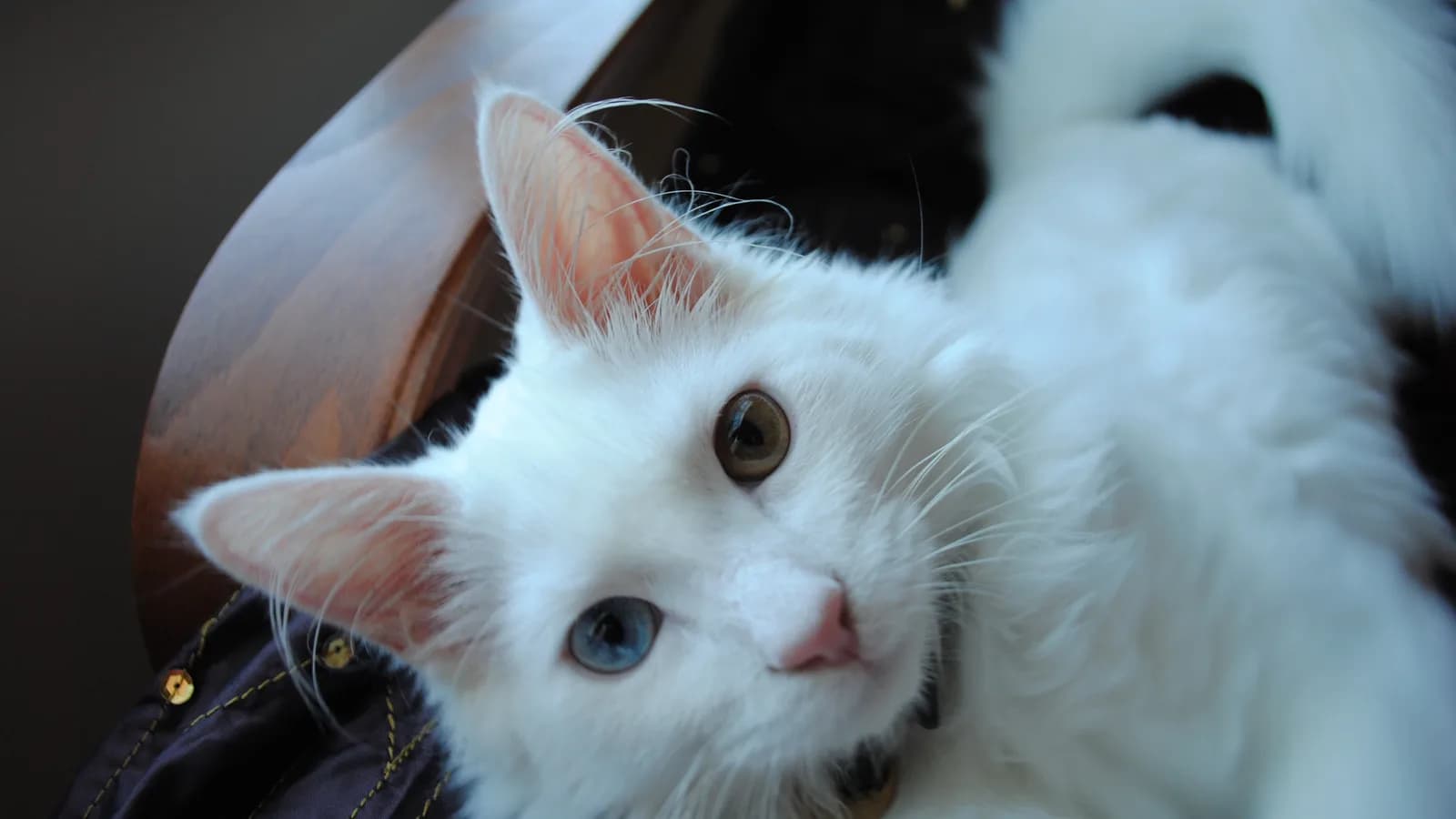
The white Turkish Angora is the breed's founding image: the Ankara Zoo's program that saved this breed deliberately concentrated on white cats with blue, gold and odd eyes. This page tells the white coat's whole story: the gene, the eyes, and the hearing question. Every number carries the population it was measured in, because this is a topic the internet rounds off badly.
The gene: one insertion, three effects
Dominant white in cats is the gene on chromosome B1: a retroviral insertion, only sequenced in 2014, that switches off pigment cells across the whole coat. It is pleiotropic, one gene with several effects, and the effects have DIFFERENT strengths. Complete penetrance for the white coat (every carrier is white). Incomplete for blue eyes and for deafness. That incompleteness is the whole story: white does not mean deaf, it means a graded risk that runs through eye color. One striking measured fact: a cat with two copies of the gene carries 77 times the odds of blue irises compared with any other genotype (270 cats, 30 breeds).
The risk gradient, with its populations attached
The baseline numbers come from studies of white cats generally, never this breed alone, and we keep them labeled. Across pooled older studies of mixed-breed white cats, about half were deaf in one or both ears. By eye color, the two source studies agree on the direction and differ on the size. Two blue eyes: 65 to 85 percent affected. One blue eye: about 40 percent. No blue eyes: 17 to 22 percent.
Cornell's own expert summary for two-blue-eyed white cats, about 80 percent, sits inside that band. And one research-colony finding illustrates the gene-dose mechanism: two-copy cats in a laboratory were 73 percent deaf with zero normal hearers, while one-copy cats mostly heard normally. That last figure comes from a colony bred for two decades to study exactly this, and it is never a pet-population rate.
The Turkish Angora's own number, smaller than you expect
Exactly one breed-isolated figure exists anywhere. 11 percent of 474 Turkish Angoras (whites AND colored cats together) failed a behavioural hearing test, as reported by the 2015 peer-reviewed review relaying the Swiss study behind it, with the review's own caveat that behavioural testing misses one-eared deafness. A smaller German study using the gold-standard test found 20.2 percent affected across 84 white cats of ten breeds pooled, Turkish Angora among the affected breeds, no breed-level split published.
Why does the breed figure sit below the white-cat baseline? Because most Turkish Angoras, even white ones, are not two-blue-eyed, and the risk lives at the blue end of the gradient. The famous cats sit in the middle of it: roughly 40 percent affected in the white-cat baseline studies, always on one side more than the other.
What a buyer can actually do
There is no DNA test for deafness itself, and nobody should sell you one. The only way to know about a specific kitten is a hearing test on that kitten: or OAE, done once, definitive. The UK made this mandatory. Since June 2016, registers no white cat's kittens on its active register without the parent's hearing certificate, and since 2019 UK sellers must warn buyers in writing.
No US, Canadian or Australian registry has an equivalent rule. and describe the risk and recommend testing (CFA adds that breeding white to colored cats reduces the odds, and that colored kittens often cost less because no test is needed).
Canada's standard simply declines to penalize deafness at the show table. One US price point for orientation: UC Davis's hearing clinic lists a test at about $201 all-in. A deaf cat, for the record, lives an excellent indoor life: it needs a strictly indoor home, approach-from-the-front manners, and visual or vibration cues. Any concern about a specific kitten's hearing is a veterinary appointment, not a breed-page paragraph: something wrong with your cat means call your vet, out of hours an emergency clinic.
The Van cousin, precisely
One precision no competing page makes, and it matters in Turkey's own cat family. The Turkish Van's famous coat (color on the head and tail only) comes from a DIFFERENT gene, white spotting, which does not carry this deafness pathway. An ordinary van-patterned cat is protected by its own genetics regardless of breed. But a SOLID white cat of the Van breed (the variant called Turkish Vankedisi) carries the same W-gene risk as a solid white Angora. The rule is about the coat's gene, never about the breed name.
The risk gradient on one card
| Population | Affected (one or both ears) | Source population |
|---|---|---|
| White cats, two blue eyes | 65-85% | Mixed-breed white-cat studies |
| White cats, | About 40% | Mixed-breed white-cat studies |
| White cats, no blue eyes | 17-22% | Mixed-breed white-cat studies |
| Turkish Angoras, all colors | 11% (n=474) | Behavioural testing, as relayed by the 2015 review |
| Ten white pure breeds pooled | 20.2% (n=84) | German -tested pre-breeding sample |
- No DNA test for deafness exists: only a or OAE hearing test on the kitten itself
- UK: hearing certificate mandatory before a white cat's kittens reach 's active register (since 2016)
- US/Canada/Australia: recommended, not required; about $201 at one US university clinic
- A deaf cat lives an excellent strictly-indoor life with front-approach manners and visual cues
 The vet's take

Veterinary review
Are you a vet?
Your professional read belongs here: every verified practitioner can leave a note, published once our editors have reviewed it.
Sign in and get your license number verified. We check it in the public register, we never ask for or keep a copy of your diploma, and your number is never published.
Frequently asked questions
Are all Turkish Angoras white?
No, and the registries say so plainly: white is the traditional, founding color, but the breed comes in a wide palette (the full map). TICA's standard accepts all colors.
Are white Turkish Angoras deaf?
Some, not most: the one breed-level figure (11 percent of 474 cats, whites and colored together, per the review relaying it) sits well below the general white-cat baseline, because deafness risk runs with BLUE EYES. Two blue eyes: 65-85 percent in white-cat studies. No blue eyes: 17-22 percent.
Can you test a white kitten for deafness?
Yes, and only one way: a BAER or OAE hearing test on the kitten itself (about $201 at one US university clinic). No DNA test for deafness exists. The UK requires the certificate before a white cat's kittens can be actively registered; North American registries recommend rather than require.
Do odd-eyed white cats hear normally?
Often, not always: about 40 percent were affected in the white-cat baseline studies, frequently on the blue-eyed side only. A one-sided-deaf cat behaves almost normally, which is exactly why only a hearing test answers the question.
 Community questions
Got a question this page doesn't cover? Ask it: the best ones get published here with their answer.
This is information, not veterinary advice, and it cannot tell you what is wrong with your cat. Our rule is a simple one: if something is wrong with your cat, call your vet, and call an emergency clinic if it is out of hours. Nothing you read here is a reason to wait.
Medical information applies to every reader. Prices, legal duties and common practice do not: unless stated otherwise, they are given for the United States, and they differ in the UK, Canada and Australia, and often between states or provinces. Check with your own vet and your own local authority.
Our sources
- TICA Turkish Angora breed page
- CFA Turkish Angora breed page
- GCCF, BAER testing for white cats
- UC Davis hearing test clinic
- Cornell Feline Health Center, deafness
- David et al. 2014, KIT white/white-spotting study
- Strain 2015, genetics of deafness review
- Strain (LSU), cat breeds with congenital deafness
- Cvejic et al. 2009, BAER pre-breeding study
- CCA-AFC Turkish Angora standard

Worth keeping a paw on
Pin this guide
So you can find it the day you need it, and share it with someone whose cat does the same thing. One click and it sits in your board.
Pin it on Pinterest
 Purr or Pass
The cat newsletter
Our verified guides, no spam. Unsubscribe in one click.
More Turkish Angora guides
The Turkish Angora profile →
Turkish Angora guide
Turkish Angora Colors: The Famous White Is Just the Beginning
The white cat everyone pictures is one option among roughly forty. The full registry palette, the five eye-color classes, and the black question answered.
Read
Turkish Angora guide
Turkish Angora Price: One Question Decides Almost Everything
Live market reads from four countries, why £50 "Turkish Angoras" exist alongside £2,000 ones, and the registry facts UK buyers deserve.
Read
The floor belongs to our members. Keep it kind, links are not allowed, and images go through moderation before anyone else sees them.