

Himalayan Cat: The Persian in Evening Dress
Blue eyes, a pointed coat and four registries that cannot agree what to call it. The Himalayan's real history, measured temperament, health file and daily-comb contract.

Published August 21, 2026 10 min read
Contents
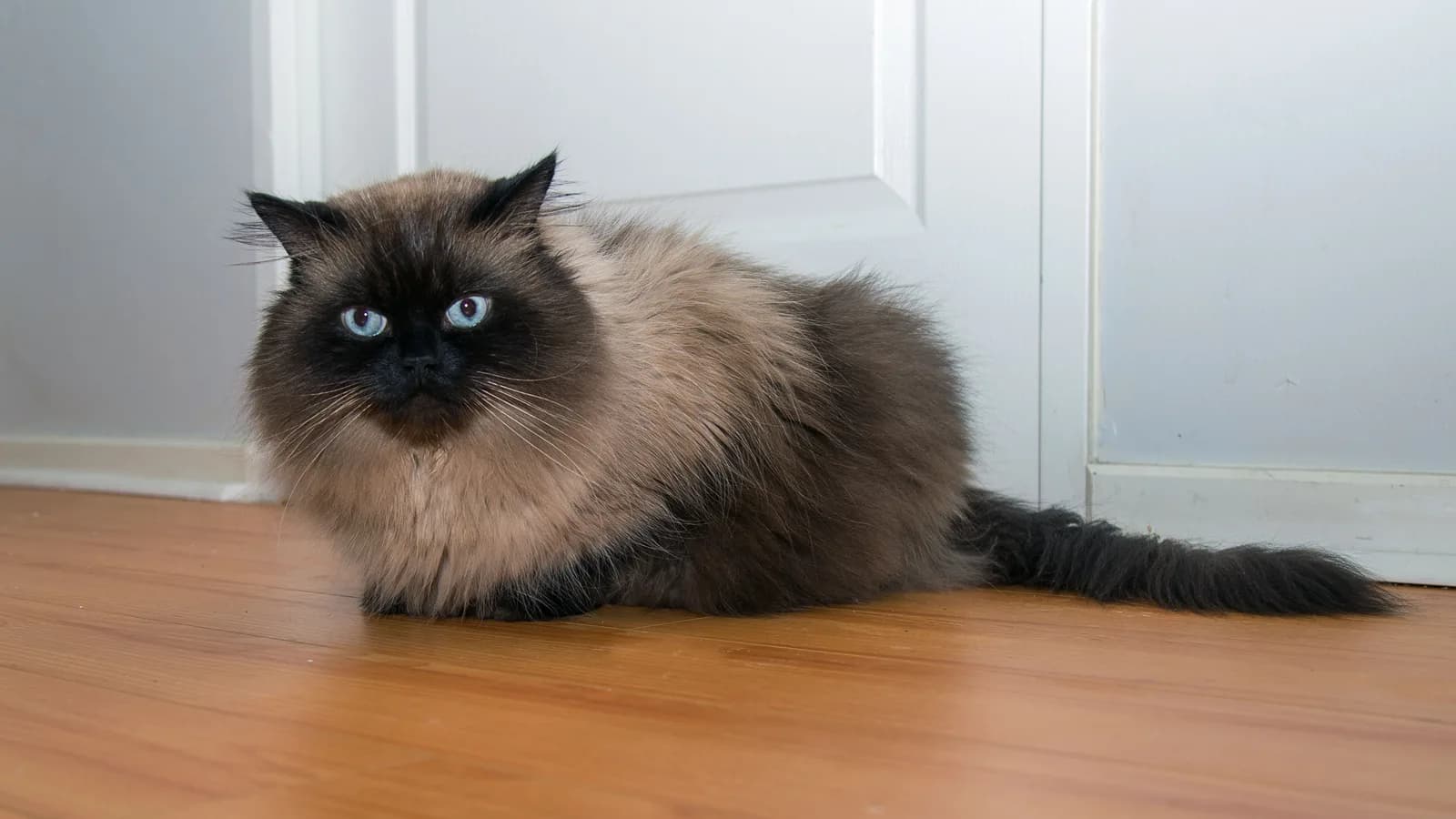
The Himalayan is a Persian-type cat wearing a Siamese color scheme: the full long coat, cobby body and flat face of the Persian, with the pale body, dark points and deep blue eyes of the pointed pattern. It is a deliberately man-made breed, built from Persian-by-Siamese crosses in breeding programs that began in the 1930s. And it has spent its whole institutional life being filed and re-filed. It was its own breed at from 1957 to 1984, and a Persian color division there since.
It is its own breed at , a "Colourpoint" in Britain, and two separate breeds in Canada. That paperwork story is genuinely the breed's defining fact, and the full registry story is its own page. One disambiguation up front: the name honors the color pattern (the pointing gene is called the Himalayan gene across species), not the mountains. No cat fancy history places this breed anywhere near the Himalayas.
What the paperwork means in practice
Buy in Texas and your kitten registers as "Persian, Himalayan Division". The same cat is its own breed on a , a Colourpoint Persian in London, and one of two Himalayan breeds in Toronto. Nothing about the animal changes at a border; the receiving registry simply re-files it. Even the show-shopping experience follows the paperwork. Canada's main marketplace lets you filter by "Himalayan" while Britain's cannot (the kittens-for-sale page carries the live samples).
Size and weight: shared vocabulary, one tiny number
Every registry describes the same body it describes for the Persian: medium to large, cobby, carried low. None of them puts a number on it ('s own weight boxes are empty on the Himalayan page, exactly as on the Persian's). The measured shelf is nearly bare too. The closest cohort figures are the Persian's own (roughly 3.1 to 4.3 kg / 6.8 to 9.5 lb split by sex, measured in Persians, not Himalayans).
Add exactly one Himalayan-specific data point: a small German study's Colourpoint row, three female cats averaging 3.2 kg (7.1 lb). Three cats is a footnote, not a population figure, and we label it that way. A large Brazilian growth study adds one qualitative finding. Of four major breeds it tracked, the Himalayan was the smallest by its peak-weight age (reached around age 8). Under the coat, this is a small, compact cat.
Lifespan: one measured proxy, one honest convention
No published study has measured the Himalayan's lifespan separately. The closest measured figure comes from a 2019 UK study of 3,235 Persians, whose own methods note the sample may include colourpoint (Himalayan) cats: a median age at death of 13.5 years. Pet-content sites that run a dedicated Himalayan page independently publish "9 to 15 years". That is a commonly cited estimate with no study behind it, which we report as the convention it is. 's own consumer page says "a very healthy breed... between 8-11 years". That is TICA's own unsourced figure.
And it sits oddly beside the same group's show standard, which disqualifies any cat that cannot breathe normally with a closed mouth. One tightly scoped finding belongs here rather than in a headline. A 2026 study of over 14,000 feline anesthetics across 21 countries grouped Persian, Exotic Shorthair and Himalayan as its "extreme brachycephalic" phenotype. It found roughly double the adjusted risk of anesthetic death for the group. That is a fact about the anesthesia event, worth a conversation with your vet before any procedure. It is never a statement about everyday life expectancy.
Temperament: the measured surprise
The registry portrait is consistent: gentle, quiet, calm-preferring, easygoing ('s own Himalayan words). 's hosted breed history draws a warmer, people-oriented cat that follows you from task to task. The measured record adds a wrinkle the tidy "it's just a pointed Persian" frame misses. One Japanese study (67 veterinarians ranking twelve breeds; 22 to 38 raters per trait) clustered Himalayan and Persian together at the factor level. But its own ranked table put the Himalayan among the three most timid breeds of the twelve, with the Persian mid-pack.
And it scored the Himalayan NOTICEABLY friendlier than the Persian on the panel's most reliable trait (3.11 versus 2.35, eighth versus eleventh of twelve). One modest study, never replicated for this breed, and we present it as exactly that. But it is the only measured behaviour data that treats the Himalayan as its own population, and it refuses to treat the two breeds as interchangeable. On the activity traits the two are honest twins. Both sit at the bottom of the panel for general activity, playfulness and novelty-seeking. This is a presider, not a participant.
Grooming: the same daily contract, stated louder
Everything on the Persian grooming page applies here without modification: daily combing to the skin with a metal comb, armpits and behind the ears first, never scissors on a mat at home, daily eye-wiping. What is worth adding: 's Himalayan-specific page is, if anything, MORE emphatic than its Persian one.
The coat "requires constant grooming... demands a serious time commitment," and the flat face "must be cleaned regularly and carefully as tearstains can be deposited." Even the breed's celebrity record-holder doubles as a data point. Colonel Meow's Guinness-documented fur routine took two owners, brushing two to three times a week, for a cross-bred coat. A purebred show coat asks for more.
Health: what is measured, what is shared, what is not
This section informs, it never diagnoses: something wrong with your cat means call your vet, out of hours an emergency clinic.
The flat face carries the Persian Breed Group's shared file: measured impaired ventilation in brachycephalic cats regardless of visible symptoms (a 2026 plethysmography study whose affected groups included Himalayans), eye and tear-duct anatomy, dental crowding, and the registries' own breathing clauses. 's shared standard withholds all awards for audible breathing, and disqualifies any cat unable to breathe normally with a closed mouth. 's breeding policy draws the line the evidence supports: moderate, well-balanced heads should not cause problems; breeding toward the extreme end does. Signals worth a vet visit: noisy breathing at rest, open-mouth breathing, activity avoidance. Open-mouth breathing or collapse is an emergency.
PKD (polycystic kidney disease) is the breed family's historic scourge and its best testing story. No study names a Himalayan-only prevalence, and we say so. The one screening study that counted Himalayans (48 of 320 cats, Sydney and Brisbane, 2001) found 42 to 45 percent affected across its whole sample. That figure describes the population, not Himalayans alone. The UK trajectory shows what testing achieves: from roughly half of a 2001 screening population to 0.7 percent of a 2019 general-practice cohort.
has mandated a negative PKD test for full Persian-group registration, Colourpoint included, since 2016. Two genuinely reassuring negatives: a UC Davis study typed the pointing gene itself against PKD and found no association (being pointed neither adds nor removes the risk). The same study cleared the pointing gene of the old belief that PRA ran in Himalayan lines specifically. The buyer's question is unchanged everywhere: both parents' PKD results, or no purchase.
The blue eyes are not the deaf-white mechanism. 's genetics document states it plainly: the Himalayan gene's blue eyes are totally separate from the dominant-white blue eyes that carry the white-cat deafness association.
FIP is the one measured place this breed diverges from the Persian. A 16-year US teaching-hospital study found Himalayans significantly over-represented among feline infectious diagnoses, while Persians explicitly were not. That is a proportion among diagnosed cases at one hospital, not a population rate. It is also the sharpest evidence that "just a pointed Persian" is not a health statement.
Beyond that, the breed's own research literature is 19 single-case reports scattered across nearly every organ system. That is the signature of a breed name that appears on registration paperwork often enough to get case reports written, not of any dominant disease.
Are Himalayan cats hypoallergenic?
No, and the coat runs the other way. No study measures this breed's allergen output in either direction. No cat breed is allergen-free. And a long, dense, daily-shedding coat carries MORE allergen-bearing hair around your home, not less. The full mechanism lives on the Persian hypoallergenic page. The only test that answers for you is time spent with the specific cat.
Records and history: the receipts
Both of the only two currently-live Guinness World Records cat titles our research found for any Persian-type cat belong to Himalayan-Persians specifically: Tinker Toy, the smallest cat ever (a blue point Himalayan-Persian, 7 cm tall), and Colonel Meow, longest fur on a cat (22.87 cm, a Himalayan-Persian rescue).
Any page telling you "the Persian" holds those records is being imprecise; the pointed side of the family owns them. The origin story, honestly, is two stories. 's account starts in 1931 with Virginia Cobb and Dr. Clyde Keeler's experimental program (their work reached the Journal of Heredity in 1936, decades before either registry's current page), and adds Ben Borrett's parallel Canadian work.
's hosted history starts "around 1950", credits Brian Sterling-Webb's decade of UK work for 's 1955 recognition, and dates the US recognition precisely: Mrs. Goforth's application at the CFA Annual Meeting, Washington DC, December 18, 1957. The accounts disagree on where the story begins, so we print both with their owners' names on them. The breed's nickname, "Himmy," appears independently in both registries' own documents. And the pop-culture roster is genuinely deep: Mr. Jinx of "Meet the Parents," Sassy of "Homeward Bound," Martha Stewart's three composers (Beethoven, Mozart and Bartok), all commonly identified as Himalayans in the film and press coverage around them.
The whole passport file in three numbers
years the Himalayan ran as 's own breed (1957-1984) before the board merged it against both councils' votes
27
different registry answers to 'is it a separate breed': division, own breed, Colourpoint, two breeds
4
live Guinness cat titles held by Himalayan-Persians: smallest ever, and longest fur
2
 The vet's take

Veterinary review
Are you a vet?
Your professional read belongs here: every verified practitioner can leave a note, published once our editors have reviewed it.
Sign in and get your license number verified. We check it in the public register, we never ask for or keep a copy of your diploma, and your number is never published.
Frequently asked questions
Are Himalayan cats hypoallergenic?
No: no breed is, no study measures this breed's allergen output, and the daily-shedding long coat spreads more allergen-carrying hair, not less. Time with the specific cat is the only test that answers for your household.
How long do Himalayan cats live?
No study has measured Himalayans separately. The closest measured proxy is the UK Persian cohort's 13.5-year median (3,235 cats, possibly including colourpoints); pet-content sites conventionally print 9-15 years without a study; TICA's own page says 8-11, unsourced. We lead with the measured figure and label the rest.
How much does a Himalayan cat cost?
Live August 2026 samples: US $1,000-4,500 on marketplace listings, UK £250-1,800 (mostly crosses), Canada CA$250-1,800 with purebreds clustering $400-1,000, and Australia publishes no figures at all. The full four-market table is on our kittens-for-sale page.
Do Himalayan cats shed?
Yes, substantially: it is a full Persian-type double coat, and daily combing is the cross-registry consensus, not a counsel of perfection. No source publishes a shedding rating; the daily comb IS the answer.
Are Himalayan cats from the Himalayas?
No: the breed was built in US, UK and Canadian breeding programs from Persian-Siamese crosses. The name follows the color pattern, which geneticists call the Himalayan gene across several species.
Are Himalayan salt lamps safe for cats?
Different topic entirely: that question is about a household object and any cat, not this breed, and it belongs with your vet or an animal poison line rather than a breed profile. The overlap is only the name.
Is a Himalayan the same as a Persian?
Four registries, four answers: color division (CFA), own breed (TICA), "Colourpoint" pattern (GCCF), two separate breeds (Canada's CCA-AFC). One physical standard underneath. Our comparison page carries the whole story, including the 1984 merger both breed councils voted against.
 Community questions
Got a question this page doesn't cover? Ask it: the best ones get published here with their answer.
This is information, not veterinary advice, and it cannot tell you what is wrong with your cat. Our rule is a simple one: if something is wrong with your cat, call your vet, and call an emergency clinic if it is out of hours. Nothing you read here is a reason to wait.
Medical information applies to every reader. Prices, legal duties and common practice do not: unless stated otherwise, they are given for the United States, and they differ in the UK, Canada and Australia, and often between states or provinces. Check with your own vet and your own local authority.
Our sources
- TICA Himalayan breed page
- CFA hosted history, The Himalayan Persian (1999)
- CFA Persian breed page
- GCCF Persian breed page
- GCCF Persian Breeding Policy
- GCCF Persian & Exotic Registration Policy (2025)
- CCA-AFC Himalayan breed standard
- O'Neill et al. 2019, UK Persian demography
- Redondo et al. 2026, breed-specific anesthetic mortality
- Takeuchi & Mori 2009, behavioral profiles of feline breeds
- Kienzle & Moik 2011, body weight of pure-bred cats
- Barrs et al. 2001, PKD prevalence Sydney/Brisbane
- Rah et al. 2006, no association coat colors, PRA and PKD
- Pesteanu-Somogyi et al. 2006, FIP prevalence by breed
- Guinness World Records, smallest cat ever
- Guinness World Records, Colonel Meow longest fur
- Lyons et al. 2005, tyrosinase mutations

Worth keeping a paw on
Pin this guide
So you can find it the day you need it, and share it with someone whose cat does the same thing. One click and it sits in your board.
Pin it on Pinterest
 Purr or Pass
The cat newsletter
Our verified guides, no spam. Unsubscribe in one click.
More Himalayan guides
Himalayan guide
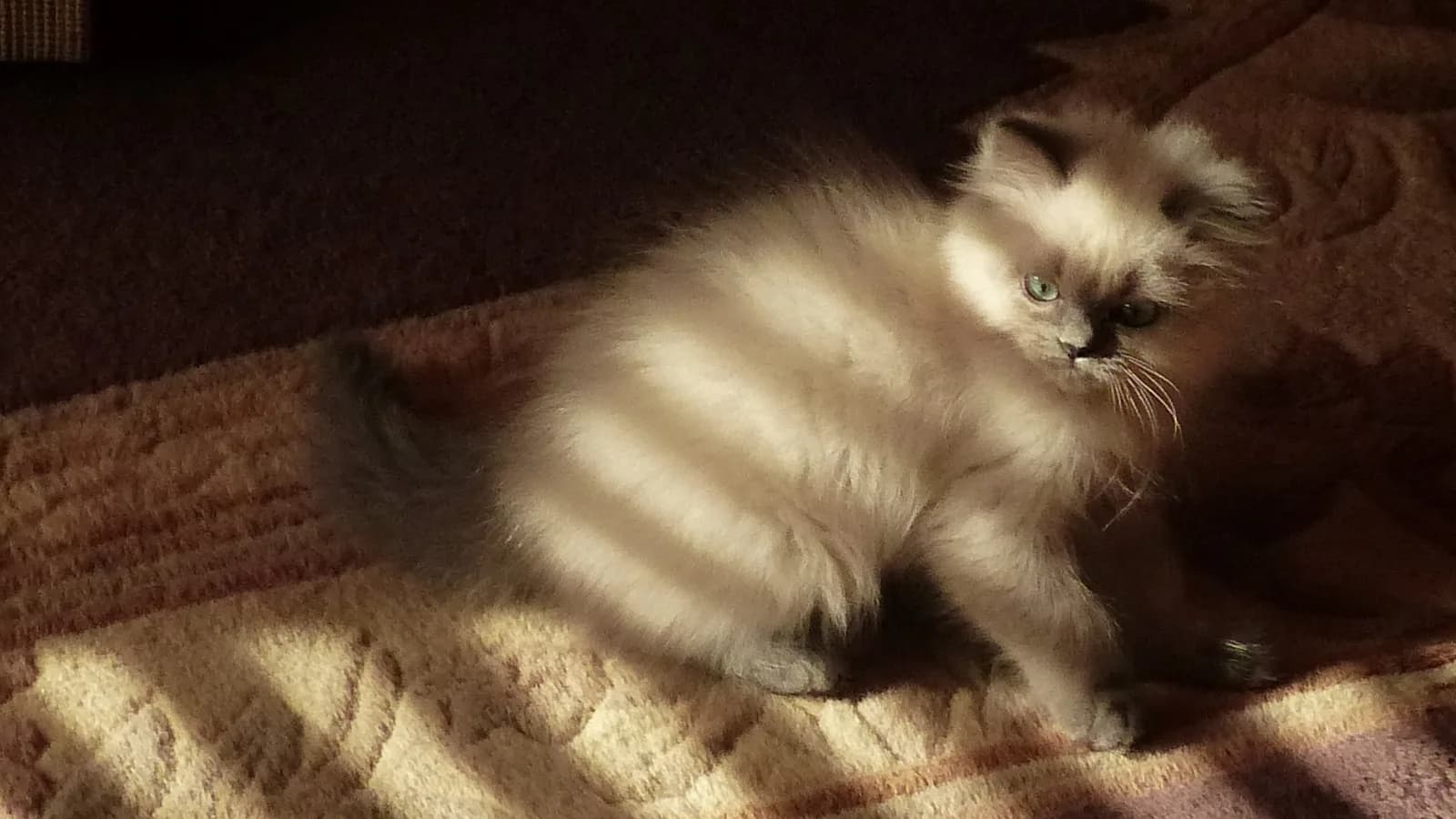
Himalayan Kittens for Sale: What the Listings Actually Say
Live marketplace samples and named catteries, read August 2026: US $1,000-4,500, UK £250-1,800 (mostly crosses), Canada's same-litter split, and Australia's documented absence.
Read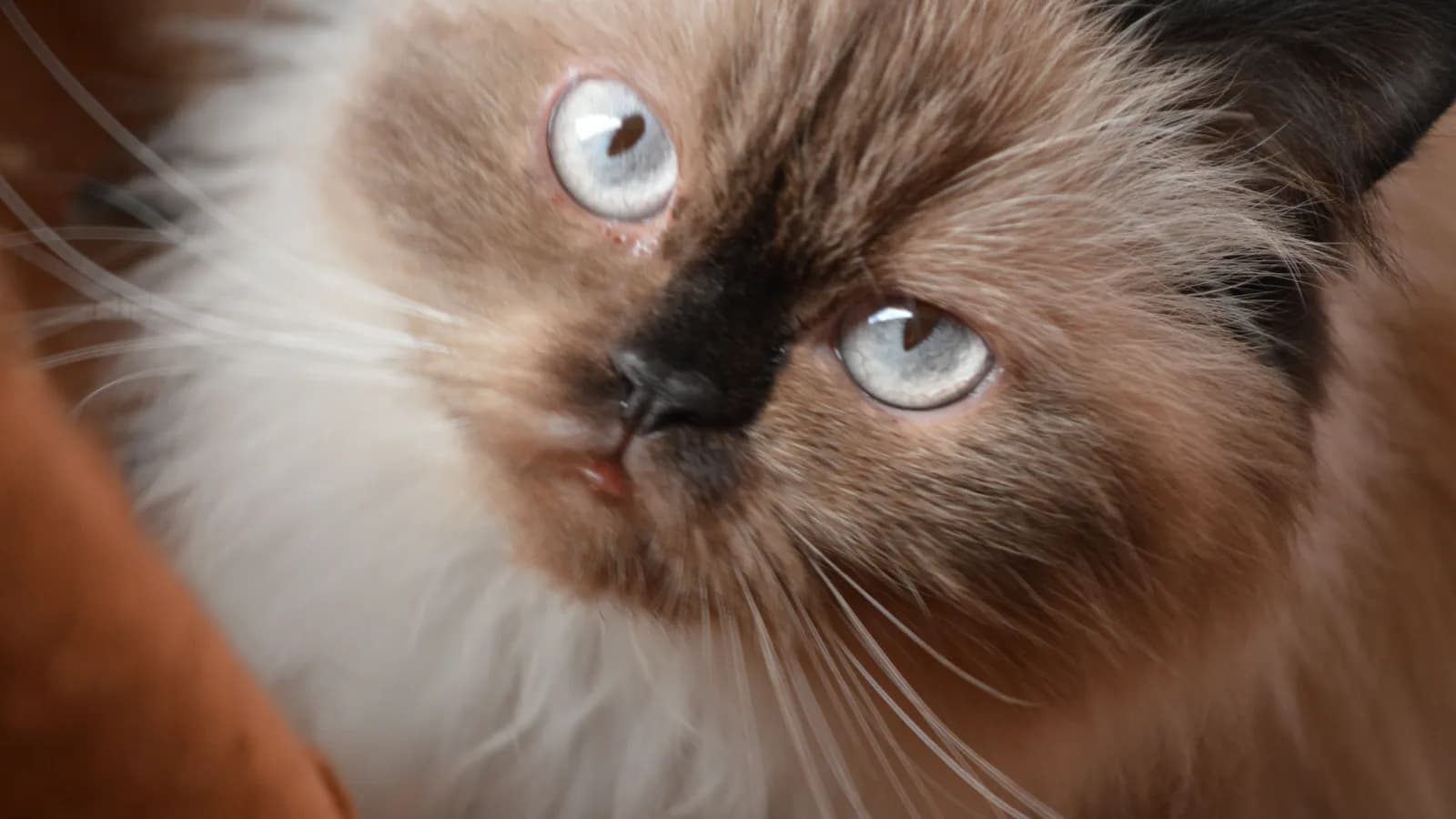
Himalayan guide
Himalayan Cat Colors: The Same Cat, Counted Four Ways
Every registry names the same core eight points, then CFA counts 16, GCCF 20 and Canada's registry about 66. The palette, the blue-eye rule, and why the counts differ.
Read
The floor belongs to our members. Keep it kind, links are not allowed, and images go through moderation before anyone else sees them.