

Oriental Shorthair vs Siamese: One Standard, Two Paint Jobs
The registries define these two breeds in the same document, with the same body and the same weights. The real difference is one fork: pointed or not. We read all six standards.

Published August 21, 2026 6 min read
Contents
Most breed comparisons weigh two different cats. This one cannot: does not even keep two separate standard documents. One PDF, titled "Siamese Breed Group (SI/BA/OS/OL)," defines the Siamese, the Balinese, the Oriental Shorthair and the Oriental Longhair in a single paragraph, scores them on a single point table, and forks exactly once: "SI/BA: All pointed colors. OS/OL: All traditional colors." Same head, same body, same coat texture, same temperament clauses. TICA's own consumer page compresses the whole comparison into three words: a different "paint job." So the honest version of this page is not "two breeds compared", it is one body plan and the single fork that splits it, plus the places where the other registries draw that fork differently, which is where it gets genuinely interesting for a buyer.
Same body, same numbers, by the registries' own figures
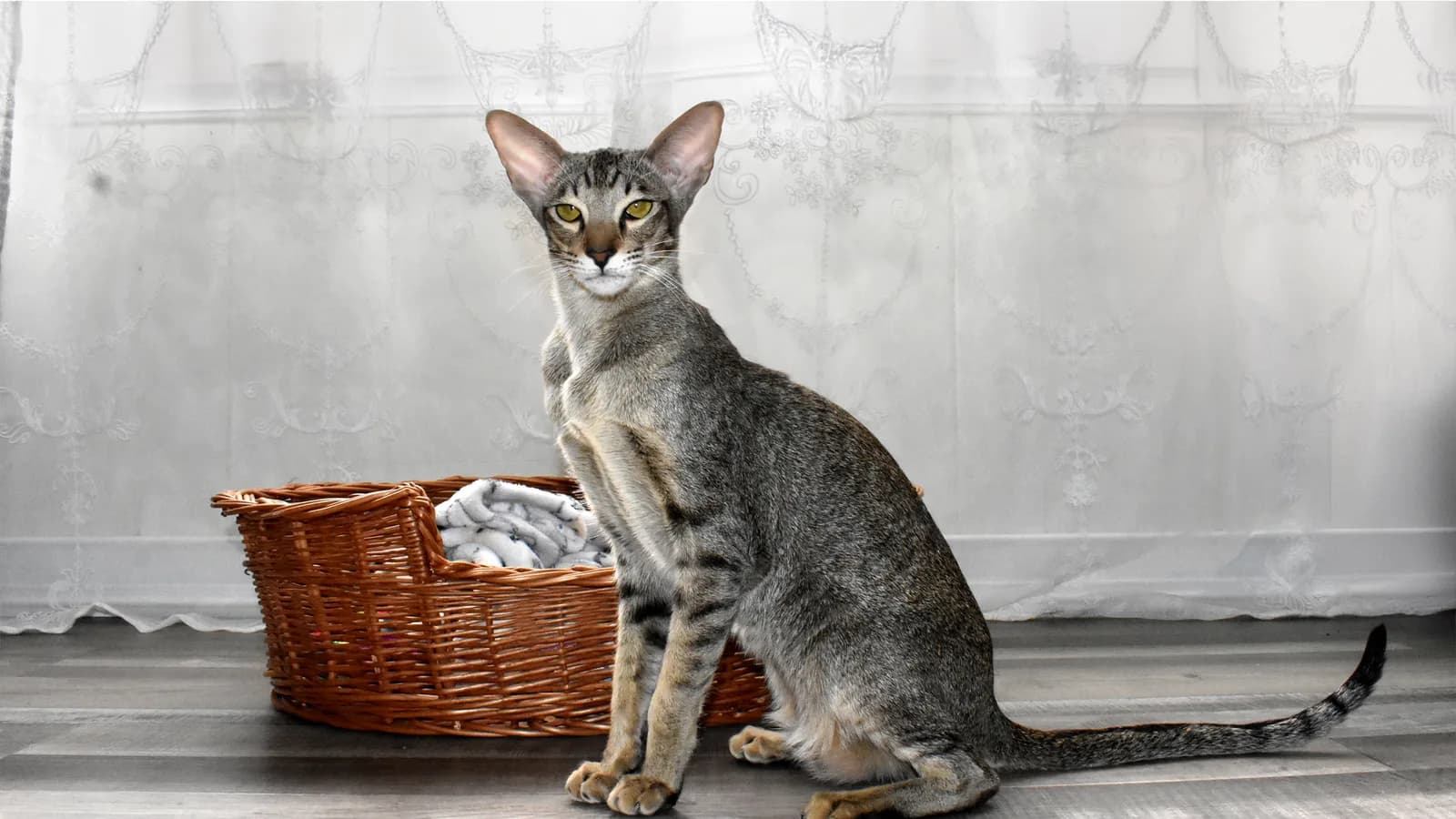
publishes weight ranges separately on each breed's page, and they are numerically identical: females approximately 5 to 8 lb (2.3 to 3.6 kg), males approximately 8 to 12 lb (3.6 to 5.4 kg), on both pages. 's own summary boxes land a pound apart: Oriental "8 - 14 lbs", Siamese "8 - 15 lbs". No registry we read publishes a body difference between the two breeds, because by their own standards there is none to publish: judged side by side, both are the same svelte, long-lined, large-eared cat.
The fork: pointed, or not
The line every registry draws sits at the coat pattern, and each registry draws it its own way. This is the most useful thing our six-standard read found, because it decides what papers a given cat can actually carry:
- : the flat version. Siamese and Balinese take ALL pointed colors; Oriental Shorthair and Longhair take all traditional, meaning non-pointed, colors. A pointed Oriental does not exist at TICA, full stop.
- : the surprising version. CFA keeps the two as fully separate breeds with separate standards, and the CFA Oriental standard contains its own "Pointed Color Class": red point, cream point, cinnamon point, fawn point and their and variants can be registered as Orientals. What cannot: "DISQUALIFY: Seal point, seal smoke point, chocolate point, chocolate smoke point, blue point, blue smoke point, lilac point, lilac smoke point," verbatim from the standard. In plain terms, a cat pointed in one of the four traditional Siamese colors is excluded from Oriental at CFA and falls to Siamese or Colorpoint Shorthair; a cat pointed outside them can wear Oriental papers.
- (Canada): the third mechanism. Its Oriental standard states "POINTED ORIENTALS ARE RECOGNIZED AS BALINESE LH/SH EXCEPT FOR BI-COLOUR / VAN": a pointed Oriental in Canada is registered as a Balinese, whatever the length of its coat.
Three registries, three different answers to the same cat. If you are buying a pointed kitten from Oriental lines, the registry named on the paperwork is not a detail: it decides what breed your cat officially is.
Colors: four traditional points against several hundred everything-elses
The Siamese palette is anchored by the four traditional point colors (seal, chocolate, blue, lilac), extended differently registry by registry; the color children on our Siamese profile take them one by one. The Oriental's whole identity is the opposite grant: every traditional color and pattern the fancy recognizes. How many that makes depends on who is counting, and the registries genuinely disagree with themselves: 's page says 281, 's page manages both 150 and 600 in the same document, says 816. Our Oriental colors page traces where each number comes from; the honest summary is "several hundred, counted loosely."
Temperament and lifespan: same family, measured apart
, the only registry whose summary boxes state a one-line temperament for each, gives the Oriental "Lively, intelligent & sociable" and the Siamese "Outgoing, extrovert & noisy": the same cat, with the volume knob named on the Siamese side. Both our profiles carry the fuller, measured picture. On lifespan the two breeds separate more than their shared body would suggest, with the caveat that the samples differ wildly: the Oriental's measured anchor is 14.01 years (Farrell 2024, n=16, a small cohort we flag every time we print it); the Siamese carries 11.69 years as the life-expectancy marker from a large UK primary-care cohort, with a 14.2-year median in the older UK study beside it. Different studies, different eras, different sample sizes: we print both and rank neither.
Registration mechanics, for buyers who care about papers
's own Rules of Registration make the Siamese one of the most closed books in the fancy: allowable outcross breeds "None," requirement 8 generations. The CFA Oriental, by contrast, allows four outcross breeds (Siamese, Colorpoint, Balinese, Javanese) and has required only 3 generations since 2013. Neither is better; they are different contracts. A Siamese pedigree is a longer, narrower document; an Oriental pedigree legitimately carries recent Siamese ancestors, which is the breed working as designed.
The whole comparison on one card
| Oriental Shorthair | Siamese | |
|---|---|---|
| Standard () | Same document: Siamese Breed Group | Same document: one point table for four breeds |
| Coat pattern | All traditional (non-pointed) colors | All pointed colors; four traditional at the core |
| weights | F ~5-8 lb / M ~8-12 lb | Identical: F ~5-8 lb / M ~8-12 lb |
| Color count | Several hundred, counted loosely (281/150-600/816) | Four traditional points, extended per registry |
| registration | 3 generations, 4 outcross breeds | 8 generations, no outcross |
| Measured lifespan | 14.01 y (n=16, small) | 11.69 y (large UK cohort) |
 The vet's take

Veterinary review
Are you a vet?
Your professional read belongs here: every verified practitioner can leave a note, published once our editors have reviewed it.
Sign in and get your license number verified. We check it in the public register, we never ask for or keep a copy of your diploma, and your number is never published.
Frequently asked questions
Is an Oriental Shorthair just a Siamese in a different color?
By TICA's and GCCF's own documents, essentially yes: one shared physical standard, and the Oriental is the non-pointed assignment of it. CFA keeps them as two separate breeds with separate standards, so the administratively correct answer depends on the registry.
What is the difference between an Oriental Shorthair and a Siamese?
The coat pattern fork: Siamese are pointed (darker extremities, four traditional colors at the core of the palette); Orientals carry the non-pointed versions of every traditional color, several hundred by the registries' own loose counts. Body, head, coat texture and temperament clauses are the same.
Are they the same size?
By TICA's published figures, exactly: females about 5 to 8 lb (2.3 to 3.6 kg), males about 8 to 12 lb (3.6 to 5.4 kg), on both breed pages.
Can an Oriental have blue eyes and points?
At TICA, no: pointed cats register as Siamese or Balinese. At CFA, only in the non-traditional point colors (red, cream, cinnamon, fawn and their variants); the four traditional Siamese point colors are disqualified from Oriental. In Canada (CCA-AFC), a pointed Oriental is registered as a Balinese. The paperwork follows the registry, not the cat.
Which lives longer?
The measured anchors we carry are 14.01 years for the Oriental (n=16, small) and 11.69 years for the Siamese (large UK cohort). The samples are too different to declare a winner; both profiles carry the full sourcing.
 Community questions
Got a question this page doesn't cover? Ask it: the best ones get published here with their answer.
This is information, not veterinary advice, and it cannot tell you what is wrong with your cat. Our rule is a simple one: if something is wrong with your cat, call your vet, and call an emergency clinic if it is out of hours. Nothing you read here is a reason to wait.
Medical information applies to every reader. Prices, legal duties and common practice do not: unless stated otherwise, they are given for the United States, and they differ in the UK, Canada and Australia, and often between states or provinces. Check with your own vet and your own local authority.
Our sources
- TICA Siamese Breed Group standard (SI/BA/OS/OL, PDF)
- TICA Oriental Shorthair breed page
- TICA Siamese breed page
- CFA Oriental standard (PDF)
- CFA Oriental Rules of Registration (PDF)
- CFA Siamese Rules of Registration (PDF)
- GCCF Oriental breed page
- GCCF Siamese breed page
- ACF Oriental Shorthair standard (PDF)

Worth keeping a paw on
Pin this guide
So you can find it the day you need it, and share it with someone whose cat does the same thing. One click and it sits in your board.
Pin it on Pinterest
 Purr or Pass
The cat newsletter
Our verified guides, no spam. Unsubscribe in one click.
More Oriental Shorthair guides
The Oriental Shorthair profile →
Oriental Shorthair guide
Oriental Longhair: The Breed With More Names Than Undercoat
Angora, Javanese, Mandarin, Foreign Longhair, or a division of Oriental: the same green-eyed silky cat under six flags, with the honest files on weight, lifespan and coat.
Read
Oriental Shorthair guide
Oriental Shorthair Price: A Market of Flat Fees and Copied Tables
Four named US catteries, a UK sample against the marketplace's own wider claim, a mostly-Quebec Canadian picture, and the syndicated cost table two sites share word for word.
Read
Oriental Shorthair guide
Oriental Shorthair Breeders: Read the Registry Before the Website
How each registry files this breed (and its longhaired twin), the Havana trap, the UK's falling registration numbers, and how to adopt one instead.
Read
Oriental Shorthair guide
Are Oriental Shorthairs Hypoallergenic? The Two Mechanisms People Merge
The short sleek coat sheds less visible hair, and that is a different mechanism from allergen production, which nobody has measured in this breed. The honest file.
Read
Oriental Shorthair guide
Oriental Shorthair Colors: We Traced the Number Everyone Repeats
TICA counts 281, CFA says 150 and 600 on the same page, GCCF computes 816, and the famous "over 300" traces to a retired document. The real palette, ebony first.
Read
The floor belongs to our members. Keep it kind, links are not allowed, and images go through moderation before anyone else sees them.